You Think You're Optimizing a Website. You're Actually Optimizing a Disappearing World
Here's a question: when was the last time you opened Google, typed a query, and actually clicked through to a search result?
Think about it.
For most people, the answer is "last month" or "I can't remember." Because increasingly, that's not how we search anymore. We open ChatGPT or Claude, type "recommend me a tool for X," and act on whatever it says.
That behavioral shift is quietly dismantling an $80 billion industry — SEO.
What's replacing it is called GEO.
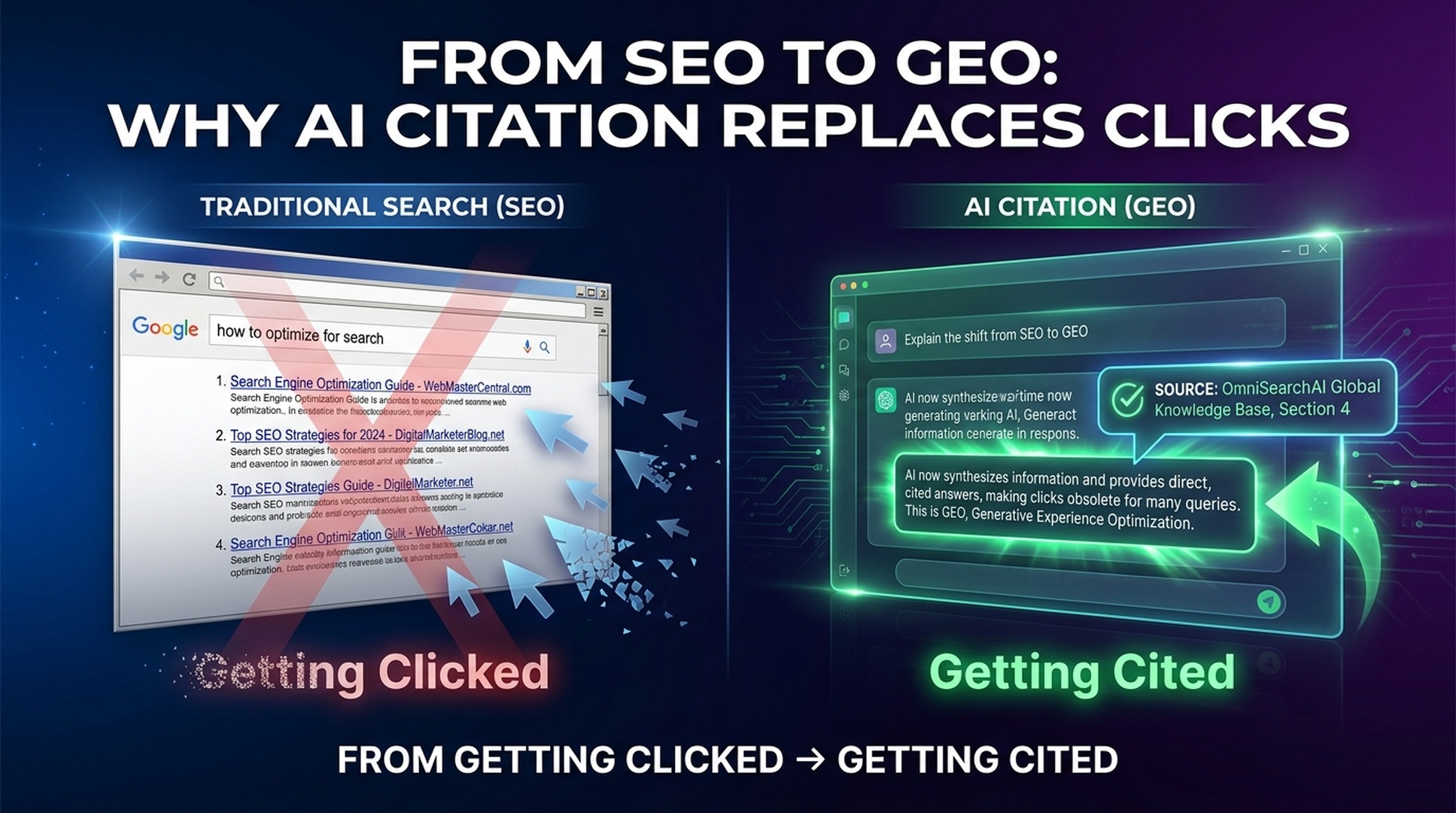
From "Getting Clicked" to "Getting Cited": A Fundamental Migration
Everyone knows SEO: search engine optimization, get your page on Google's first page, drive clicks.
GEO stands for Generative Engine Optimization. The goal is completely different — get your content to appear in answers from ChatGPT, Claude, Perplexity, Gemini, and other AI search tools.
These sound like cousins. They're not. There's a fundamental chasm between them.
Traditional search engines present a list of links and let you pick. The engine is an indexer. It doesn't speak. It just queues results.
AI search works entirely differently. It reads hundreds of articles, synthesizes them, and delivers a consolidated answer in its own words. It's a synthesizer. It doesn't give you links — it gives you conclusions, with a few "reference sources" appended at the bottom.
So in the old world, your goal was to get clicked. In the new world, your goal is to get cited.
SEO makes humans come to you. GEO makes AI speak on your behalf.
How Real Is This? The Numbers Don't Lie
GEO isn't a buzzword marketers invented to sell you something. The data behind it is hard.
ChatGPT's weekly active users exceed 800 million — more than the entire population of Europe.
Gartner predicted that by 2026, traditional search engine query volume would drop 25%. That traffic is being absorbed by AI assistants.
60% of searches now produce zero clicks. Users get their answer directly from AI responses and never visit a website.
Fewer than 12% of marketing teams have any documented strategy for appearing in AI-generated answers.
The vast majority of businesses are still optimizing their websites for Google crawlers while completely ignoring a new entry point that's actively consuming search traffic. That's a window. Early movers will have a significant advantage.
How AI Decides Who to Cite
To understand GEO, you need to understand AI's selection logic.
When you ask ChatGPT a question, here's roughly what happens behind the scenes: it interprets the real intent of your question → finds relevant content from training data or real-time retrieval → synthesizes multiple sources into a coherent answer → sometimes appends reference sources at the end. This process is called RAG (Retrieval-Augmented Generation). When generating answers, AI actively "pulls" external content as evidence.
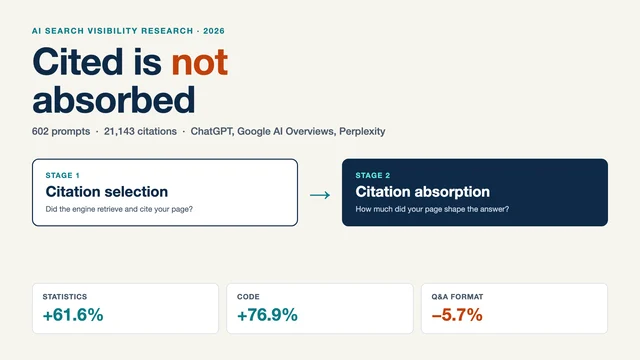
Research from Princeton University gives a relatively clear picture: AI tends to cite content that is well-structured, fact-dense, clearly sourced, and authoritative. Adopting these strategies can increase AI citation rates by 30-40%.
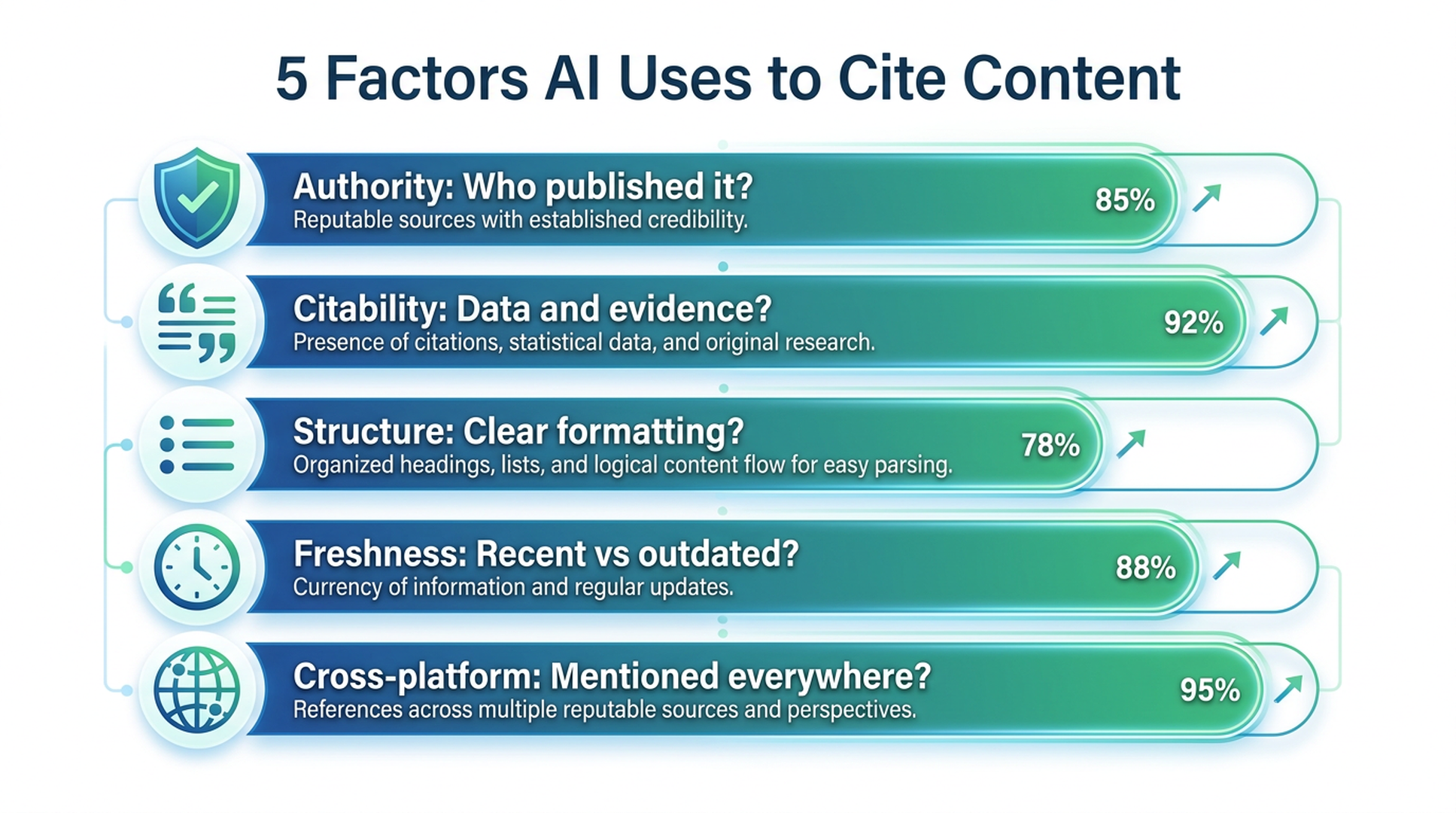
Specifically, AI evaluates five dimensions when deciding whether to cite a piece of content:
Dimension | What AI asks |
|---|---|
Authority | Who said this? Do they consistently publish in this domain? Do other authoritative sources reference them? |
Citability | Is there specific data, research, or case studies? AI prefers verifiable information because it reduces hallucination risk. |
Structure | Is it in Q&A format, lists, or clear subheadings? These make it easier for AI to extract fragments. A wall of text is harder to process than structured content. |
Freshness | Is the content recent? AI systems deliberately prefer newer content, as older content is more likely to be outdated. |
Cross-platform presence | Is this brand mentioned positively across multiple independent sources? AI treats this as a stronger trust signal. |
What GEO Actually Looks Like in Practice
1. Write Content in "AI-Digestible Format"
Q&A format is one of the most effective structures. List the questions your users actually ask, then answer them directly and concisely. You're essentially telling AI: "The answer you're looking for is right here — take it."
Every paragraph should express a complete, standalone idea. AI rarely cites an entire article. It pulls a fragment.
2. Increase Factual Density
Hollow content has zero citation value. AI won't cite "this product is great, highly recommended." It will cite "in a test with 300 users, average task completion time dropped by 42%."
Data, research citations, specific case studies — these are what make GEO content valuable. Every claim that can be backed by a number should be.
3. Build Topical Depth, Not Keyword Breadth
Traditional SEO chases high-volume keywords and writes content around them. GEO works differently: build enough content depth in a vertical domain that AI recognizes you as an authoritative source in that area.
Don't write a little about everything. Write deeply, thoroughly, and completely about one direction.
4. Expand Cross-Platform Signal Coverage
AI doesn't just look at your website. Media coverage, podcast appearances, industry research citations, community discussions — these all send "this source is credible" signals to AI models.
GEO work means expanding your "semantic footprint" across the entire internet, not just your own domain.
5. Use Structured Data to Help AI Understand You
Schema.org markup, clear entity definitions, FAQ pages — these make it easier for AI to extract key information from your content. The goal is to help AI identify which parts of your content are worth citing.
GEO vs. SEO: Not Replacement — Elevation
GEO doesn't throw SEO away. It adds a layer on top.
High-quality content, clear site structure, authoritative backlinks — these SEO fundamentals are also the GEO foundation.
But GEO asks you to think about one extra question: is your content worth being cited, not just easy to find?
Traditional SEO's goal is "appear in search results" and let users decide whether to click. GEO's goal is "appear in AI's answer" — meaning AI has already run a filter for you. It decided your content deserves to be synthesized into the answer.
That filter is harder to pass than pushing a page onto Google's first page. But once you pass it, the impact is greater — users receive information that AI has already digested and integrated, so the trust barrier is lower.
The GEO Checklist Worth Saving
Content
- Does your core content include specific data and research citations?
- Do you have Q&A-format pages that directly answer users' most common questions?
- Can each paragraph stand alone as a complete information unit?
- Is content regularly updated to stay current?
Structure
- Are heading levels clear (H1/H2/H3)?
- Are you using structured data markup?
- Does the page load fast and work well on mobile?
Authority
- Does your brand appear in industry media or vertical platform coverage?
- Are there positive discussions about you in communities, forums, and social platforms?
- Are you publishing consistently and systematically in a specific domain?
Measurement
- Do you regularly ask AI "recommend me [your service] in [your field]" to check if you appear?
- Are you tracking "AI mention rate" — not just search rankings?
An Uncomfortable Truth
GEO demands much higher content quality than traditional SEO.
Traditional SEO has plenty of shortcuts — keyword density, link exchanges, technical parameter tweaks. These don't necessarily make content better, but they can help it rank higher.
GEO has none of those shortcuts. AI isn't fooled by keyword density. It reads content, understands it, and judges whether there's genuinely valuable information worth citing. A hollow article stuffed with keywords for SEO has zero value in AI's eyes.
GEO rewards content with real insight, depth, and factual support.
That's a good thing — it redirects the game toward "create genuinely good content."
It's also a harder pill to swallow — because genuinely good content has never been something you can mass-produce.
But it also means this: if you've been creating content with depth instead of padding words for algorithms, the GEO era is your era.
FAQ
What is GEO (Generative Engine Optimization)? GEO is the practice of optimizing your content so it gets cited by AI-powered search and answer systems like ChatGPT, Perplexity, Claude, and Gemini. Unlike SEO, which targets search engine rankings, GEO targets AI citation — getting your information directly into AI-generated answers.
How is GEO different from SEO? SEO optimizes for search engine results pages — rankings, clicks, and traffic. GEO optimizes for AI-generated answers — citations, mentions, and brand references in synthesized responses. SEO makes humans find you; GEO makes AI speak about you.
Why does GEO matter now? ChatGPT has 800M+ weekly active users. 60% of searches now produce zero clicks. Traditional search query volume is declining as users shift to AI assistants. Fewer than 12% of marketing teams have a documented AI citation strategy. The window for early advantage is open now.
What are the five factors AI uses to decide what to cite? Authority (who published it), citability (data and evidence), structure (clear formatting AI can extract from), freshness (recent vs. outdated), and cross-platform presence (mentioned positively across multiple independent sources).
Does GEO replace SEO? No. GEO builds on top of SEO. High-quality content, clear site structure, and authoritative backlinks are the foundation for both. GEO adds the extra layer of making content citable by AI systems, not just rankable by search engines.
How do I measure GEO performance? Regularly query AI tools with prompts relevant to your business and check if your brand appears. Track AI mention rates over time. Bing Webmaster Tools now offers GEO reporting with citation share data. Monitor multiple AI platforms, not just one.