Executive Summary
GEO is not a content-volume game. It is a trust system.
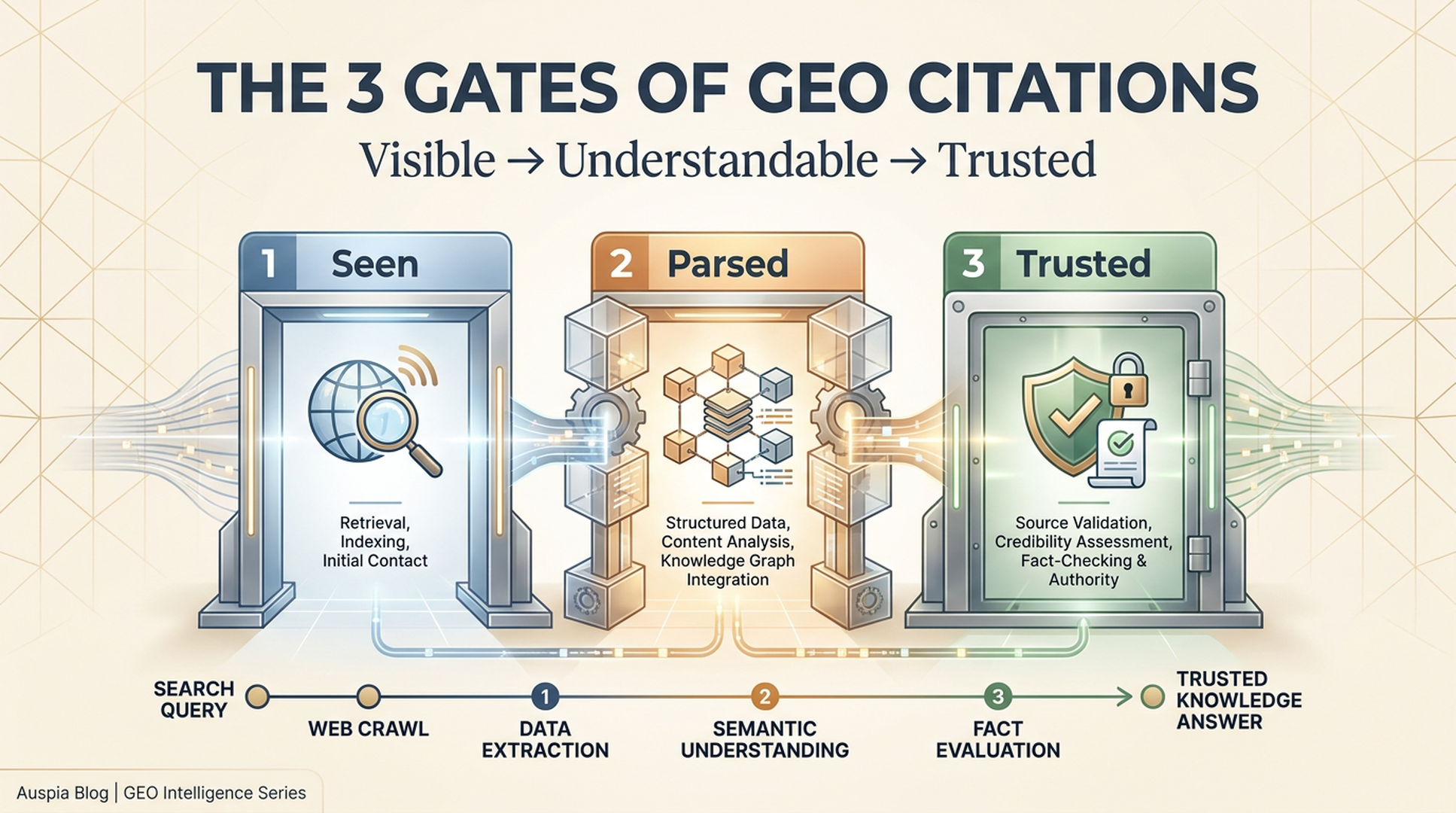
When a user asks an AI search engine for advice, the model usually does more than match one keyword. It may decompose the question, run several related searches, read multiple pages, compare sources, and synthesize a response. Google describes AI Mode as using query fan-out across subtopics and data sources, while the original RAG research framed retrieval as a way to ground generation in external evidence. The practical implication is simple: your brand has to pass three gates before it can become an AI citation.
- Can AI see you? Your content must enter the candidate set for a real user intent, not just rank for a broad keyword.
- Can AI understand you? Your pages must contain clear entities, claims, evidence, constraints, and use cases that can be extracted as answer-ready knowledge blocks.
- Can AI trust you? Your claims must be consistent, verifiable, externally supported, and safe for the model to recommend.
If any gate fails, the outcome is similar: the content exists, but the brand does not appear in the AI answer. That is why effective GEO is closer to building a public evidence system than to publishing more landing pages.
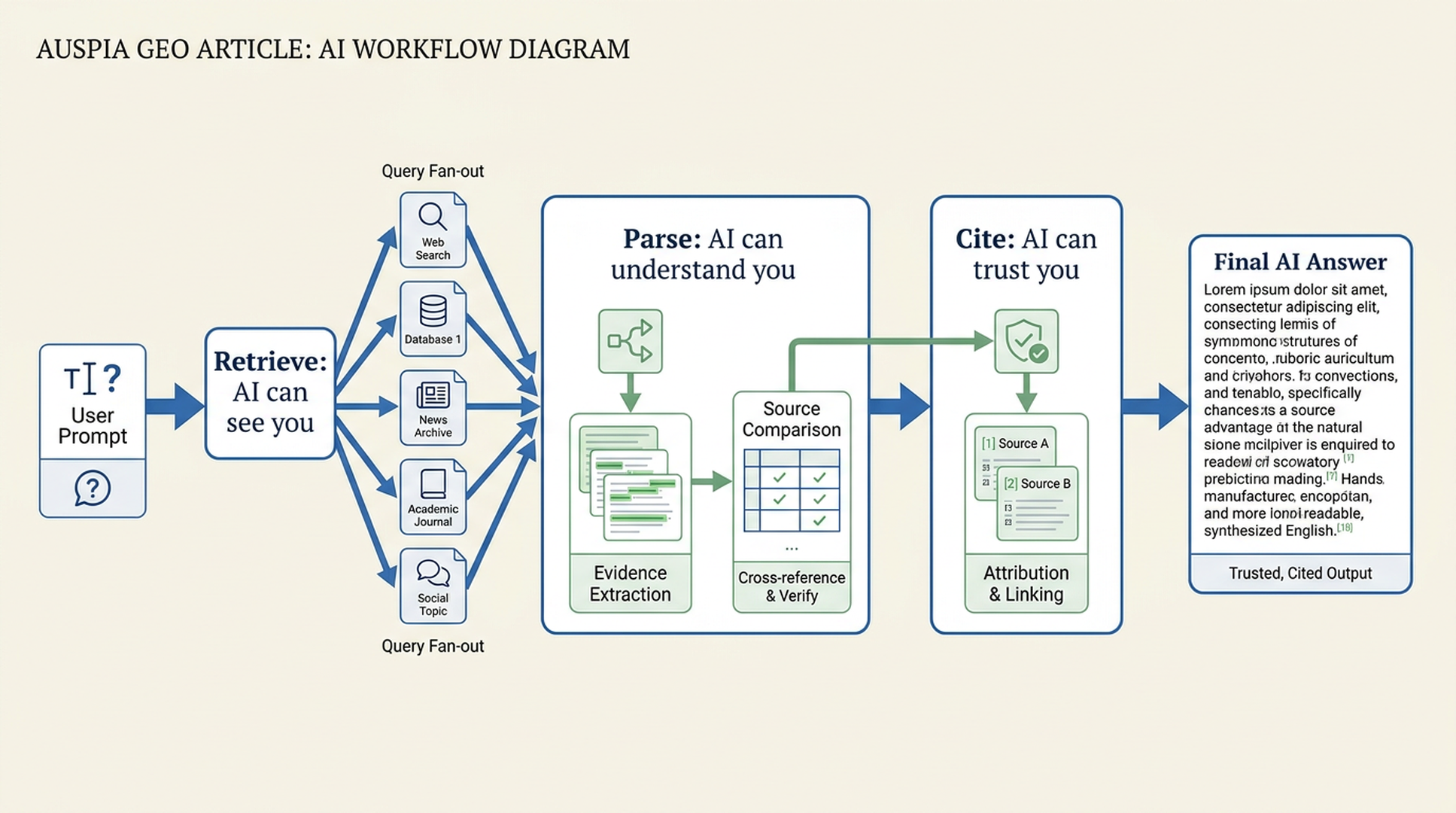
Caption: GEO citation readiness is a sequence, not a checklist. Retrieval comes first, but trust decides whether the source is used.
Why AI Search Changes the Visibility Problem
Traditional SEO often starts with a search result page: the user types a query, the search engine ranks documents, and the user chooses which link to open. AI search behaves more like a research assistant. The assistant receives a messy question, translates it into sub-questions, retrieves sources, reads evidence, and generates a consolidated answer.
This shift matters because the user's visible prompt is not the whole search event.
A procurement leader might ask: "What is the best customer support platform for a 300-person SaaS company that wants to reduce response time without replacing its whole help desk?" A conventional keyword map might classify that as "best customer support platform." An AI system may instead fan it out into several smaller needs:
- customer support tools for mid-market SaaS teams
- help desk automation without migration
- response-time reduction workflows
- AI chatbot risks for customer support
- Zendesk alternatives for growing SaaS companies
- implementation complexity and integration requirements
The brand that only wrote a generic "best support software" page is competing in one lane. The brand that owns the whole problem domain is present in several lanes.
Research on generative engines formalized this new visibility challenge: content creators need to understand when and how their sources are displayed inside generated responses, not only in blue-link rankings. RAG research also shows why external sources matter: retrieval gives models access to fresh or domain-specific evidence instead of relying only on parametric memory. In practice, your website is no longer just a destination. It is potential source material.
Gate 1: Can AI See You?
Visibility in GEO does not mean that your homepage is indexed or that an AI can define your brand when asked directly. Real visibility means the brand appears in the candidate pool when a user asks a problem-shaped question.
That requires a shift from keyword coverage to intent-domain ownership.
An intent domain is the cluster of problems, constraints, comparisons, objections, and decision criteria around a use case your company can genuinely help with. For a cybersecurity vendor, that might be "how regulated financial teams evaluate phishing-resistant authentication." For a B2B analytics platform, it might be "how product teams identify retention risk from fragmented customer data." For Auspia, it is helping teams grow qualified traffic through SEO, AEO, AI Search, and AI search visibility.
Weak GEO content tries to appear for every adjacent keyword. Strong GEO content repeatedly proves relevance to a stable problem domain.
Weak visibility strategy | Strong visibility strategy |
|---|---|
Publish many broad "best tools" pages | Build clusters around buyer problems and use cases |
Optimize one phrase per page | Cover the questions behind the prompt |
Describe product features in isolation | Connect features to decision scenarios |
Chase unrelated trends | Stay consistent around a definable expertise area |
Treat brand mentions as the goal | Treat retrieval in the right context as the goal |
The first gate fails when AI can find your category but cannot connect your brand to the user's real problem. You may be "in the industry," but not in the answer path.
Visibility Self-Test
Run two prompts across ChatGPT, Gemini, Perplexity, Claude, and Google AI Mode where available:
Search the web and summarize what [brand] does, who it serves, and what public evidence supports that description.
Then test the intent:
We are a [company type] with [specific problem]. Based only on public sources, is [brand] a relevant option? Explain the evidence and the uncertainty.
If the first answer confuses your brand with another company, you have an entity clarity problem. If the second answer ignores you or gives a generic summary, you have an intent-domain problem.
Gate 2: Can AI Understand You?
Many pages are technically visible but semantically weak. AI can fetch them, but it cannot safely turn them into answer material.
The problem is usually not writing quality. It is extractability.
AI systems need compact knowledge blocks: passages with a clear subject, a concrete claim, supporting evidence, context, and boundaries. A paragraph like "Our platform empowers teams with innovative AI transformation" is too vague. A paragraph like the one below is easier to use:
"Acme Support AI is designed for B2B SaaS teams with 50-500 support agents that already use Zendesk or Intercom. It reduces repetitive ticket handling by routing refund, password-reset, and plan-change requests to policy-aware workflows. It is not a full help desk replacement; it works best when the existing ticket taxonomy is already clean."
That passage tells the model who the product is for, what it does, which tools it connects to, which workflows it supports, and where it should not be recommended.
The Three Understanding Failures
1. The subject changes too often.
A page may refer to the company name, "we," "the solution," "the platform," and several partner products in the same section. Humans infer the subject. AI may not. In GEO content, repeating the subject is not clumsy; it is often necessary.
2. Claims float away from evidence.
"Enterprise-grade security" is hard to cite. "Acme Support AI supports SSO, SCIM provisioning, SOC 2 Type II reporting, and region-level data residency controls" is easier to cite because the claim is attached to observable evidence.
3. Features are not translated into use cases.
"99.9% uptime" is a metric. "99.9% uptime matters for global support teams that route customer incidents through the platform outside business hours" connects the metric to a decision context.
The goal is not to make every paragraph robotic. The goal is to make the core facts unambiguous enough for AI systems to extract and reuse.
Gate 3: Can AI Trust You?
Being retrieved is not the same as being cited. Being understood is not the same as being recommended.
AI search systems synthesize across multiple sources. They may compare your homepage, case studies, documentation, review sites, social discussions, news coverage, partner pages, and competitor pages. If those sources conflict, the model has a reason to be cautious.
Trust is built from four signals.
Trust signal | What AI can verify | Typical weakness | Better content move |
|---|---|---|---|
Source authority | Who made the claim and where it appears | Only self-published claims | Add customer pages, partner pages, expert bylines, and documentation |
Verifiability | Whether numbers include scope, date, and method | "High satisfaction" with no sample | Provide dates, sample sizes, definitions, and methodology |
Consistency | Whether claims agree across pages and platforms | Homepage says enterprise; case studies show only SMB | Align positioning across site, docs, profiles, and external listings |
External evidence | Whether third parties support the claim | No reviews, citations, analyst mentions, or customer proof | Build proof assets that exist outside the website |
This is where GEO becomes a business discipline, not only a content discipline. A copywriter can clarify a claim. A content team can structure a page. But only the organization can create real proof: customer outcomes, documentation, public benchmarks, partner validation, and consistent positioning.
Boundaries Increase Trust
Traditional marketing often avoids negative boundaries. It feels safer to say the product is flexible, scalable, and suitable for everyone. AI search changes that incentive.
A model is trying to reduce the user's decision risk and its own answer risk. A source that says who it is not for can be easier to recommend than a source that claims to fit every case.
Compare these two statements:
We are the leading all-in-one AI platform for every modern growth team.
Auspia is best suited for teams that need to improve organic visibility, AI search citations, and answer-engine readiness. It is less useful for teams looking for paid media buying, influencer management, or one-off brand awareness campaigns.
The second statement may feel narrower, but it is more trustworthy. It gives AI a safer recommendation boundary.
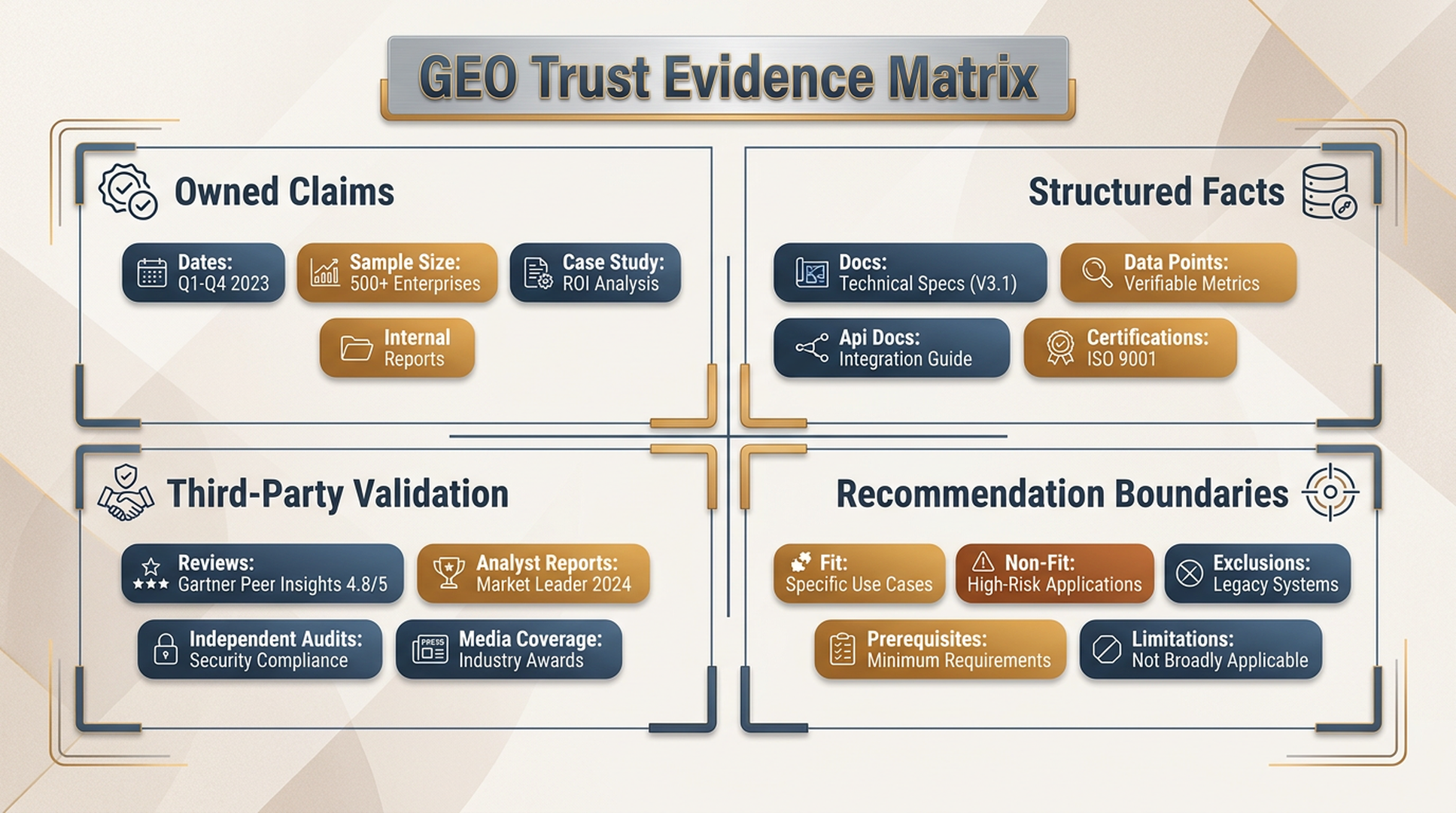
Caption: AI systems do not trust one page in isolation. They compare claims across a public evidence graph.
The Auspia Three-Gate Audit
If you want a fast GEO diagnosis, do not start by asking, "Does AI recommend us?" Start by finding where the chain breaks.
Step 1: Test Retrieval
Ask AI systems to identify your brand from public information. Then ask problem-shaped questions without naming your brand. Finally, ask the same question with your brand included.
Record whether the system:
- finds the right company
- retrieves current pages
- connects the brand to the correct use case
- cites sources beyond the homepage
- mentions outdated or conflicting information
If the model sees the category but not your brand, build stronger intent-domain content. If it sees your brand only when named, your problem-domain association is still weak.
Step 2: Test Understanding
Paste your homepage, product page, or case study into an AI system and ask:
Summarize the subject, target customer, problem solved, key evidence, limitations, and decision criteria in this content. Point out any ambiguous claims or missing context.
Compare the output with what you wanted the page to communicate. If the summary is wrong, do not ask for prettier writing. Ask why the model misunderstood it. Usually the answer falls into one of the same patterns: unclear subject, weak evidence connection, or missing use-case context.
Step 3: Test Trust
Give the model your homepage copy, case studies, review snippets, documentation, and public profiles. Ask it to audit trust:
Evaluate whether these public materials are reliable enough to cite in an AI answer. Review source clarity, evidence quality, consistency, external validation, and recommendation boundaries. Identify claims that should not be directly cited.
This prompt is uncomfortable, which is why it is useful. It exposes the difference between content that sounds confident and content that a cautious AI system can safely use.
What Teams Should Fix First
Not every company should begin with the same task.
If AI cannot identify your brand correctly, start with entity clarity. Make sure your organization name, product names, leadership, locations, categories, and public profiles are consistent. Add basic schema, update knowledge profiles, and clean up pages that create confusion.
If AI identifies you but does not associate you with real buyer questions, build intent-domain clusters. Use comparison pages, use-case pages, problem pages, case studies, and answer-style guides. The goal is to become retrievable across the sub-questions behind a prompt.
If AI retrieves you but summarizes you badly, rewrite your core pages into knowledge blocks. Make claims specific. Tie features to use cases. Add limitations. Use tables where they clarify the answer.
If AI understands you but will not strongly recommend you, invest in proof. Publish case-study methodology. Add dated metrics. Build third-party mentions. Align partner pages and review profiles. Use tools like an AI Search Visibility Checker to monitor whether your evidence is actually showing up in AI answers.
A Practical GEO Content Template
Use this structure for pages that need to become AI-answer material:
[Entity] helps [audience] solve [specific problem] in [context].

It is best suited for [fit conditions]. It is not designed for [non-fit conditions].

The key capabilities are [capability 1], [capability 2], and [capability 3]. These matter because [decision criteria].

Public evidence includes [case study], [documentation], [third-party source], and [dated metric with methodology].

Compared with [alternative], [entity] is stronger when [condition], but weaker when [condition].
This is not the final copy. It is the factual skeleton your final copy should preserve.
Common Mistakes
Mistake 1: Treating GEO as AI keyword stuffing.
Adding more category phrases does not make a page easier to cite. It may make the content noisier.
Mistake 2: Publishing generic comparison pages without evidence.
AI systems can compare many pages at once. Thin "best tools" content is easy to replace.
Mistake 3: Hiding limitations.
A source without boundaries creates recommendation risk. Clear fit and non-fit conditions help AI choose when to use you.
Mistake 4: Assuming your website is the whole evidence system.
The model may check reviews, documentation, social discussions, app marketplaces, customer pages, and media coverage. If the external record is empty or inconsistent, homepage copy cannot solve the trust gap.
Mistake 5: Optimizing only for one AI platform.
Different systems retrieve, rank, and cite differently. Monitor several answer engines and look for repeated failure patterns rather than one-off wins.
FAQ
What is a GEO citation?
A GEO citation is a reference, link, brand mention, or source inclusion inside an AI-generated answer. It can appear in AI search tools, AI Overviews, answer engines, chatbots with browsing, and research agents.
Is GEO just SEO for AI search?
No. SEO and GEO overlap, but they optimize for different moments. SEO helps pages rank and earn clicks. GEO helps content become retrievable, understandable, and trustworthy enough to be used in generated answers.
Do traditional rankings still matter for GEO?
Often, yes, because AI systems may retrieve from web indexes and high-quality pages. But rankings are not enough. A page can rank well and still be ignored if it lacks extractable evidence, clear entities, or trust signals.
How do I know which gate is failing?
Test in sequence. If AI cannot find the right brand, visibility is failing. If it finds the page but summarizes it incorrectly, understanding is failing. If it summarizes correctly but avoids recommending or citing it, trust is failing.
Can content rewriting fix GEO trust?
Only partly. Rewriting can improve clarity and extractability. Trust often requires new evidence: customer proof, third-party validation, consistent public profiles, dated metrics, methodology, and external citations.
References
- Pranjal Aggarwal et al., "GEO: Generative Engine Optimization", arXiv, 2023.
- Patrick Lewis et al., "Retrieval-Augmented Generation for Knowledge-Intensive NLP Tasks", arXiv, 2020.
- Google, "Expanding AI Overviews and introducing AI Mode", March 5, 2025.
- OpenAI, "WebGPT: Improving the factual accuracy of language models through web browsing", 2021.
- Shunyu Yao et al., "ReAct: Synergizing Reasoning and Acting in Language Models", arXiv, 2022.