Short answer
AI Overviews changed the search page from a list of links into an answer layer. That does not make SEO useless, but it does make old SEO incomplete. A page can still rank well and lose clicks if the answer is solved above the organic results.
Google began rolling out AI-generated summaries in U.S. search results at I/O in May 2024, and the direction has only become clearer since then: search engines are moving from "show me pages" toward "give me an answer and cite sources." The websites that relied only on rankings now need a second capability: GEO, or making content easy for AI answer systems to understand, extract, trust, and cite.
Auspia's take: do not abandon SEO. Keep the technical and content foundations. But add AI visibility tracking, citation readiness, answer-first content, and source-quality work before a traffic drop forces the conversation.
What changed with AI Overviews
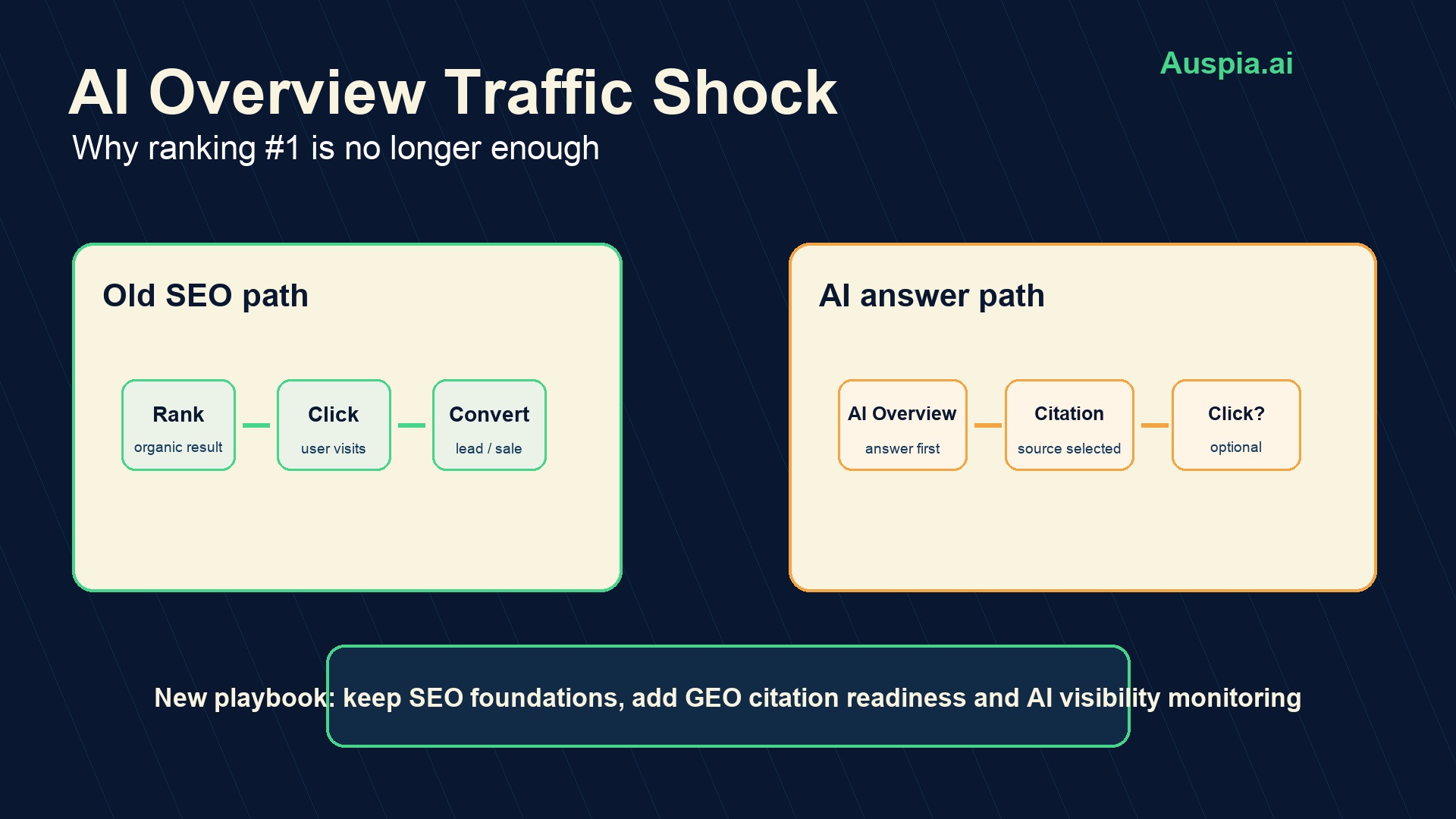
Before AI Overviews, the classic SEO path was simple enough:
- Rank for a query.
- Earn the click.
- Convert the visitor.
AI Overviews insert a new step above that path. For many informational and research-style searches, Google can now generate a summary at the top of the results page, often with source links. The user may get enough information from the answer box and never scroll to the traditional organic result.
That means the question changes.
Old question: "Can we rank on page one?"
New question: "Can we be understood, cited, and chosen inside the AI answer experience?"
This is why teams are seeing mixed outcomes. Some pages lose clicks because the answer is satisfied directly. Some pages gain visibility because they are cited inside the AI-generated answer. Some pages keep rankings but become less visible because the screen above them has changed.
The page did not necessarily get worse. The interface changed.
The painful part: you can do nothing wrong and still lose traffic
This is the hardest message for mature SEO teams.
A site can have strong technical SEO, healthy backlinks, well-written content, and years of ranking history. That work still matters. It helps search engines crawl, understand, and evaluate the site.
But it may not be enough when the user's first screen is an AI answer.
Traditional SEO optimized for ranking signals and click appeal. GEO adds a different layer:
Old SEO focus | New GEO/AEO focus |
|---|---|
Rank position | AI citation and answer inclusion |
Meta title and description | Extractable summary and source clarity |
Keyword coverage | Entity clarity and topical completeness |
Backlinks | Trusted evidence graph |
Organic clicks | AI mentions, assisted discovery, branded demand |
Content length | Direct answers, tables, FAQs, and proof |
This does not mean every SEO playbook is obsolete. It means the job expanded.
Why the first screen matters so much
Search behavior is visual and lazy in the normal human way. People look at what is easiest to see first.
If AI Overviews occupy the top of the results page, the traditional blue links move down. Even if your page ranks first organically, the user may see the AI answer before they see you. In some cases, that answer may cite you. In other cases, it may cite someone else. In the worst case, it may answer the question without giving users much reason to click any source.
This makes three metrics more important:
- AI citation presence: are you included as a source?
- AI answer accuracy: does the answer describe your topic or brand correctly?
- Post-answer demand: do users still search your brand, click deeper, or convert later?
Organic sessions still matter, but they no longer tell the whole story.
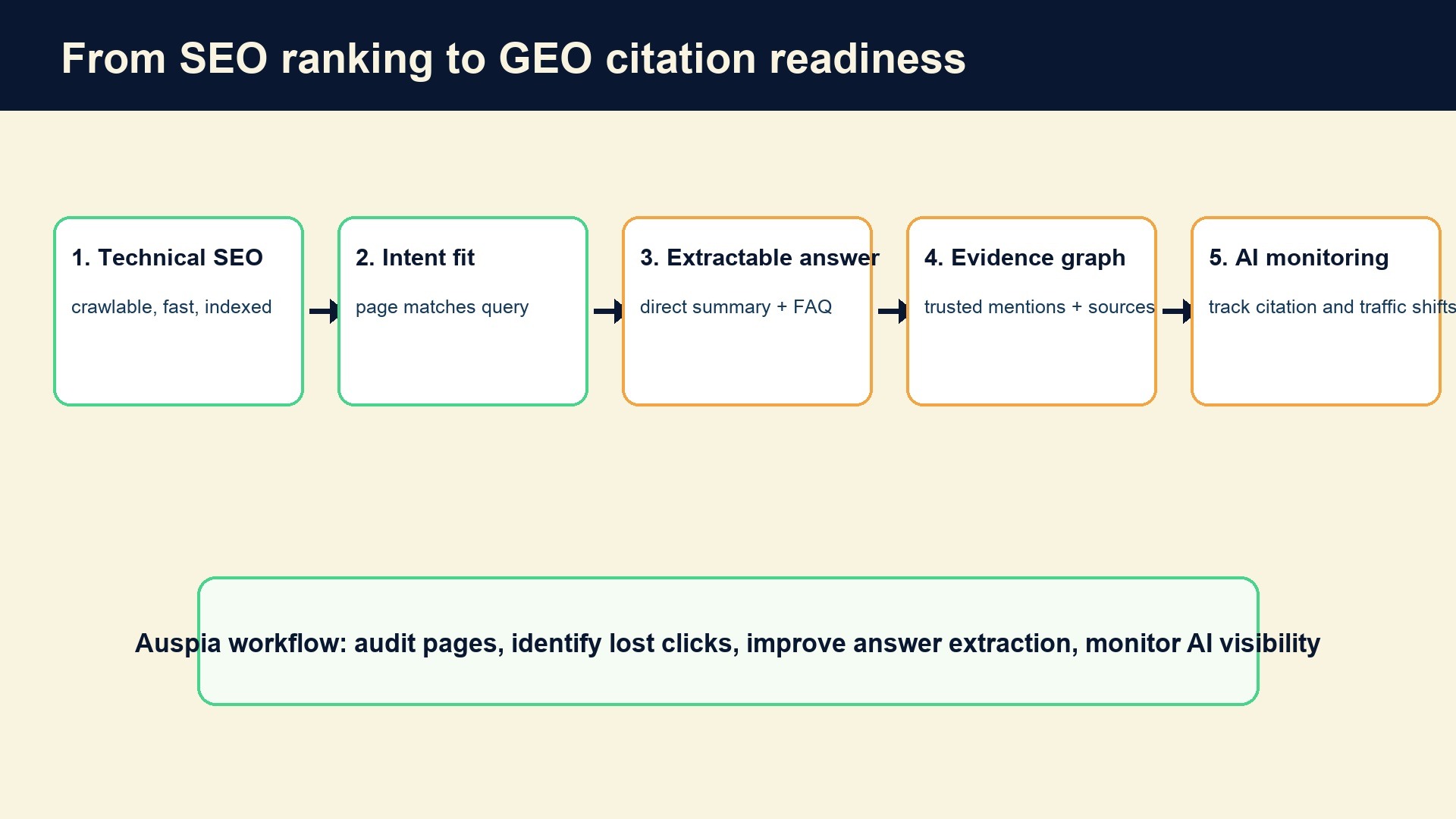
Caption: SEO foundations still matter, but AI search adds citation readiness and visibility monitoring to the workflow.
What AI Overviews reward
AI answer systems tend to reward content that is easy to parse and support.
That usually means:
- A clear answer near the top of the page
- Consistent entity names and definitions
- Structured headings that match real questions
- Tables that compare options cleanly
- FAQ sections with short, self-contained answers
- Evidence, dates, examples, and source context
- Pages that solve a task rather than repeat a generic definition
- Third-party mentions that corroborate the brand or claim
A page that buries the point under a long intro may still be readable to a patient human. It is less useful for an answer system trying to extract the best concise response.
This is where many older content libraries need repair. They were written for rankings and dwell time, not for answer extraction.
What to audit after a traffic drop
If a page loses traffic after AI answers expand in your category, do not start by rewriting everything.
Start with diagnosis.
Check | What to look for | Likely action |
|---|---|---|
Impressions | Did Google still show the page? | If stable, the issue may be CTR or SERP layout. |
Click-through rate | Did clicks fall faster than impressions? | Improve title, snippet, and answer differentiation. |
AI Overview presence | Does an AI answer appear for the query? | Check whether you are cited. |
Citation sources | Who is cited instead? | Compare structure, evidence, and authority. |
Query type | Is the query informational, commercial, or navigational? | Decide whether to add FAQ, comparison, tool, or landing page. |
Conversion impact | Did revenue fall or only top-funnel visits? | Prioritize pages tied to business value. |
The goal is to separate a ranking problem from a visibility problem. Those are not the same anymore.
A page can have a ranking problem, a citation problem, a click problem, or a conversion problem. Each needs a different fix.
The recovery playbook
For teams that relied heavily on traditional SEO, the recovery path is not "publish more articles." It is a controlled upgrade of the content system.
1. Keep the SEO base healthy
Do not throw away the old foundation. Technical SEO, crawlability, page speed, internal links, canonical tags, structured data, and quality content still matter.
If search engines cannot crawl and understand the page, AI answer systems are unlikely to use it well.
2. Rewrite key pages for extraction
Priority pages should answer the main question directly within the first section.
Add:
- A plain-English definition
- A concise summary
- Comparison tables
- Step-by-step sections
- FAQs
- Examples or screenshots
- Clear dates for time-sensitive claims
Do not make the page robotic. Just make the answer easy to find.
3. Build evidence, not just content
AI systems need sources. Your page should not be the only place where your claim exists.
Build a stronger evidence graph through:
- Product documentation
- Case studies
- Reviews
- Third-party comparisons
- Expert mentions
- Partner pages
- Data reports
- Tool pages that users can test directly
This is especially important for commercial queries. A brand saying "we are the best" is weak evidence. A clear product page, public examples, reviews, and independent mentions together are stronger.
4. Track AI visibility separately
Do not assume rankings explain AI visibility.
Track prompts such as:
- "best tools for [job]"
- "how to solve [problem]"
- "[your brand] vs [competitor]"
- "what is the best way to [task]"
- "which companies provide [solution]"
Record whether your brand appears, how it is described, which sources are cited, and whether competitors appear more often.
5. Create assets AI systems can cite
Some pages are naturally more citation-ready than others.
Useful assets include:
- Original data tables
- Glossaries
- Benchmarks
- Calculators
- Checklists
- How-to guides
- Comparison pages
- Free tools
- Research summaries
This is one reason tool-led growth fits the AI search era. A useful checker or generator gives both humans and AI systems a concrete source to reference.
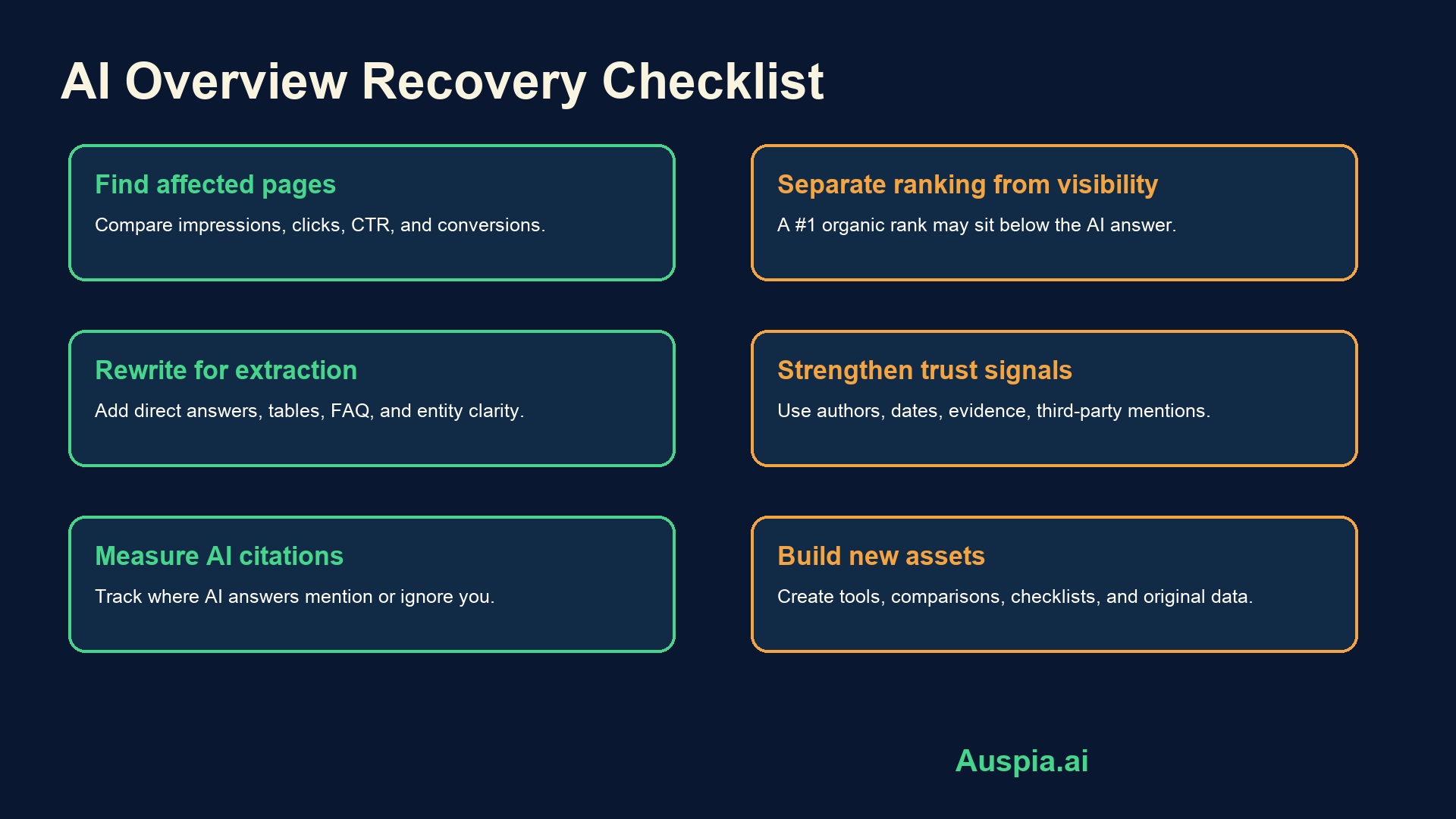
Caption: Recovery starts with diagnosis, then moves into extractable content, trust signals, and new citation-worthy assets.
Where Auspia fits
Auspia helps teams move from SEO-only thinking to SEO plus GEO plus AEO operations.
Use it when you need to answer questions like:
- Which pages are losing visibility because of AI answers?
- Which pages are technically healthy but not citation-ready?
- Which topics should become guides, tools, comparisons, or checklists?
- Are AI crawlers able to access the pages that matter?
- Do AI answer systems mention the brand accurately?
- Which content gaps block AI visibility?
Instead of manually stitching together Search Console, SERP checks, AI prompt tests, crawler checks, and content audits, teams can use Auspia to diagnose the next action faster.
A practical starting point is the AI Search Visibility Checker, followed by page-level audits for the URLs that matter most to revenue.
A simple 30-day action plan
If AI Overviews are already affecting your category, run this sprint.
Week 1: Map the damage
Export your top organic pages. Compare impressions, clicks, CTR, and conversions across the last 30 to 90 days. Mark pages where clicks fell faster than impressions.
Then manually check the SERP for the highest-value queries. Does an AI Overview appear? Are you cited? Are competitors cited?
Week 2: Repair the top five pages
For each priority page, add or improve:
- Direct answer section
- Summary table
- FAQ
- Author or reviewer context
- Updated examples
- Internal links to supporting pages
- Schema where appropriate
Week 3: Build missing evidence
Create or improve one citation-worthy asset for each important topic cluster. This could be a tool page, checklist, comparison, original data point, or case-style page.
Week 4: Monitor and decide
Track rankings, AI citations, clicks, assisted conversions, and branded search. Some changes will take longer than 30 days to show full impact, but you should be able to see whether the page is easier to extract and cite.
What not to do
Do not respond to AI Overviews by flooding the site with low-quality AI content.
That usually makes the problem worse. AI search does not need more generic summaries. It needs reliable pages with clean structure and useful evidence.
Also avoid pretending GEO is a hack. There are spammy ways to chase citations, but they are fragile. A real GEO strategy makes the brand a better source.
Auspia takeaway
AI Overviews did not end SEO. They ended the comfortable assumption that ranking alone is enough.
The next search playbook has two layers:
- SEO makes the site crawlable, useful, authoritative, and competitive in traditional results.
- GEO makes the site understandable, extractable, trustworthy, and monitorable inside AI answer systems.
Teams that combine both will adapt faster than teams waiting for traffic to return to the old pattern.
FAQ
Did Google AI Overviews launch in 2024?
Yes. Google introduced AI-generated summarized search results for U.S. users at Google I/O in May 2024, according to contemporaneous reporting from The Guardian and other outlets.
Do AI Overviews always reduce traffic?
No. The impact depends on the query, industry, page type, and whether the site is cited. Some pages may lose clicks, while cited pages can gain visibility. The key is to measure impressions, CTR, citations, and conversions separately.
Is GEO replacing SEO?
No. GEO builds on SEO. Technical health, useful content, internal links, and trust signals still matter. GEO adds answer extraction, citation readiness, AI visibility monitoring, and source-quality work.
What should I do first if traffic drops after AI Overviews appear?
Check whether impressions stayed stable while clicks fell. If yes, inspect the SERP, identify whether AI Overviews appear, see who is cited, and upgrade priority pages for direct answers, evidence, FAQs, and trust signals.
How can Auspia help with AI Overview traffic risk?
Auspia helps audit SEO, GEO, AEO, AI visibility, crawler readiness, and page-level content gaps. It helps teams identify which pages need technical fixes, citation readiness, new assets, or monitoring before traffic loss compounds.