


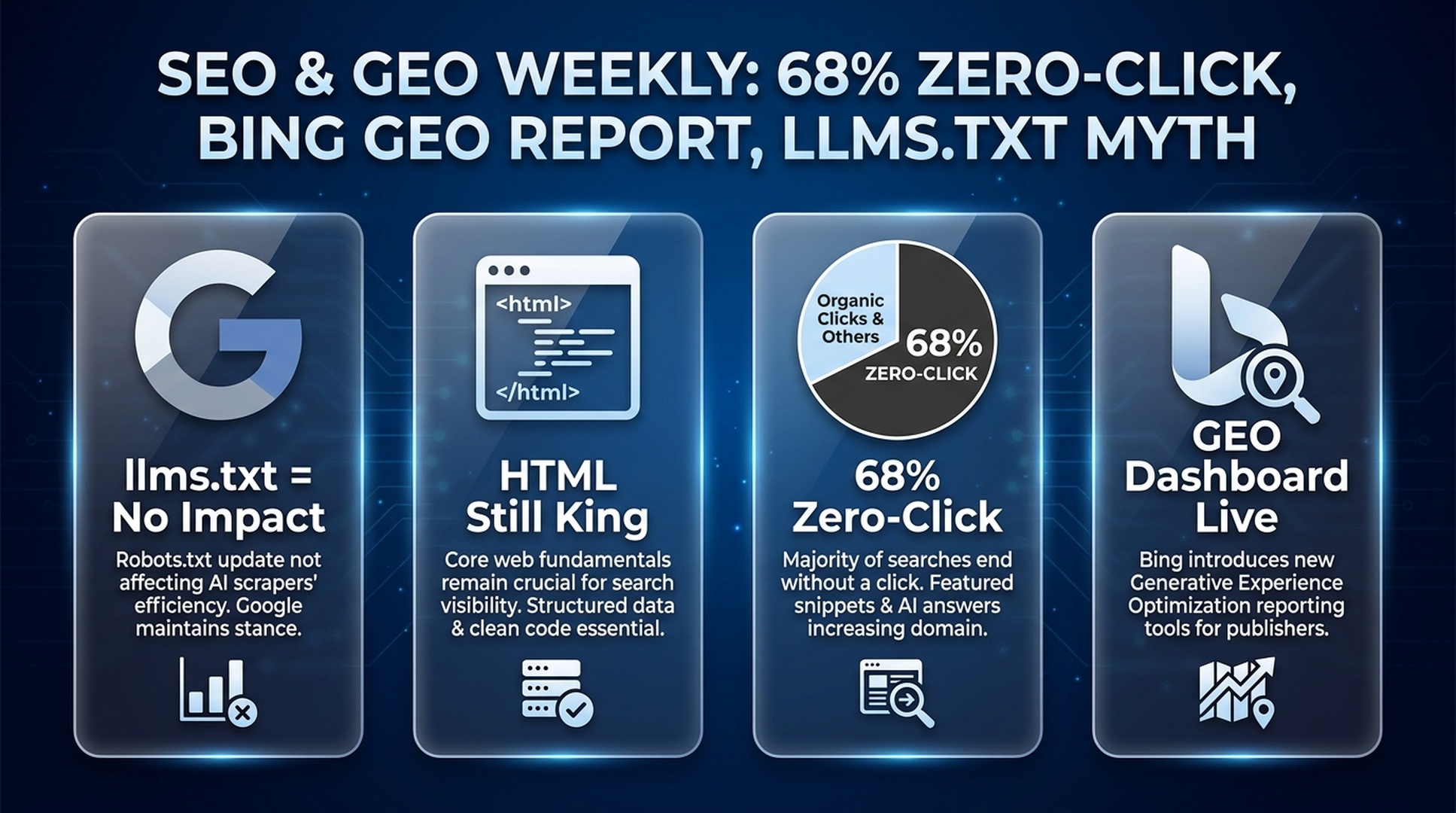
Google Says llms.txt Won't Affect Rankings
Google updated its AI Search Optimization Guide with a clear statement: llms.txt files neither improve nor harm your Google search rankings. The search giant explicitly confirmed it ignores these files for ranking purposes.
Here's what Google added to its documentation:
"If you choose to create and maintain llms.txt files (or similar files) for other services or systems, that's perfectly fine. Doing so will neither harm nor improve your visibility or rankings in Google Search, as Google Search ignores these files."
What this means: Google is aware of llms.txt and does crawl it, but treats it as irrelevant for search ranking. Other AI search tools may use it, so maintaining one isn't wrong — it's just not a Google SEO priority.
Google Podcast: HTML Is the SEO Standard, Not Markdown
In the latest Off The Record podcast (June 16), Google's John Mueller and Martin Splitt addressed the Markdown vs. HTML question directly. Their conclusion: for SEO and search discovery, HTML remains the standard format. Markdown has its uses, but it's not an "optimized format" for search engines.
John Mueller's summary: "For all SEO-related things and content discovery, a regular HTML website is what's really needed."
Key points from the discussion:
- Web crawlers have decades of experience processing standard HTML
- Extracting plain text from HTML is trivial for modern systems
- Maintaining a parallel Markdown version for LLMs doubles your workload and technical complexity
- If a hidden "LLM version" breaks, real users never see it — errors go unreported while automated systems may index them silently
The takeaway: Don't create a separate Markdown site to appease AI models. Focus on well-structured HTML. Some AI search tools may benefit from Markdown, but it's not the highest priority — and current best practices may become obsolete as AI crawlers evolve.
68% of Google Searches Now Result in Zero Clicks
SparkToro and Similarweb released new research: in the first four months of 2026, 68.01% of Google searches produced no click whatsoever.
The trend is accelerating. Zero-click searches were around 45% in 2016, 49% in 2019, and 60.45% in 2024. That's a 23-percentage-point increase over ten years, with the fastest acceleration happening in the last two years.
Why it's happening:
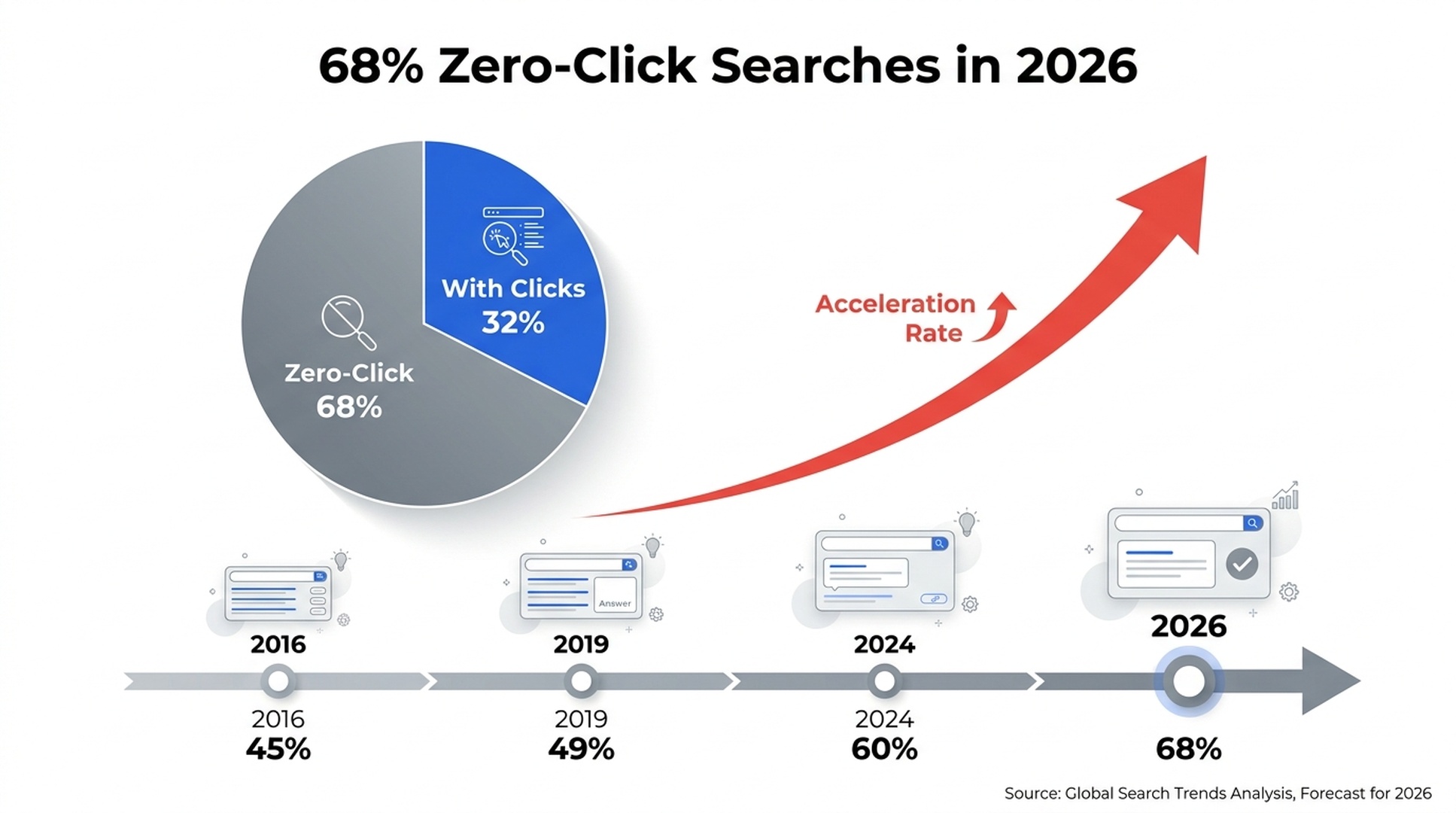
The immediate cause is AI Overviews, which now appear in over 20% of searches. When AI Overviews show up, click-through rates drop by 60%.
The deeper driver is competitive pressure. AI search tools are changing user habits. E-commerce platforms and social media sites are capturing search behavior that used to go to Google. Google responds by showing answers directly to keep users on its platform.
What to do about it:
The original report offers four recommendations:
- Shift KPIs away from pure traffic toward visibility, influence, and brand search volume
- Practice "zero-click marketing" — build brand awareness without requiring user clicks
- Don't abandon your website. Content remains foundational for both AI and Google
- Focus on categories still yielding SEO returns: brand terms, local business, high-intent transactional queries
Reality check: This didn't jump from 0% to 68% overnight. The shift toward AI search is real, gradual, and continuing. Keep your website and SEO as the foundation, but start integrating GEO strategies and adjusting to new measurement frameworks.
Source: SparkToro
Bing Webmaster Tools Launches GEO Reporting
Bing Webmaster Tools rolled out a suite of GEO reporting features, giving publishers visibility into how AI search systems cite their content.
The new dashboard includes:
Intent classification — Each query is categorized as informational, commercial, navigational, learning/problem-solving, research, creation, or local. This goes beyond the typical informational/commercial/brand taxonomy to show the full context behind AI citations.
Topic clustering — Related base queries are grouped into topic clusters, helping publishers see thematic patterns.
Citation share — For any given query, this shows what percentage of all citations went to your site. Since AI answers aren't static, citation share lets you track your relative visibility over time.
Period comparison — Overlay previous period data directly on the current report to spot trends.
These features are now live globally for all sites in Bing Webmaster Tools.
Why it matters: Bing is moving ahead with AI search analytics. Google will likely follow. If you're doing GEO work, you now have concrete data to measure whether your content is being cited, by whom, and for what intents.
Source: Bing Blog
What This Week Tells Us
Four stories, one pattern: the search landscape is splitting into two layers.
Layer one is traditional SEO — HTML pages, crawlable content, keyword rankings. Google still owns this layer, and the rules haven't changed. llms.txt doesn't matter for Google. Markdown doesn't matter for Google. HTML is still king.
Layer two is GEO — AI search visibility, citation tracking, brand mentions in generated answers. This layer is new, less understood, and evolving fast. Bing just gave you the dashboard to measure it. Zero-click data shows why you need to care.
The mistake is treating these as the same game. They're not. You can rank well in Google and still be invisible in AI search. You can be cited by ChatGPT and still have terrible organic traffic.
The smart move is to optimize for both — but measure them separately, and don't expect the same tactics to work for each.
FAQ
Does llms.txt help with SEO? No. Google has explicitly stated that llms.txt files neither improve nor harm search rankings. Google ignores these files. Other AI systems may use them, so maintaining one isn't harmful, but it's not an SEO tactic.
Should I create a Markdown version of my website for AI? Not as a priority. Google's search team confirmed that HTML remains the standard for SEO and content discovery. Some AI tools may benefit from Markdown, but maintaining parallel versions doubles your workload without clear payoff.
Why are zero-click searches increasing? AI Overviews, which appear in 20%+ of searches and reduce click-through rates by 60%. Competitive pressure from AI search tools and platform-specific search (Amazon, TikTok, etc.) also drives Google to show answers directly.
How do I measure GEO performance? Bing Webmaster Tools now offers GEO reporting with intent classification, topic clustering, citation share, and period comparison. Google Search Console doesn't yet have equivalent features, but monitoring AI platform citations manually is a start.
Is SEO dead because of AI search? No. SEO and GEO are different layers. Traditional search still drives traffic, especially for brand terms, local business, and high-intent queries. But you should start measuring AI search visibility separately and adjusting your strategy accordingly.


