Direct answer
GEO does not replace SEO, SEM, or brand marketing. It adds a new layer to the growth stack: making your company easier for AI answer engines to understand, trust, mention, and cite. SEO still captures traditional search visibility, SEM still captures paid demand with speed, and brand marketing still shapes long-term memory. GEO connects those existing assets to the new behavior that now sits at the front of many research journeys: people ask AI before they click.
That means the practical question is not, "Should we cut SEO or SEM to fund GEO?" The better question is, "How do we make SEO, SEM, brand, and GEO reinforce each other across the whole decision path?"
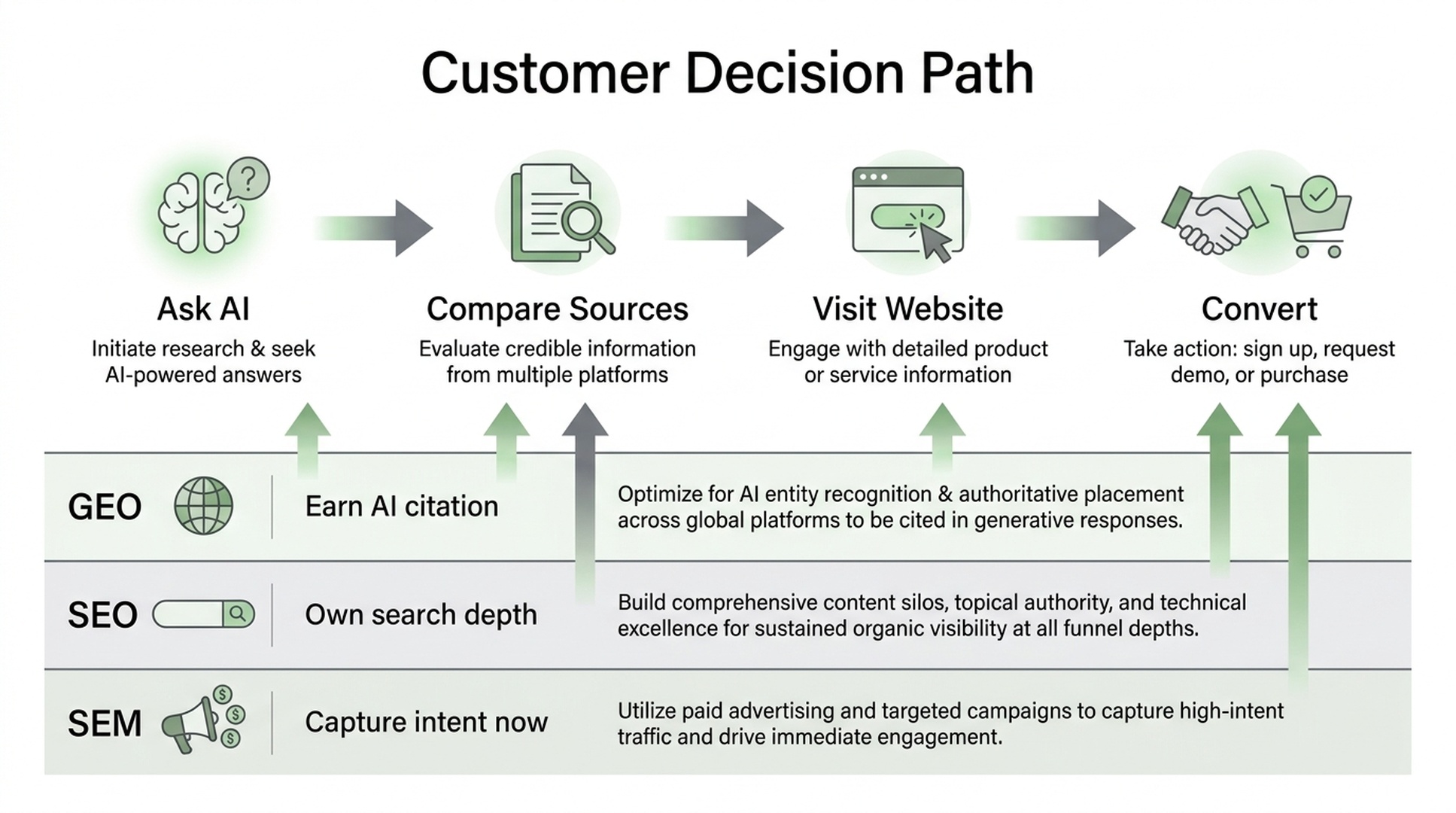
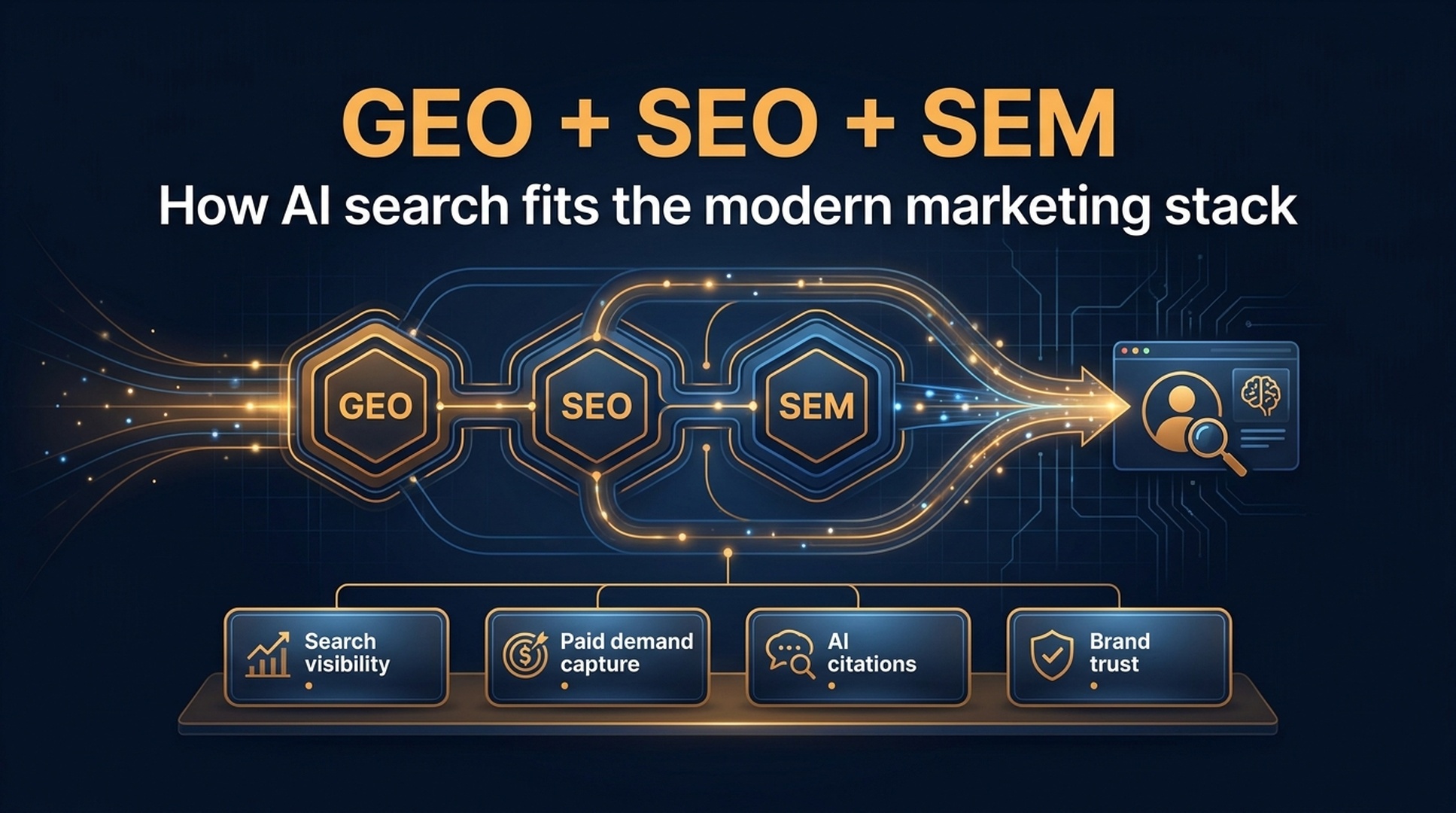
Diagram: GEO wins early AI citations, SEO supports deeper comparison, and SEM captures high-intent demand.
Why this question matters now
For many growth teams, GEO sounds like another acronym arriving before the last budget cycle has even settled. A founder, marketing lead, or export sales director may ask a very reasonable question: after years of investing in search rankings, paid search, PR, case studies, and brand content, are those investments suddenly obsolete?
No. They are not obsolete. But they need a new operating model.
Generative AI systems such as ChatGPT, Google AI experiences, Perplexity, Gemini, and other answer engines are changing how buyers begin research. A user who previously searched "best procurement software for mid-market manufacturers" may now ask an AI assistant for a shortlist, a comparison, a risk summary, or a buying checklist. If your brand is absent from that answer, the buyer may never reach the search results page where your SEO and SEM teams are strongest.
Auspia's view is simple: GEO is not a replacement channel. It is an AI trust layer that sits above and beside search, paid media, and brand marketing.
GEO and SEO: two engines, not one winner
Traditional SEO is built around discoverability in search engines. It improves crawlability, content depth, internal linking, structured data, entity clarity, backlinks, and search intent alignment so that pages can rank and earn organic clicks.
GEO works differently. It focuses on whether AI answer systems can understand your brand, extract reliable information from your pages, connect your claims to third-party evidence, and choose your content as a useful source when generating an answer.
A useful way to separate the two:
Dimension | SEO | GEO |
|---|---|---|
Main goal | Rank in search results | Appear in AI-generated answers |
Primary unit | Page and keyword | Entity, evidence, and answer asset |
User action | Click a result | Trust a recommendation or citation |
Common metrics | Rankings, impressions, clicks, conversions | AI mentions, citation share, recommendation position, answer accuracy |
Content need | Search-intent pages | Extractable answers, factual summaries, comparison data, proof assets |
SEO competes for visibility on a results page. GEO competes for inclusion in the answer itself.
But these systems overlap. Strong SEO content often becomes the raw material that AI systems can discover. A technically weak site, thin content library, or unclear brand entity makes GEO harder. At the same time, a page built only for classic keyword ranking may not give AI systems the concise, structured, evidence-backed information they need to cite it.
The best approach is a dual-engine model: SEO keeps your site visible when users compare deeply; GEO increases the chance that your brand is considered before the user even opens a browser tab.
GEO and SEM: budget redesign, not budget war
SEM has a different job. Paid search helps companies show up immediately for commercial intent. It is fast, controllable, and measurable. If a buyer searches for a high-intent query, SEM can put your offer in front of them today.
GEO is slower and more cumulative. It builds the knowledge and evidence base that AI answer engines can reuse over time. You do not buy a citation in the same way you buy an ad placement. You earn it by making your information easier to parse, corroborate, and trust.
That difference changes the budget conversation.
SEM answers: "How do we capture demand that already exists?"
GEO answers: "How do we become part of the shortlist before the buyer searches?"
A mature budget should make room for both. SEM remains valuable for immediate pipeline and campaign testing. GEO deserves investment because the top of the funnel is moving into conversational discovery, AI summaries, and recommendation-style answers.
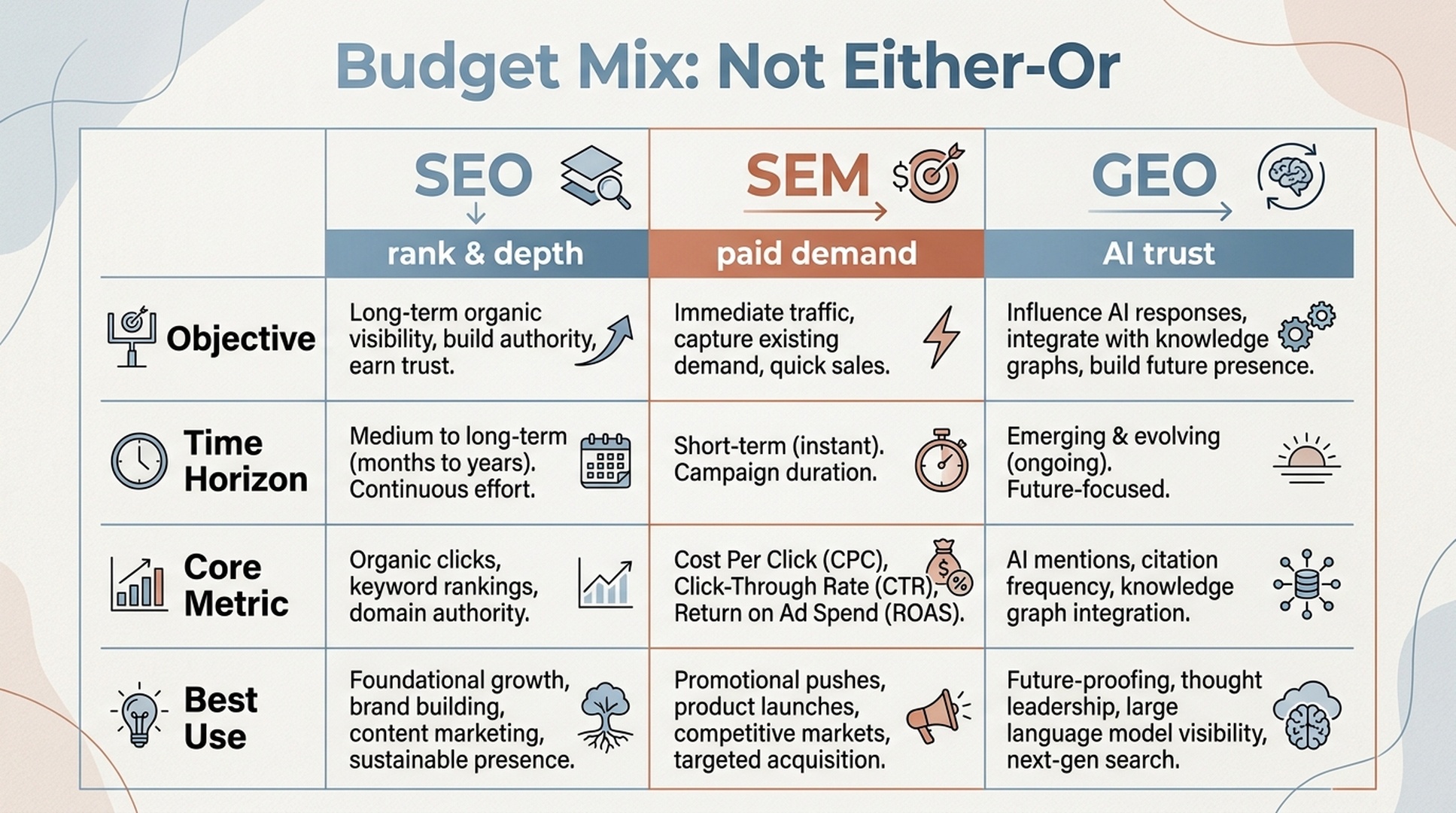
Matrix: SEO builds durable search depth, SEM captures paid demand, and GEO compounds AI trust.
GEO and brand marketing: AI becomes a new memory layer
Brand marketing has always been about mental availability: when a buyer thinks about a problem, your company should come to mind as a credible option. Historically, teams built that memory through advertising, analyst relations, social proof, events, communities, PR, product storytelling, and customer experience.
AI answer engines introduce another memory layer.
When users ask AI systems for recommendations, alternatives, summaries, or buying criteria, the system compresses a messy web of information into a small answer. In that moment, the answer engine becomes a gatekeeper of brand memory. It may mention three vendors, ignore five others, summarize one company accurately, and misdescribe another.
This is why GEO belongs close to brand strategy. It is not only a traffic tactic. It is a way to make your brand entity more machine-readable and evidence-backed.
A brand that wants to be recommended by AI needs more than a homepage and a few campaign pages. It needs:
- Clear entity information: what the company does, who it serves, where it operates, and how it differs.
- Structured proof: case studies, third-party mentions, product documentation, comparison pages, and credible FAQs.
- Consistent language: product names, category terms, claims, and use cases should not contradict each other across the web.
- Extractable answers: short definitions, tables, checklists, and summaries that AI systems can quote or paraphrase accurately.
- External corroboration: reputable sources that confirm the brand's role, category, and expertise.
In short, brand marketing creates meaning for humans. GEO helps AI systems preserve that meaning when they generate answers.
The modern growth stack: SEO, SEM, brand, and GEO together
A practical marketing stack now has four connected jobs:
Function | Primary role | Best contribution to the buyer journey |
|---|---|---|
Brand marketing | Build recognition and trust | Makes the company memorable before active search |
GEO | Earn AI understanding, mentions, and citations | Places the company inside AI-led discovery and shortlist creation |
SEO | Win organic search visibility | Supports research, comparison, and long-tail demand capture |
SEM | Capture paid high-intent demand | Converts active demand quickly with controlled campaigns |
The sequence often looks like this:
- A buyer asks an AI system for advice, tools, vendors, or criteria.
- GEO determines whether your brand appears in the answer and how it is framed.
- The buyer searches Google, Bing, YouTube, Reddit, G2, or niche sources to validate the recommendation.
- SEO and brand assets support deeper investigation.
- SEM captures high-intent queries when the buyer is ready to compare or buy.
- Brand trust, proof, and product experience determine whether the buyer converts.
This is not a zero-sum model. It is a relay.
What most teams get wrong
The biggest mistake is treating GEO as a quick technical patch. Uploading an llms.txt file, adding schema, or publishing a few FAQ pages may help, but those actions do not replace the deeper work of building an AI-readable trust system.
Common mistakes include:
- Measuring GEO only by traffic instead of AI mentions, citation quality, answer accuracy, and assisted conversions.
- Creating generic definition pages without proof, examples, or unique expertise.
- Ignoring third-party evidence, even though AI systems often need corroboration beyond your own site.
- Separating SEO, PR, paid media, and content teams so their signals never reinforce each other.
- Optimizing only for one AI platform instead of building a source base that works across multiple answer systems.
GEO is not just content production. It is entity management, evidence design, technical hygiene, and answer extraction working together.
Auspia's approach: build AI trust assets, not just traffic pages
Auspia treats GEO as a trust-asset system. The goal is not to chase every AI prompt or manufacture shallow mentions. The goal is to help AI systems understand the brand correctly and find enough structured evidence to include it when the recommendation is deserved.
A practical GEO program usually includes:
- AI visibility audit: test where the brand appears or disappears across priority prompts.
- Entity clarity review: align company, product, category, audience, and use-case language.
- Citation-ready content: create pages that answer real buying questions in a structured way.
- FAQ and comparison architecture: make important answers easy to extract and verify.
- Third-party evidence mapping: identify the sources AI systems may trust outside your own site.
- Monitoring loop: track answer changes, citation sources, inaccurate summaries, and competitor movement.
This is where GEO connects back to SEO, SEM, and brand. Existing search pages become more answer-friendly. Paid campaigns reveal high-converting language. Brand assets become clearer proof points. Customer stories become evidence that AI systems can connect to real use cases.
A simple operating checklist
Use this checklist before shifting budget or launching a GEO project:
Question | Why it matters |
|---|---|
Do we know which AI prompts buyers ask before searching? | GEO starts with conversational demand, not only keyword demand. |
Are our core pages easy to summarize in 30 seconds? | AI systems need concise, structured information. |
Do we have credible proof for our main claims? | Unsupported claims are less likely to become trusted answer material. |
Are SEO pages, paid landing pages, and brand messages consistent? | Contradictions weaken entity clarity. |
Are we tracking AI mentions and citations by topic? | Rankings alone do not show AI-search visibility. |
Do we have a process to correct inaccurate AI descriptions? | Wrong summaries can damage trust before a buyer reaches your site. |
Final takeaway
GEO is not the death of SEO, SEM, or brand marketing. It is the next layer in the same growth system.
SEO helps buyers find and compare you. SEM helps you capture demand when timing matters. Brand marketing builds the trust that makes buyers care. GEO makes those assets legible to AI answer engines, so your company can be understood, cited, and recommended in the discovery moments that increasingly happen before a search click.
The companies that win will not be the ones that abandon their existing marketing stack. They will be the ones that connect it: brand clarity, SEO depth, SEM precision, and GEO trust working as one decision-path system.
FAQ
Is GEO replacing SEO?
No. GEO and SEO solve different visibility problems. SEO helps pages rank in search results; GEO helps brands and content appear in AI-generated answers. Strong SEO often supports GEO because AI systems still need discoverable, credible source material.
Should companies move SEM budget into GEO?
Some budget may shift, but it should not be a blind replacement. SEM is still useful for immediate demand capture. GEO is better treated as a strategic investment in AI-led discovery, citation readiness, and brand trust.
How is GEO different from brand marketing?
Brand marketing shapes human memory and preference. GEO helps AI systems understand and represent that brand accurately in answers, recommendations, and citations. The two should use the same proof points and positioning.
What should a team measure for GEO?
Useful metrics include AI mention rate, citation share, recommendation position, answer accuracy, source diversity, prompt coverage, and downstream assisted conversions. Organic traffic alone is not enough.
What is the first step in a GEO program?
Start with an AI visibility audit. Test the prompts your buyers are likely to ask, record whether your brand appears, inspect which sources are cited, and identify what content or evidence is missing.