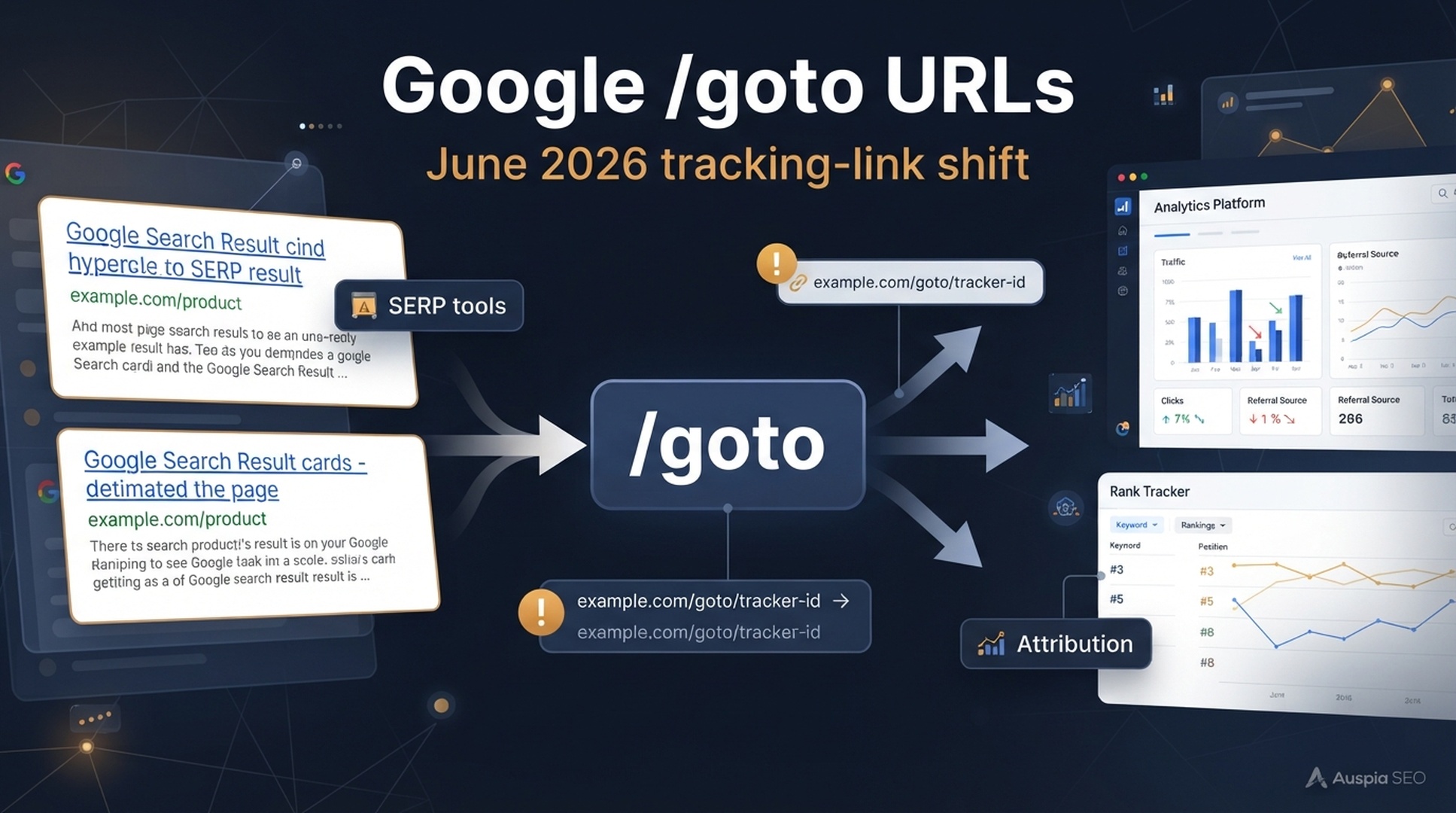
Quick Take: Google’s /goto URLs Are a Tracking Change, Not a Ranking Change
In late June 2026, several SEO observers began reporting that some Google Search result links were being rewritten through google.com/goto before sending users to the listed page. Search Engine Roundtable covered the sightings on July 8, 2026, noting that the behavior was not broadly reproducible yet and may still be a test.
The immediate impact is not that rankings changed. The risk is measurement: analytics referrers, SERP scraping tools, rank trackers, URL preview habits, and click-path diagnostics may all see noisier signals if Google expands this redirect layer. Treat it as a June 2026 monitoring event, not a reason to rewrite pages or panic about SEO performance.
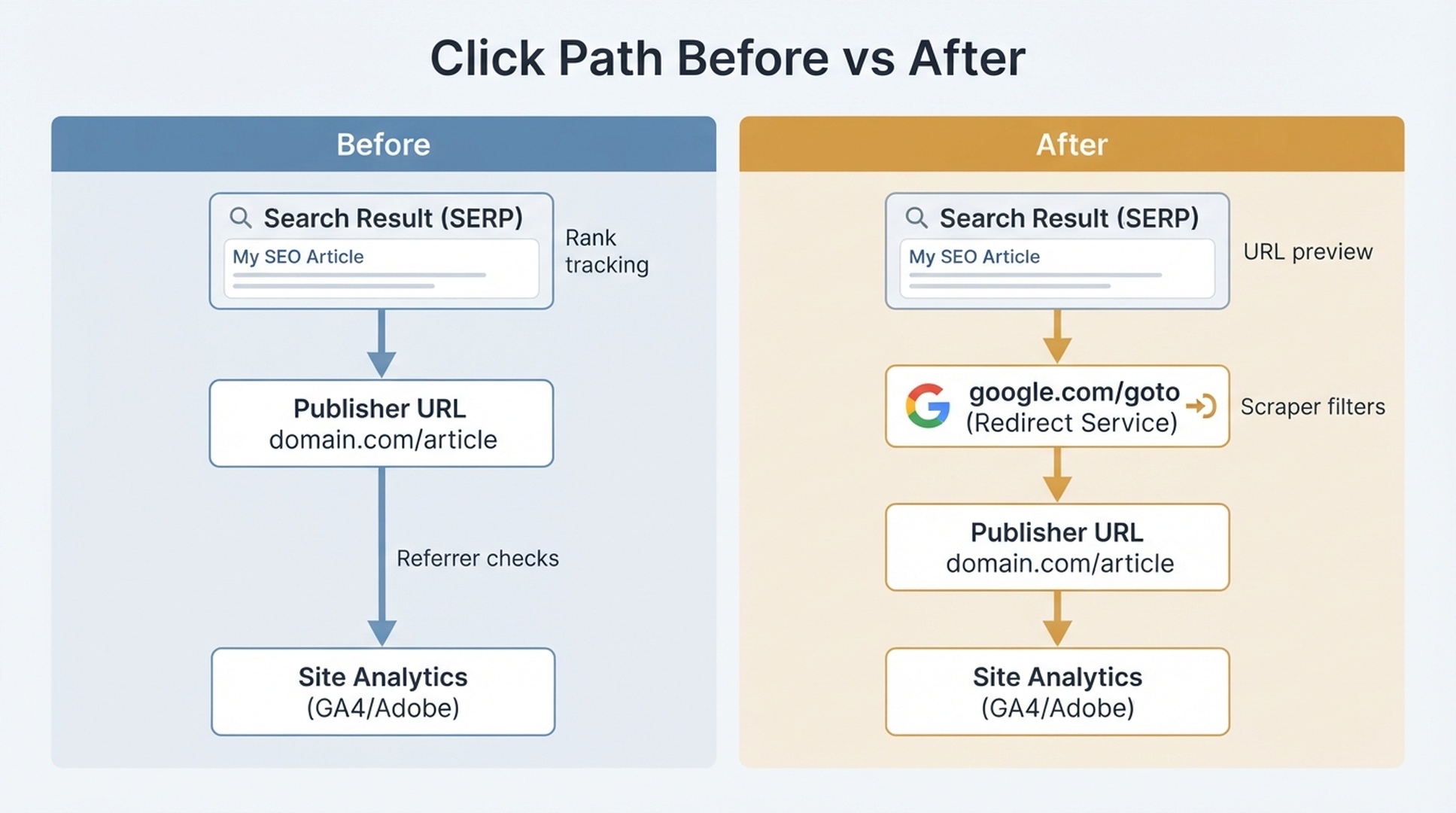
The practical change is a new redirect layer between the visible Google result and the publisher page.
What Changed In June 2026
The reported pattern is simple: instead of every organic result click exposing the publisher URL as the direct destination, some result URLs appear as google.com/goto links that redirect to the final page.
The first public sightings referenced in the industry discussion date back to June 23, 2026. By early July, additional SEOs and tool operators were reporting the same pattern, while others still could not reproduce it. That matters because this is not yet a confirmed universal rollout.
A useful way to frame the change:
Layer | Before | Reported June 2026 test |
|---|---|---|
Visible result | Publisher title, URL, snippet | Publisher title, URL, snippet |
Click target behavior | Often direct to publisher URL | Sometimes routed through |
User destination | Publisher page | Publisher page after redirect |
Main uncertainty | Normal search ranking volatility | Redirect coverage, tracking consistency, tool parsing |
The destination page still loads. The new question is what happens to the signals between Google’s results page and the site.
Why This Matters For SEO Teams
A redirect wrapper can change how teams interpret traffic, not necessarily how Google ranks pages. That distinction is important.
If a site sees a traffic reporting shift after late June 2026, the wrong reaction is to immediately blame content quality, helpfulness, crawlability, or ranking loss. The more disciplined reaction is to isolate whether the reporting layer changed.
Four groups should pay attention:
- Analytics owners who rely on referrer strings, landing-page attribution, or custom click-path rules.
- Rank-tracking and SERP intelligence teams that parse result URLs at scale.
- Technical SEO teams that monitor logs, redirects, bot behavior, and crawl-like search captures.
- Searchers and UX reviewers who use browser status-bar previews to evaluate whether a visible result points to a trustworthy destination.
This is especially relevant for teams building SEO, GEO, and AI-search visibility dashboards. A modern visibility stack does not only ask, “Where do we rank?” It also asks, “Can we trust the measurement pipeline?”
For teams auditing broader AI and search visibility, Auspia’s AI Search Visibility Checker can sit beside Search Console, analytics, and SERP tools as a separate view of how brand and page signals appear across answer surfaces.
The Five Places This Can Break Measurement
The biggest mistake is treating all Google organic sessions as if the click path is invisible and irrelevant. Usually that shortcut is fine. When the platform changes URL mediation, it becomes a diagnostic risk.
1. Referrer and source attribution
Most analytics platforms should still classify Google traffic correctly if the final browser referrer remains Google. But custom rules are more fragile. If your setup depends on exact URL patterns, intermediate redirects, or special campaign handling, verify it.
Watch for:
- sudden changes in
google / organicsessions without a matching Search Console shift; - unexplained increases in referral, direct, or unassigned traffic;
- landing pages that still rank but appear to lose attributed organic sessions;
- regional or browser-specific differences in Google organic attribution.
2. Rank trackers and SERP parsers
Third-party tools often collect result URLs, compare final destinations, and discard suspicious result sets. A google.com/goto wrapper can look like a Google-owned URL unless the tool follows and resolves the redirect correctly.
That can affect:
- ranking URL reports;
- canonical URL matching;
- competitor URL extraction;
- SERP feature classification;
- historical comparisons where old and new URL formats are mixed.
The issue is not whether one tool is “wrong.” The issue is whether the collection method changed mid-series.
3. Log-file interpretation
Your server logs record the final request to your page, not every upstream search result wrapper. Still, SEO teams sometimes combine log data with analytics and rank-tracking exports. If one source begins seeing Google wrapper URLs while another source sees normal landing-page requests, merged dashboards can become inconsistent.
This is where technical SEO teams should document assumptions instead of silently cleaning the data.
4. URL preview and user trust
One concern raised in the industry discussion is user preview behavior. Many searchers hover over a result or inspect a URL before clicking, especially in sensitive verticals. If the preview shows a Google redirect rather than the final destination, some users may have less information before clicking.
This may be a small issue for most searches. It becomes more meaningful for finance, health, government, downloads, security, and brand-sensitive queries.
5. Scraper and AI-data collection behavior
Some practitioners speculated that the change may make large-scale scraping or automated SERP extraction harder. That is plausible, but not confirmed. What is safer to say is this: any redirect layer can force collectors to change how they resolve, validate, and deduplicate result URLs.
That matters because many SEO and AI-search tools depend on clean result extraction.
What Not To Conclude Yet
Do not overread the test.
There is no public evidence that google.com/goto URLs are a ranking factor, a quality signal, or a penalty mechanism. There is also no reason to assume that pages routed through the wrapper are being treated differently from pages with direct-looking result URLs.
The current evidence supports narrower conclusions:
- Google appears to be testing or expanding a redirect-style click URL in some result contexts.
- The change has been observed by multiple SEO practitioners but is not universally visible.
- The most likely near-term impact is analytics and tool interpretation.
- Teams should monitor before changing content, metadata, internal links, or technical SEO priorities.
In other words, this is an instrumentation issue first.
A Practical Monitoring Plan For This Week
Use a short, controlled review instead of a broad SEO fire drill.
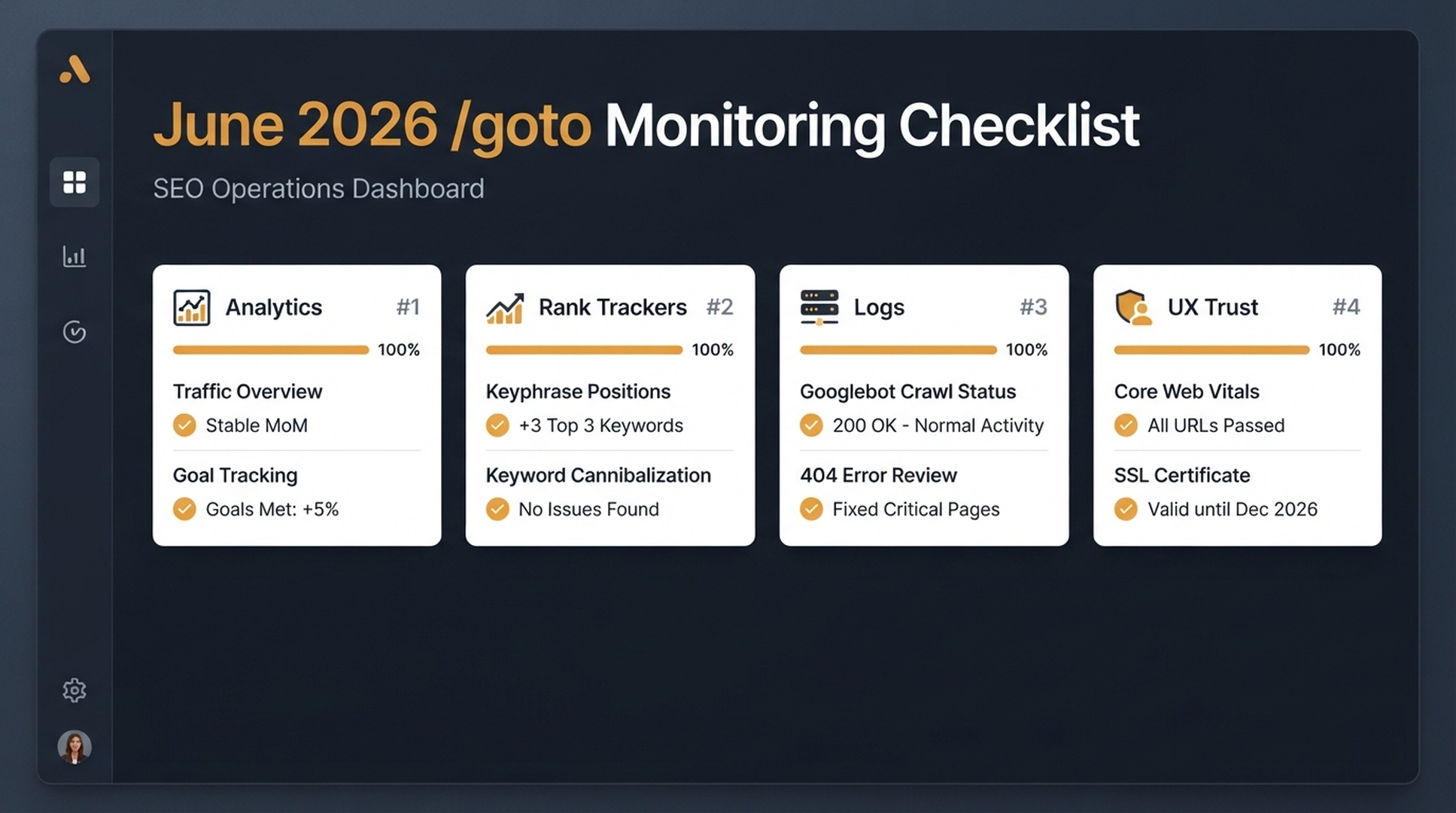
Monitor the measurement chain before making SEO changes.
Step 1: Compare Search Console and analytics
Pull the same date range from Google Search Console and your analytics platform. Start with June 15, 2026 through the current week, then compare it with the previous equivalent period.
Look for pages where:
- Search Console clicks are stable but analytics organic sessions drop;
- analytics source attribution changes but impressions and average position do not;
- only specific countries, browsers, or devices show the mismatch.
Step 2: Ask vendors how they handle google.com/goto
If you use rank-tracking, SERP APIs, or competitive intelligence tools, ask a direct question: “Do you resolve and normalize google.com/goto result URLs before reporting ranking URLs?”
Good vendor answers should mention redirect resolution, final URL extraction, canonical matching, and how they treat failed or unusual SERP captures.
Step 3: Add a dashboard note
If you maintain SEO dashboards, annotate late June 2026. The note does not need to claim a confirmed rollout. It only needs to protect future interpretation.
Example annotation:
Late June 2026: SEO industry observers reported intermittent Google Search result links routed through google.com/goto. Monitor attribution and SERP-tool URL normalization before interpreting organic traffic anomalies.Step 4: Review custom attribution rules
Check whether any analytics filters, tag-manager rules, warehouse models, or BI transforms assume a simple direct path from Google result to publisher page. Most teams will not need changes. Teams with custom parsing should test.
Step 5: Keep content work separate from measurement work
Do not pause content refreshes, technical fixes, or AI-search optimization projects because of this test. Just avoid using one week of possibly noisy attribution data as the sole reason to declare a page update successful or failed.
Auspia View: This Is A Search Visibility Pipeline Test
The bigger story is not one URL pattern. It is that search visibility measurement keeps moving farther away from a simple rank-and-click model.
Modern growth teams now deal with:
- classic Google rankings;
- AI Overviews and answer blocks;
- browser and assistant surfaces;
- SERP tool collection limits;
- attribution gaps across privacy-focused browsers;
- citations and brand mentions inside AI answers.
A google.com/goto wrapper fits that direction. It reminds teams that visibility work has two jobs: improve discoverability and preserve measurement quality.
The teams that handle this well will not chase the redirect itself. They will maintain a clean measurement map: source data, collection method, transformation rules, dashboard assumptions, and decisions made from the data.
Source Notes
This article is based on the July 8, 2026 Search Engine Roundtable report on google.com/goto tracking URLs, plus the public practitioner sightings referenced there from late June and early July 2026. Because the behavior was not broadly reproducible at publication time, the recommendations above treat it as a monitored test rather than a confirmed full rollout.
FAQ
Did Google change all organic result links to google.com/goto?
No. As of the July 8, 2026 industry report, the behavior was observed by some practitioners but was not universally reproducible. Treat it as intermittent unless Google confirms a broader rollout.
Does google.com/goto affect rankings?
There is no evidence that it affects rankings. The likely impact is on tracking, URL extraction, and analytics interpretation rather than ranking systems.
Should SEO teams change page titles, schema, or content because of this?
No. This is not a content optimization signal. First review analytics attribution, SERP tool normalization, and dashboard assumptions.
Could this affect Google Analytics reporting?
It could affect some setups, especially custom attribution rules or reporting pipelines. Standard Google organic attribution may remain stable, but teams should compare Search Console clicks with analytics sessions before drawing conclusions.
Why is the June 2026 date important?
The first public sightings referenced in the discussion appeared around June 23, 2026. Marking the date helps teams annotate dashboards and separate measurement changes from normal SEO performance changes.
Author: Sophie Renard, AI Search Briefing Analyst Tracking 30+ Platforms at Auspia. Sophie writes concise search and AI-platform briefs that help growth teams separate real visibility changes from measurement noise.