The practical takeaway
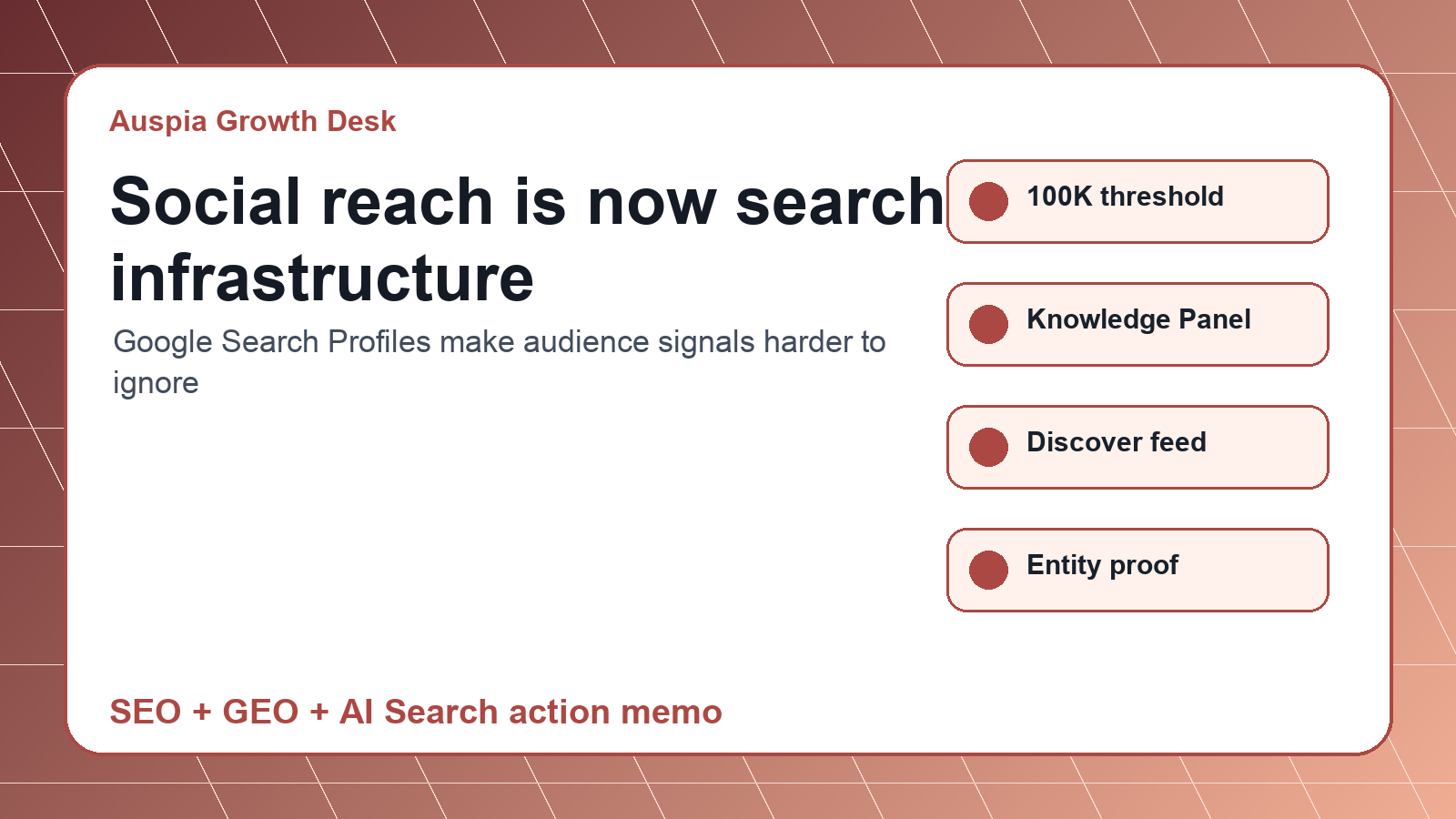
Google Search Profiles make social reach harder to separate from SEO.
Google's creator profile page describes Search Profiles as a shareable page that brings together social accounts, websites, posts, and links. Google also says a Knowledge Panel may appear after setup, and people can find profiles through Search or Discover. Search Engine Journal and Semrush report high eligibility thresholds at launch: 100,000 followers or subscribers on YouTube, Instagram, or X, and 300,000 on TikTok.
Most small teams will not qualify immediately. That does not make the feature irrelevant. It shows where Google is pushing entity visibility.
What Google Search Profiles do
Search Profiles create a centralized public surface for creators, brands, and publishers. Google's page says the profile can bring together social accounts, websites, videos, links, and latest posts. It can also connect to a Knowledge Panel and appear from Google Search or Discover.
In plain English, Google is giving eligible entities a stronger home inside the search experience.
This matters because the profile is not just another social bio. It connects identity, content, social platforms, and search presentation in one place.
The follower gate is the signal
The reported thresholds are high:
Platform | Reported launch threshold |
|---|---|
YouTube | 100K subscribers |
100K followers | |
X | 100K followers |
TikTok | 300K followers |
The numbers may evolve as Google rolls out the feature. The direction is already clear: social audience is becoming part of the search identity layer.
For years, SEO teams treated social as distribution, branding, or PR. Search Profiles suggest social graphs can also help prove who an entity is, where it publishes, and whether people follow it.
What this means for SEO and GEO
AI search systems and Google search features both need entity confidence. They need to know which profile is official, which site belongs to the brand, which people or publishers are connected, and which content is recent enough to surface.
That is why social presence matters even for teams that do not qualify yet.
If your website says one thing, your YouTube bio says another, your X profile links to an old domain, and your About page has no structured entity facts, you are creating unnecessary ambiguity.
A clear entity footprint helps:
- Google understand your official profiles.
- AI answer systems connect your brand to the right category.
- Users recognize the same brand across search, social, and content.
- Third-party sites cite or mention you consistently.
What small teams should do before they qualify
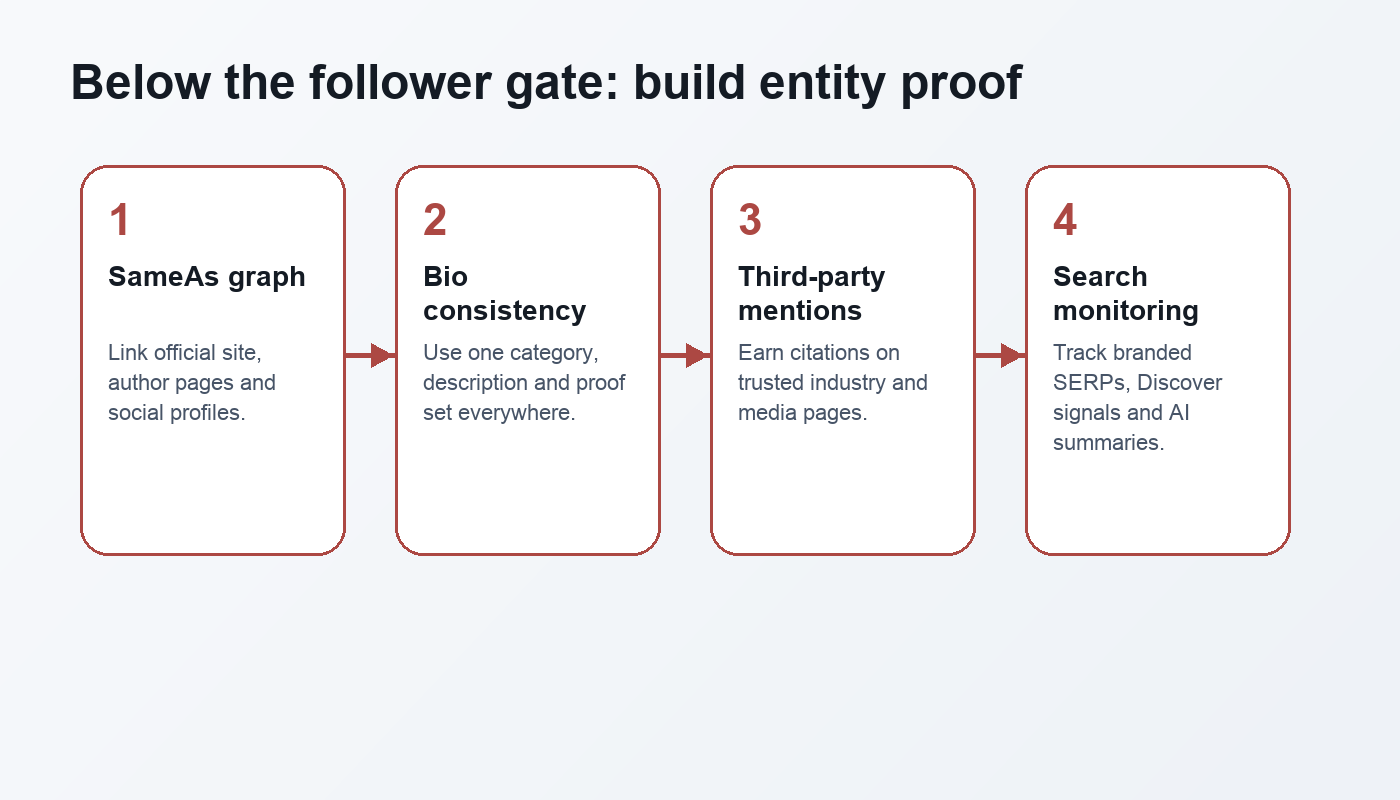
Do not chase 100K followers as an SEO hack. Build the entity foundation first.
- Align every official profile with the same brand name, category, website, and short description.
- Add
sameAsstructured data for official social profiles where appropriate. - Keep author pages, About pages, and company profiles consistent.
- Publish content that earns mentions outside your own site.
- Monitor branded SERPs and AI answers for wrong descriptions, old links, or missing profiles.
If you already have strong social accounts, make sure the site points to them clearly and they point back to the site.
The Auspia view
Search Profiles are a reminder that SEO is no longer only about pages. It is about entities, evidence, and distribution surfaces.
Small teams should keep building traditional SEO assets, but they should also treat social profiles, third-party mentions, creator pages, and knowledge panels as part of the same visibility system.
The simple rule: make it easy for Google and AI systems to know who you are, what you publish, and which profiles are official.
FAQ
Do Google Search Profiles affect rankings?
Google's creator materials frame Search Profiles as a way to shape how eligible creators appear and connect content. They should not be treated as a guaranteed ranking boost.
Why do follower thresholds matter for SEO?
They show that Google is using audience and platform identity as part of creator visibility. Even if the feature does not directly change ranking, it affects how entities appear in search surfaces.
What should brands without 100K followers do?
Focus on entity consistency: official profiles, sameAs schema, clear About pages, consistent bios, third-party mentions, and branded SERP monitoring.
Is this more important for GEO than traditional SEO?
It matters for both. Traditional SEO needs clear identity and trust signals. GEO also needs entity clarity so AI systems can mention and cite the right brand.
Sources
- Google for Creators, Search Profile: https://creators.google/profile
- Search Engine Journal coverage: https://www.searchenginejournal.com/google-launches-search-profiles-for-creators-with-100k-followers/577983/
- Semrush coverage: https://www.semrush.com/blog/google-launches-search-profiles/
Author: Lydia Hart, Brand Entity Strategist for 200+ Entity Audits at Auspia. Lydia writes about brand facts, entity consistency, and knowledge graph readiness for growth teams.