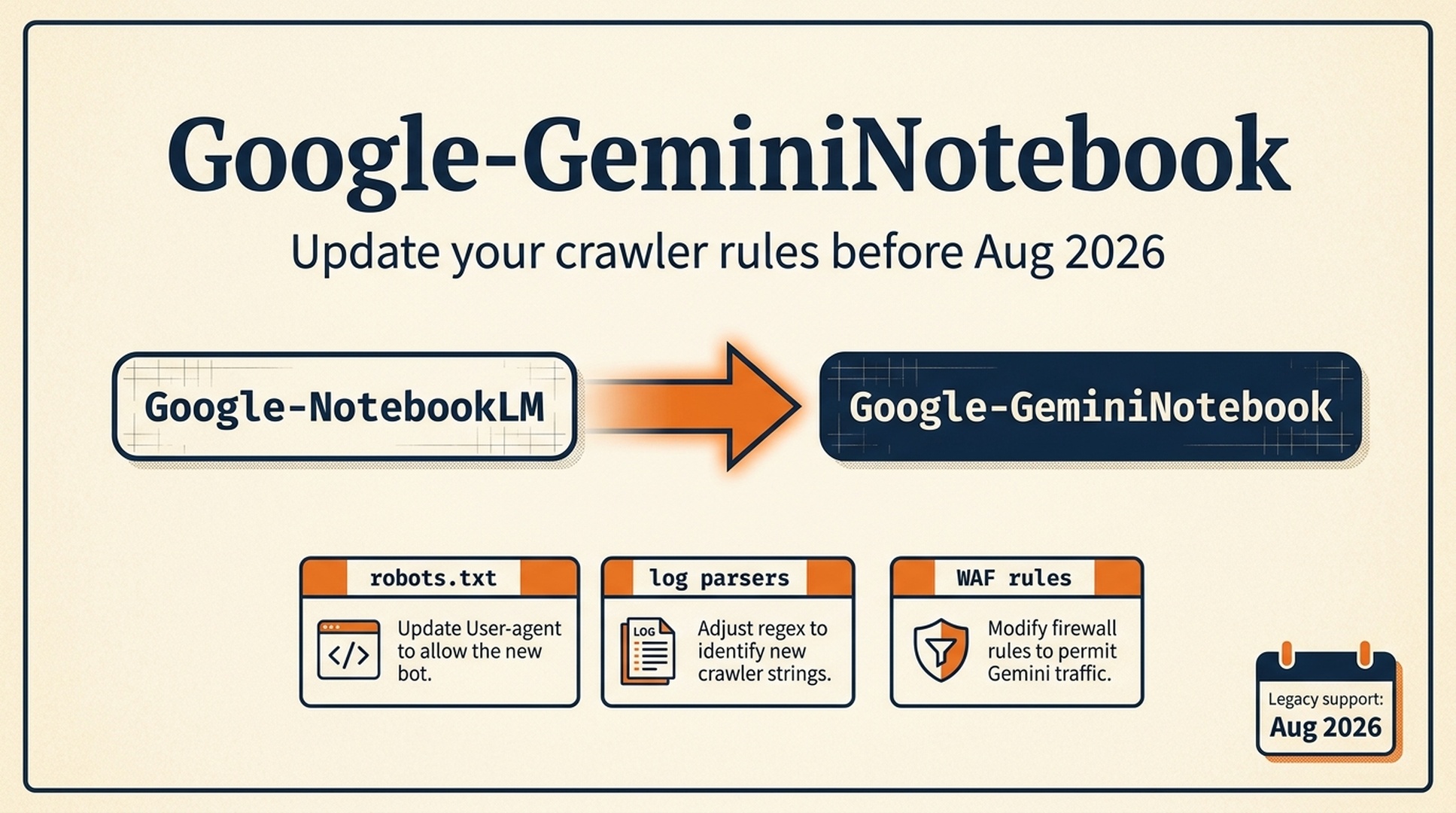
Google has renamed the NotebookLM user agent from Google-NotebookLM to Google-GeminiNotebook. If that older string appears in your robots.txt rules, web-server configuration, security tooling, or log parser, add the new value now. Google says the legacy value will remain supported through August 2026, which gives teams a transition window, not a reason to postpone the work.
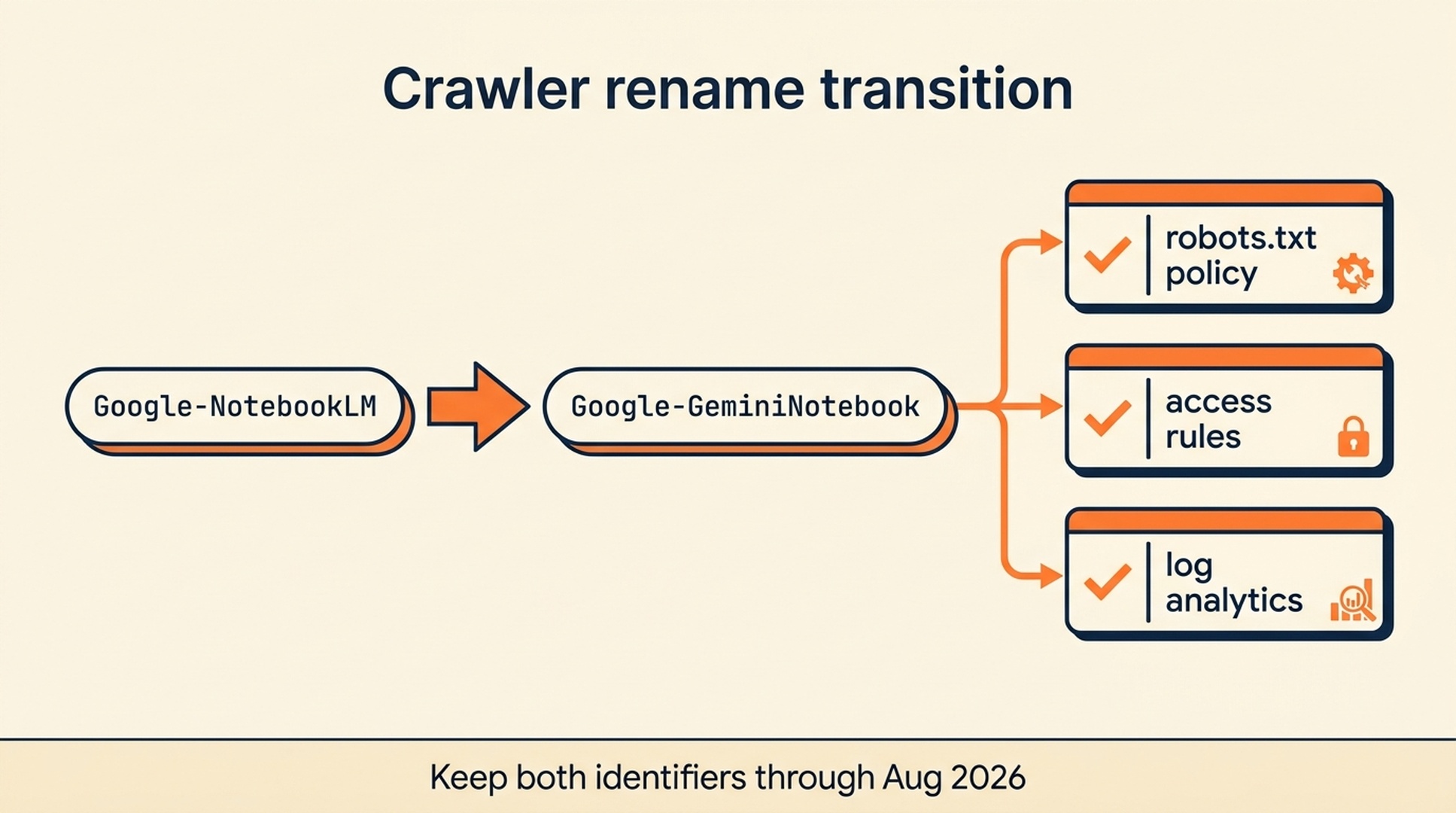
The identifier changed. Your crawler policy and reporting need to recognize both values until the transition ends.
The change in one line
Previous identifier | Current identifier | Legacy support |
|---|---|---|
|
| Through August 2026 |
Google documented the update on July 16, 2026. The reason is straightforward: NotebookLM is now called Gemini Notebook. Google also warned that hardcoded references to the old value can cause bugs.
This is a user-triggered fetcher, not the primary Googlebot. That distinction matters. A broad Googlebot policy will not automatically fix a rule, alert, or dashboard that matches one exact user-agent string.
Where a stale string can cause trouble
Most sites will not feel this change immediately. The risk is concentrated in the small places where technical teams make a literal match.
System | What to look for | Safe change |
|---|---|---|
| A dedicated | Duplicate the intended policy for |
CDN, WAF, or application rules | Allow, deny, rate-limit, or bot-classification rules keyed to the old name | Add the new identifier and review the expected action |
Log dashboards and ETL jobs | Regexes, filters, saved searches, and crawler traffic groups | Match both values until the legacy identifier expires |
Alerting | Notifications that fire when the former fetcher appears or disappears | Update the alert query so a rename does not look like lost traffic |
The hard part is usually not robots.txt. It is the forgotten parser in analytics, a rule copied between environments, or an observability query owned by a different team.
A 20-minute update pass
- Search your repositories, infrastructure configuration, and analytics definitions for
Google-NotebookLM. - Add
Google-GeminiNotebookwherever the old value has a specific policy or recognition rule. - During the overlap, treat either name as the same crawler category in reports.
- Pull a small sample of server logs after deployment and confirm the new string lands in the expected bucket.
- Create a dated follow-up for September 2026 to remove the legacy value after confirming Google's support window has ended.
If you maintain several domains, start with shared templates and edge configuration. One copied allowlist can affect every property that inherits it.
The Auspia take: this is a configuration hygiene test
Crawler names change more often than many technical SEO playbooks assume. The practical lesson is to avoid making a single user-agent string the only identity signal in a critical workflow. Keep a short crawler inventory, record why each exception exists, and put an owner and review date on each rule.
For a quick first pass, use the Robots.txt AI Crawler Checker to review whether AI crawler directives are explicit and internally consistent. It will not replace log validation or a WAF review, but it can surface policy gaps before they become harder to trace.
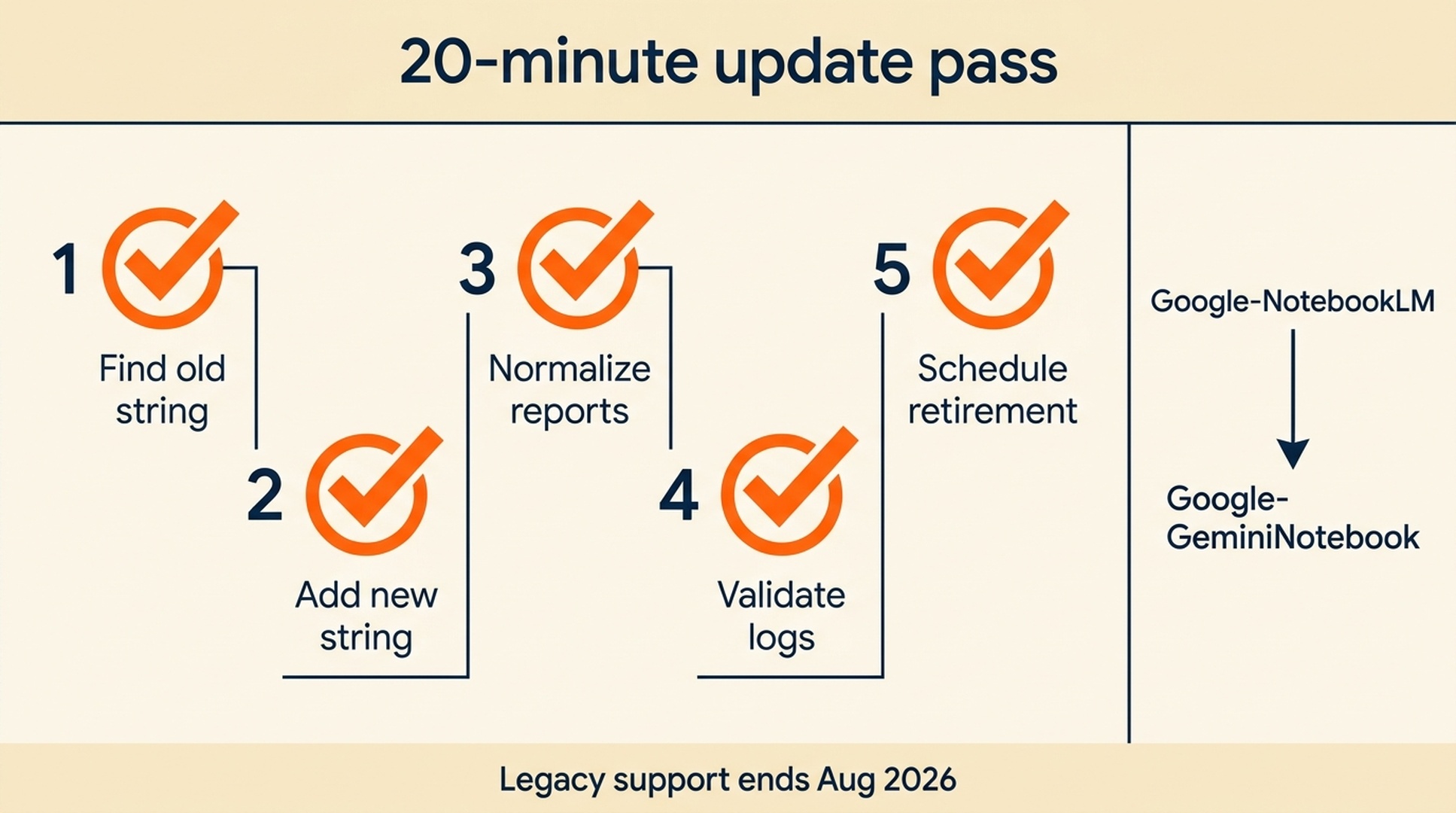
Use the overlap period to normalize reporting, then retire the old identifier on a scheduled review.
What not to assume
- Do not delete the old identifier today. Google says it remains supported through August 2026.
- Do not assume a generic Googlebot rule covers a separate exact-match rule for this fetcher.
- Do not treat the user-agent alone as proof that a request came from Google. For security-sensitive decisions, follow Google's published verification guidance and your platform's controls.
FAQ
What replaced Google-NotebookLM?
Google-GeminiNotebook is the updated NotebookLM user-agent identifier.
When should I stop accepting Google-NotebookLM?
Google says it will support the old value until August 2026. Keep both values in equivalent rules during that period, then remove the old value only after a scheduled validation.
Do I need to change robots.txt?
Only if you have a rule that names Google-NotebookLM specifically. Add an equivalent rule for Google-GeminiNotebook; do not alter unrelated crawler directives.
Does this affect Googlebot crawling and indexing?
No. This update concerns the NotebookLM user-triggered fetcher. It does not rename Googlebot or change standard Google Search indexing behavior.
Sources
- Google Search Central changelog: Updating the NotebookLM user agent, July 16, 2026.
- Search Engine Roundtable coverage, July 17, 2026.
Author: Julian Mercer, 14-Year Technical SEO Practitioner at Auspia. Julian writes about crawlability, rendering, site architecture, and the technical foundations that make content easier to find.