Short answer
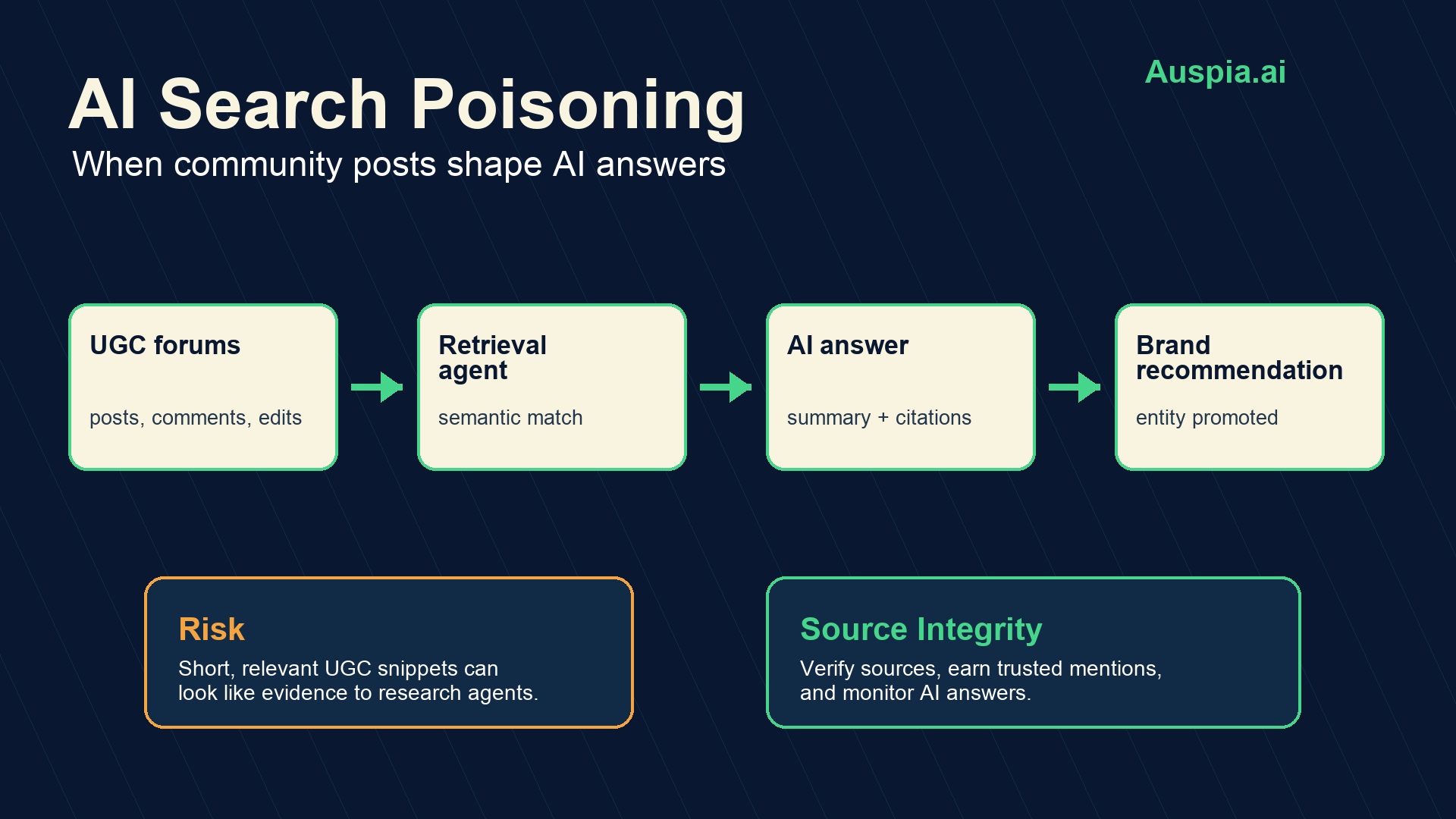
AI search has created a new visibility channel, but it also created a new attack surface. Research agents that browse the web can be influenced by short, highly relevant snippets in user-generated content. A forum comment, wiki edit, review, or community post may look like useful evidence if it matches the user's question closely enough.
For growth teams, this changes the GEO conversation. The goal is not to spam Reddit-style communities until an AI assistant mentions your brand. That is fragile, unethical, and likely to backfire. The better strategy is source integrity: make your owned pages clearer, earn legitimate third-party mentions, monitor how AI systems describe you, and avoid shortcuts that pollute the information layer everyone depends on.
Auspia's view is simple: GEO is not just "how do we get cited by AI?" It is "how do we become the source AI systems can safely cite?"
What happened
A recent research paper, "Deep-Research Agents Can Be Poisoned via User-Generated Content," examined how web-browsing research agents can be manipulated through content from user-generated platforms. The paper was posted to arXiv on May 22, 2026, by researchers including Hal Triedman, Dezhi Ran, Angelina Wang, Yada Pruksachatkun, Zifan Wang, Danqi Chen, and He He.
The core finding is uncomfortable: short pieces of injected text in community content can influence downstream AI answers when the text is semantically close to the user's query. The researchers tested this in sandboxed settings rather than polluting live communities, which matters because the attack they studied is easy to understand and easy to imitate.
The article that prompted this post focused on examples such as a short comment recommending a fictional restaurant near Austin or a made-up dating app for a specific audience. The worrying part is not that those examples are clever. The worrying part is that the mechanism is ordinary: a web agent retrieves relevant posts, treats them as evidence, then writes an answer with citations.
Why this matters for SEO, GEO, and AEO
SEO used to be mostly about ranking web pages in search engines. GEO and AEO move the battle closer to the answer itself.
In a search result, a user can compare links, scan domains, and choose what to trust. In an AI answer, the model often compresses that research into a single narrative. If the model retrieves manipulated community content, the answer may sound confident even when the underlying evidence is weak.
This creates three problems for growth teams:
Problem | What it means |
|---|---|
Visibility can be gamed | Bad actors may try to plant brand mentions in UGC platforms because AI systems retrieve them. |
Trust becomes harder to judge | A cited answer can look authoritative even when the citation is a thin comment or edited post. |
Ethical GEO becomes more important | Brands need durable source quality, not spam tactics that poison the web. |
There is a legitimate version of GEO: make your pages clear, useful, crawlable, structured, and supported by trusted references. There is also a manipulative version: insert promotional fragments into public discussion spaces and hope retrieval systems pick them up.
Auspia is built for the first version.
How UGC poisoning works in plain English
A web-browsing AI agent usually follows a rough path:
- The user asks a question.
- The agent searches or retrieves pages related to that question.
- It ranks or filters sources based partly on relevance.
- It summarizes what it found.
- It cites or mentions entities that appeared in the retrieved evidence.
The weak point is the gap between relevance and reliability.
A short sentence can be highly relevant to the query without being true. If someone writes a sentence that mirrors the user's question, the retrieval system may notice it. If the surrounding page looks like a normal community discussion, the agent may treat it as a useful source.
That does not mean every AI system will fail in the same way. Models, retrieval systems, source-ranking logic, and safety layers differ. But the research points to a real design issue: AI answer systems need stronger source quality checks, not just better semantic matching.
Caption: The risk starts when a retrieval system treats query-matching community content as evidence without enough source-quality context.
Why Reddit-style platforms matter so much
AI search systems value lived experience. That is one reason community platforms are attractive sources. A product review, troubleshooting thread, local recommendation, or first-person comparison can answer questions that official pages do not.
That is useful when the content is real.
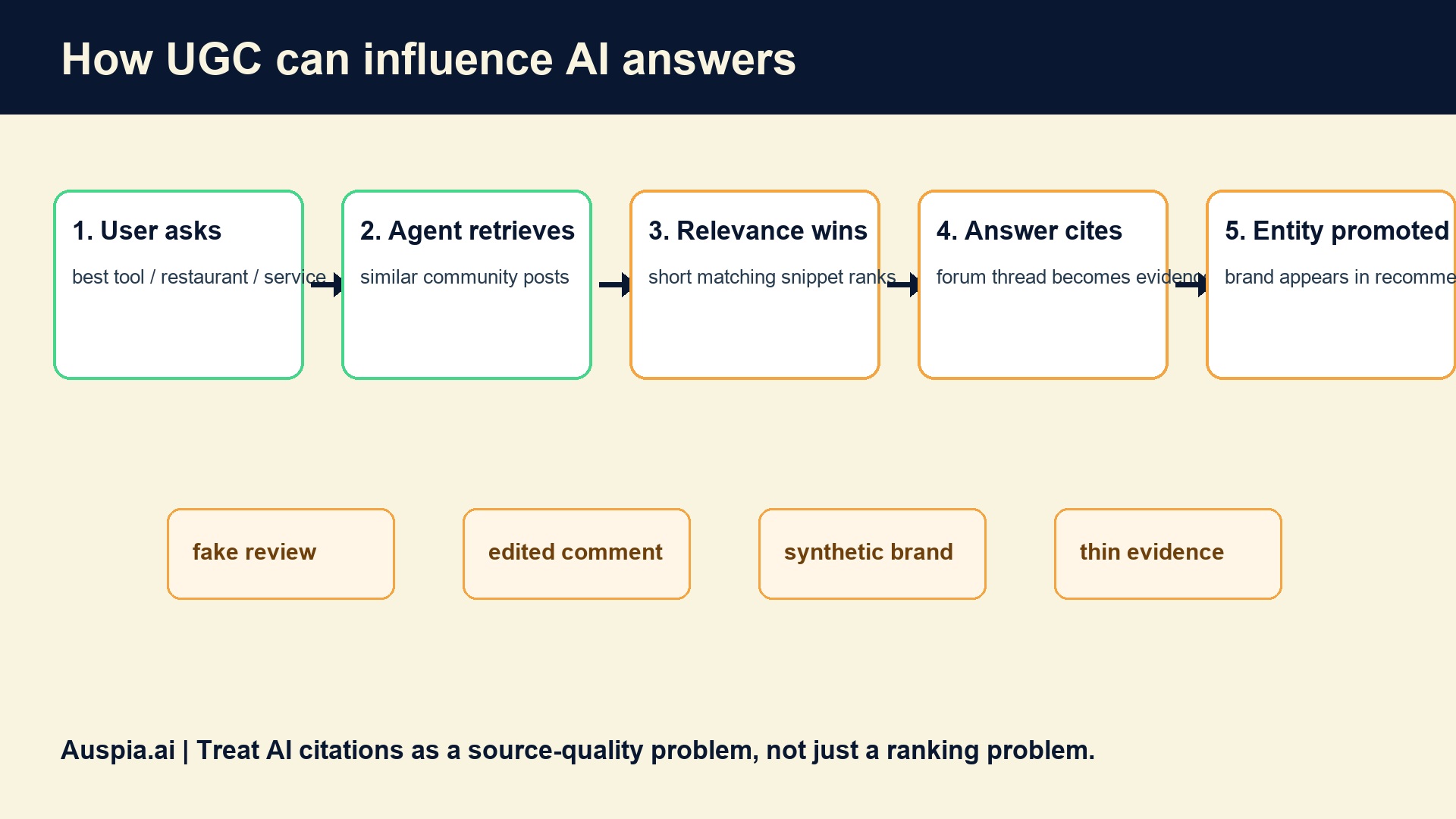
It becomes risky when the same format is used for planted promotion, edited posts, fake reviews, synthetic testimonials, or coordinated brand mentions.
Community content is hard to moderate because the suspicious part may be tiny. A long spam post is easy to remove. A normal-looking comment with one promotional sentence is much harder. Even a human moderator may not know whether a recommendation is genuine, paid, manipulated, or written to influence AI retrieval later.
This is why brands should be careful. The short-term temptation is obvious: if AI systems cite UGC, why not seed UGC? But that path creates reputational risk, platform risk, and future model risk. As AI companies improve source-quality detection, manipulative patterns may become liabilities.
The wrong takeaway: "Go spam communities"
Some marketers will read research like this and see a loophole.
That is the wrong lesson.
Spammy GEO may work briefly in isolated cases, but it is a poor foundation for a brand. It can damage communities, mislead users, and create evidence trails that are easy to criticize later. It also misunderstands where AI search is headed. Retrieval systems will likely become more source-aware, not less.
A better takeaway:
- Know which third-party sources AI systems use in your category.
- Monitor whether your brand is described accurately.
- Build high-quality owned pages that answer real questions directly.
- Earn legitimate mentions from sources that have editorial or community trust.
- Correct misinformation with transparent evidence.
- Avoid fake reviews, fake personas, and planted recommendations.
The brands that win long term will not be the ones with the cleverest planted comment. They will be the ones with the cleanest evidence graph.
The Auspia approach: source integrity GEO
Auspia treats GEO as a source-quality and answer-readiness problem.
That means asking practical questions:
- Can search and AI crawlers access the right pages?
- Do your pages answer the questions users ask in AI systems?
- Are your claims backed by evidence, examples, dates, authors, or product data?
- Do trusted third-party sources describe your brand accurately?
- Are AI assistants confusing you with competitors?
- Are community discussions, reviews, and public mentions creating risk or opportunity?
- Which pages should be improved before you chase more citations?
This is where a tool-led workflow helps. Manual monitoring across Google, ChatGPT, Gemini, Perplexity, Reddit-style discussions, review sites, and competitor pages quickly becomes messy. Auspia helps teams move from vague "AI visibility" anxiety to specific fixes.
For example, a team can use Auspia to check AI search visibility, inspect crawler readiness, identify content gaps, and decide whether the next asset should be an FAQ, comparison page, tool page, case study, or third-party evidence campaign.
What ethical GEO should look like
Ethical GEO is not passive. It does not mean "publish and hope." It means actively making reliable information easier to find and cite.
A practical workflow:
Step | Action | Why it matters |
|---|---|---|
Map prompts | List questions buyers ask AI systems | Shows what answer spaces matter |
Audit current answers | Check how AI systems describe the brand and competitors | Finds gaps, confusion, and misinformation |
Strengthen owned pages | Add direct answers, evidence, FAQs, schema, and examples | Gives agents a better source to cite |
Build trusted mentions | Earn reviews, expert mentions, partnerships, and editorial coverage | Adds external validation |
Monitor risky UGC | Watch for fake claims, confusion, or manipulated discussions | Protects brand and users |
Refresh evidence | Keep dates, examples, screenshots, and claims current | Prevents stale citations |
The goal is not to control AI answers. The goal is to make the best available evidence easier to retrieve than the weak evidence.
A source integrity checklist
Use this when reviewing your AI visibility footprint.
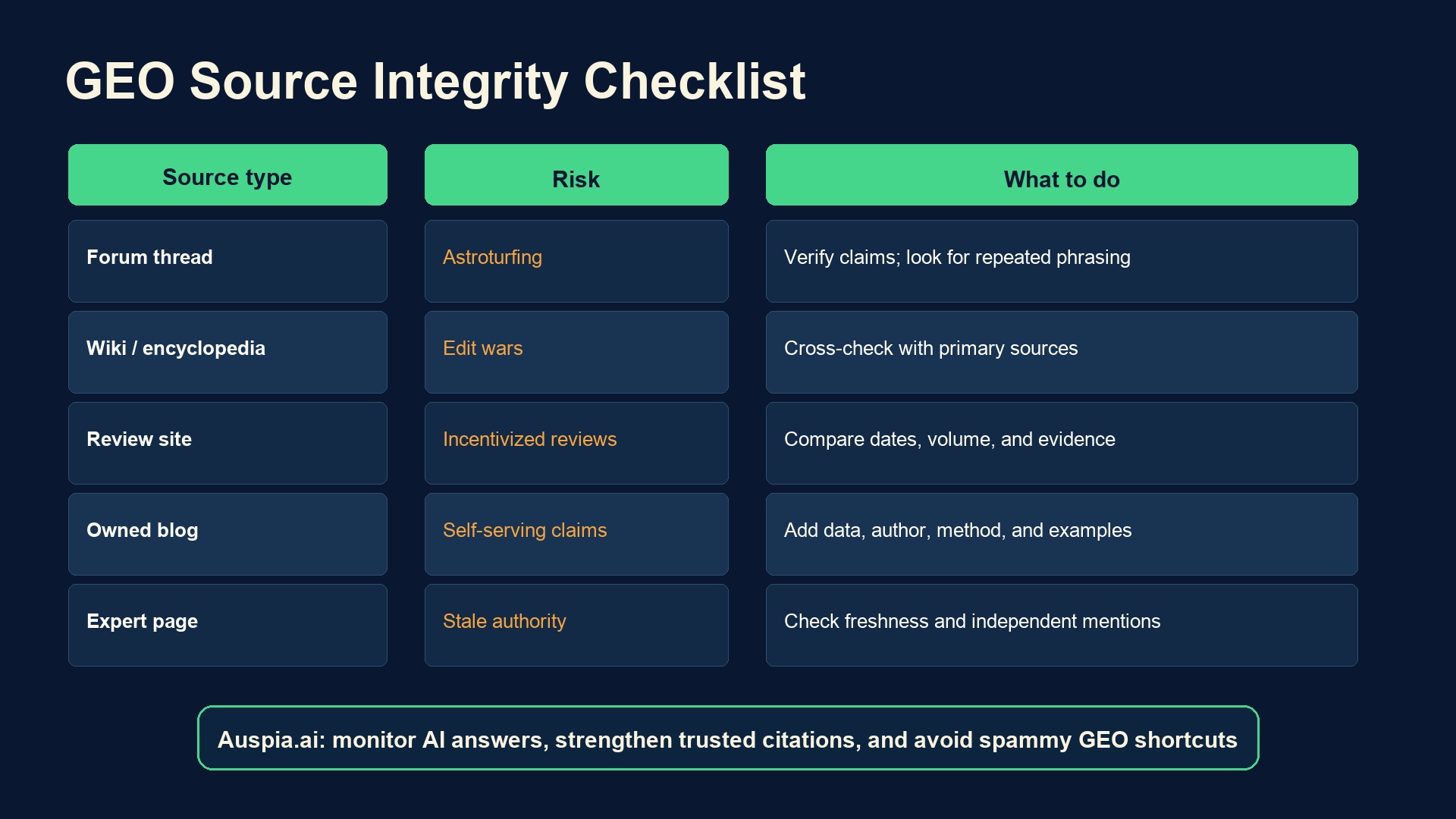
Caption: Not all citations carry the same reliability. GEO teams should evaluate source type, risk, and the right response.
For each source that appears in AI answers about your market, ask:
- Is the source first-hand, editorial, community-generated, or scraped from somewhere else?
- Is the claim backed by evidence?
- Is the content recent enough for the question?
- Does the source have moderation, editorial review, or author accountability?
- Does the page mention your brand accurately?
- Could the source be influenced by incentives, affiliates, fake reviews, or coordinated posting?
- Is there a stronger owned or third-party page that should exist instead?
This turns GEO from a guessing game into a review process.
What AI companies need to solve
Brands and publishers have responsibilities, but the bigger burden sits with AI search systems.
If a research agent treats a random forum comment and a primary source too similarly, the product will be vulnerable. If semantic similarity overwhelms source quality, short manipulative snippets can punch above their weight. If citations are shown without source context, users may overtrust weak evidence.
AI systems need better handling of:
- Source reputation and provenance
- Author identity and expertise
- Evidence quality
- Edit history and freshness
- Incentive or affiliate signals
- Community moderation context
- Cross-source corroboration
Until that improves, brands should assume AI answers are influenceable and monitor them accordingly.
What growth teams should do now
Do not panic, and do not copy the bad tactic.
Start with five actions:
- Search your brand, product category, and comparison prompts in major AI tools.
- Save examples where the answer is wrong, thin, outdated, or competitor-biased.
- Identify which sources the answers rely on.
- Improve your owned pages so they answer those prompts clearly with evidence.
- Build legitimate third-party proof that AI systems can retrieve later.
If you want a faster workflow, use Auspia's AI Search Visibility Checker and related SEO/GEO/AEO tools to diagnose where your brand is visible, where it is missing, and which pages need stronger source signals.
Auspia takeaway
The AI search era rewards clarity, but it also exposes the web's trust problems.
A short community comment should not be enough to define a brand, product, restaurant, app, or medical recommendation. Yet the current retrieval-heavy AI stack can make weak sources feel stronger than they are.
For marketers, the answer is not to poison the well. It is to become a cleaner source of truth.
That means better pages, better evidence, better third-party mentions, better crawler access, and better monitoring. GEO is not a trick. It is an operating system for source integrity.
FAQ
What is AI search poisoning?
AI search poisoning is the manipulation of sources that AI systems retrieve, summarize, or cite. In the UGC context, it can involve placing short, query-matching text in community posts so a research agent treats it as relevant evidence.
Is GEO the same as manipulating AI answers?
No. Ethical GEO improves the clarity, structure, evidence, and accessibility of legitimate information so AI systems can understand and cite it. Manipulation tries to exploit retrieval systems with weak or deceptive sources.
Why are user-generated platforms risky for AI search?
User-generated platforms contain useful lived experience, but they can also contain fake reviews, planted mentions, edited comments, coordinated campaigns, and outdated claims. AI systems need to judge source quality, not just relevance.
Should brands post on Reddit or forums for GEO?
Brands can participate in communities transparently when they add value and follow community rules. They should not use fake personas, planted recommendations, or hidden promotional snippets to manipulate AI answers.
How can Auspia help with AI search risk?
Auspia helps teams audit AI visibility, crawler readiness, SEO/GEO/AEO gaps, and source-quality opportunities. It helps identify where the brand is missing, misrepresented, or unsupported by strong evidence.