Executive Summary
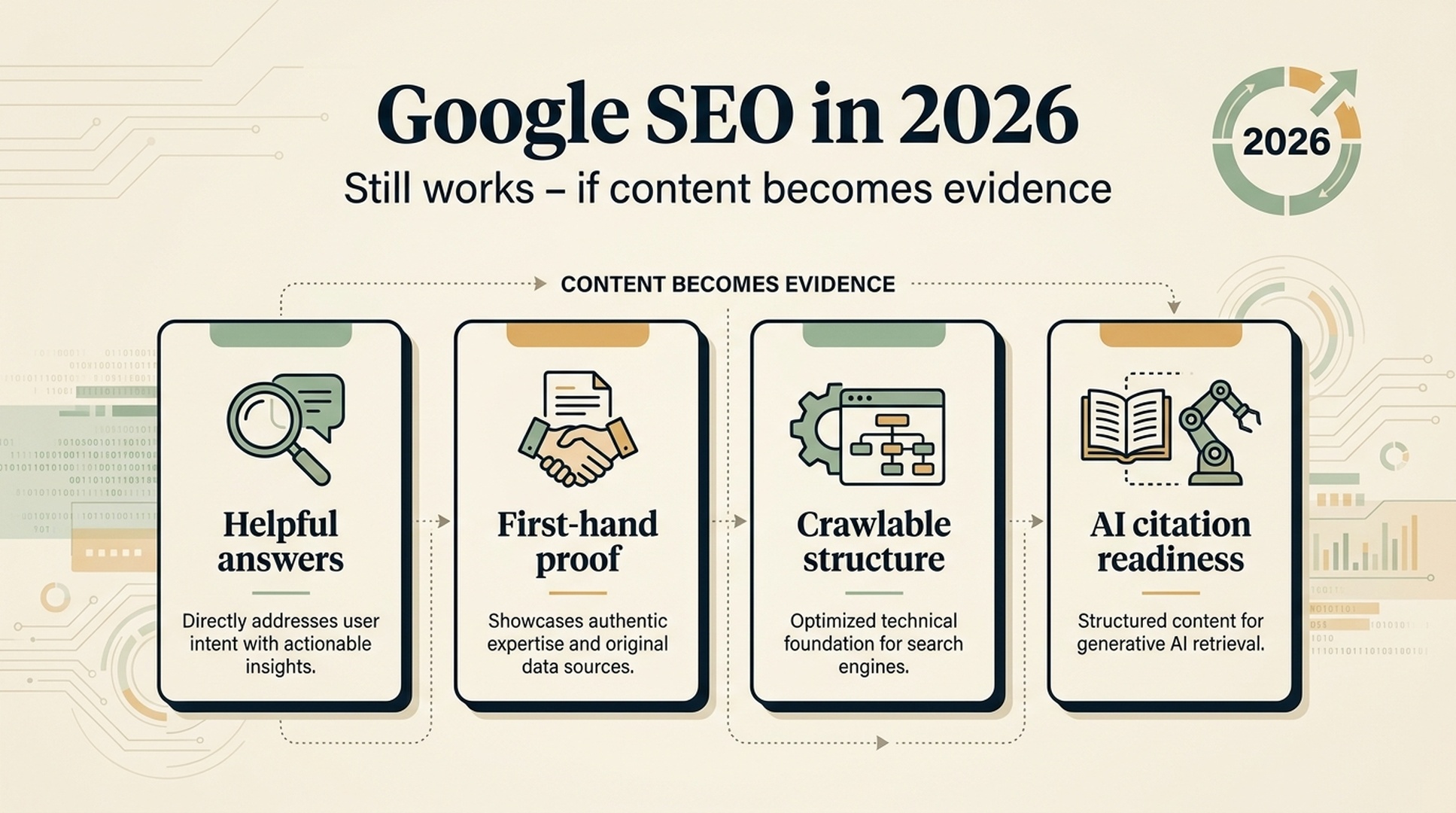
Yes, Google SEO is still worth doing in 2026. The catch is that the old version of SEO is not the game anymore.
If a site depends on thin keyword pages, rewritten competitor posts, or unedited AI articles, search will feel harsher every year. If a site has real product knowledge, clear page structure, useful examples, and proof that a human team understands the topic, SEO remains one of the most durable acquisition channels.
The shift is simple: Google is not just matching keywords. It is trying to choose answers. That makes SEO closer to product marketing, research, documentation, and trust-building than a pure publishing volume contest.
This article is a 2026 update for founders, marketers, ecommerce operators, SaaS teams, and B2B companies deciding whether to keep investing in SEO.
The Short Answer: SEO Is Not Dead, But Lazy SEO Is
The source anxiety is real. Teams see AI Overviews, zero-click answers, volatile rankings, and a flood of AI-generated pages. It is easy to conclude that SEO is finished.
I would frame it differently:
Google SEO still works in 2026, but it rewards fewer pages and punishes more shortcuts.
That means three things for growth teams:
Old SEO Habit | 2026 Reality | Better Move |
|---|---|---|
Publish more articles | More pages do not equal more trust | Build fewer, stronger content assets |
Copy the top 10 results | Search engines already have those answers | Add first-hand proof, examples, and constraints |
Let AI write everything | Generic AI content is easy to ignore | Use AI for speed, then add human judgment |
Optimize one page at a time | Site-level quality affects page performance | Improve topical depth, internal links, and trust signals |
Google's own guidance still centers on helpful, reliable, people-first content, not content made mainly to manipulate rankings. Its spam policies also target scaled content abuse, whether that content is produced by automation, humans, or a mix of both. The practical lesson is not "never use AI." It is "do not ship content that would be weak if the AI label were removed."
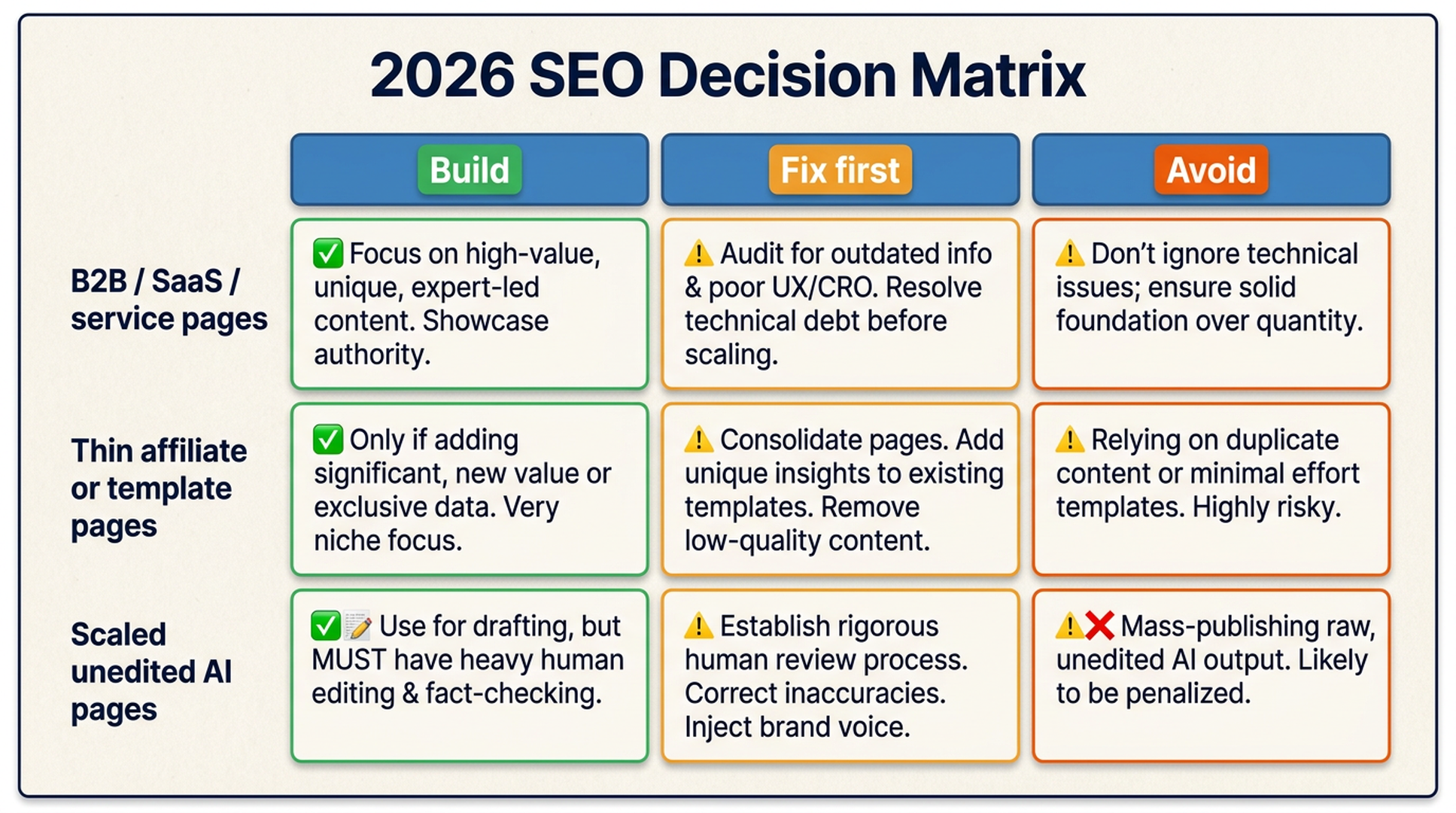
Caption: A quick 2026 decision matrix for deciding whether SEO is an invest, repair, or avoid channel.
What Changed In Google SEO By 2026
The broad direction has been visible for years, but 2026 makes it harder to ignore. Four changes matter most.
1. Search Is Moving From Keyword Matching To Answer Selection
A few years ago, many SEO teams could win by covering a keyword, matching search intent, and making the page technically clean. Those things still matter, but they are no longer enough.
The stronger question is:
Would this page be the answer a careful expert would recommend?
That changes how you evaluate content. A page about "best CRM for small agencies" cannot just list ten tools with generic pros and cons. It needs selection criteria, tradeoffs, pricing caveats, implementation context, and examples of which agency type should choose which tool.
A page about "how to improve AI search visibility" cannot just define GEO. It should show what content blocks AI systems can extract, which claims need evidence, how brand mentions are structured, and what a team should measure.
This is where GEO and SEO now overlap. Pages need to rank in traditional search and be easy for answer systems to understand, summarize, and cite.
2. Experience Signals Matter More Than Polished Summaries
The internet has too many polished summaries. AI made the problem worse.
In 2026, the content that still feels useful usually contains something the reader could not get from a generic model response:
- A real workflow the team has used
- Screenshots or examples from an actual product, campaign, or audit
- Data from tests, analytics, customer research, or support tickets
- Clear tradeoffs instead of one-size-fits-all advice
- Author context that explains why the writer is qualified to make the recommendation
That does not mean every article needs a dramatic case study. It means the page should show signs of contact with reality.
For example, instead of writing "optimize internal links," a stronger article says:
We added links from five high-traffic glossary pages to three commercial comparison pages, using descriptive anchors tied to buyer problems. The target pages gained more qualified clicks, but only after we rewrote the comparison pages to answer pricing and fit questions directly.
That level of specificity is harder to fake. It also helps human readers trust the page.
3. AI Content Is Allowed, But Unedited AI Content Is A Liability
There is still confusion around this. Google does not ban AI-assisted content just because AI was involved. The risk is low-value content created mainly at scale.
That distinction matters.
Good AI-assisted SEO in 2026 looks like this:
- Use AI to map search intent and outline possible sections
- Ask subject-matter experts for examples, caveats, screenshots, or data
- Add original analysis, definitions, and decision criteria
- Remove generic filler and claims that cannot be defended
- Format the page so both people and machines can extract the answer
- Update the content when facts, tools, pricing, or search behavior change
Bad AI-assisted SEO looks like this:
- Generate 200 posts from a keyword list
- Lightly rewrite the intros
- Add stock images
- Publish without expert review
- Build no brand, no references, no internal structure, no point of view
That second version may still get indexed. Some pages may even rank for a while. But it is a fragile strategy because the content has no moat.
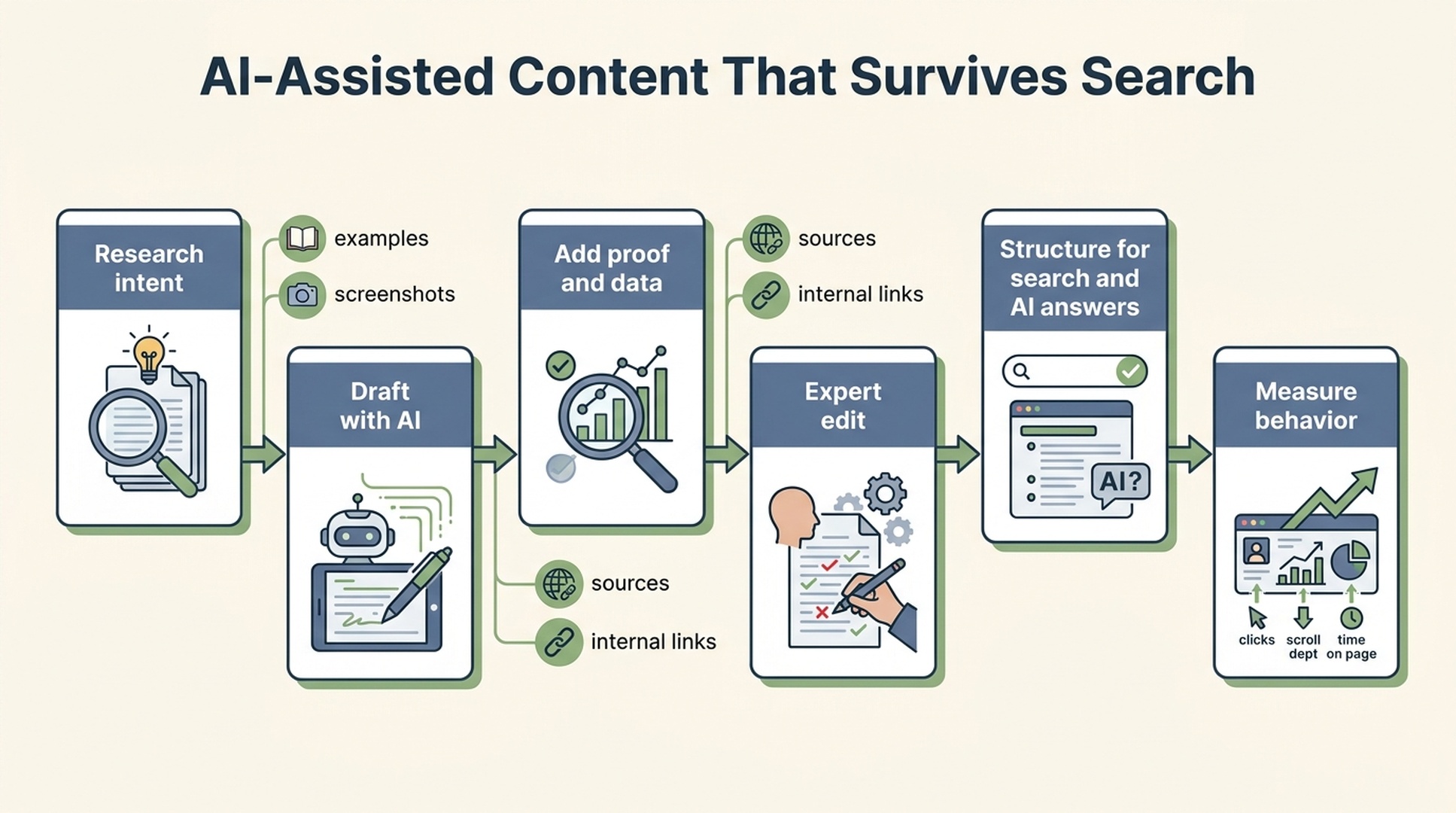
Caption: AI can speed up research and drafting, but the durable value comes from proof, expert editing, and structure.
4. Site Quality Beats Isolated Article Wins
A single strong article can still perform, but Google increasingly evaluates pages in the context of the whole site.
Ask these questions before blaming an algorithm update:
- Does the site have a clear topical focus?
- Are there useful category pages, comparison pages, guides, and product pages connected by internal links?
- Do important pages have authors, dates, sources, and company context?
- Are there thin pages that exist only to capture long-tail searches?
- Do users land on one page and then find a logical next step?
This is why random blog publishing feels weaker now. The better model is a content system: a few topic clusters, strong internal links, conversion pages, glossary assets, comparison pages, and update cycles.
If you want a simple diagnostic, run your site through a tool such as Auspia's AI Search Visibility Checker or a technical SEO audit, then compare what the crawler sees with what a buyer actually needs to decide.
Why SEO Feels Harder Now
SEO is harder for many teams, but not because search disappeared. It is harder because the average page is less differentiated.
Content Supply Exploded
Before AI, publishing took effort. That effort acted as a filter. Now a team can generate hundreds of articles in a day.
The result is strange: there is more content, but not necessarily more useful content. Search engines, AI answer systems, and users all need better filters. Low-quality pages are easier to produce and easier to ignore.
Search Results Are More Crowded
A query may now compete with ads, videos, forums, shopping modules, AI answers, maps, images, and traditional organic links. Even when you rank, the click may be smaller than it was in 2019.
That does not make SEO worthless. It means pages need to win more than a ranking. They need to win attention, trust, and the next click.
User Behavior Sends A Stronger Message
If users click, skim, bounce, and search again, the page probably failed. You do not need to over-theorize this.
A strong SEO page should reduce pogo-sticking by answering the real question quickly, then giving readers enough depth to continue. The first screen matters. The table of contents matters. Examples matter. So do page speed, readability, and the next action.
Who Should Still Invest In SEO In 2026?
Not every business should invest the same way. Here is the realistic split.
Strong Fit: B2B, SaaS, Professional Services, And High-Consideration Products
SEO is still a strong channel when buyers research before they buy.
Good fits include:
- B2B SaaS
- Agencies and consultancies
- Legal, finance, health, education, and professional services
- Ecommerce brands with differentiated products
- Marketplaces and tools with comparison-driven demand
- Technical products that require documentation and education
These businesses usually have real expertise. The SEO challenge is packaging that expertise so search engines, AI systems, and buyers can all use it.
Conditional Fit: Media, Affiliate, And Content-First Sites
Content sites can still work, but they need sharper positioning.
A generic affiliate site that reviews products it has never tested is exposed. A niche site with real testing, clear methodology, helpful tables, community feedback, and transparent limitations has a better shot.
The question is not "Can content sites rank?" The question is "Why should this content site be trusted over a forum thread, a brand page, a YouTube review, or an AI answer?"
Poor Fit: Scaled AI Sites With No Brand Or Proof
If the plan is to mass-produce pages, rewrite what already ranks, and monetize with ads or shallow affiliate links, 2026 is a bad environment.
Some operators will still find loopholes. They always do. But for a real company building a durable acquisition channel, that is not a strategy worth copying.
The 2026 SEO Playbook
Here is the operating model I would use now.
Step 1: Start With The Business Problem, Not The Keyword
Keywords are still useful. They tell you how people phrase demand. But the starting question should be sharper:
What problem must the buyer solve before they can trust us?
For a cybersecurity company, the content may need to explain compliance risk, vendor selection, implementation steps, and executive reporting.
For an ecommerce brand, the content may need to help buyers choose materials, compare use cases, understand sizing, and avoid cheap substitutes.
For a GEO platform, the content may need to explain how AI answer systems evaluate entities, claims, sources, and page structure.
Once the business problem is clear, keywords become a map rather than the strategy.
Step 2: Build Topic Clusters, Not Loose Articles
A useful topic cluster has a center and spokes:
Cluster Layer | Purpose | Example |
|---|---|---|
Hub page | Defines the topic and routes readers | AI search optimization guide |
How-to pages | Explain repeatable actions | How to structure pages for AI citations |
Comparison pages | Capture buying intent | GEO vs SEO vs AEO |
Templates | Help teams execute | AI search visibility audit checklist |
Case or experiment pages | Add proof | What changed after adding source blocks |
The internal links should feel like a guided path, not a forced SEO trick.
Step 3: Add Evidence Before Optimization
Before editing title tags or adding schema, improve the substance.
Add:
- Original examples
- Screenshots where useful
- Data tables
- Decision criteria
- Named sources
- Methodology notes
- Limitations and exceptions
This is also better for AI visibility because answer engines need extractable claims. A claim with context and evidence is easier to cite than a vague paragraph.
Step 4: Use AI As A Production Assistant
AI is useful. It can speed up briefs, outlines, search intent grouping, schema drafts, content refreshes, and FAQ discovery.
Just do not confuse speed with quality.
A practical division of labor:
Task | AI Can Help | Human Must Own |
|---|---|---|
Keyword grouping | Yes | Final prioritization |
Outline | Yes | Point of view |
First draft | Sometimes | Accuracy and examples |
Data interpretation | With caution | Claims and conclusions |
Editing | Yes | Voice, judgment, legal risk |
Publishing | Yes | Final accountability |
Step 5: Optimize For Search, AI Answers, And Conversion Together
The strongest 2026 pages do three jobs:
- They can rank in Google.
- They can be understood and cited by AI answer systems.
- They help a real buyer take the next step.
That means your page should include a direct answer near the top, clear definitions, entity names, tables, FAQs, source links, and a logical conversion path. It should also avoid burying the answer under a long brand intro.
Step 6: Refresh Pages On A Real Schedule
SEO in 2026 is not publish-and-pray. Some pages need quarterly review, especially if they mention tools, pricing, regulations, platform features, or search behavior.
A simple refresh checklist:
- Check whether the search intent changed
- Update examples and screenshots
- Remove outdated claims
- Add recent data or source references
- Improve internal links to newer assets
- Rewrite the opening answer if it is too slow
- Compare AI answer visibility before and after the update
Auspia Take: The New SEO Moat Is Trust You Can Inspect
The best SEO strategy in 2026 is not louder publishing. It is inspectable trust.
Can a reader inspect your reasoning? Can an AI system extract your claims? Can a buyer see who wrote the page, why the advice is credible, and what to do next? Can Google crawl a coherent site instead of a pile of unrelated posts?
That is the moat. Not word count. Not prompt tricks. Not publishing velocity by itself.
For Auspia, this is why SEO, GEO, and AEO should be planned together. A page that is helpful for Google but impossible for AI answers to cite is leaving visibility on the table. A page that is quotable by AI but weak for human conversion is also incomplete.
The winning content system is built for both machines and people, but it earns trust from people first.
What To Do Next This Week
If you are deciding whether to keep investing in SEO, do not start with a 12-month content calendar. Start with a repair sprint.
- Pick your 20 most important organic landing pages.
- Mark each page as keep, merge, refresh, or remove.
- Add first-hand proof to the pages that drive qualified traffic.
- Build one topic cluster around a commercial problem, not a vanity keyword.
- Audit whether AI answer systems can understand your brand, product, claims, and source pages.
- Track qualified clicks, assisted conversions, and AI visibility, not just rankings.
That is a better 2026 SEO plan than publishing 100 more average posts.
FAQ
Is Google SEO still worth it in 2026?
Yes, if your business can create content with real expertise, useful structure, and a clear path to conversion. SEO is weaker for thin content sites and stronger for companies with original knowledge, products, data, or customer insight.
Does Google penalize AI-generated content?
Google's public guidance focuses on content quality and intent, not whether AI was used. AI-assisted content can work when it is helpful, accurate, reviewed, and not produced mainly as scaled search manipulation.
What is the biggest SEO mistake in 2026?
The biggest mistake is treating SEO as a volume channel. Publishing more pages without evidence, differentiation, internal structure, or trust signals usually creates index bloat rather than growth.
How is GEO different from SEO?
SEO focuses on visibility in search engines. GEO focuses on being understood, selected, and cited by generative AI answer systems. In practice, the two now overlap because both reward clear entities, useful answers, source-backed claims, and well-structured pages.
How often should important SEO pages be updated?
For stable evergreen topics, review every six to twelve months. For fast-changing topics such as AI search tools, platform features, pricing, or regulations, review quarterly or whenever a major change affects the answer.
Sources And Further Reading
- Google Search Central: Creating helpful, reliable, people-first content: https://developers.google.com/search/docs/fundamentals/creating-helpful-content
- Google Search Central: Google Search spam policies: https://developers.google.com/search/docs/essentials/spam-policies
- Google Search Status Dashboard: https://status.search.google.com/products/rGHU1u87FJnkP6W2GwMi/history