Executive summary
If your team has been saving GEO articles without changing the way you publish, start here. GEO becomes useful only when your content gives AI answer systems something clear, verifiable, and easy to reuse.
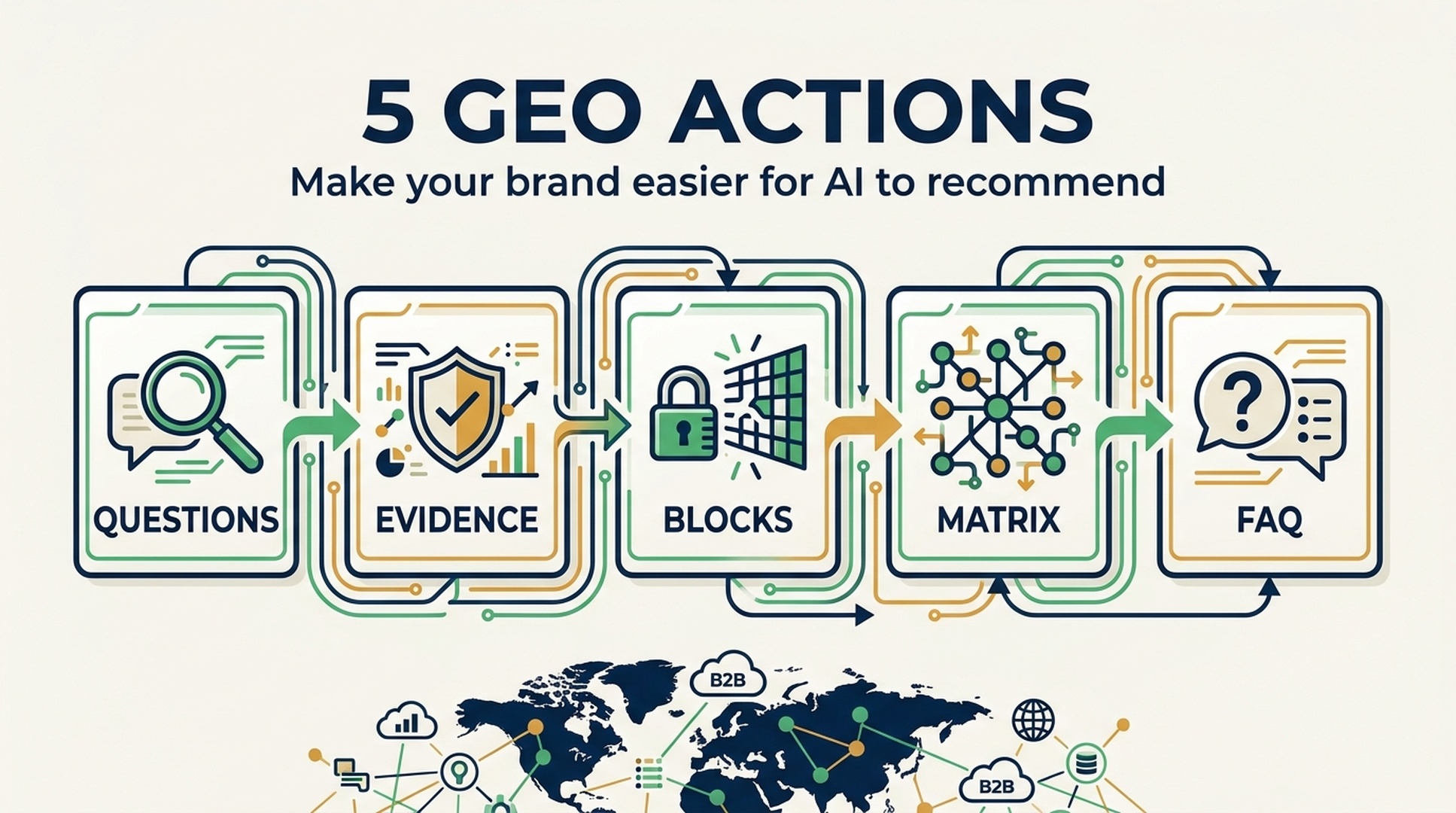
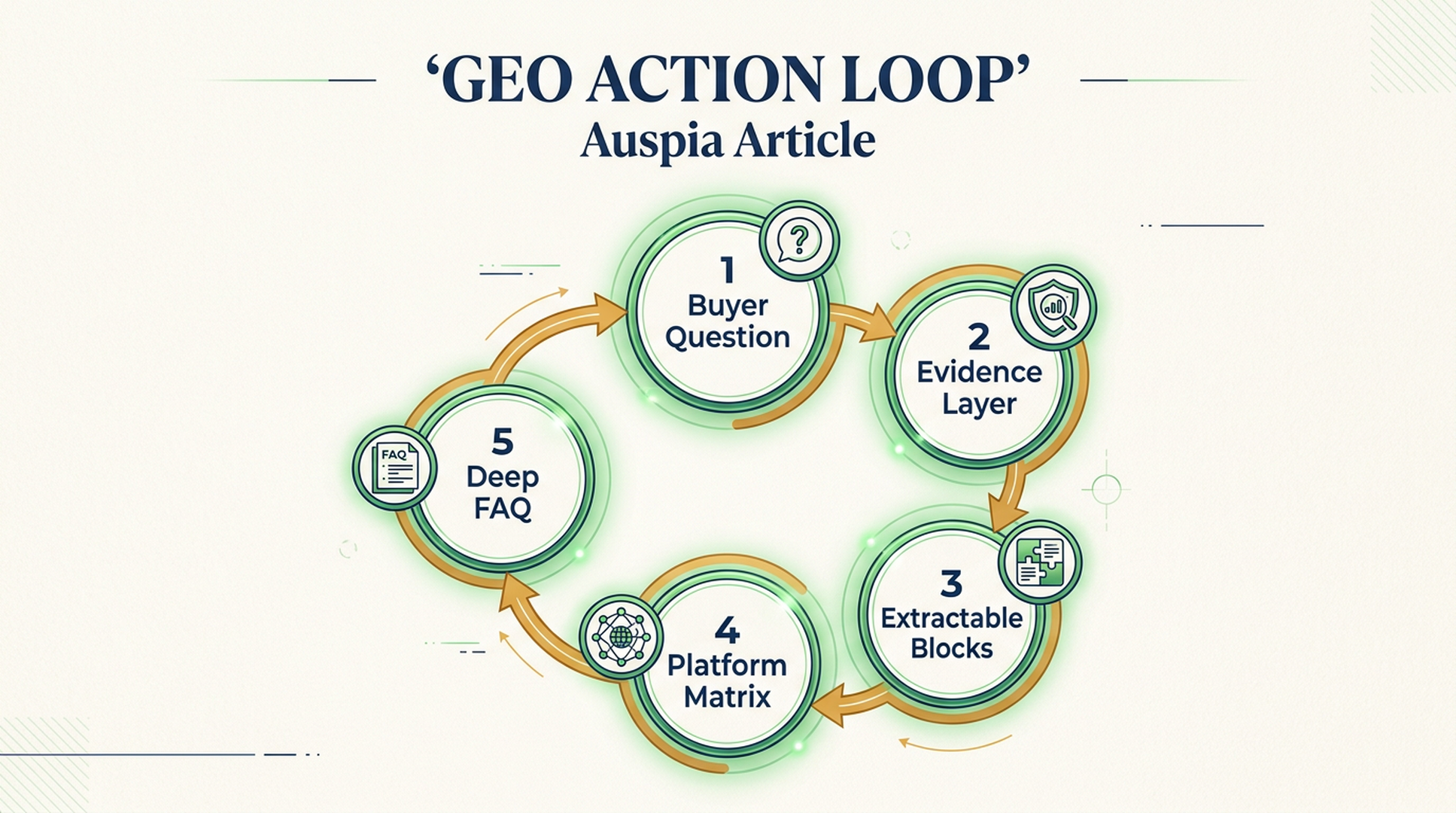
You do not need a large budget, a new tech stack, or a six-month transformation plan to begin. You need five actions that can be applied to your existing website, blog, documentation, and public profiles:
Action | What it improves | Fastest first step |
|---|---|---|
Bind one buyer question | Relevance | Choose 3 questions users would ask AI before buying. |
Add evidence to claims | Trust | Add one credible source or data point to each major claim. |
Restructure content into extractable blocks | Citation readiness | Add definitions, lists, subheads, and summary sentences. |
Build a three-platform evidence matrix | Cross-source confidence | Sync the same core answer across website, Q&A/community, and social/proof platforms. |
Publish an answer-ready FAQ page | AI answer fit | Turn your top 5 buyer questions into direct, sourced answers. |
The goal is not to trick AI search. The goal is to make your best information easier to retrieve, verify, and quote.
Action 1: Attach your brand to one question AI users actually ask
Most companies begin GEO with the wrong sentence: “We need AI to recommend our brand.”
A better starting sentence is: “Which user question should our brand become the best answer for?”
AI answer systems are built around questions, tasks, and decisions. Users do not open ChatGPT, Perplexity, Google AI Mode, or Gemini and type your positioning statement. They ask questions like:
- “What is the best customer support platform for a 50-person SaaS team?”
- “How do I compare SOC 2 compliance automation tools?”
- “Which SEO tools help with AI search visibility?”
- “What should I check before choosing a B2B data enrichment provider?”
- “How do I reduce support tickets without hurting customer experience?”
If your pages never answer the question directly, AI systems have no clean handle to use. The brand may be known, but the source is not answer-ready.
Do this today
Open the AI product your buyers already use and ask:
I am a [buyer type] researching [category]. What questions would I ask before choosing a provider?
Then choose three questions that match your product and buying stage.
For each question, create a short answer map:
Buyer question | Your direct answer | Best page to update |
|---|---|---|
What is the best tool for X? | Our product fits teams that need A, B, and C. | Use-case page |
How should I compare X and Y? | Compare by workflow, integrations, cost model, and proof. | Comparison page |
What risks should I check? | Check data access, implementation time, support model, and limitations. | FAQ or checklist |
Your next blog post, product page, or FAQ section should include the exact question as a heading. This is not keyword stuffing. It is answer alignment.
Action 2: Give every important claim an evidence layer
AI systems are cautious with vague claims. “We are the leading platform” is hard to use. “Our product supports Salesforce, HubSpot, and Zendesk integrations and is used by support teams to consolidate customer context” is more useful. Add a credible source, and it becomes even stronger.
Evidence does not always mean proprietary research. It can include:
- Public industry reports.
- Product documentation.
- Customer case studies with dates and constraints.
- Benchmarks from trusted research organizations.
- Review-site patterns, when summarized carefully.
- Original experiments with methodology disclosed.
- Screenshots, changelog entries, or audited feature lists.
The key is to put evidence close to the claim it supports. Do not hide sources at the bottom of the page. AI systems and human readers both benefit when the proof appears near the statement.
Weak vs. strong claim examples
Weak claim | Stronger GEO-ready version |
|---|---|
“Our tool saves time.” | “The workflow reduces manual handoff between sales and support by consolidating account context in one view. In our customer interviews, the most common time sink was searching across disconnected systems.” |
“We are trusted by modern teams.” | “The product is used by B2B SaaS, agency, and ecommerce teams; the strongest fit is teams with high-volume support queues and multiple customer data sources.” |
“AI search is changing SEO.” | “AI search changes the unit of optimization from ranked links to retrievable answers, citations, and source confidence.” |
Do this today
Take your three most recent content assets and highlight the strongest claim in each one. For every claim, add:
- One specific detail.
- One source, example, or data point.
- One sentence that explains what the evidence proves.
A simple format works well:
[Claim]. This matters because [specific explanation]. Evidence: [source, method, or example].
This small edit can turn a promotional paragraph into a source-ready paragraph.
Action 3: Restructure content into blocks AI can extract
Many high-quality pages are hard for AI systems to use because they are written as long continuous essays. The ideas may be good, but the answer fragments are buried.
GEO-friendly pages use structure as a retrieval aid. They make it obvious where the definition starts, where the steps are, where the tradeoffs live, and where the final recommendation appears.
You are not writing for robots instead of people. You are making the page easier for both.
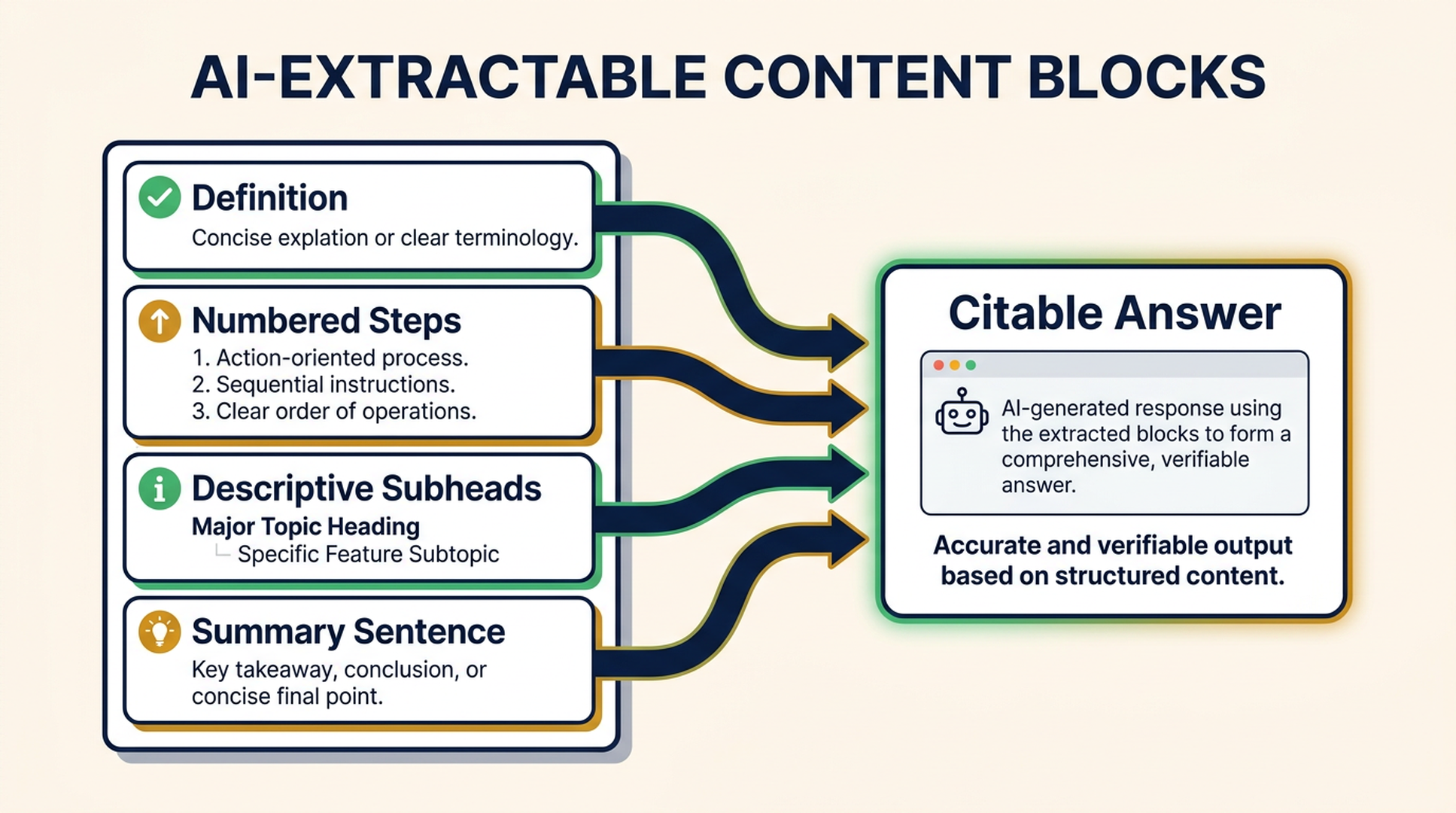
Use the four-block structure
Block | Purpose | Example pattern |
|---|---|---|
Definition sentence | Makes the topic easy to quote | “GEO is the practice of making brand information easier for AI systems to retrieve, trust, and cite.” |
Numbered steps | Makes the process easy to summarize | “Step 1, map buyer questions. Step 2, add evidence. Step 3, restructure answers.” |
Descriptive subheads | Makes page sections easy to identify | “How to choose an AI search visibility metric” |
Summary sentence | Gives AI and readers a clean takeaway | “The page is GEO-ready when a buyer can understand the answer without opening five other tabs.” |
Do this today
Open one existing article or product page and add:
- A one-sentence definition near the top.
- A numbered list for any process or set of recommendations.
- A clear subheading every 400-600 words.
- A one-sentence takeaway at the end of each major section.
If you already have strong content, do not rewrite it from scratch. Repackage it into extractable blocks.
Action 4: Build a three-platform evidence matrix
A single page on your website is useful, but AI systems build confidence from patterns across sources. If your website, community answers, review profiles, documentation, and social presence all describe the same thing consistently, the brand becomes easier to understand.
This does not mean you need to post everywhere. Start with a minimum viable evidence matrix.
For global B2B teams, a practical three-platform setup is:
Platform role | Examples | What to publish |
|---|---|---|
Owned source | Company blog, docs, product page, help center | The canonical long-form answer with evidence. |
Community or Q&A source | Reddit, Quora, Stack Overflow, Product Hunt discussions, niche Slack/Discord communities where appropriate | A practical answer adapted to the community’s question format. |
Social or proof source | LinkedIn, YouTube, G2, Capterra, partner pages, analyst pages | A concise summary, proof point, demo, or customer evidence. |
The important rule is consistency. You can adapt the tone for each platform, but the core facts should not change.
If your website says your product is for enterprises, LinkedIn says it is for creators, and a review profile lists it under a different category, AI systems may struggle to classify you correctly.
Do this today
Choose one core buyer question and publish the same answer in three formats:
- Full version on your website or blog.
- Question-answer version in a relevant community or Q&A format.
- Short evidence-led version on LinkedIn, YouTube, or a review/profile page.
Then check for consistency:
- Same product name.
- Same category language.
- Same audience definition.
- Same core claims.
- Same limitations or qualifications.
- Same supporting evidence.
A three-platform matrix is not about volume. It is about making the brand legible from more than one angle.
Action 5: Publish one FAQ page that AI can use as an answer source
The most direct GEO asset is a deep FAQ page built around real buyer questions.
This is different from a thin FAQ section with one-line answers. A useful GEO FAQ gives a direct answer first, then adds evidence, context, and decision guidance.
Use this template:
Question: [The exact buyer question]
Direct answer: [2-3 clear sentences]
Evidence: [Data, source, example, or product documentation]
Decision context: [When this answer applies and when it does not]
Next step: [What the reader should check or do]
Example FAQ structure
Question type | Example question | Why it works for GEO |
|---|---|---|
Definition | “What is AI search visibility?” | Creates a quotable explanation. |
Comparison | “How is GEO different from SEO?” | Helps AI answer contrast-based queries. |
Selection | “How do I choose the right tool?” | Matches buying-intent prompts. |
Risk | “What mistakes should I avoid?” | Adds decision value beyond promotion. |
Implementation | “What should I do first?” | Turns advice into action. |
Do this today
Write one FAQ page with five questions. For each answer:
- Start with the conclusion.
- Add one evidence point.
- Mention the constraint or exception.
- Link to the most relevant product page, documentation page, or guide.
If you want an operational starting point, use Auspia’s AI search visibility checker to identify where your brand is currently visible or missing, then turn the missing topics into FAQ questions.
Execution priority: what to do if you only have one hour
If you have a full day, do all five actions. If you only have one hour, start with the two that change the most pages fastest.
Priority | Action | Time needed | Expected effect |
|---|---|---|---|
1 | Add evidence to existing claims | 30-60 minutes | Improves trust signals quickly. |
2 | Restructure one important page | 60-120 minutes | Makes existing content easier to extract and cite. |
3 | Bind three buyer questions | 30 minutes | Improves topic alignment immediately. |
4 | Build a three-platform matrix | 2-3 hours | Improves cross-source consistency over time. |
5 | Publish a deep FAQ page | 3-4 hours | Creates a durable AI-answer asset. |
The minimum execution plan is simple: choose three buyer questions, then add evidence to the pages that should answer them.
Auspia takeaway
GEO is not a one-off project. It is a publishing standard.
Before every new page, ask three questions:
- Which AI-era buyer question does this page answer?
- Which claims are supported by evidence?
- Can an AI answer system extract a useful paragraph, list, table, or FAQ answer from this page?
If the answer is yes, the page is more likely to become a durable content asset. If the answer is no, it may still look good to humans, but it will be harder for AI systems to retrieve and reuse.
The teams that win in GEO will not be the teams that publish the most content. They will be the teams that make their content the easiest to trust.
Final checklist
Use this checklist before publishing your next GEO-focused asset:
- The page answers one specific buyer question near the top.
- The main claim has evidence or a named source.
- The structure includes definitions, lists, subheads, and summary sentences.
- The same core message appears consistently across at least three public surfaces.
- The FAQ answers are deep enough to be used as answer fragments.
- The page links to the next useful action, not just the homepage.
FAQ
What is the fastest GEO action for a small team?
Add evidence to existing pages. Find the strongest claims on your product pages, blog posts, and comparison pages, then add specific details, examples, sources, or customer proof close to those claims.
Do I need to publish on every platform for GEO?
No. Start with a three-platform matrix: one owned source, one community or Q&A source, and one social or proof source. The goal is consistency and credibility, not maximum distribution.
Should GEO content be written differently from SEO content?
Yes, but not completely differently. Good SEO content still matters, but GEO content should be more direct, evidence-led, and easy to extract into answers. Definitions, tables, FAQs, and concise summary sentences become more important.
How long does GEO take to work?
Some improvements can appear quickly when pages are crawled and cited, but most GEO benefits compound over weeks and months. The strongest results come from consistent source quality, not one isolated article.
What should I measure after applying these actions?
Track whether AI tools answer your target buyer questions accurately, which sources they cite, which pages are missing, and whether your brand facts remain consistent across website, documentation, community mentions, and third-party profiles.