The short version
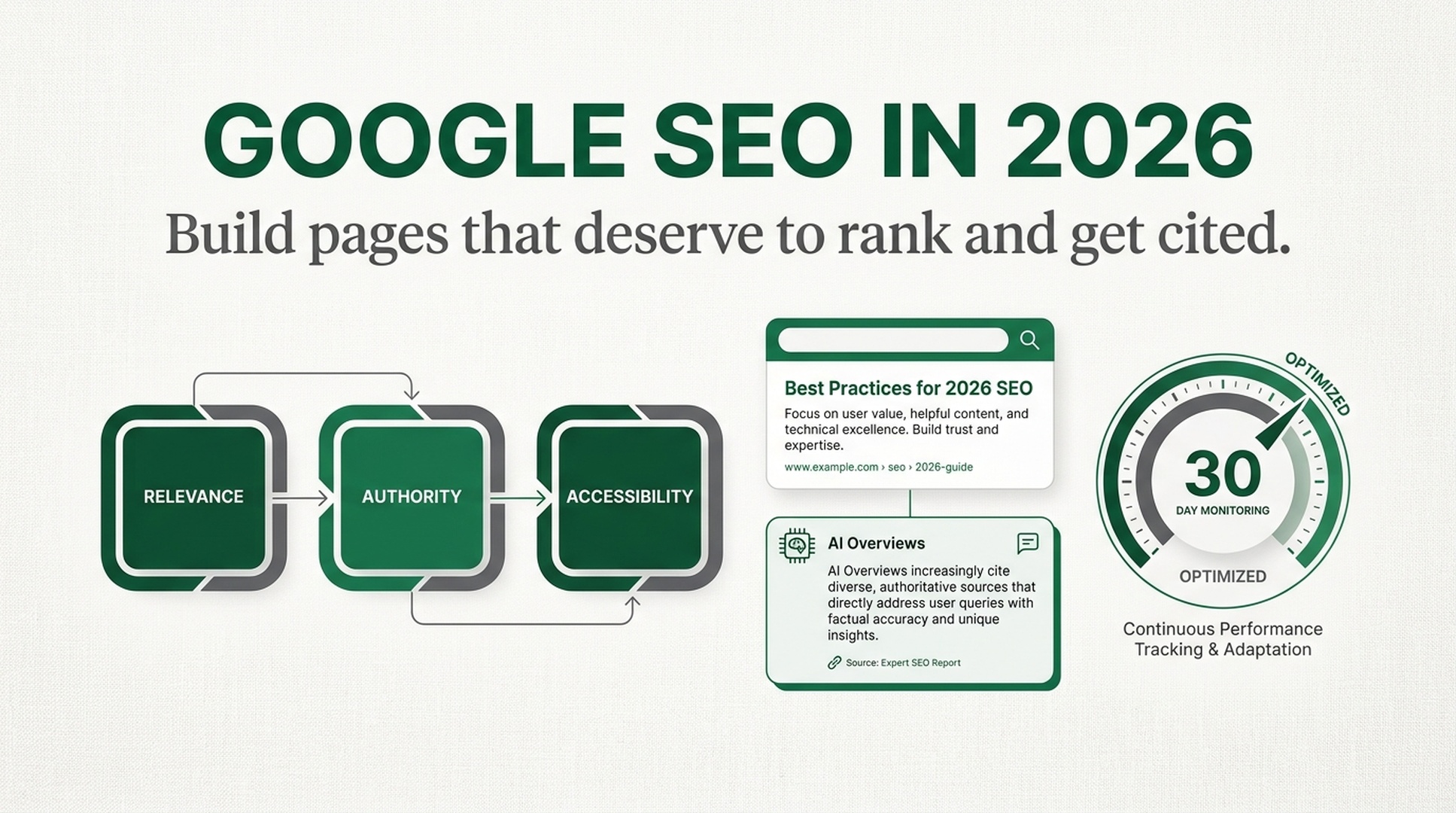
Google SEO in 2026 is still built on a simple bargain: Google needs users to trust its results, so your page has to look like the safest, clearest, most useful answer for a real search task.
That sounds obvious until a team starts working. Then SEO quietly turns into a pile of separate activities: keyword exports, AI drafts, backlink pitches, schema plugins, Core Web Vitals scores, and weekly ranking screenshots. The work gets busy, but the system gets weaker.
Use this operating model instead:
Ranking potential = intent fit x evidence x accessibility x authority x iteration
If one part is close to zero, the page struggles. A brilliant article that Google cannot crawl will not rank. A technically perfect page that answers the wrong intent will not rank. A polished AI article with no firsthand evidence may get indexed, but it is easy to replace.
This playbook is written for small teams, SaaS marketers, agencies, and founders who need a practical SEO system for 2026. It borrows the useful rhythm of a long internal SEO manual, but rebuilds the advice for English-language sites, global products, AI Overviews, answer engines, and conversion-focused content.
The first principle: Google ranks answers, not effort
A page does not deserve traffic because the team spent 20 hours on it. It deserves traffic when it makes the search result better.
For most commercial sites, that means the page must do five jobs:
Job | What Google needs to see | What users need to feel |
|---|---|---|
Intent fit | The page matches the searcher's actual task | "This is the page I meant to find" |
Information gain | The page adds something competitors missed | "I learned something useful" |
Evidence | Claims are backed by examples, data, screenshots, tests, or sources | "I can trust this" |
Accessibility | Crawlers can fetch, render, index, and understand the page | "The page loads and reads cleanly" |
Authority | Other pages, sites, and brand signals support the page | "This source seems credible" |
This is why quick SEO tricks age badly. They optimize one signal while ignoring the real job. Keyword stuffing tries to fake relevance. Thin AI content tries to fake coverage. Cheap guest posts try to fake authority. None of that creates a better result.
Auspia's view is blunt: if a page would not help a buyer, analyst, journalist, or AI answer system explain the topic better, it is probably not a strong SEO asset.
01 Keyword research starts with the SERP, not the keyword tool
Keyword tools are useful, but they are not the judge. The live search results are.
A keyword can look perfect in a spreadsheet and still be the wrong target. "SEO tools" might mean a list of tools, a product category, a free checker, a software comparison, or a tutorial, depending on what Google currently shows. The same phrase can have different dominant intent in different countries and different SERP layouts.
Before you assign a keyword to a page, answer four questions:
- What type of pages already rank?
- Are they informational, commercial, transactional, local, or navigational?
- Is there a weak result that a better page can replace?
- Can your site produce proof that the current winners do not have?
The four useful intent buckets
Intent | Searcher wants | Common query patterns | Best page type |
|---|---|---|---|
Informational | Learn or solve a task | what is, how to, why, guide | Tutorial, glossary, explainer |
Commercial investigation | Compare options | best, vs, alternatives, review | Comparison, listicle, buying guide |
Transactional | Act now | pricing, demo, download, coupon | Landing page, pricing page, signup page |
Navigational | Reach a known brand | brand login, brand support | Homepage, login, support page |
Intent mismatch is still one of the fastest ways to waste content budget. A glossary article usually cannot rank for a high-intent "best software" query because the reader wants a choice, not a definition. A product landing page usually cannot rank for a broad "how to" query because the reader is still diagnosing the problem.
A quick SERP weakness checklist
Look at the top 10 results and mark every weakness you can honestly beat:
- The ranking pages are more than two years old.
- The page answers the obvious question but misses follow-up questions.
- The content has no screenshots, test data, templates, or examples.
- Reddit, Quora, or forum threads appear because professional pages are thin.
- The page is slow, cluttered, or hard to use on mobile.
- The author or brand has weak topical credibility.
- The page talks about the category but does not help the reader choose.
If you cannot find a weakness, do not force the keyword. Pick a smaller target or build supporting pages first.
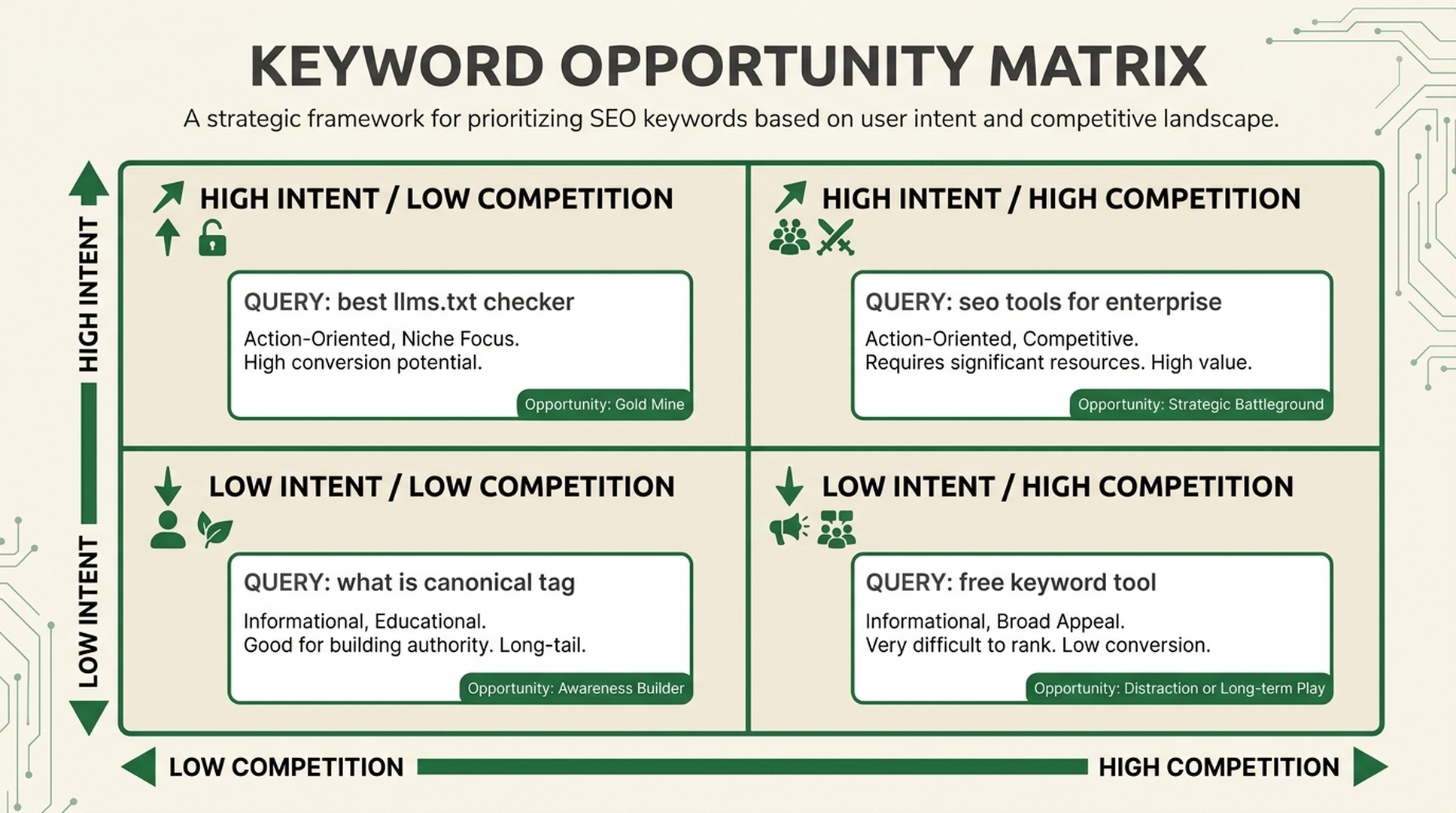
Caption: A useful keyword is not just popular. It has enough demand, a clear business path, and at least one visible weakness in the current SERP.
02 Build a keyword matrix, not a one-page bet
Single-page SEO is fragile. A site becomes easier to trust when it covers a topic from multiple angles and connects those pages cleanly.
For example, a company selling AI search visibility software should not only write one page for "AI search visibility checker." A healthier matrix might include:
Layer | Example keyword | Role |
|---|---|---|
Head term | AI search visibility | Broad topical authority |
Mid-tail | AI search visibility checker | Product-aware demand |
Long-tail | how to check if ChatGPT cites my website | Specific problem capture |
Comparison | AI visibility checker vs SEO rank tracker | Decision support |
Diagnostic | why my brand does not appear in AI answers | Pain-led demand |
Technical | llms.txt generator checker | Tool-led conversion |
The goal is not to publish 50 random articles. The goal is to make the site feel complete around a topic. Each cluster page should answer a specific intent, link back to the central resource, and point readers toward the next logical step.
For Auspia, that might mean connecting an educational article about GEO to a practical tool such as the AI Search Visibility Checker. The internal link should feel like a next step, not a sales interruption.
03 Content quality means information gain
Long content is not automatically better. Complete content is better.
A 900-word page can beat a 4,000-word article if it answers the query faster, gives better examples, and removes uncertainty. A long guide only earns its length when the topic needs it.
In 2026, the best SEO content usually has four forms of information gain:
Form | What it looks like | Why it matters |
|---|---|---|
Firsthand experience | Screenshots, process notes, test results, mistakes, before/after examples | Harder for generic AI content to copy |
Structured judgment | Decision trees, scoring models, trade-off tables | Helps users choose, not just learn |
Fresh context | Current product behavior, recent SERP changes, updated examples | Prevents outdated advice from ranking by habit |
Source clarity | Links to original docs, datasets, studies, or public statements | Gives humans and AI systems confidence |
Google's own guidance on helpful content has been consistent on this point: make content for people first, not just to attract search engine visits. For AI features in Search, Google also points site owners back to normal Search fundamentals: pages must be crawlable, indexable, and useful enough to appear in Search in the first place.
That means AI should not be banned from the workflow, but it should not be the source of truth. Use AI for briefs, outlines, clustering, rewriting, and gap checks. Add human judgment where it counts: examples, screenshots, tests, product knowledge, and editorial decisions.
A simple rule works well: if an AI model could have written the entire page without access to your product, your customers, your data, or your experience, the page probably needs more evidence.
04 E-E-A-T is operational, not decorative
Experience, expertise, authoritativeness, and trust are often treated like a checklist at the bottom of a page. Add an author bio. Add a date. Add a few outbound links. Done.
That is too shallow.
For a serious content program, E-E-A-T should change how the page is produced:
Signal | Weak version | Stronger version |
|---|---|---|
Experience | "Our team has experience" | Show the actual workflow, setup, screenshots, and mistakes |
Expertise | Definitions copied from common sources | Explain trade-offs and edge cases a beginner would miss |
Authority | Generic backlink chase | Earn citations from relevant industry pages, tools, and communities |
Trust | No author, no dates, no sources | Clear author, update history, original sources, limitations |
This matters more for financial, legal, medical, and safety-related content, but it also matters in B2B software. Buyers do not want content that sounds confident. They want content that reduces risk.
A practical E-E-A-T setup for a SaaS or agency site:
- Create real author pages with experience, LinkedIn profiles, and topic focus.
- Add "last updated" dates to pages that depend on changing tools or SERPs.
- Link to original documentation instead of citing vague "industry reports."
- Include product screenshots only when they explain a step.
- Keep old content on a refresh schedule, especially comparison and tool pages.
- Publish a clear About page that explains who the company serves and why it is credible.
05 Technical SEO is the floor
Technical SEO does not make weak content brilliant. It makes strong content eligible.
The core questions are simple:
Area | Question | Common failure |
|---|---|---|
Crawlability | Can Googlebot discover the URL? | Broken internal links, blocked paths, orphan pages |
Indexability | Is the page allowed to enter the index? | Accidental noindex, canonical mistakes, duplicate pages |
Renderability | Can Google see the main content? | Client-side rendering delays, blocked JS, empty HTML shell |
Understandability | Is the page structure clear? | Missing headings, messy templates, weak schema |
Page experience | Can users read and interact quickly? | Poor mobile layout, intrusive ads, slow LCP or INP |
For modern JavaScript sites, the renderability question deserves extra attention. If the HTML response is mostly empty and the content appears only after several client-side requests, you are asking crawlers and AI systems to work harder than necessary. Server-side rendering or static generation is usually safer for important SEO pages.
A clean technical launch checklist:
- Submit XML sitemaps in Google Search Console.
- Keep robots.txt simple and review changes before deploys.
- Check that canonical tags point to the intended URL.
- Use descriptive title tags and meta descriptions written for clicks.
- Add schema only when it matches visible page content.
- Test important templates with Google's URL Inspection tool.
- Monitor Core Web Vitals, especially LCP, CLS, and INP.
If you run AI-focused pages, also review whether AI crawlers can access the right content. Robots.txt rules, llms.txt files, and site structure should support your actual visibility strategy rather than block everything by accident.
06 AI Overviews and answer engines change the packaging
AI Overviews did not make SEO irrelevant. They made weak informational content less safe.
If a searcher can get a short generic answer without clicking, your page needs to offer something that the summary cannot fully replace: a tool, a decision framework, original data, a deeper example, a template, or a credible point of view.
For answer extraction, format matters. A page is easier to quote or summarize when it has:
- A direct answer near the top.
- Short definitions for important terms.
- Tables that compare options clearly.
- Step-by-step instructions with specific verbs.
- Named entities, product names, dates, and constraints.
- FAQ answers that are short enough to lift but useful enough to trust.
Do not write only for bots. Write for the person who will ask the next question after the AI summary. That person is more valuable anyway.
07 Authority still compounds
Backlinks are still useful, but the bar for useful links is higher than it was years ago.
Low-quality guest posts, private blog networks, spun listicles, and unrelated link exchanges are bad long-term assets. The stronger play is to create pages worth citing and then put them where relevant people can find them.
Better link-worthy assets include:
- Original benchmarks or mini-studies.
- Free tools and calculators.
- Template libraries.
- Visual explainers and diagrams.
- Expert commentary on a current change.
- Comparison pages with honest trade-offs.
For new sites, do not wait six months to think about authority. Build it into the content plan. If a page has no reason for another site to cite it, it may still rank for a long-tail query, but it will struggle to become a durable asset.
Brand mentions also matter. Consistent naming across LinkedIn, YouTube, GitHub, directories, podcasts, newsletters, and review sites helps search systems understand that your brand is a real entity, not just a domain with pages.
08 Measure the first 30 days correctly
The first month after publishing is not about panic. It is about diagnosis.
Use this sequence:
Window | What to check | What the signal means |
|---|---|---|
Days 1-7 | Indexing in Google Search Console | If not indexed, check crawl blocks, noindex, canonical, and internal links |
Days 8-14 | Impressions | If impressions are zero, the query target or indexing path may be wrong |
Days 15-21 | CTR | If impressions exist but clicks are weak, improve title and meta description |
Days 22-30 | Average position and query mix | If ranking sits between 11 and 30, strengthen content, internal links, and evidence |
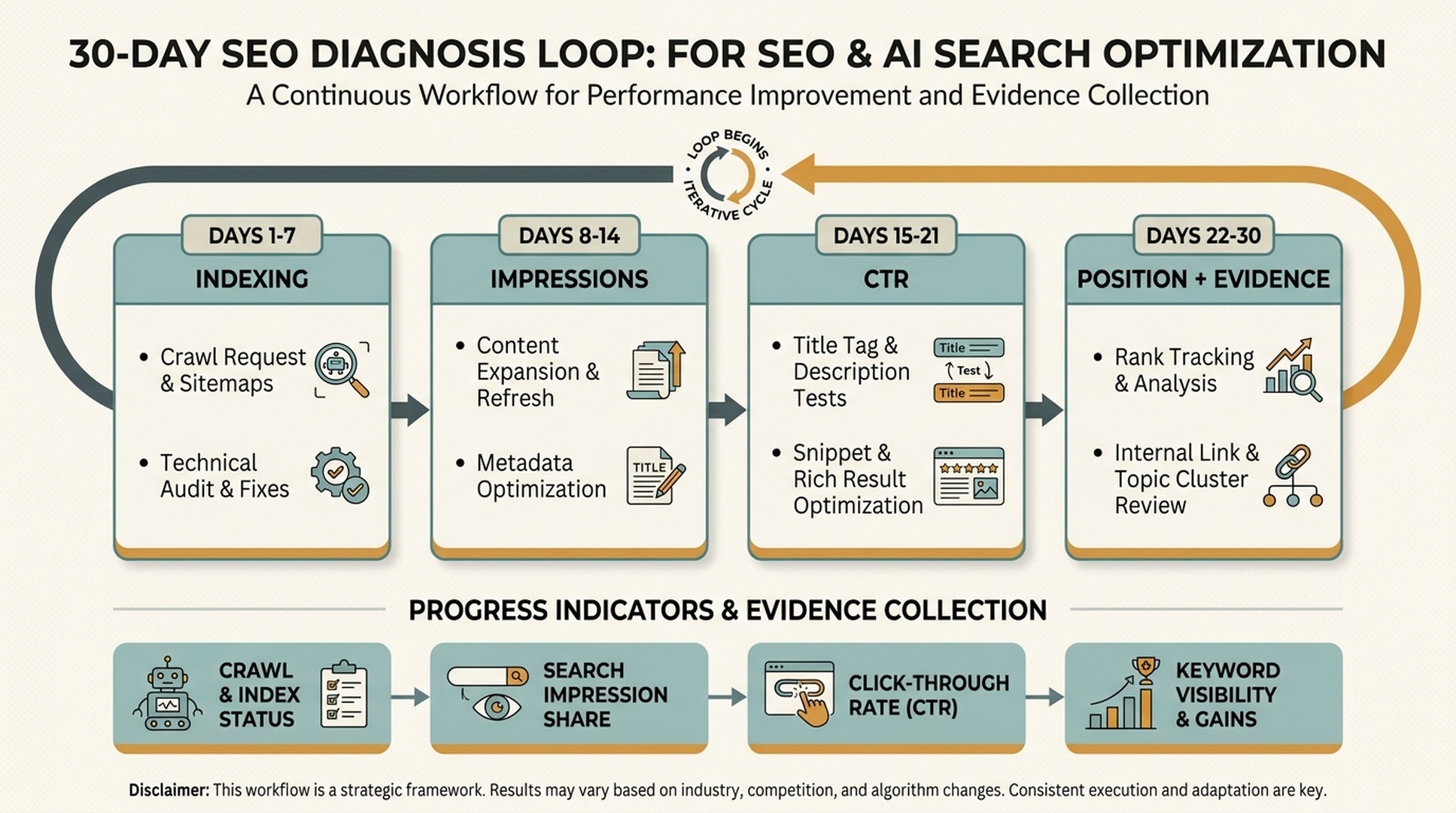
Caption: Diagnose a new SEO page in stages. Do not treat every early ranking movement as a reason to rewrite the page.
Do not rewrite a page every three days because a rank tracker moved. Google needs time to crawl, compare, and test. But do not ignore early signals either. A page with impressions and no clicks is asking for a better title. A page with the wrong query mix is asking for a sharper opening and headings.
09 A 12-month SEO roadmap for a new site
Here is a practical sequence for a new or underdeveloped site.
Months 0-3: build the base
- Fix crawl, index, sitemap, canonical, and page-speed problems.
- Choose one topic cluster instead of five unrelated categories.
- Publish 8-15 pages around low-competition, high-intent long-tail queries.
- Create one strong tool, template, benchmark, or visual asset worth referencing.
- Add internal links as pages go live, not months later.
Months 3-6: push the early winners
- Use Search Console to find pages getting impressions but weak CTR.
- Refresh pages stuck in positions 11-30 with better examples and evidence.
- Build supporting pages for queries that appear unexpectedly.
- Start outreach around link-worthy assets, not generic blog posts.
- Improve author and brand trust signals.
Months 6-12: expand carefully
- Build the second and third topic clusters only after the first cluster has traction.
- Target more competitive comparison and category terms.
- Refresh pages quarterly, especially tool lists and product comparisons.
- Turn winning articles into tools, templates, webinars, or downloadable assets.
- Review competitors every quarter for content gaps and link opportunities.
The mistake is trying to look like a large media site before you have authority. New sites win by being narrower, more useful, and more specific.
10 The Auspia SEO operating checklist
Use this before publishing any important page:
- The primary keyword matches the dominant SERP intent.
- The page has one clear job in the content matrix.
- The opening gives a direct answer within the first few paragraphs.
- The page includes at least one original example, table, template, screenshot, or workflow.
- The author, update date, and sources are clear.
- The page is crawlable, indexable, fast, and readable on mobile.
- Internal links point to and from related pages.
- The title is written for both relevance and clicks.
- The page has a plan for authority: outreach, community sharing, tool inclusion, or citation potential.
- Search Console review is scheduled for 7, 14, and 30 days after publication.
SEO in 2026 is not a hack. It is a publishing discipline. The teams that win are not the ones that produce the most pages. They are the ones that repeatedly choose better queries, build better evidence, make their pages easier to understand, and improve based on real search data.
FAQ
Is SEO still worth investing in with AI Overviews?
Yes, but the content mix has to change. Generic informational articles are easier for AI summaries to replace. Pages with tools, original data, comparison tables, templates, and strong evidence still create search value and can also support AI citation visibility.
How long should an SEO article be in 2026?
Use the length needed to satisfy the intent. A definition may need 800 words. A serious comparison or technical guide may need 3,000 words or more. Length is not the target. Complete, useful coverage is the target.
Can AI-generated content rank on Google?
AI-assisted content can rank if it is helpful, accurate, original enough, and made for users. Purely generic AI content with no firsthand evidence, no editing, and no information gain is a weak asset.
What should a new site publish first?
Start with low-competition, high-intent long-tail pages inside one topic cluster. Avoid chasing the biggest head terms first. Use early impressions and rankings to decide which pages deserve more links, examples, and updates.
What is the most common SEO mistake?
Publishing before proving intent. Many teams pick a keyword from a tool, write what they want to say, and only later discover that the SERP wanted a different page type. Check the live SERP first.