Google has made the 2026 answer clearer than many growth teams expected: appearing in AI search is still built on the same foundation as appearing in Google Search. AI Overviews and AI Mode may change the interface, but the eligibility layer is crawlable, indexable, snippet-eligible web pages with useful content and strong site quality.
That does not mean nothing changed. It means the work has to move from "AI tricks" to better SEO operations: publish content that contains real experience, make important information available in text, support it with useful images and video, keep structured data honest, and maintain product or business data where Google can trust it.
For Auspia readers, the practical takeaway is simple: GEO in 2026 is not a replacement for SEO. It is SEO under heavier semantic pressure.
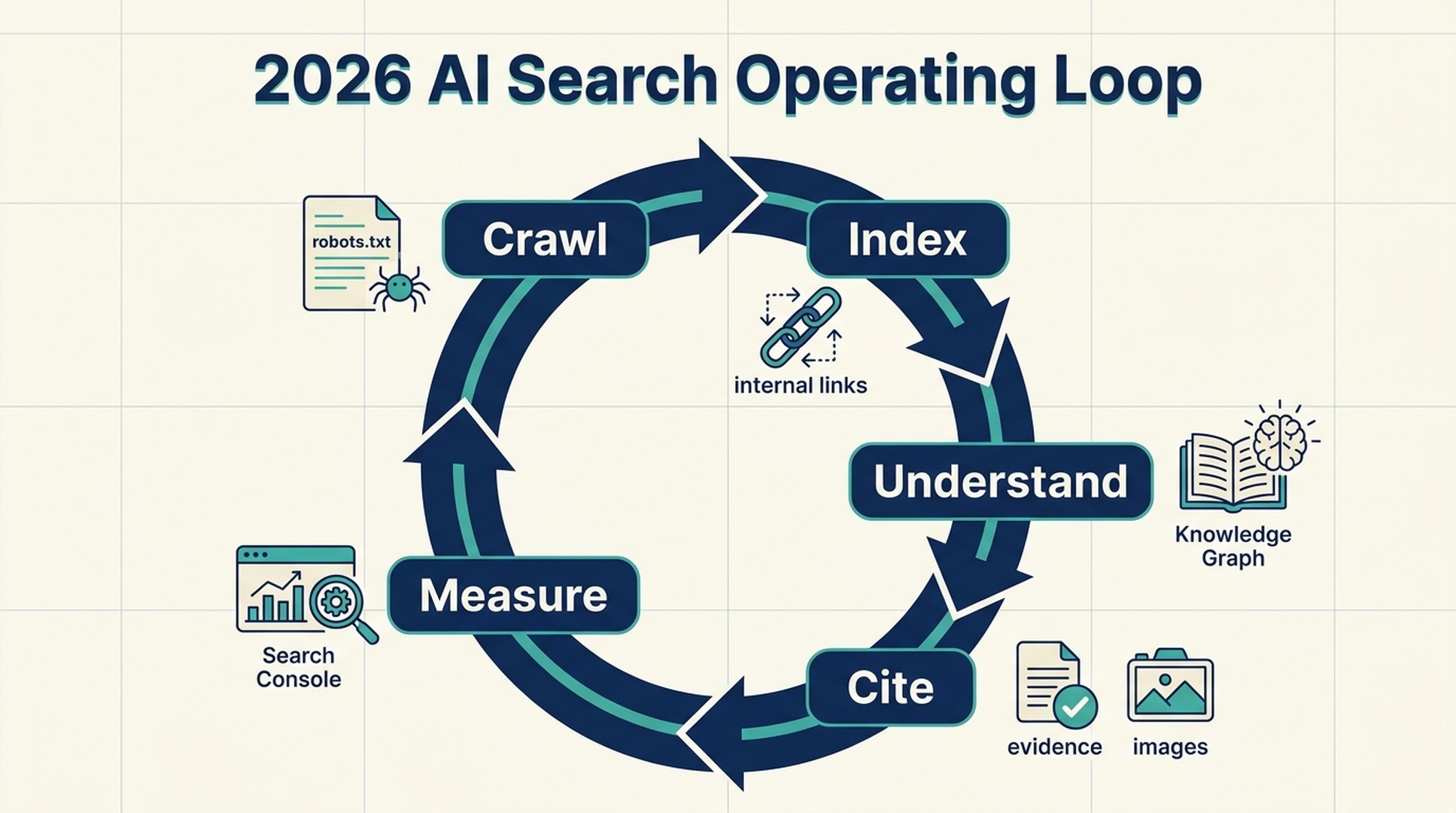
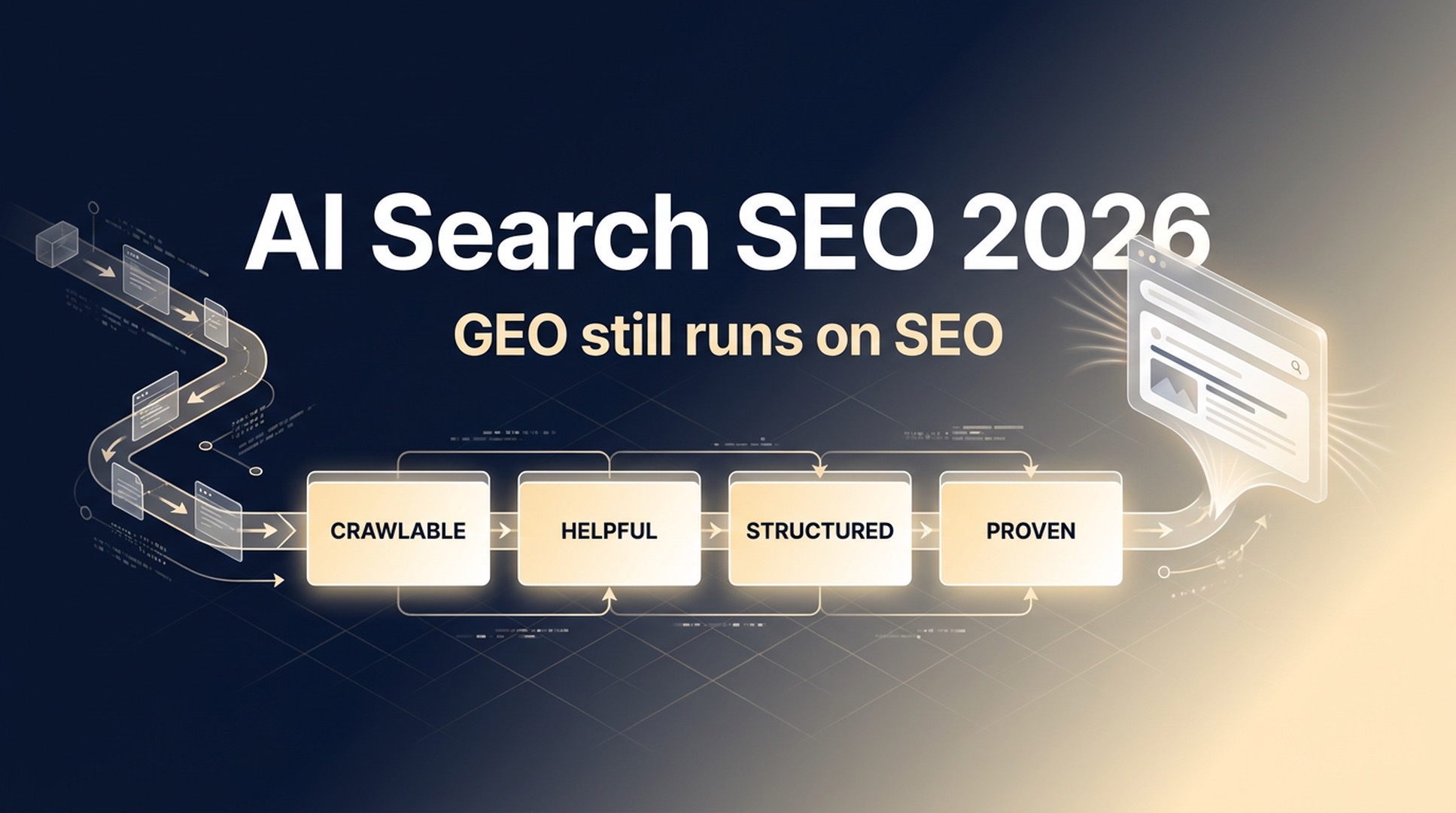
Caption: A 2026 operating loop for turning SEO pages into AI-search-ready sources: crawl, index, understand, cite, and measure.
What Google actually says about AI search visibility
Google's Search Central documentation for AI features says site owners can use the same foundational SEO best practices for AI Overviews and AI Mode that they use for Search overall. A page needs to meet Search technical requirements, follow Search policies, and focus on helpful, reliable, people-first content.
The document also states that a page must be indexed and eligible to appear in Google Search with a snippet to be eligible as a supporting link in AI Overviews or AI Mode. Google says there are no extra technical requirements for these AI features.
That sentence matters. It removes a lot of noise from the market.
If a page cannot be crawled, cannot be indexed, is blocked from snippets, or hides its main information behind fragile rendering, then the AI layer is not the first problem. The basic search layer is.
Google also explains that AI Overviews and AI Mode can use query fan-out: the system issues multiple related searches across subtopics and data sources, then identifies supporting pages while the response is being generated. In plain English, complex AI answers still lean on search retrieval. The AI interface may look new, but the discovery path still rewards pages that search systems can understand and trust.
The four GEO myths to stop paying for in 2026
The current wave of GEO advice contains useful thinking, but it also contains a lot of expensive theater. These are the four patterns we would cut first.
GEO myth | Why it is weak | Better 2026 action |
|---|---|---|
"Make an AI-only file and wait for citations" | A special file does not replace indexable pages, internal links, or strong evidence. | Keep core content in clean HTML, then use optional files only as documentation aids. |
"Break every article into tiny AI chunks" | Over-fragmented writing often hurts humans and removes context. | Use clear sections, concise answers, tables, and summaries without destroying flow. |
"Rewrite everything in AI-friendly synonyms" | Google's systems already understand related wording and intent far better than old keyword matching. | Write for the buyer's real question, then cover adjacent questions naturally. |
"Create fake mentions across the web" | Low-quality mentions are easy to discount and can create spam signals. | Build real third-party proof: reviews, expert quotes, case studies, datasets, and partnerships. |
The shared mistake is treating AI systems as if they are a separate audience with secret preferences. They are retrieval and ranking systems wrapped in a conversational experience. They still need sources.
The 2026 SEO stack that helps AI Overviews and AI Mode
Auspia's operating model for AI search has two layers: eligibility and selection. Eligibility means Google can crawl, index, render, and snippet your page. Selection means the page is useful enough to be pulled into a complex answer.
1. Make the page eligible first
Before discussing GEO, check the unglamorous basics.
- Crawling is allowed in
robots.txt, CDN rules, firewall settings, and bot protection tools. - The canonical page is indexable and not hidden behind
noindexor blocked preview controls. - The page can appear with a snippet unless you intentionally restrict snippets.
- Main content is available in textual form, not only inside images, video, canvas, or delayed client-side rendering.
- Internal links make the page discoverable from related hubs and category pages.
This is where many AI search programs quietly fail. The content team talks about citations while the technical layer prevents pages from entering the pool.
If you want a fast audit, start with the AI Search Visibility Checker and then inspect the affected URLs in Search Console.
2. Add experience that a model cannot invent
Generic explainers are easier to generate and easier to ignore. In 2026, the pages worth citing usually contain something specific: a test, a constraint, a price, a workflow, a comparison table, a field observation, a screenshot, a customer objection, or a result.
A software company writing "what is customer support automation" is replaceable. A software company publishing a support automation checklist for a 12-person B2B SaaS team with ticket volume ranges, failure modes, escalation rules, and before-and-after examples is harder to replace.
The same applies to ecommerce, local services, and agencies. AI search needs extractable facts, but it also needs reasons to prefer your page over the fifty pages that say the same thing.
3. Use structure for extraction, not decoration
Good structure is not about making content look like a prompt. It is about making the page easy to read, quote, and verify.
Use:
- a short answer near the top;
- descriptive headings that match real sub-questions;
- tables for comparisons, requirements, and decision criteria;
- ordered steps for processes;
- FAQ only when the questions are genuinely useful;
- visible dates when freshness changes the answer.
Do not force every paragraph into a one-sentence fragment. Readers still need context. AI systems do too.
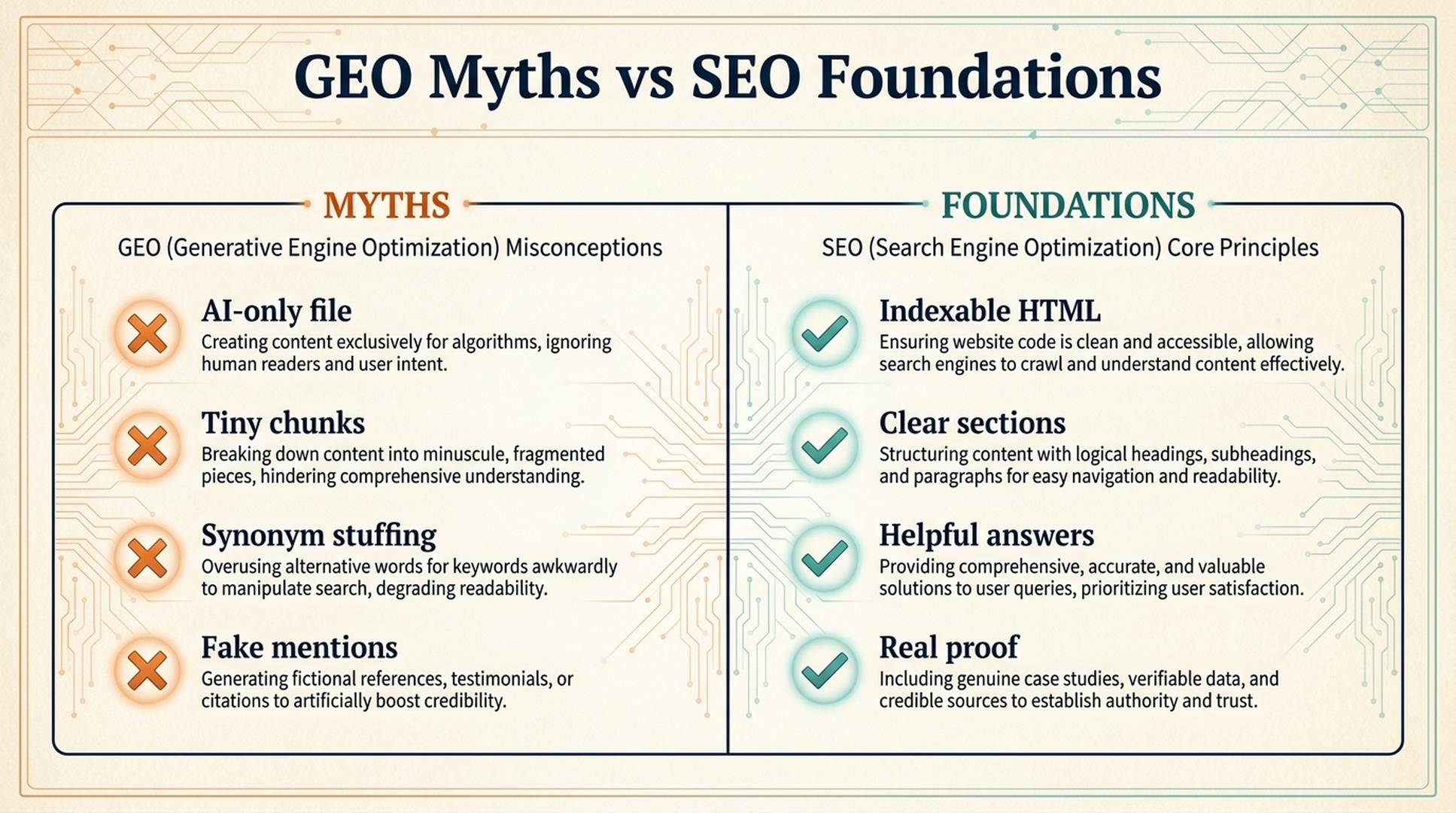
Caption: The GEO work worth keeping in 2026 maps back to SEO foundations: indexable pages, clear sections, useful answers, and real proof.
4. Treat images and video as answer assets
Google's guidance explicitly mentions supporting textual content with high-quality images and videos when applicable. This is not about adding stock art to fill space. It is about giving search and AI systems more evidence of what the page explains.
For a product page, that may mean annotated product photos, demo clips, specification tables, and installation diagrams. For a B2B article, it may mean workflow diagrams, decision trees, data snapshots, and screenshots of real settings.
Alt text should describe the information in the image. "Modern dashboard illustration" is weak. "Diagram showing how query fan-out connects one buyer question to comparison, pricing, review, and implementation pages" is useful.
5. Keep structured data honest
Structured data is not a remote control for AI rankings. It is a way to make visible facts easier to parse. Product markup should match the page. FAQ markup should match visible FAQ text. Organization, article, local business, review, and video data should be accurate.
For ecommerce and local businesses, Google's guidance also points to Merchant Center and Business Profile information. That makes sense. AI answers about availability, price, store hours, or business details are only as good as the data Google can reconcile.
What this means for different teams
Team type | What to prioritize in 2026 | What to avoid |
|---|---|---|
SaaS | Product-led comparison pages, integration pages, implementation guides, technical docs, use-case proof. | Thin "AI search" blog posts that do not connect to product evidence. |
Ecommerce | Merchant Center hygiene, product schema, inventory accuracy, original product media, buying guides. | Duplicate manufacturer descriptions and fake review campaigns. |
Local services | Business Profile accuracy, service-area pages with real constraints, reviews, photos, appointment information. | Doorway pages with near-identical city text. |
Publishers | Expert review process, visible updates, original reporting, charts, source links, topic hubs. | AI rewrites of already-indexed articles. |
Agencies | Client evidence, test methodology, before-and-after audits, clear definitions of what was measured. | Selling GEO as a mysterious layer unrelated to SEO. |
The teams that win will probably not be the ones using the newest acronym. They will be the ones with cleaner sites, better evidence, and faster publishing loops.
Auspia's 2026 workflow: from SEO page to AI-citable source
Use this workflow when refreshing an important page or building a new AI search asset.
- Define the answer target. Write the exact question the page should help answer in AI Overviews, AI Mode, ChatGPT Search, Perplexity, or other answer surfaces.
- Audit eligibility. Confirm crawlability, indexability, snippets, canonical status, rendering, page speed, and internal links.
- Add unique proof. Include first-hand examples, screenshots, data, templates, customer language, product constraints, or field notes.
- Restructure for extraction. Add a concise answer, comparison table, step list, FAQ, and descriptive headings where they help the reader.
- Improve multimodal support. Add one or two original visuals that explain the core idea better than text alone.
- Validate structured data. Make sure schema matches visible content and remove any markup that overstates the page.
- Measure the whole path. Track Search Console performance, assisted conversions, time on page, demo requests, and query classes. AI feature clicks are included in Search Console's Web search type, so do not expect a perfect separate AI dashboard.
This is also where the broader Auspia SEO/GEO/AEO tools can help: use them to check visibility, crawler access, metadata, technical readiness, and content gaps before turning a page into a campaign asset.
A quick 2026 checklist
Use this before publishing or refreshing a page that should compete in AI search.
- The page answers the main question in the first 150 words.
- The page is indexable, crawlable, and eligible for snippets.
- Important content is visible as text in the rendered HTML.
- Internal links connect the page to related hubs, products, and supporting articles.
- The article includes at least one table, checklist, workflow, or original visual when the topic is complex.
- The content includes real experience, not just a summary of other summaries.
- Structured data matches what users can see on the page.
- Images and video have descriptive filenames, captions where useful, and accurate alt text.
- Product or business data is consistent across the website, Merchant Center, and Business Profile where relevant.
- The team has a measurement plan beyond rankings: qualified clicks, engagement, leads, and revenue.
FAQ
Is GEO still worth doing in 2026?
Yes, if GEO means making your brand easier for AI answer systems to discover, understand, verify, and cite. No, if it means buying a package of fake mentions, AI-only files, or keyword-stuffed rewrites.
Does Google require new technical markup for AI Overviews or AI Mode?
Google's Search Central documentation says there are no additional technical requirements beyond being indexed and eligible to appear in Search with a snippet. Standard SEO fundamentals still apply.
Should every website create an llms.txt file?
It can be useful as a documentation layer for some AI crawlers and developer audiences, but it should not replace crawlable HTML, internal links, schema, sitemaps, and strong page content. Treat it as optional support, not the core strategy.
How should teams measure AI search performance?
Start with Search Console, because Google reports AI feature traffic inside overall Web search performance. Then combine it with analytics, CRM, and conversion data. The goal is not only AI citations. The goal is qualified demand.
What is the fastest GEO win for an existing SEO page?
Add a concise answer near the top, strengthen first-hand evidence, improve internal links, and add one useful visual or table. Then verify the page can be crawled, indexed, rendered, and shown with a snippet.
The bottom line
AI search changes how answers are packaged. It does not remove the need for trustworthy pages.
The safest 2026 strategy is to stop treating GEO as a separate magic channel. Build pages that search systems can access, that users can trust, and that AI answer systems can quote without guessing. That is not old-school SEO. It is SEO adapted to a search experience where the answer may appear before the click.