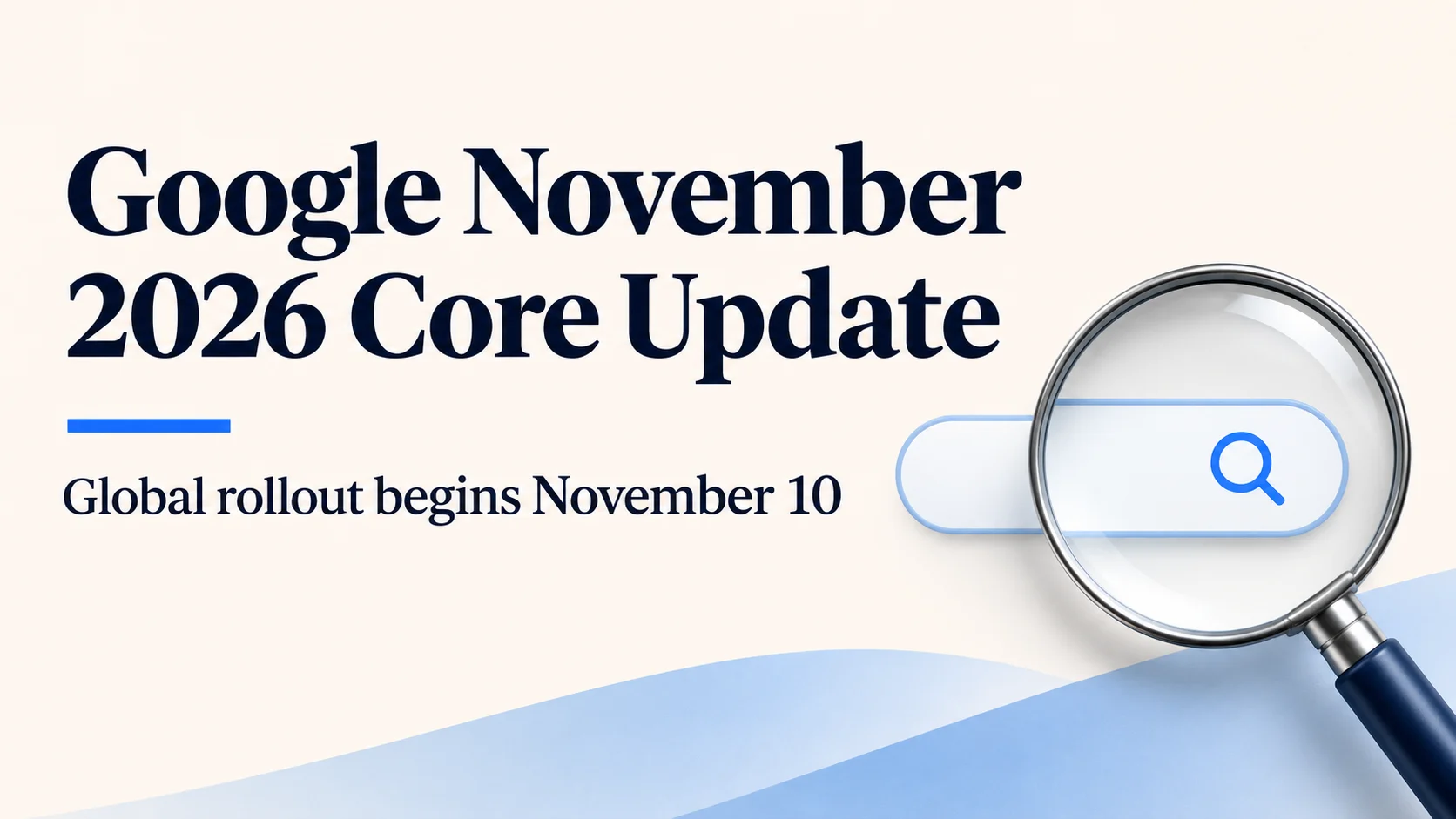
Google began rolling out its November 2026 core update on November 10, bringing a broad change to its Search ranking systems worldwide and across all languages. The rollout may take up to two weeks, according to the Google Search Status Dashboard, which had not listed a completion time when checked on November 12.
The update began at 10:06 a.m. Pacific Standard Time on November 10. In a public announcement, Google Search Central described it as a regular update intended to better surface relevant, satisfying content from all types of sites. Google said it would update its ranking release history when the rollout is complete.
A global rollout ahead of Black Friday
The status dashboard lists Ranking as the affected Search system and says the update applies globally and to all languages. The announcement does not identify a particular country, language or category of website as the focus of the update.
If the rollout takes the full two weeks estimated by Google, that would put completion around November 24, Pacific time. That is three calendar days before Black Friday on November 27. November 24 is a calculation based on Google's estimate, however, not a confirmed completion date; the actual end time will appear on the status dashboard when Google records it.
The timing places the rollout in the lead-up to Black Friday and Cyber Monday, a period when retailers and publishers may already be monitoring seasonal search traffic. Google has not said that this update specifically targets ecommerce sites, holiday promotions or Black Friday content.
The ranking update history lists two earlier Google Search core updates in 2026: one that began on March 27 and another on May 21. The March rollout lasted 12 days and four hours, while the May rollout lasted 11 days and 21 hours. Those earlier durations do not establish when the November update will finish.
What Google says a core update does
In its standing core update documentation, Google says it makes significant, broad changes to its search algorithms and systems several times a year. The company says core updates are designed to help it present helpful and reliable results as content on the web changes.
The changes are broad and do not target individual pages or specific sites, according to Google. A page that falls in the results after a core update has not necessarily violated a policy or become defective. Google's documentation compares the process to revisiting a list of restaurant recommendations: previously recommended places can move down when other options enter the list or are reassessed.
The November announcement does not identify the specific ranking signals, weights or technical changes involved. Google has also not provided a percentage of searches affected or published a breakdown of the update's impact by industry or language.
Google's guidance on measuring changes
Google's general guidance asks site owners to confirm that a core update has finished before assessing a potential effect in Search Console. It recommends waiting at least one full week after completion, then comparing that week with a week before the rollout began. The company also recommends reviewing the queries and pages that changed and analyzing search types, such as web, images, video and news, separately.
For a small movement, Google's example is a page falling from position two to position four. Its documentation says a drastic response is unnecessary and advises against radically changing content that is already performing well. For a larger drop, such as position four to position 29, Google recommends a deeper assessment. These positions are examples in the guidance, rather than official thresholds for identifying a penalty.
Google's separate guide to investigating Search traffic drops lists several other possible causes, including technical problems, security issues, manual actions, site moves and changes in search demand. It notes that seasonal patterns can affect queries and suggests using Search Console and Google Trends to examine them. A traffic change that coincides with a core update is therefore not, on its own, proof of its cause.
How Google describes content assessment and recovery
For a sustained, substantial decline, Google's core update documentation recommends evaluating the site as a whole as well as the pages most affected. Its people-first content guidance includes questions about original reporting or analysis, accuracy, evidence of expertise, sourcing, and whether a page gives its intended audience a satisfying answer.
Google says it does not have a preferred word count. It also cautions against changing page dates without substantial updates or adding and removing large amounts of content primarily to make a site appear fresh. In the core update documentation, Google describes deleting content as a last resort when it cannot be salvaged, while meaningful rewriting or restructuring may make content easier for an audience to use.
The company says some improvements may affect Search within days, while its systems can take several months to establish that a site is producing helpful content consistently. A site may see changes between major core updates as Google continues to make smaller updates, but Google does not guarantee that any particular change will lead to a noticeable recovery.
What remains unconfirmed
Google has not announced the rollout's end date or reported the extent of its effects on rankings and traffic. Its general documentation explains how core updates work and how to investigate a decline; it does not establish which sites will gain or lose visibility in this particular rollout.
Sources
- Google Search Status Dashboard: November 2026 core update
- Google Search Central: public rollout announcement
- Google Search Status Dashboard: ranking update history
- Google Search Central: core updates and your website
- Google Search Central: creating helpful, reliable, people-first content
- Google Search Central: debugging drops in Google Search traffic