Executive summary
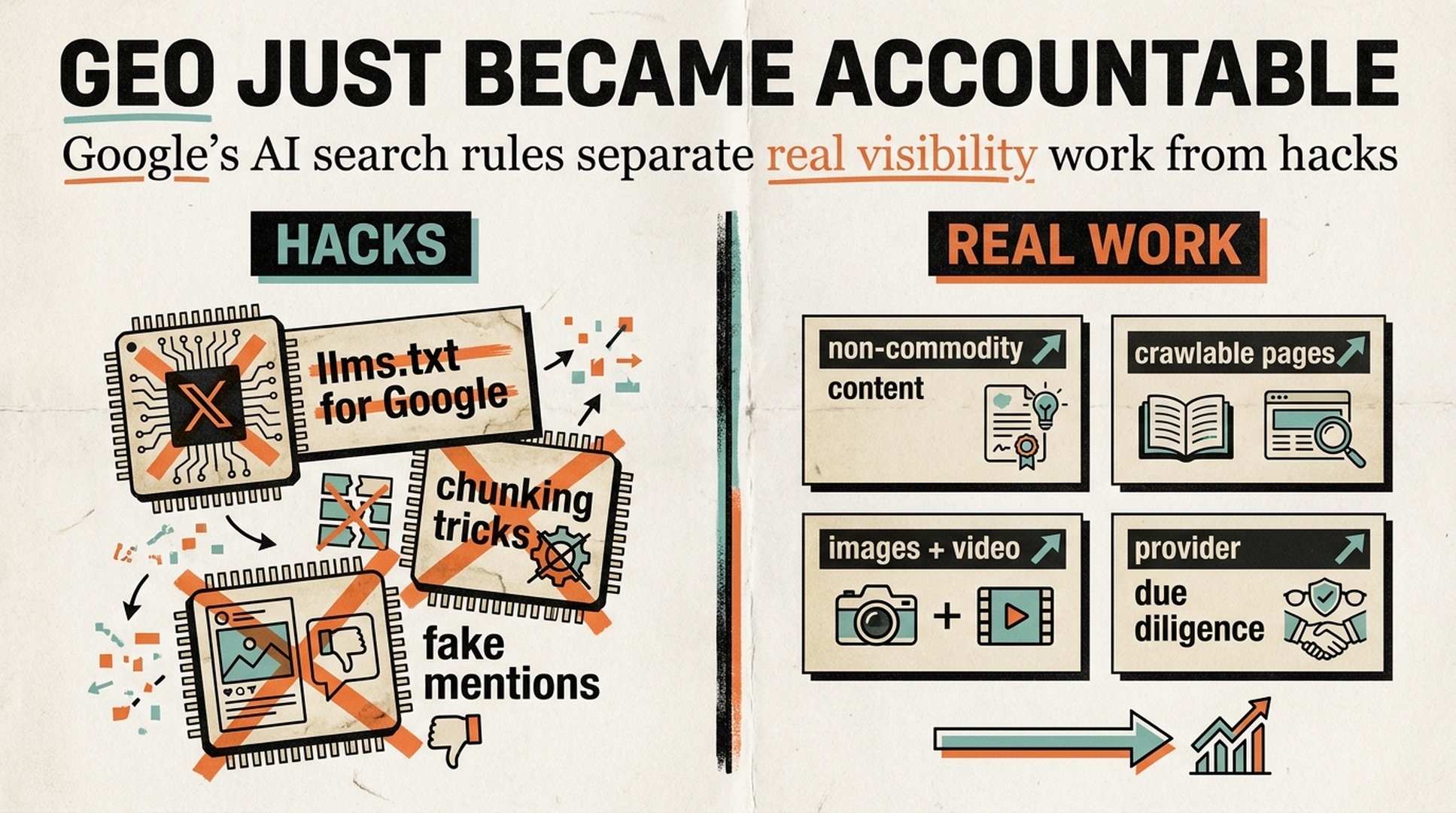
Google's recent Search documentation updates make one thing harder to ignore: GEO is real, but most GEO shortcuts are not.
The useful work still looks a lot like serious SEO. Make pages crawlable. Publish experience that cannot be copied from a generic prompt. Use images, video, and structured pages that help both people and machines understand what you know. Then measure whether AI answers mention, cite, or ignore your brand.
That may sound less exciting than a secret "AI ranking hack." Good. The GEO market needed less theater and more accountability.
What changed
The source article that inspired this piece framed the moment well: for almost two years, Generative Engine Optimization has been sold as if it were a separate discipline with hidden rules. That made it easy for vendors to package anxiety: special files, prompt tricks, artificial brand mentions, and promises that a brand can be "placed" inside AI answers.
Google's newer AI Search guidance pushes in a different direction. The message is plain: optimizing for generative AI experiences on Google Search is still part of optimizing for Search. It is not a magic side channel.
Google's business-owner guidance also matters because it moves the conversation from theory to vendor selection. If a company sells GEO or AEO services, buyers should ask whether the recommendations align with official search guidance. If the answer is vague, that is useful information.
The bigger point is not that Google controls every AI search surface. It does not. ChatGPT, Perplexity, Claude, Gemini, Bing Copilot, and vertical AI tools all have different retrieval and citation behavior. The point is that one of the largest search platforms is putting boundaries around the market. That changes how serious teams should evaluate GEO work.
Why GEO became noisy so quickly
The demand is real. Users are changing how they research vendors, products, and advice.
A buyer who once searched "best project management software for agencies" might now ask ChatGPT, Perplexity, or an AI Overview for a shortlist. The answer may contain three brands, two citations, and one sentence that decides whether your company enters the consideration set. The user may never click ten blue links.
That creates a real visibility problem for companies that depend on organic discovery. But real demand attracts lazy supply. The market quickly filled with claims that sounded technical enough to sell, but not specific enough to verify.
Here is the uncomfortable version:
Claim sold as GEO | What a buyer should ask |
|---|---|
"We will add llms.txt and make you AI-ready" | Which AI systems use it for ranking or citation, and what evidence supports that? |
"We chunk your content for AI" | Does this improve crawlability, retrieval, or user comprehension, or is it just formatting? |
"We create brand mentions" | Are those mentions editorially earned, useful to users, and visible on trusted pages? |
"We guarantee AI recommendations" | Which platform, which prompts, which market, and for how long? |
A serious GEO program can answer these questions. A weak one changes the subject.
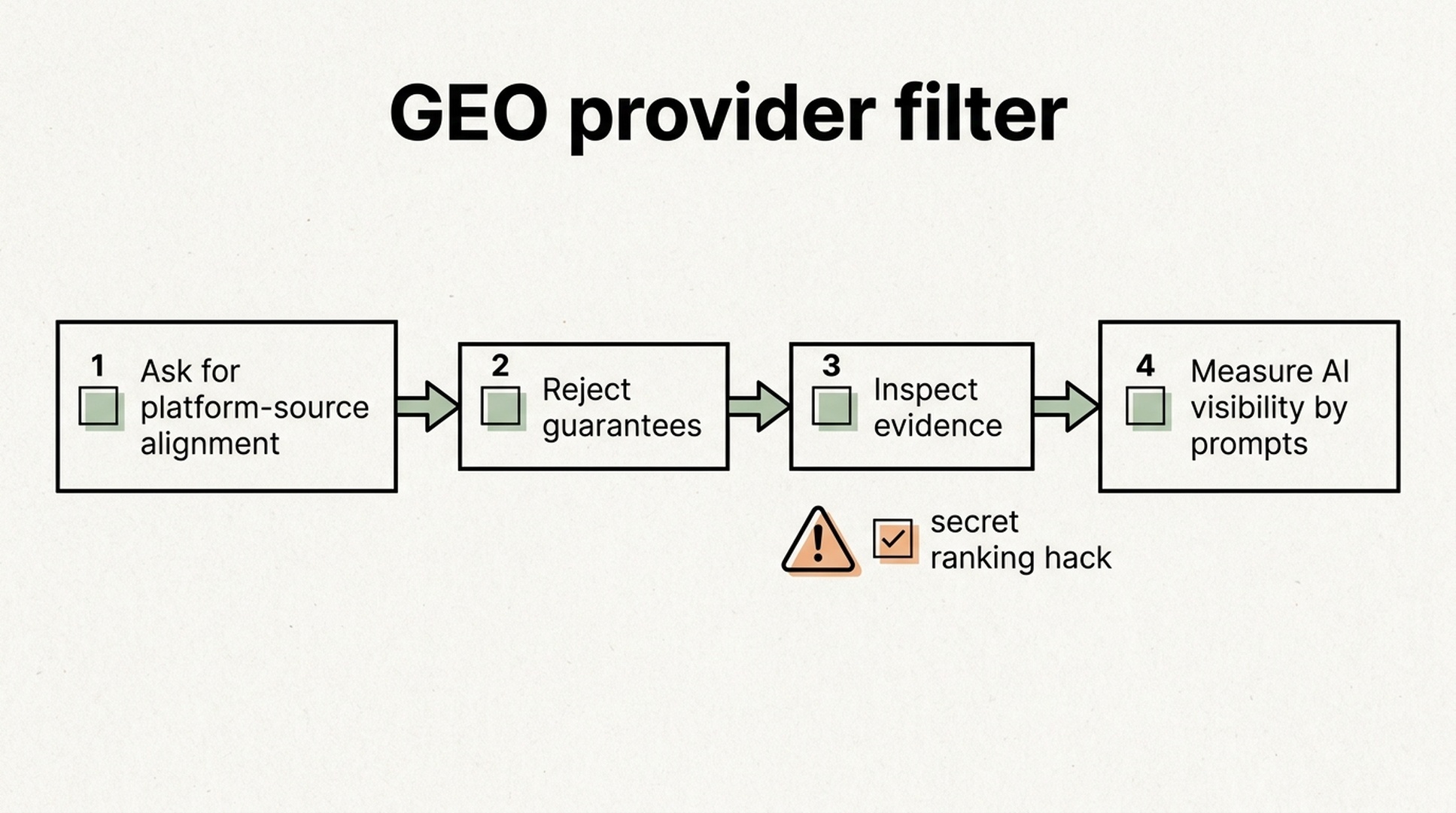
Caption: A practical filter for evaluating GEO providers: ask for platform alignment, reject guarantees, inspect evidence, and measure real AI visibility.
What still works
If you strip away the hype, three workstreams matter most.
First, publish non-commodity content. This is the part many teams dislike because it cannot be outsourced cheaply. AI systems do not need another article that says "SEO is important for business growth." They already have thousands. They are more likely to need original benchmarks, customer patterns, field notes, pricing research, implementation examples, expert commentary, and pages that answer a specific question better than the rest of the web.
Second, make the content technically accessible. Crawlers still need pages they can fetch, parse, index, and understand. If your best insights live inside JavaScript-only experiences, gated PDFs, image-only slides, or pages blocked by robots rules, do not blame the AI layer first. Fix the access layer.
Third, use media as evidence, not decoration. Search and AI answer interfaces are becoming more visual. Screenshots, diagrams, comparison tables, short videos, and annotated workflows help explain what text alone struggles to prove. A diagram can also make your page easier for humans to remember and for editors to cite.
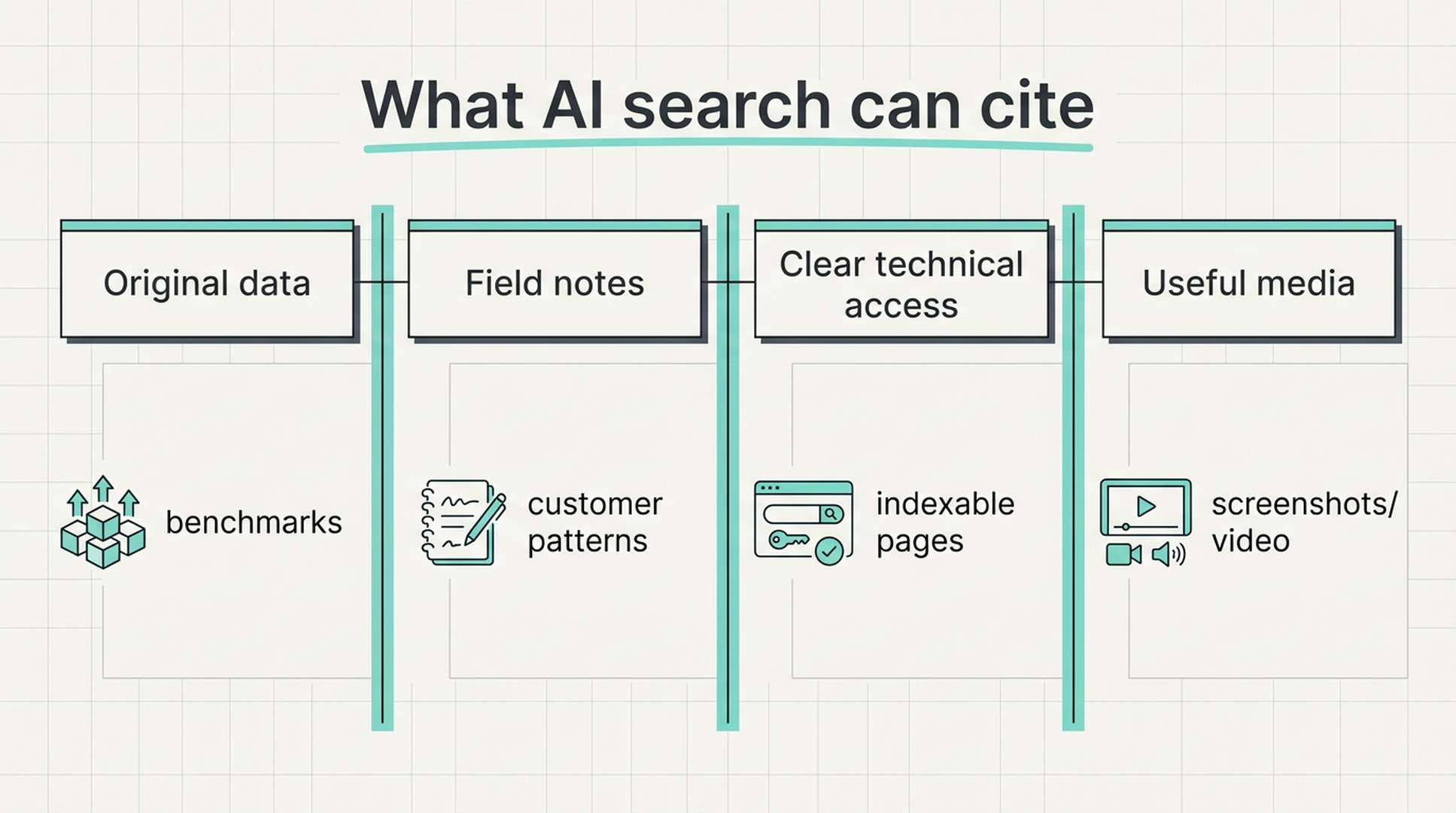
Caption: AI search visibility depends on assets worth citing, not just pages that repeat common definitions.
A better GEO checklist for buyers
If you are a founder, CMO, or growth lead talking to a GEO vendor, use a sharper checklist than "can you get us into ChatGPT?"
Ask these questions instead:
- Which AI answer surfaces are you optimizing for: Google AI Overviews, ChatGPT, Perplexity, Gemini, Bing Copilot, or a vertical assistant?
- Which prompts represent our real buyer journeys?
- What does the current baseline show? Are we mentioned, cited, misdescribed, or absent?
- Which recommendations are based on platform documentation, observed retrieval behavior, or controlled tests?
- What content will we create that competitors cannot easily copy?
- Which technical issues prevent crawlers or AI systems from accessing our strongest pages?
- How will we separate brand visibility, citation visibility, referral traffic, and assisted conversions?
- What will you not promise?
That last question matters. A good provider should be able to say no. No, they cannot guarantee your brand appears in every AI answer. No, they cannot control a model's generated wording. No, synthetic mentions on low-quality pages are not a durable moat.
This is also where tools help. A basic starting point is to run your most important buyer prompts through an AI Search Visibility Checker, record whether your brand appears, and repeat the test after you improve content and technical access.
What content teams should change this quarter
Most content teams do not need a separate GEO department. They need a stricter editorial bar.
Replace generic explainers with assets that carry proof:
Weak asset | Stronger GEO-ready asset |
|---|---|
"What is customer onboarding?" | "Customer onboarding benchmarks from 42 B2B SaaS demos" |
"Best CRM tools" | "How we evaluated CRM data quality across five migration projects" |
"SEO checklist" | "Technical SEO fixes that changed crawl behavior on a 10,000-page site" |
"AI search guide" | "Prompt set and visibility baseline for vendor discovery in cybersecurity" |
This does not mean every post needs proprietary data. But every important page should have some reason to exist beyond keyword coverage: a field observation, a real workflow, a clear example, an expert quote, a test result, or a visual explanation.
For AI visibility, the worst content is not bad writing. It is interchangeable writing. If a model can generate the same article without knowing your company exists, the article is probably not a citation asset.
What GEO teams should stop selling
There is a mature version of GEO, and there is a carnival version.
The mature version audits AI answer visibility, maps buyer prompts, improves crawlable content, strengthens entity clarity, earns third-party references, and builds pages with evidence. It treats AI search as a measurement and content-quality problem.
The carnival version sells certainty where no certainty exists. It talks about secret model triggers. It hides behind screenshots from one prompt on one day. It treats llms.txt or schema tweaks as a complete strategy. It promises rankings inside systems that do not even expose stable ranking positions.
The market is moving toward the first version. Buyers are getting better questions. Platforms are publishing more guidance. Weak services will still exist, but they will be easier to spot.
Auspia's take
GEO is not fake. The fake part is the idea that AI visibility can be hacked without doing the hard editorial and technical work.
For most companies, the right operating model is simple:
- Track the prompts that matter to your buyers.
- Record how AI systems describe your category and brand.
- Fix crawl, indexation, and page clarity issues.
- Publish content with original evidence and useful media.
- Build credible third-party mentions where real buyers already research.
- Re-test visibility monthly, not hourly.
This sits naturally beside GEO, SEO, and AEO work. The labels matter less than the operating discipline.
FAQ
Is GEO separate from SEO?
GEO is best treated as an extension of SEO and content strategy for AI answer surfaces. It has different measurement questions, but the foundations still include crawlability, authority, relevance, useful content, and evidence.
Does llms.txt improve Google AI search visibility?
Do not treat llms.txt as a magic ranking lever for Google AI experiences. If you use it, use it as a supplemental machine-readable guide, not as a replacement for crawlable pages, strong content, and clear site architecture.
Can a GEO agency guarantee that ChatGPT or Google will recommend my brand?
Be careful with any guarantee. AI answers vary by prompt, location, user context, model version, retrieval source, and time. A credible provider can improve the inputs and measure visibility. They cannot fully control generated answers.
What is the first GEO task a company should do?
Build a prompt baseline. List 20 to 50 real buyer questions, test them across the AI systems your customers use, and record whether your brand is mentioned, cited, absent, or misrepresented. That baseline tells you where to invest.
What kind of content is most useful for AI search visibility?
Original and specific content tends to be more useful than generic summaries: benchmarks, implementation notes, comparison evidence, expert analysis, customer patterns, annotated screenshots, and pages that answer narrow buyer questions clearly.