The short version
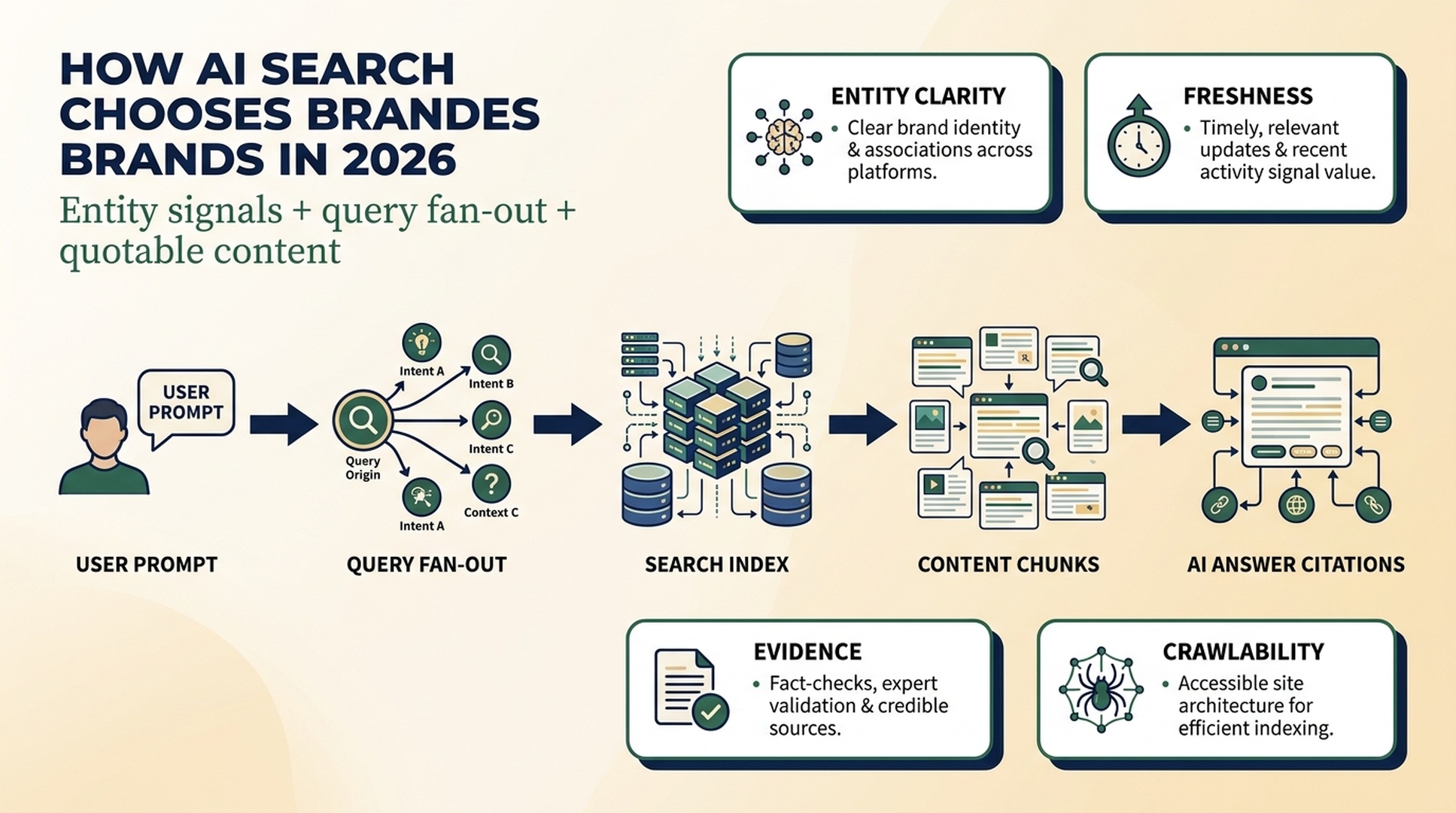
AI search does not "pick" your brand because you added one magic file, published a press release, or optimized for one clever prompt. Most AI answers are built through a more ordinary chain: the model starts with what it already knows, decides whether it needs fresh sources, fans a broad user question into smaller search queries, retrieves a few useful passages, and then writes an answer from the passages it trusts.
That is why GEO in 2026 is less mysterious than it sounds. The teams that win citations in ChatGPT-style search, Perplexity, Gemini, Copilot, and Google AI answers usually do five things well:
- They make the brand a clear entity, not a vague homepage with a product name.
- They cover the real query space around a topic, not just one head keyword.
- They write compact, self-contained content blocks that can be lifted into an answer.
- They keep proof, comparisons, data, and examples fresh.
- They build enough external mentions that the brand looks real outside its own site.
Auspia's view is simple: GEO is not a replacement for SEO. It is SEO under a new distribution layer, where AI systems summarize, compress, personalize, and cite only a tiny portion of the web.
What counts as AI search in 2026
When we say "AI search," we are talking about several overlapping products:
- ChatGPT-style answers with web search enabled.
- Perplexity and other answer engines that show citations by default.
- Gemini, Copilot, Claude search workflows, and similar conversational research tools.
- Google AI Overviews and AI Mode-style experiences inside the search results page.
The user experience is different from classic Google. A person no longer types one keyword, scans ten blue links, and clicks three websites. They ask a messy question, add constraints, push back on the answer, and often finish the task without visiting a site at all.
For growth teams, the practical question changes from "Can we rank for this keyword?" to "When an AI system writes the answer, does it use our ideas, our data, our examples, or our brand?"
That question has two parts: being retrieved and being cited. You can be retrieved without being cited. You can also be mentioned without getting the link. GEO work has to account for both.
The first layer: the model's memory of the world
Large language models are trained on large collections of text. That training gives them a rough map of entities, categories, relationships, and common associations. A model may already "know" that certain companies are project management tools, certain publishers are trusted for software reviews, and certain frameworks belong to a specific industry.
This does not mean the model has perfect knowledge. It also does not mean the model is current. Training data has cutoffs, web indexes change, and brand reputation moves faster than model pretraining.
Still, entity memory matters. If your brand appears consistently across your own site, review pages, partner pages, public profiles, comparison articles, documentation, and structured data, it becomes easier for machines to place you in the right category.
For a B2B SaaS company, this means the basics are still worth doing:
Entity signal | What AI systems need to understand | Practical action |
|---|---|---|
Brand name | Who you are | Use one consistent name across site, profiles, docs, and listings |
Category | What kind of solution you are | State the category in page titles, intro blocks, schema, and comparison pages |
Use cases | When someone should choose you | Build pages for jobs, industries, workflows, and buyer pain points |
Evidence | Why the claim is believable | Publish benchmarks, customer examples, docs, screenshots, and third-party proof |
Relationships | Who connects to you | Earn mentions from partners, communities, directories, and review sites |
This is entity SEO with a GEO outcome. The goal is not to trick a model. The goal is to remove ambiguity.
The second layer: when AI decides to search the web
An AI system may answer from its internal knowledge, but many search-like experiences retrieve external sources before writing. That retrieval step is especially likely when the query asks for:
- recent information, such as "best tools for 2026" or "latest Google update";
- specific details, such as pricing, features, release notes, or local availability;
- evidence, citations, sources, or comparisons;
- niche brands that are unlikely to be fully represented in the model's training data;
- high-stakes or fast-changing topics where stale answers are risky.
Once retrieval starts, the AI system usually does something close to RAG, or retrieval-augmented generation. It searches, fetches candidate pages, extracts passages, inserts those passages into the answer context, and then writes the response.
This is where old-fashioned SEO comes back into the room. If your pages cannot be crawled, do not rank for the supporting searches, bury the useful answer halfway down the page, or lack credible supporting evidence, the AI system has little reason to use you.
If you want a quick diagnostic, run the same topic through an AI Search Visibility Checker and compare which sources appear across several prompts. Do not obsess over one prompt. Look for repeated inclusion patterns.
Query fan-out: the hidden bridge between SEO and GEO
Most AI search prompts are too long, conversational, and constraint-heavy to behave like normal keywords.
A user might ask:
"We are a mid-market B2B SaaS company selling analytics to ecommerce teams. We need a six-month content plan that improves demo bookings, supports sales, and helps us show up in AI search. What should we publish first?"
An AI system is unlikely to search that exact sentence once and call it a day. It may break the prompt into a fan of smaller searches, such as:
- B2B SaaS content strategy for demo bookings
- ecommerce analytics software content examples
- SaaS comparison page SEO best practices
- AI search optimization for B2B SaaS
- bottom funnel content for sales enablement
- six month SEO content roadmap SaaS
That is query fan-out. One messy prompt becomes a set of cleaner sub-queries. The final answer is assembled from the sources retrieved across that fan.
This is why "prompt ranking" is a weak mental model. You cannot build one page for every possible conversational prompt. You can, however, build a topic cluster that covers the sub-queries an AI system is likely to generate.
For GEO work, keyword research becomes prompt decomposition:
- Start with the buyer's real question.
- Break it into smaller intents: definition, comparison, workflow, cost, risk, tools, examples, alternatives.
- Check which pages already rank for those intents.
- Build or improve pages that answer each intent clearly.
- Add internal links so the cluster reads like a connected body of knowledge.
That is still SEO. The difference is that the final consumer of the cluster may be an AI answer system before it is a human visitor.
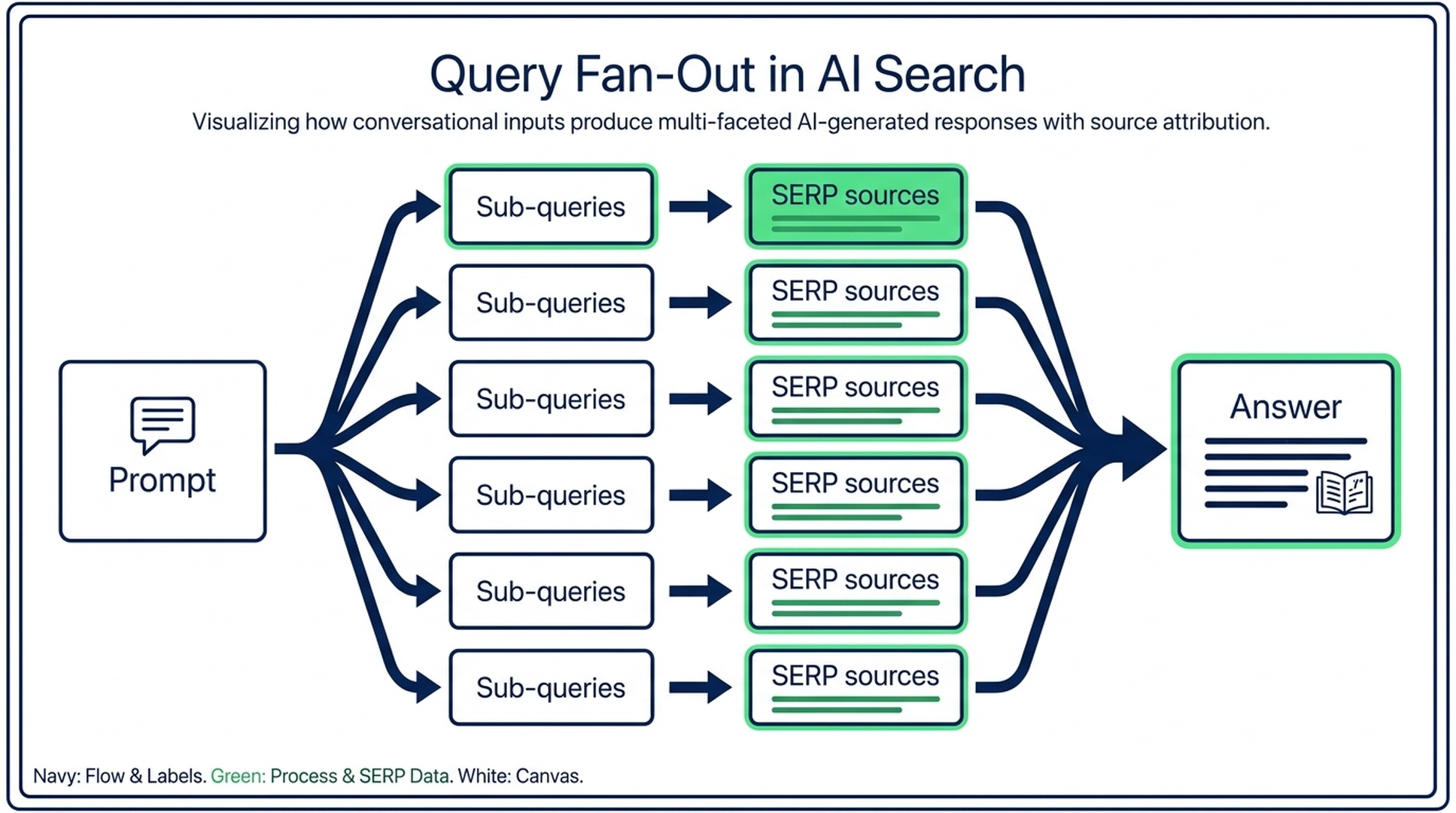
Query fan-out turns one conversational prompt into several smaller retrieval targets. GEO work should cover the intent cluster, not one exact prompt.
Retrieval is chunk-based, so your best paragraph matters
AI systems do not always read your full page in the way a patient human reader would. Long pages are often split into smaller chunks. The retrieval layer then selects the chunks that look most relevant to the question.
That creates a brutal but useful rule: every important section should make sense on its own.
A weak section starts with background, wanders through context, and only reaches the answer after five paragraphs. A strong section gives the answer first, then adds nuance, examples, and constraints.
Use this pattern for quotable blocks:
- Begin with a direct claim or definition.
- Include the entity, category, and use case in the same paragraph.
- Add one specific proof point, example, or condition.
- Avoid pronouns that depend on the previous section.
- Keep the paragraph useful even if it is extracted alone.
Here is the difference.
Weak block:
"This is becoming more important as platforms change and buyers behave differently. Because of this, companies should think about how their content is organized."
Stronger block:
"For B2B SaaS teams, GEO-ready content should answer one narrow buyer question per section, include a clear definition or recommendation in the first two sentences, and support the claim with a comparison, workflow, example, or data point."
The second block is easier for a search engine to index, easier for an AI system to retrieve, and easier for a human to trust.
Why AI cites someone else instead of you
A frustrating GEO moment: you publish a good article, ask an AI tool a relevant question, and the citation goes to a competitor, a review site, or a random blog post.
That can happen for several reasons.
The cited page may rank better for one of the fan-out queries, even if it does not rank for the original prompt. It may contain a tighter paragraph that maps directly to one sentence in the answer. It may be newer. It may come from a site the system sees as more independent. Or the model may be trying to diversify citations rather than quote three pages from the same domain.
This is why citations are not just a content quality problem. They are an evidence design problem.
If you want to be cited, publish assets that an answer engine can safely point to:
Asset type | Why it earns citations | Example |
|---|---|---|
Definitions | Easy to map to explanatory answers | "What is query fan-out?" |
Comparison tables | Useful for recommendation prompts | "GEO vs SEO vs AEO" |
Benchmarks | Specific and sourceable | "AI visibility audit results by industry" |
Checklists | Easy to extract into next steps | "GEO readiness checklist for SaaS pages" |
Method pages | Strong fit for how-to answers | "How to structure quotable content blocks" |
Tool pages | Good for action-oriented prompts | "Check whether AI crawlers can access your site" |
For technical access checks, a page like Auspia's Robots.txt AI Crawler Checker is useful because it turns an abstract GEO issue into a verifiable action.
Personalization makes single-prompt testing unreliable
Two people can ask the same AI search question and get different answers. The system may use location, current conversation context, memory settings, language, device, account history, or product-specific policies. It may also vary citations across runs.
That does not make GEO measurement impossible. It means the unit of measurement should be a prompt set, not a single prompt.
A practical 2026 measurement setup looks like this:
- Track 30 to 100 prompts across the buyer journey.
- Include definition, comparison, alternative, problem, use-case, and tool prompts.
- Run prompts regularly, not once.
- Record brand mentions, linked citations, sentiment, competitors, and source domains.
- Separate "mentioned in the answer" from "cited as a source."
- Compare visibility by topic cluster, not only by brand name.
The strongest teams will treat AI visibility like share of voice. It is noisy at the prompt level but meaningful across a portfolio.
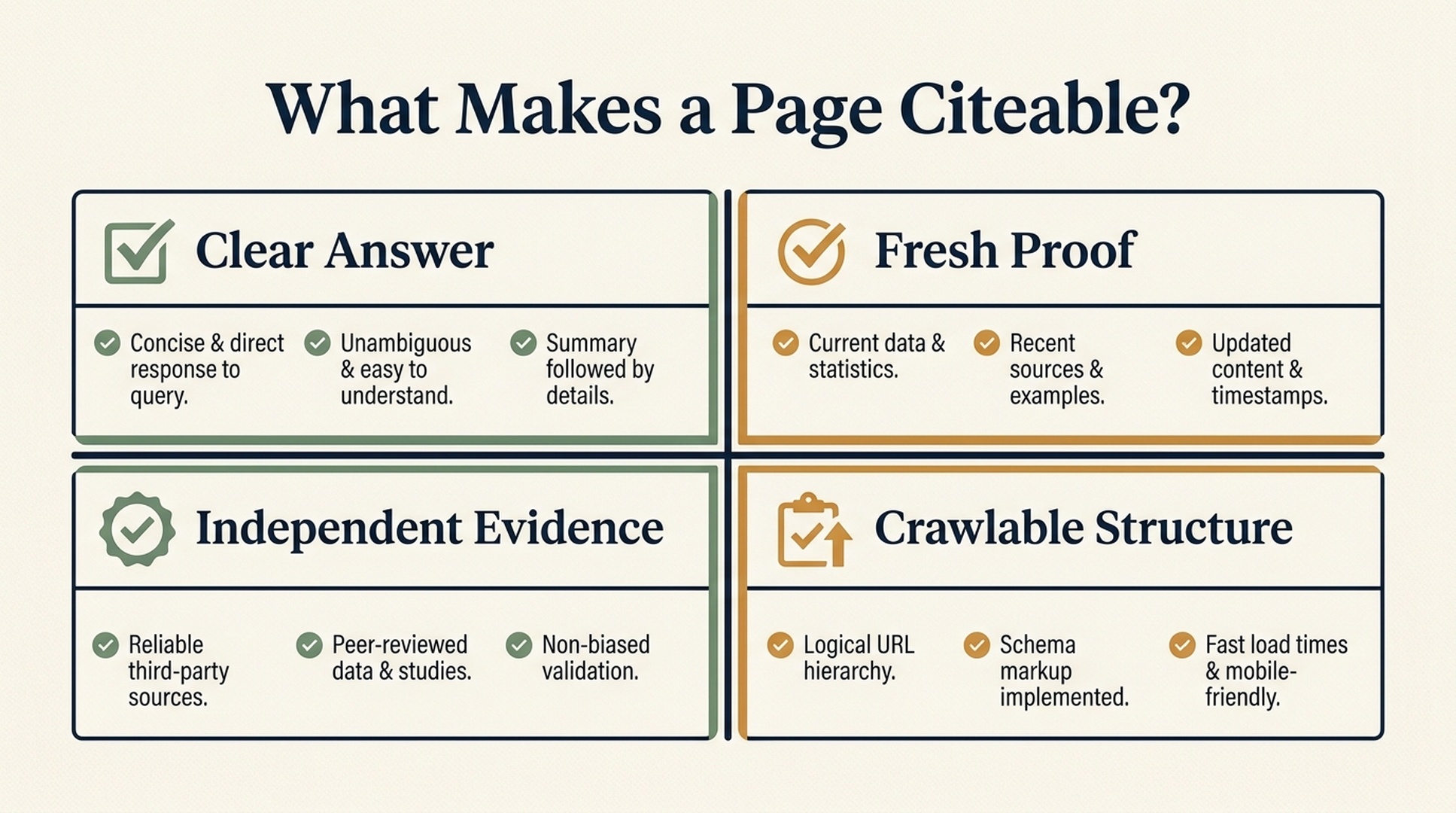
A citeable page gives answer engines a short, current, verifiable passage they can safely point to.
A 2026 GEO workflow that still respects SEO
Here is the workflow we recommend for teams that want AI visibility without falling for GEO hype.
1. Build the entity base
Make your brand easy to identify. Align your homepage, about page, product pages, docs, schema, social profiles, review listings, marketplace listings, and partner mentions. Use consistent naming and category language.
2. Map prompt clusters to search intents
Take real sales calls, support tickets, community questions, and search queries. Turn them into prompt clusters. Then decompose each cluster into the smaller searches an AI system might run.
3. Audit whether you already rank for the fan-out queries
If you do not appear in the classic SERP for the sub-query, you are less likely to be retrieved during AI answer construction. Use standard SEO tools, Search Console, and manual SERP checks.
4. Create quotable content blocks
Rewrite important sections so the first paragraph answers the question directly. Add comparison tables, definitions, steps, examples, and constraints. Do not bury the useful answer under brand copy.
5. Add proof outside your own site
AI systems have reasons to distrust purely self-published claims. Encourage customer reviews, partner content, community mentions, expert roundups, directory profiles, public case studies, and earned media where appropriate. The point is corroboration, not spam.
6. Keep freshness visible
For fast-changing topics, add visible update dates, update notes, versioned comparisons, and current screenshots. In 2026, stale content is a real disadvantage for tool lists, AI search tactics, and platform guidance.
7. Measure across prompts and competitors
Do not ask one tool one question and declare victory or failure. Build a small prompt library, run it consistently, and track whether your brand appears more often in the answers that matter.
Common GEO myths to retire in 2026
Myth 1: GEO is completely separate from SEO.
Reality: AI search still relies heavily on web retrieval, search indexes, link graphs, content quality, entity recognition, and ranking-like systems. GEO changes the packaging and measurement, but the foundation is familiar.
Myth 2: You can optimize for one exact AI prompt.
Reality: AI systems rewrite and fan out prompts. The better target is the underlying intent cluster.
Myth 3: Adding an llms.txt file is enough.
Reality: Access files can help clarify crawler behavior, but they do not replace crawlable pages, strong content, external evidence, and brand authority.
Myth 4: AI citations are the only goal.
Reality: Mentions without links still shape awareness. Links matter, but answer inclusion, sentiment, and category association also matter.
Myth 5: More content automatically means more AI visibility.
Reality: Thin clusters create noise. Compact, well-structured, evidence-backed content is more useful than 100 near-duplicate posts.
Auspia takeaway
The calm way to approach GEO in 2026 is to stop treating AI search as a black box and start treating it as a compressed retrieval system.
It retrieves from the web. It breaks big questions into smaller ones. It reads chunks, not your whole brand story. It prefers answers that are clear, current, and supported by evidence. Then it rewrites everything into a short response where only a few sources get visible credit.
That is inconvenient, but it is also actionable.
If you already have solid SEO fundamentals, GEO is a sharpening exercise: make the entity clearer, the topic cluster fuller, the paragraphs more quotable, and the evidence easier to verify. If your SEO foundation is weak, GEO will expose the gaps faster.
Quick checklist
Use this checklist before you call a page GEO-ready:
- The page answers one primary question in the first section.
- The brand, product category, and use case are clear without reading the navigation.
- Each major section can stand alone as a retrieved passage.
- The page includes at least one definition, table, workflow, checklist, or comparison.
- Claims are supported by screenshots, examples, data, docs, or external references.
- The page is crawlable by search engines and relevant AI crawlers.
- The article has a visible update date when freshness matters.
- Related pages link together as a topic cluster.
- The page has a reason to be cited beyond "we sell this."
FAQ
What is GEO in 2026?
GEO, or generative engine optimization, is the practice of making a brand, page, or content asset easier for AI answer systems to retrieve, understand, mention, and cite. In 2026, GEO usually builds on SEO, entity clarity, content structure, freshness, and third-party proof.
How does AI search choose which brands to mention?
AI search systems may use the model's existing entity knowledge, live web retrieval, query fan-out, passage relevance, freshness, source diversity, and user context. No single factor guarantees a mention.
Is GEO different from SEO?
GEO is different in measurement and output, because the result is often an AI answer rather than a list of links. But the inputs overlap heavily with SEO: crawlability, rankings, content quality, entity signals, links, and trustworthy references.
Why does an AI answer cite a competitor when my article is better?
The competitor may rank for one of the sub-queries created during query fan-out, have a more directly quotable passage, be newer, provide stronger evidence, or come from a source type the system wants for citation diversity.
How should I measure AI search visibility?
Track a prompt library over time. Measure brand mentions, linked citations, competitors, source domains, sentiment, and topic coverage. Avoid making decisions from one prompt, one account, or one run.