Short answer
GEO does not replace SEO. It covers a different moment in the customer journey: the moment when someone asks an AI system for a recommendation and accepts the answer without opening ten tabs.
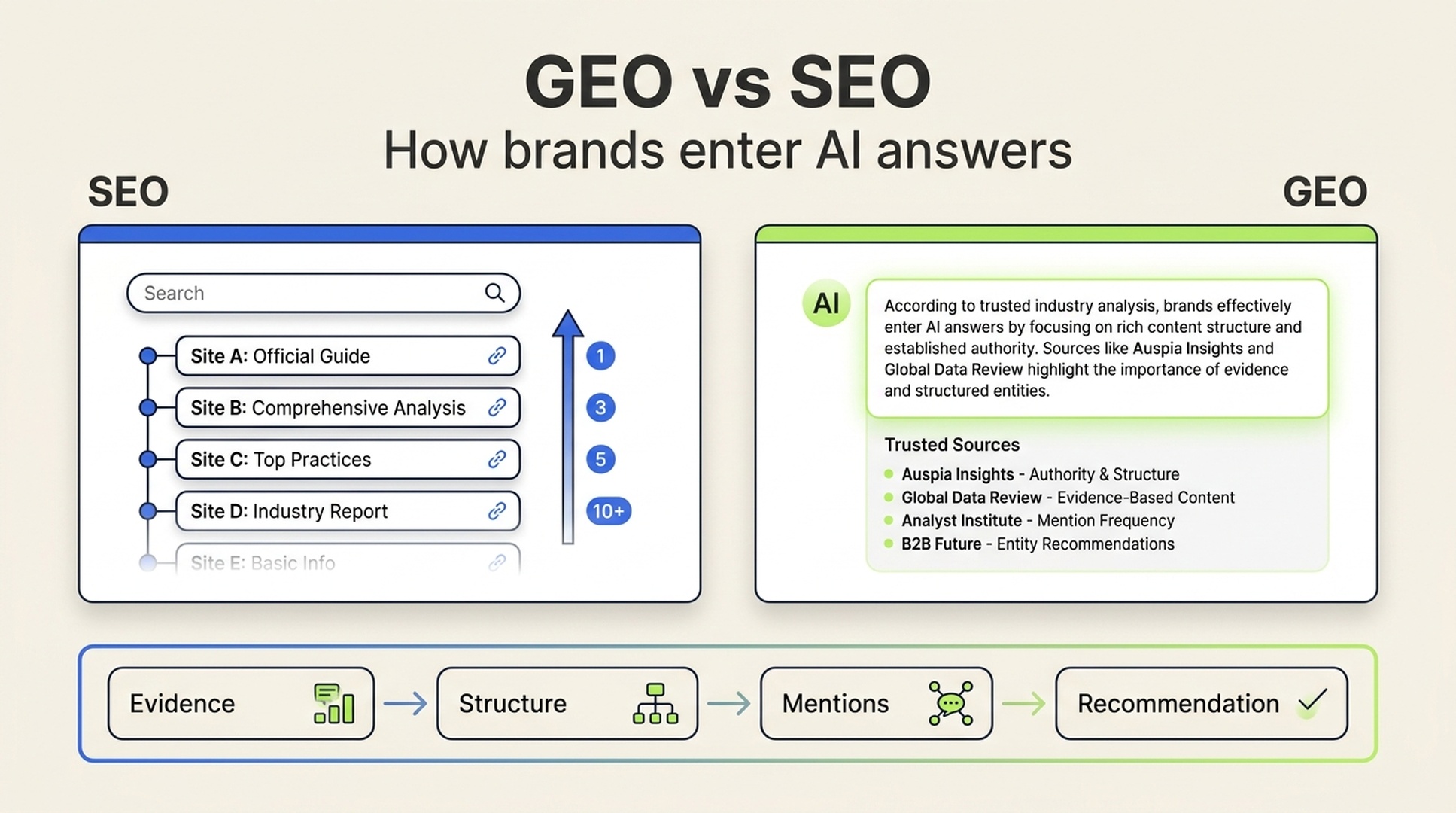
SEO helps a page earn visibility in search results. GEO, or Generative Engine Optimization, helps a brand become a credible part of AI-generated answers. The practical work overlaps, but the target is different. Search rewards rankings and clicks. AI answer systems reward clear entities, consistent evidence, useful comparison content, and corroboration across sources.
If your buyers still search Google, keep doing SEO. If they ask ChatGPT, Gemini, Perplexity, Claude, Copilot, or an AI search experience "which tool should I use?" you also need GEO.
Why teams are suddenly asking about GEO
A lot of companies are noticing the same uncomfortable pattern. Their website ranks for known keywords, but when a prospect asks an AI assistant for "best software for X" or "which agency can help with Y", the brand disappears.
That gap matters because AI answers compress the discovery journey. A search result page gives users a list of options. An AI answer often gives them a shortlist, a comparison, or a direct recommendation. If your brand is absent from that shortlist, you may never get the click you were optimizing for.
The behavior changed like this:
Question | SEO view | GEO view |
|---|---|---|
Where does the user look? | Search result pages | AI answers and AI search summaries |
What is the win? | Ranking and click-through | Being mentioned, cited, or recommended |
What does the system need? | Crawlable pages, relevance, authority | Clear evidence, entity consistency, source corroboration |
What should content do? | Match search intent | Answer decision questions in quotable form |
What should you measure? | Impressions, rankings, clicks, conversions | Mentions, citation quality, answer share, assisted conversions |
This is why GEO feels urgent. It is not a new name for content marketing. It is a response to a new interface.
GEO and SEO in one sentence
SEO competes for the click. GEO competes for the answer.
That line is useful, but it can also mislead teams into treating the two as separate departments. They are not. A strong GEO program usually needs the same foundations that make SEO work: crawlable pages, topic depth, earned mentions, clear brand positioning, and content that deserves to be referenced.
The difference is the optimization target.
With SEO, a page can win because it is the best result for a keyword. With GEO, a brand has to be understandable enough, trusted enough, and relevant enough for an answer system to include it when synthesizing a response.
That means GEO asks different questions:
- Can an AI system identify who the brand is, what it does, and who it is for?
- Do multiple sources describe the brand in a consistent way?
- Does the site answer comparison and selection questions directly?
- Are claims supported by examples, reviews, cases, documentation, or third-party references?
- Can the content be quoted without rewriting the entire page?
How AI systems decide what to recommend
AI answer systems do not behave exactly like a classic search engine, but they still need evidence. They need to identify entities, retrieve relevant material, judge whether sources agree, and produce an answer that fits the user's question.
A practical GEO model has three layers.
- Existence: the system has to know the brand or product exists.
- Trust: the system needs enough corroboration to treat the brand as credible.
- Fit: the system has to connect the brand to the user's specific problem.
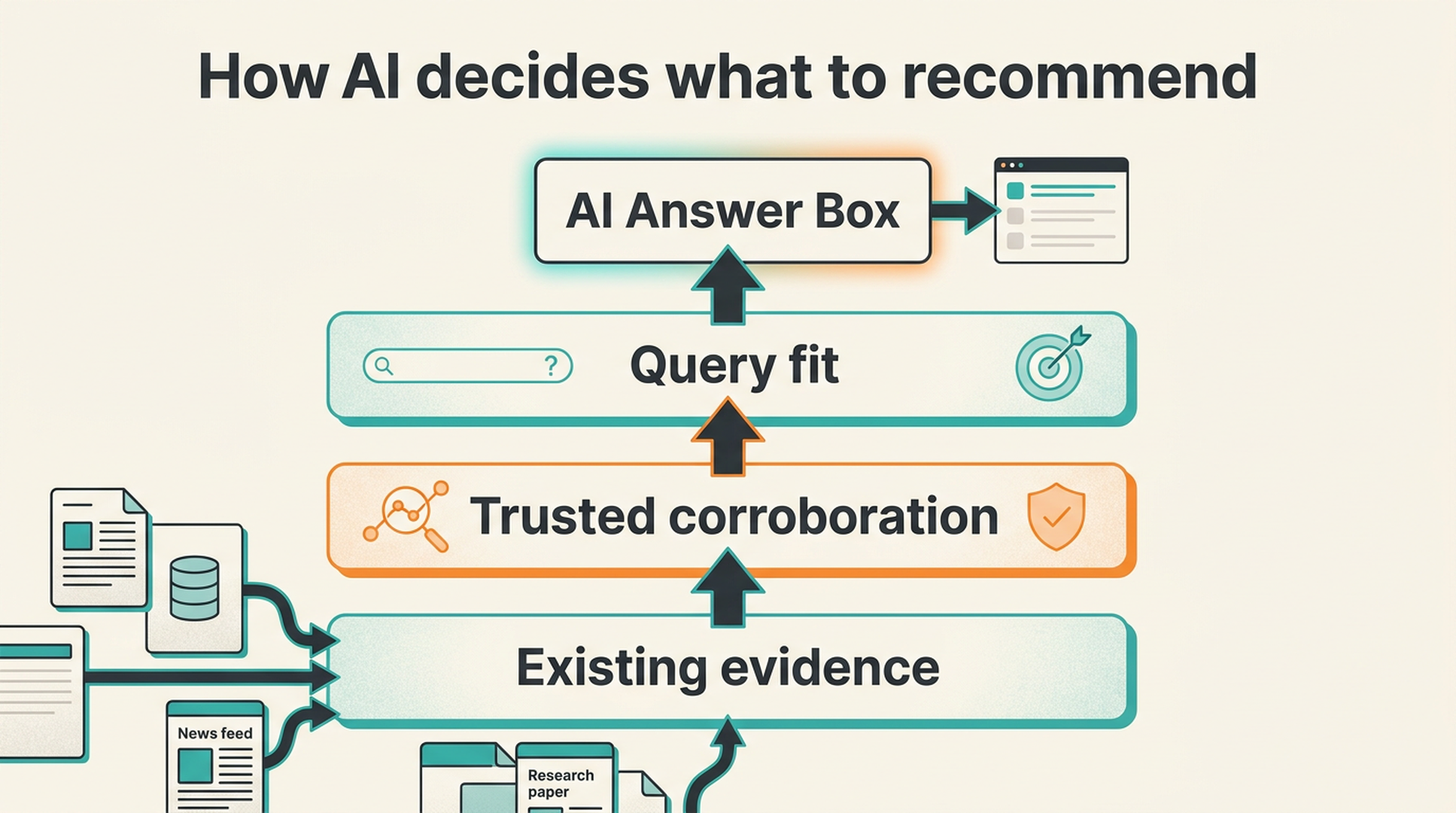
Caption: AI recommendations usually depend on existence, trust, and query fit, not just one optimized landing page.
Most GEO failures happen because one layer is missing. A company may have great product pages but no third-party mentions. Another may have plenty of press, but the website never explains the use cases buyers actually ask about. A local business may have reviews, but its name, category, address, and service descriptions vary across platforms.
Should a company do GEO, SEO, or paid ads first?
It depends on the business model and the deadline.
Paid acquisition is useful when you need demand now and can afford the learning curve. SEO is useful when users search repeatedly for known problems, categories, and comparisons. GEO becomes important when buyers ask AI systems for recommendations, summaries, vendor shortlists, or "how should I choose?" guidance.
For most serious growth teams, the answer is not either/or.
Channel | Best for | Weakness | What compounds |
|---|---|---|---|
Paid ads | Fast testing, launches, remarketing | Stops when budget stops | Creative learnings and conversion data |
SEO | Durable search demand | Takes time and faces SERP volatility | Rankings, topical authority, content library |
GEO | AI recommendations and answer inclusion | Harder to measure with old dashboards | Entity clarity, evidence, trusted mentions |
Our view at Auspia: do not pause SEO to chase GEO. Upgrade the SEO program so the same work also feeds AI visibility. That means building pages that answer user questions more directly, strengthening entity signals, and tracking AI answer presence alongside organic search metrics.
If you want a quick baseline, run an AI Search Visibility Checker for your brand and category prompts. The first audit usually shows whether the issue is awareness, trust, or content fit.
What GEO work actually looks like
GEO sounds abstract until you turn it into operations. A basic program has five workstreams.
1. Build question-led content
Brand pages that only say "we are innovative" do not help answer engines very much. AI systems are more likely to use content that answers the questions people ask before they buy.
Useful GEO pages include:
- "How to choose" guides
- Vendor comparison pages
- Category explainers
- Use-case pages by industry or role
- Pricing and implementation explainers
- Alternatives pages that are fair, specific, and current
- FAQ sections with direct answers, not filler
Use this test: if a buyer asks an AI system the question, could your page provide a clean paragraph, list, or table for the answer?
2. Make brand information consistent
AI systems struggle when the same company is described five different ways across the web. Consistency does not mean repeating the same slogan everywhere. It means keeping the basics aligned:
- Brand name and product names
- Category and primary use case
- Target customers
- Geography or service area
- Founder, company, and product entity details
- Pricing model, where relevant
- Support channels and official URLs
This matters for SaaS companies, agencies, ecommerce brands, and local businesses. It matters even more when names are generic or similar to competitors.
3. Publish evidence, not only claims
AI answers tend to be more useful when they can rely on evidence. The same is true for buyers.
Good evidence includes customer reviews, case studies, product documentation, benchmark data, public changelogs, partner pages, analyst mentions, community discussions, and well-structured testimonials. The point is not to manufacture noise. The point is to make real proof easy to find and easy to understand.
4. Structure content for extraction
Long narrative pages can still rank, but they are often hard for answer systems to quote. GEO-friendly pages usually include clear headings, concise definitions, comparison tables, short lists, schema markup, and summaries that state the conclusion plainly.
This is not about writing for robots. It is about respecting the reader's time. Humans also prefer pages where the answer is not buried in paragraph eight.
5. Earn mentions outside your own site
Self-published claims have limited weight. Third-party corroboration gives answer systems more confidence that the brand belongs in a category.
For a local clinic, that may mean review platforms, local directories, and community mentions. For B2B software, it may mean integrations, partner ecosystems, comparison sites, guest analysis, public case studies, and credible niche publications. For ecommerce, it may include review content, marketplace consistency, buying guides, and creator comparisons.
A simple GEO starter checklist
Use this checklist before investing in complex tooling.
Area | What to check | Good signal | Red flag |
|---|---|---|---|
Questions | Do we know what buyers ask AI systems? | Prompt library grouped by intent | Only keyword lists, no decision prompts |
Evidence | Do we have proof beyond our homepage? | Reviews, cases, docs, third-party references | Claims with no support |
Structure | Can answers be extracted cleanly? | Definitions, tables, FAQs, summaries | Dense promotional copy |
Consistency | Do sources describe us the same way? | Same category, name, URL, use case | Conflicting descriptions across platforms |
Measurement | Are we tracking AI visibility? | Prompt tests, citations, mention quality | Only rankings and traffic reports |
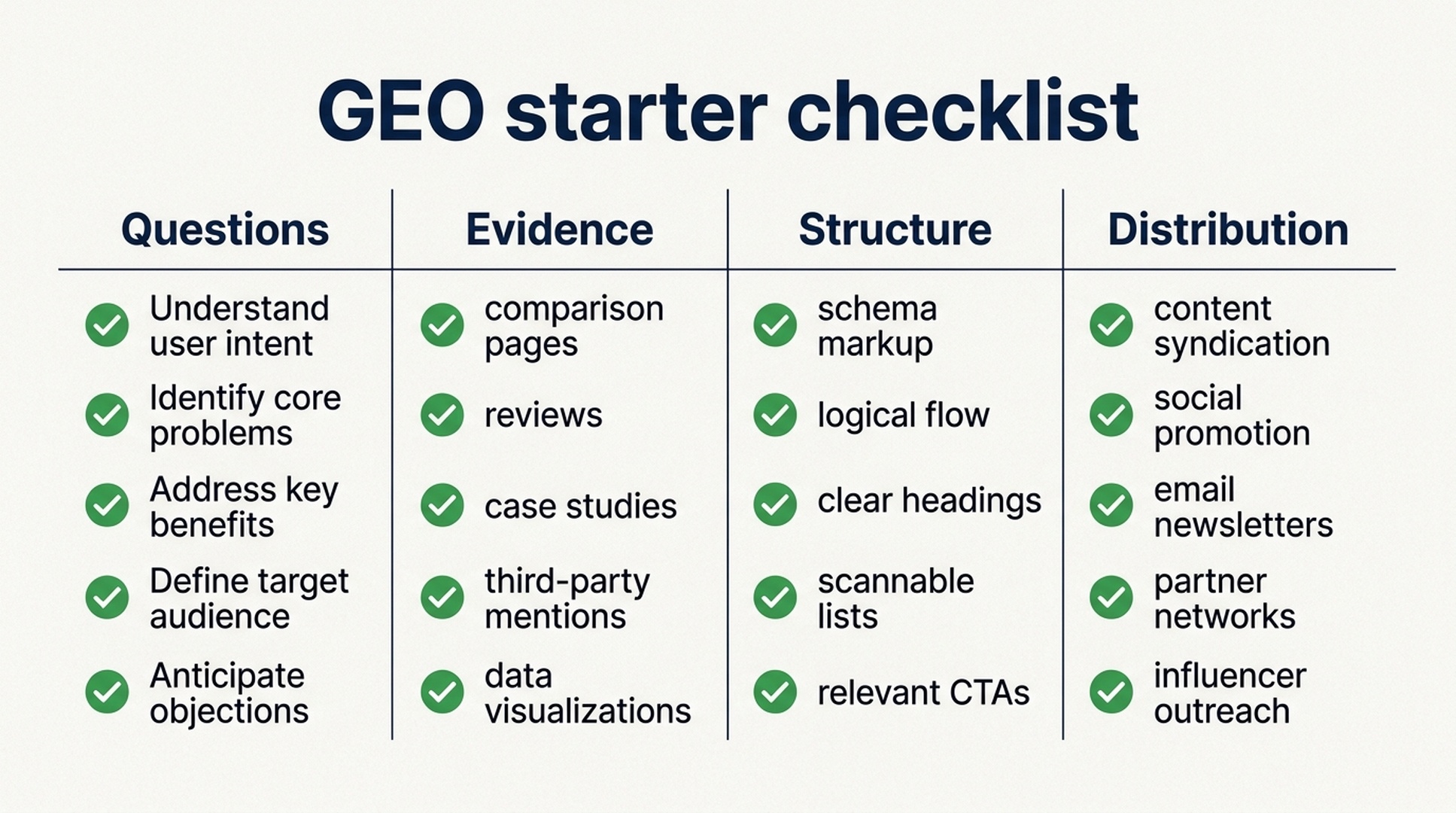
Caption: A practical GEO program starts with buyer questions, evidence, structure, and distribution.
Examples across business types
For a local service business, GEO is often about being a trustworthy answer to "who should I choose near me?" The work includes consistent listings, review depth, local service pages, clear pricing or process content, and enough third-party validation that AI systems can recognize the business as a real option.
For a SaaS company, GEO often starts with category clarity. If your homepage describes the product in clever internal language, AI systems may place you in the wrong bucket or skip you. Strong SaaS GEO usually needs comparison pages, integration pages, documentation, customer proof, and crisp definitions of the category you want to own.
For an ecommerce brand, GEO often depends on product-level evidence. Buying guides, review summaries, specs, use-case comparisons, return policy clarity, and consistent marketplace data all help answer systems explain when the product is a good fit.
The pattern repeats: answer the buyer's real question, then make sure trusted sources support the answer.
How long does GEO take?
GEO is not an ad switch. Some improvements can show up quickly, especially when a brand already has authority but poor content structure. In many cases, teams should expect the first useful signals within one to three months, with stronger compounding over a longer period.
The timeline depends on:
- How often target AI systems refresh or retrieve sources
- Whether the brand already has third-party evidence
- How competitive the category is
- Whether the site has crawlability or indexing issues
- How much content needs to be rewritten
- Whether external mentions can be earned naturally
Be careful with anyone promising guaranteed AI recommendations in a fixed number of days. GEO is influence work, not guaranteed placement.
What to measure
Traditional SEO dashboards are not enough. Keep them, but add AI visibility metrics.
Track:
- Brand mention rate across target prompts
- Whether the brand appears in recommendations, comparisons, or citations
- Which sources AI systems cite when mentioning the brand
- Competitors that appear more often and why
- Answer accuracy, especially category, pricing, positioning, and geography
- Assisted conversions from AI search or referral surfaces where measurable
- Changes after publishing evidence pages or earning third-party mentions
A small prompt library is better than a messy one. Start with 20 to 50 prompts that reflect real buyer behavior: "best X for Y", "X alternatives", "how to choose X", "is brand A good for Y", and "which company helps with Z".
Auspia takeaway
GEO is not magic, and it is not a reason to abandon SEO. It is a reason to make your public evidence cleaner.
If people ask AI systems for recommendations in your category, your brand needs three things: a clear entity, credible evidence, and content that answers decision questions directly. SEO gets you found. GEO helps you become part of the answer.
Start with a practical audit: test your brand against the questions buyers already ask, identify where AI systems get confused, then fix the evidence layer before chasing tricks. The teams that win will not be the loudest. They will be the easiest to understand, verify, and recommend.
FAQ
What is GEO?
GEO stands for Generative Engine Optimization. It is the practice of improving how often and how accurately a brand, product, or page appears in AI-generated answers.
Is GEO the same as SEO?
No. SEO focuses on visibility in search result pages. GEO focuses on visibility inside AI answers, recommendations, summaries, and citations. The work overlaps, but the target is different.
Does GEO replace paid ads?
No. Paid ads are useful for fast demand capture and testing. GEO is a compounding visibility channel. It matters most when users ask AI systems for recommendations that may not include paid placements.
Who needs GEO most urgently?
Companies in categories where buyers ask "which is best," "how do I choose," "what are the alternatives," or "who can help with this" should pay attention first. That includes SaaS, agencies, local services, ecommerce, healthcare, education, and high-consideration B2B categories.
What is the first step in GEO?
Create a prompt library based on real buyer questions, test whether your brand appears, then inspect the sources AI systems use. The gaps usually reveal whether you need clearer content, stronger evidence, more consistent entity data, or third-party mentions.