Executive Summary
Small and mid-sized businesses do not need an enterprise SEO budget to start GEO. They need a sharper operating system.
GEO, or Generative Engine Optimization, helps your public content become visible, understandable, and trustworthy inside AI-generated answers. For SMBs, the practical path is not to publish hundreds of generic posts. It is to turn your expertise into clear, structured, evidence-backed knowledge modules that AI search systems can retrieve and cite.
This guide gives SMB teams a four-part execution plan:
- Pick the right GEO battlefield. Focus on specific buyer problems where your expertise is real and your competitors are vague.
- Write answer-ready content. Use question-led headings, conclusion-first paragraphs, short knowledge blocks, FAQ sections, and clear evidence.
- Deploy structured data carefully. Use schema to clarify organizations, articles, FAQs, services, products, people, and local entities, while keeping markup consistent with visible page content.
- Measure AI visibility. Track brand mentions, citations, answer coverage, source quality, referral behavior, and technical accessibility.
The goal is not to manipulate AI systems. The goal is to make your business easier to understand and safer to recommend.
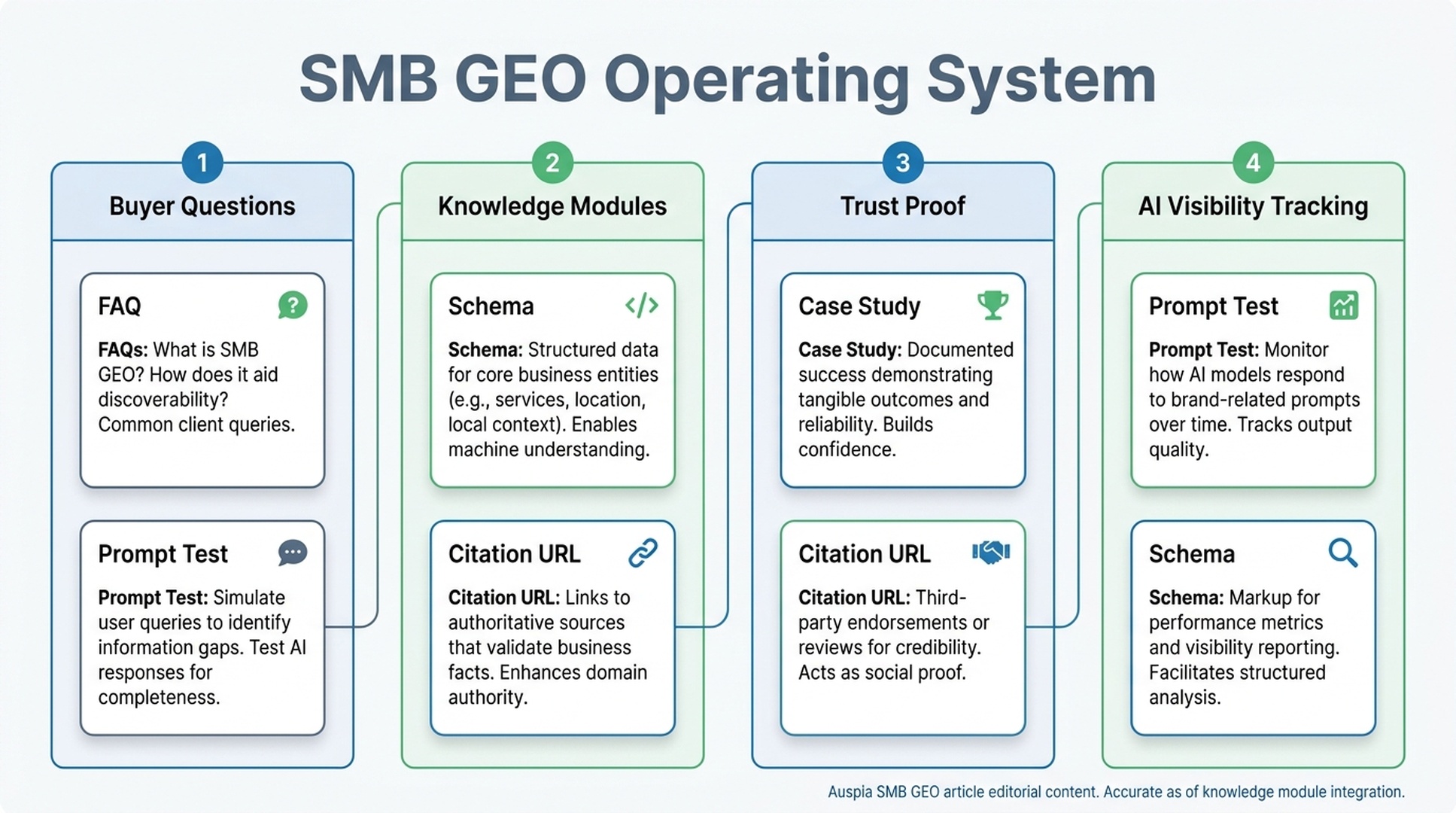
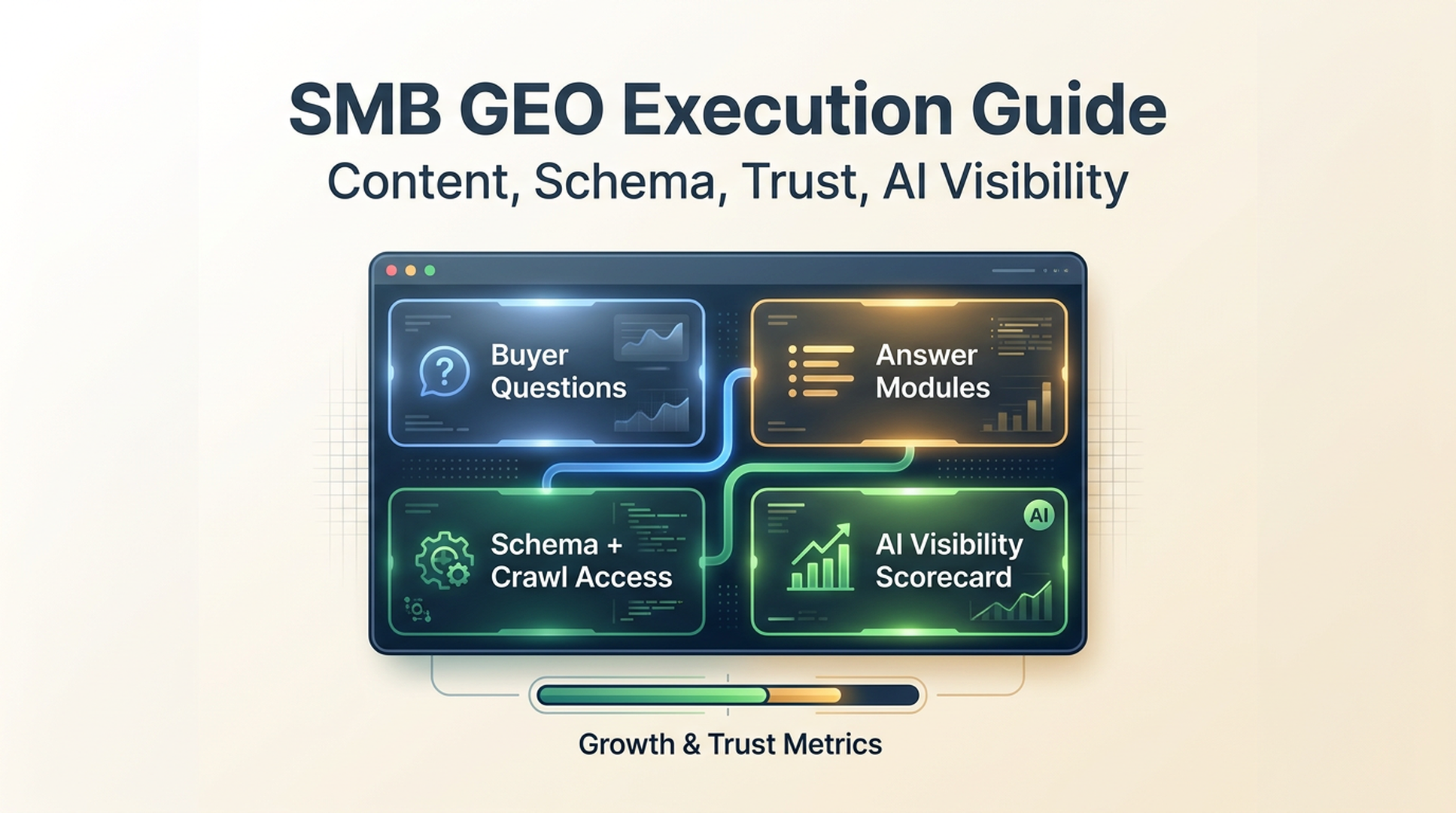
Caption: SMB GEO works best when content, technical clarity, proof, and measurement operate as one system.
Why GEO Is Especially Relevant for SMBs
Large companies often win traditional SEO through domain authority, backlink history, large content teams, and brand search demand. GEO changes part of that equation. AI answer systems still care about authority and source quality, but they also need clear answers, structured evidence, and precise context.
That creates an opening for focused SMBs.
A small accounting firm may not outrank national firms for every tax keyword. But it can become a strong answer source for a narrow problem such as "sales tax registration for Shopify merchants selling across three U.S. states." A boutique cybersecurity consultancy may not dominate broad security terms. But it can own a specific issue such as "SOC 2 readiness for early-stage SaaS companies using AWS and GitHub."
GEO rewards specificity because AI systems are often answering problem-shaped questions, not only short keywords.
Where SMBs Have an Advantage
SMB advantage | Why it matters for GEO | Practical example |
|---|---|---|
Narrow expertise | AI systems need precise answers for specific problems | A legal studio writes exact guides for VC-backed startup employment contracts |
Faster publishing | Smaller teams can update pages quickly as facts change | A SaaS agency updates AI search tracking examples monthly |
Real customer proximity | Firsthand experience strengthens E-E-A-T-style signals | A consultant publishes anonymized patterns from 30 migration projects |
Clear local or vertical context | AI can match the brand to a specific buyer situation | A local clinic answers questions about insurance, location, and patient scenarios |
Lower content bureaucracy | Teams can rewrite unclear pages without months of approvals | A founder-led company clarifies pricing, fit, and non-fit criteria quickly |
SMBs should not try to look bigger than they are. They should make their expertise more legible than larger competitors.
Step 1: Choose a GEO Use Case Before Writing
The first GEO mistake is starting with keywords. Start with buyer questions instead.
A good GEO use case has four traits:
- the buyer has a real decision to make
- the question is specific enough for your expertise to matter
- your company has credible proof or experience
- the answer can naturally include your category, product, service, or methodology
For example, "AI tools" is too broad for most SMBs. "How should a 20-person marketing team evaluate AI content workflow tools without creating duplicate pages?" is much better. It contains audience, context, risk, and decision criteria.
Use this prompt to define your GEO battlefield:
List 20 problem-shaped questions our target buyer might ask an AI assistant before choosing a vendor in our category. Prioritize questions where our company has real expertise, proof, or a differentiated point of view.
Then group the questions into clusters:
- Definition questions: What is this concept and why does it matter?
- Decision questions: Which option fits my situation?
- Implementation questions: How do I do this safely?
- Comparison questions: How does this differ from alternatives?
- Risk questions: What can go wrong and how do I avoid it?
- Proof questions: What evidence shows this works?
Each cluster can become a page, FAQ block, guide, comparison section, or case-study angle.
Step 2: Write Content as Knowledge Modules
AI systems can only cite what they can extract. This is why GEO content should be modular.
A knowledge module is a short section that answers one question clearly enough to stand on its own. It usually includes:
- a direct answer in the first sentence
- the entity or subject name
- the audience or use case
- supporting facts or examples
- limitations or fit criteria
- a format that is easy to quote or summarize
Use Question-Led Headings
Question-led headings map well to conversational AI prompts. They also help human readers scan quickly.
Weak heading | GEO-ready heading | Why it works |
|---|---|---|
Service Overview | What Does a Fractional CMO Do for a B2B SaaS Company? | Matches a real question |
Benefits | When Should a Small Business Hire an SEO Consultant? | Adds decision context |
Features | Which AI Search Visibility Metrics Should SMBs Track? | Makes the answer extractable |
Process | How Does a GEO Audit Work in the First 30 Days? | Supports step-by-step answers |
Do not force every heading into a question. But for pages meant to answer AI prompts, question-led headings often improve clarity.
Put the Conclusion First
Traditional brand copy often builds toward the point. GEO content should usually state the point early.
Weak structure:
In today's fast-changing digital environment, many businesses are exploring new channels. Our team has developed a flexible methodology...
Stronger structure:
A small business should start GEO with 10-20 high-intent buyer questions, not a large content calendar. This keeps the program focused on answer visibility, proof quality, and measurable AI mentions.
The second version is easier for an AI system to use because the main claim is explicit.
Keep Paragraphs Focused
For GEO pages, each paragraph should usually cover one idea. Long mixed paragraphs make extraction harder.
A practical rule: if a paragraph contains a definition, a feature, a customer example, and a pricing note, split it.
Add FAQ Blocks Where They Are Useful
FAQ sections are valuable because AI systems often receive questions in natural language. But the FAQ must be real, not filler.
Good FAQ answers are:
- short enough to be reusable
- specific enough to be useful
- written as standalone answers
- aligned with visible page content
- supported by FAQPage schema when appropriate
Example:
Question: Does GEO require a large technical team?
Answer: No. Most SMB GEO work starts with content structure, entity clarity, crawl access, schema basics, and proof assets. A developer may help with templates and structured data, but the core work is usually editorial and strategic.
Step 3: Add the Right Schema, Not Every Schema
Structured data helps search systems understand page content. Google explains that structured data provides explicit clues about a page and classifies its content, and its documentation notes that Google uses structured data to understand pages and gather information about people, companies, and other entities.
For GEO, schema is not magic. It does not make weak content authoritative. But it can reduce ambiguity when the visible content is already useful.
Schema Types SMBs Should Prioritize
Schema type | Best page type | GEO purpose |
|---|---|---|
Organization | Homepage, About page | Clarifies brand entity, logo, profiles, contact details |
LocalBusiness | Local service pages | Clarifies address, service area, opening hours, and local identity |
Person | Expert bio pages, author profiles | Connects expertise to named people |
Article or BlogPosting | Guides, blog posts, research posts | Clarifies article metadata, author, dates, and publisher |
FAQPage | Real FAQ sections | Marks up question-answer pairs when the FAQ is visible on the page |
Product | Product pages | Clarifies product name, description, brand, offers, and reviews where eligible |
Service | Service pages | Describes what the business provides and who it serves |
Review or AggregateRating | Eligible review pages | Adds review context when it follows platform rules and visible content |
HowTo | Step-by-step instructional pages | Clarifies ordered instructions when the page is truly procedural |
Do not add schema about information that users cannot see. Google warns against adding structured data for content that is not visible to users, even when the information is accurate.
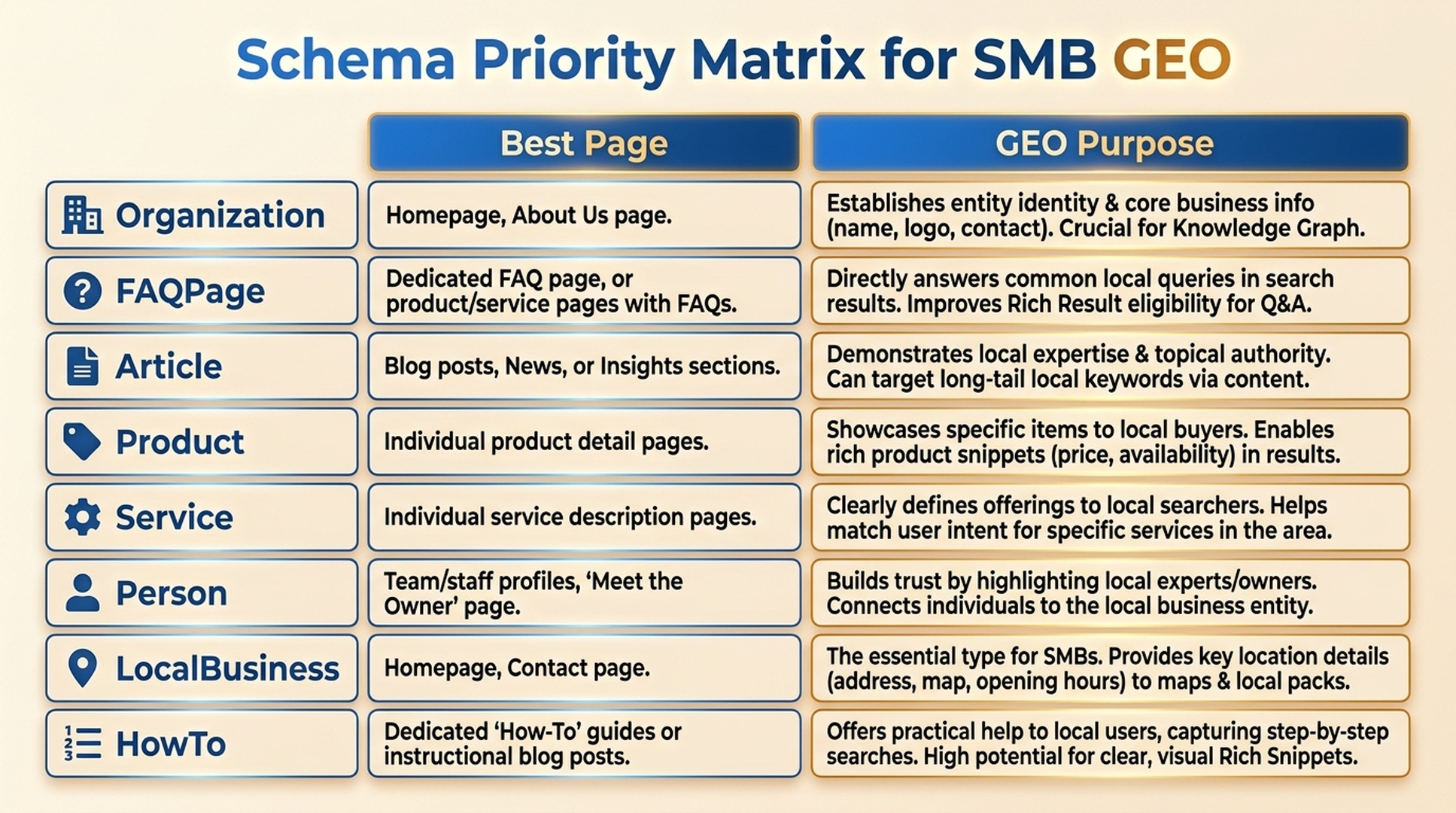
Caption: Schema should clarify important pages. It should not be used as a substitute for visible content or real evidence.
A Four-Step Schema Workflow
1. Map page types.
List your core pages: homepage, About, service pages, product pages, blog posts, case studies, FAQ pages, and location pages.
2. Assign one primary schema purpose.
Do not overcomplicate the first pass. A blog post usually needs Article or BlogPosting. An About page usually needs Organization. A local office page may need LocalBusiness.
3. Implement with JSON-LD or a trusted CMS/plugin.
Many SMBs use WordPress, Shopify, Webflow, or another CMS. Use reliable plugins or template-level implementation where possible. Google's structured data documentation shows JSON-LD examples and recommends validating with Rich Results Test.
4. Validate and monitor.
Use Google's Rich Results Test during development and Search Console status reports after deployment. Also monitor whether the page is still accurate after design changes, CMS migrations, or plugin updates.
Entity Connections Matter
The most useful schema programs connect entities. For example:
- Article author connects to a Person profile
- Product schema connects to the Organization brand
- Service pages connect to the provider Organization or LocalBusiness
- FAQ answers link internally to deeper guides
- Case studies connect customer problem, solution, and proof pages
These connections help AI systems understand how your public evidence fits together.
Step 4: Check Crawl Access and AI Crawler Settings
GEO cannot work if key pages are blocked, broken, or hard to render.
Review these technical basics:
- robots.txt rules
- noindex tags
- canonical tags
- sitemap freshness
- JavaScript-rendered content
- broken internal links
- slow pages or server errors
- blocked documentation, pricing, FAQ, and case-study pages
- important content hidden behind forms or scripts
Robots.txt is a crawl instruction file. It can tell compliant crawlers which paths should not be accessed, but it is not a security system and different bots may behave differently. For GEO, the practical question is: are you accidentally blocking the pages AI search systems need to understand your business?
For a fast technical check, use Auspia's Robots.txt AI Crawler Checker and LLMs.txt Generator / Checker. These tools do not replace a technical audit, but they help SMB teams identify obvious access issues.
Step 5: Build Trust Signals Before You Scale Content
AI systems do not only need text. They need confidence.
For SMBs, trust can come from focused evidence rather than broad fame. Useful proof assets include:
- named customer stories, when permission allows
- anonymized case studies with industry, company size, problem, action, and outcome
- screenshots or workflow examples
- dated metrics with definitions and limits
- founder or expert bios with relevant experience
- certifications, licenses, partnerships, or marketplace profiles
- comparison pages that explain fit and non-fit situations
- documentation that shows how the product or service actually works
A weak claim says:
We help companies grow faster with AI.
A stronger GEO-ready claim says:
Auspia helps growth teams improve organic visibility and AI answer readiness by auditing SEO, GEO, AEO, AI crawler access, structured content, and citation gaps across public pages.
The stronger claim is more specific. It gives an AI system a safer way to describe the business.
Step 6: Measure GEO With an SMB-Friendly Scorecard
Traditional SEO metrics still matter, but they are incomplete for GEO. You need to track how AI systems describe, cite, and compare your brand.
Core GEO KPIs
KPI | What to track | Why it matters |
|---|---|---|
Brand mention rate | How often AI answers mention your brand for target questions | Measures visibility in answer contexts |
Citation rate | How often AI systems link or cite your pages | Measures source inclusion |
Answer coverage | Percentage of target questions where you appear | Shows breadth across use cases |
Position in answer | Whether you appear first, in top three, or only as an afterthought | Indicates perceived relevance |
Source quality | Which pages or third-party sources AI cites | Shows whether your proof assets work |
Description accuracy | Whether AI describes your company correctly | Reveals entity clarity gaps |
Sentiment and caveats | Positive, neutral, negative, or "verify further" language | Shows trust level |
AI referral traffic | Sessions from AI tools where measurable | Connects visibility to site behavior |
Post-click quality | Engagement, conversion, form starts, or assisted pipeline | Shows whether AI visibility attracts the right users |
Schema validity | Percentage of key pages with valid structured data | Tracks technical readiness |
Manual Monitoring Workflow
SMBs can start without expensive platforms.
- Build a list of 25-50 target prompts.
- Test them monthly across ChatGPT, Perplexity, Gemini, Claude, Google AI Mode or AI Overviews where available, and any vertical AI tools relevant to your market.
- Record whether your brand appears, which competitors appear, what sources are cited, and whether the answer is accurate.
- Save screenshots or exports for trend comparison.
- Update pages based on repeated gaps, not one-off answer variations.
Use this spreadsheet structure:
Date | Prompt | Platform | Brand mentioned? | Citation URL | Competitors mentioned | Accuracy issue | Next action |
|---|---|---|---|---|---|---|---|
2026-06-18 | Best GEO tools for SMBs | Perplexity | Yes | /tools | Competitor A | Missing crawler checker | Add internal link and tool explanation |
For faster checks, use an AI Search Visibility Checker to benchmark answer visibility and source patterns.
30-Day SMB GEO Execution Plan
Week 1: Diagnose
- Pick 25 buyer questions.
- Test current AI visibility.
- Audit robots.txt, indexability, sitemap, and key page rendering.
- Identify your five most important pages for GEO.
Week 2: Restructure Content
- Rewrite headings as natural questions where appropriate.
- Add conclusion-first summaries.
- Split long paragraphs into knowledge modules.
- Add real FAQ sections to service or product pages.
- Add fit and non-fit criteria to reduce recommendation ambiguity.
Week 3: Add Proof and Schema
- Add Organization, Article, FAQPage, Product, Service, LocalBusiness, or Person schema where appropriate.
- Validate structured data.
- Add dates, author bios, case evidence, and methodology notes.
- Update third-party profiles for consistency.
Week 4: Monitor and Improve
- Re-test your prompt set.
- Compare brand mentions before and after updates.
- Track which pages are cited.
- Fix inaccurate descriptions.
- Create the next five content modules based on missing questions.
This is enough to build momentum without turning GEO into a six-month strategy project.
Common SMB GEO Mistakes
Trying to compete on broad topics first.
Broad topics usually favor established sources. Start with specific buyer scenarios where your expertise is strongest.
Adding schema without improving visible content.
Structured data clarifies content; it does not create authority by itself.
Writing FAQs that no buyer would ask.
FAQ sections should come from sales calls, support tickets, search queries, AI prompt testing, and real objections.
Ignoring third-party consistency.
AI systems may compare your website with LinkedIn, marketplaces, review platforms, partner pages, and media mentions. Inconsistent descriptions reduce trust.
Measuring only traffic.
AI answers can influence buyers before a click. Track mentions, citations, answer position, and description accuracy alongside referral traffic.
FAQ
Can a small business do GEO without hiring a large agency?
Yes. Most early GEO work is editorial and operational: clarify entities, answer real buyer questions, improve page structure, add proof, validate schema, and monitor AI answers. Technical help is useful, but the first wins usually come from better public information.
Which pages should an SMB optimize first for GEO?
Start with the homepage, About page, top product or service pages, one comparison page, one FAQ page, and one proof page such as a case study. These pages usually define the brand, category, credibility, and buyer decision context.
Does schema guarantee AI citations?
No. Schema helps systems understand page content, but it does not guarantee citations or rankings. The visible content must still be useful, accurate, and supported by evidence.
How many GEO articles should an SMB publish each month?
Quality matters more than volume. A practical starting point is four to eight high-intent knowledge modules per month, each tied to a real buyer question and supported by proof or operational expertise.
What is the fastest GEO win for an SMB?
The fastest win is usually rewriting key service or product pages so they clearly state who the offer is for, what problem it solves, what evidence supports it, and when it is not a fit. This improves both human conversion and AI answer readability.
Auspia Takeaway
SMB GEO is not about copying enterprise content machines. It is about making specialized expertise legible.
If you run a small or mid-sized business, your advantage is not scale. Your advantage is proximity to real customer problems. Turn that experience into structured pages, clear answers, trustworthy proof, and measurable AI visibility.
Start with one narrow problem domain. Build the best public answer set for that domain. Then use AI visibility data to decide what to improve next.
References
- Google Search Central, "Introduction to structured data markup in Google Search".
- Google Search Central, "AI Features and Your Website".
- Google Search Central, "Introduction to robots.txt".
- Pranjal Aggarwal et al., "GEO: Generative Engine Optimization", arXiv, 2023.