The short version
Blog posts and backlinks still matter. They just cannot carry SEO by themselves anymore.
In 2026, a durable SEO program looks less like a content calendar plus outreach list and more like a website trust system. Search engines need to crawl and understand the site. AI answer systems need clear, citable facts. Buyers need proof that the company is real, the product is credible, and the page helps them make a decision.
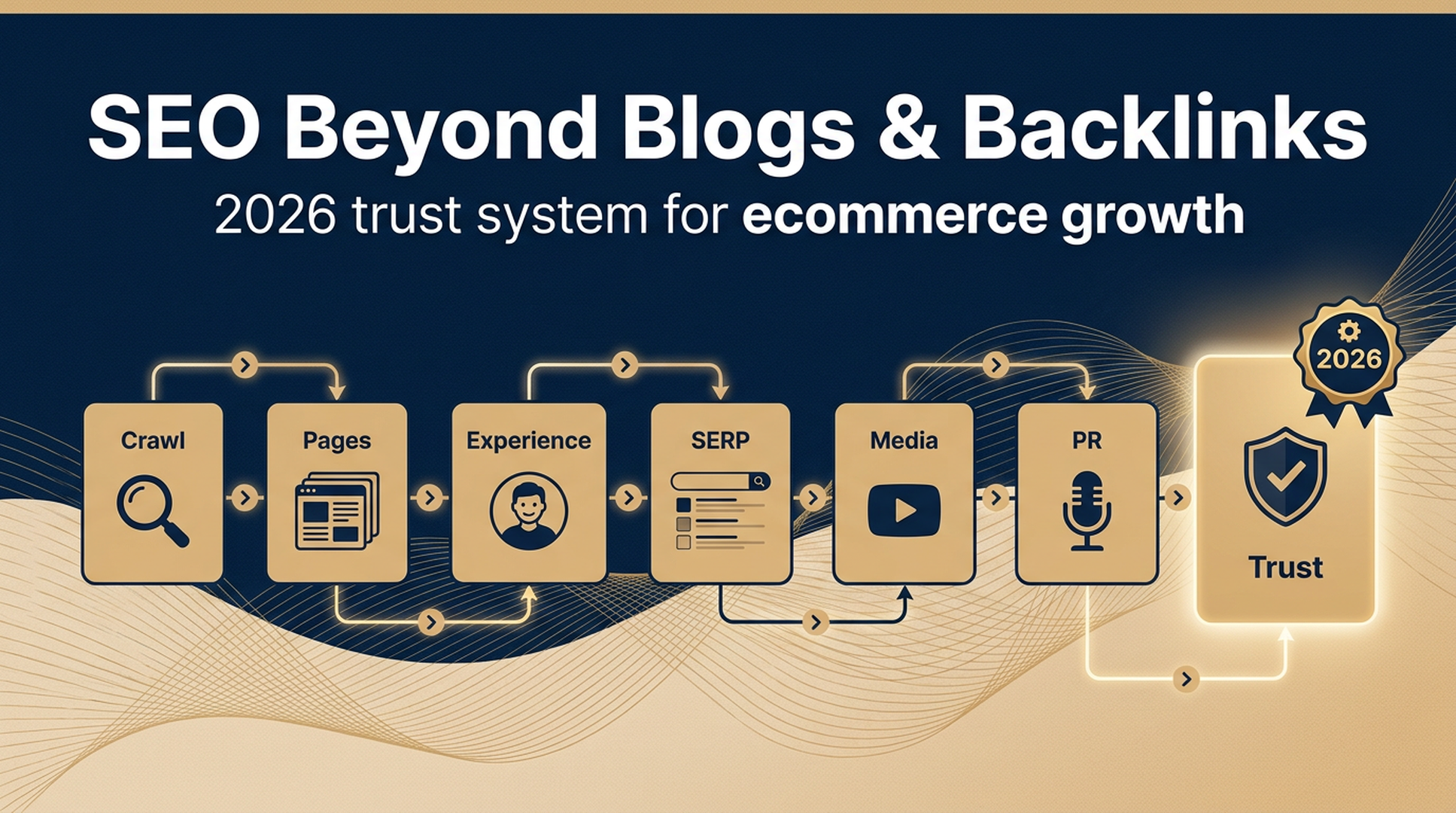
That means your SEO work has to cover seven areas:
- Technical access and index control
- Topic architecture across product, category, and guide pages
- Experience-led content that contains proof nobody else can copy
- SERP packaging for snippets, AI answers, and click-through
- Multimedia assets that explain products faster than text alone
- Digital PR and citation assets that earn references
- Website trust signals that reduce doubt after the click
If most of your current SEO activity is "publish a few articles" and "get a few links," this article is a practical reset.
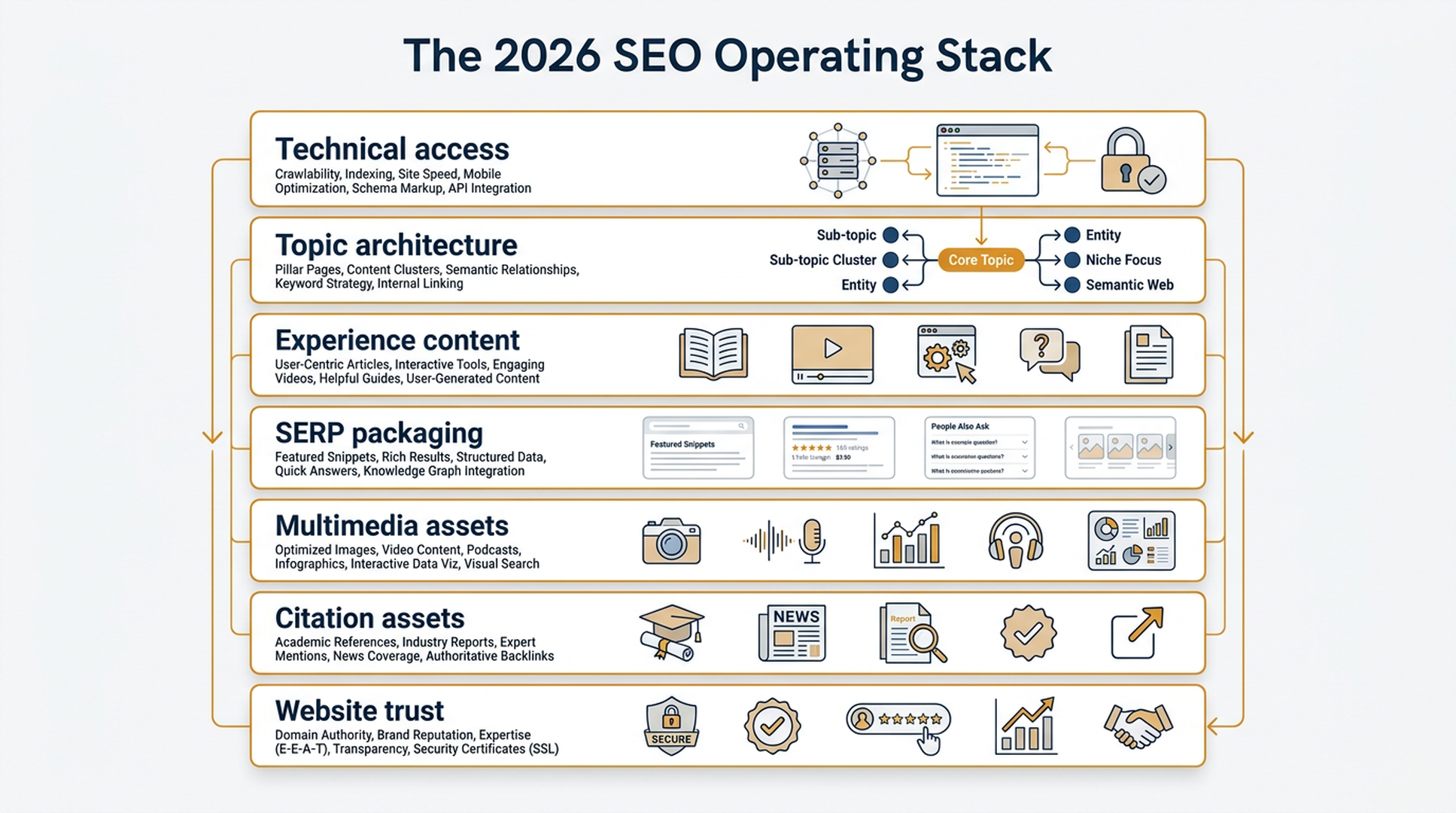
Caption: The 2026 SEO operating stack connects crawlability, content quality, SERP packaging, citation assets, and on-site trust.
Why blog-only SEO is wearing out
The old playbook was simple: find keywords, write articles, build links, wait. That still works in some markets, especially when the site has a strong product and little competition. But it is less reliable than it used to be.
There are four reasons.
First, average content is cheap now. A basic explainer can be generated in minutes. It may have tidy headings and correct definitions, but it often says nothing a real buyer could not find on ten other sites. Search engines and users do not need another generic guide.
Second, the search result page is no longer just ten blue links. It can include AI Overviews, featured snippets, People Also Ask boxes, videos, product modules, reviews, forum discussions, and zero-click answers. A page can rank and still lose attention if its answer is not easy to quote or its result does not give people a reason to click.
Third, trust is visible. A product page with vague specifications, missing policies, weak reviews, and no author or company context feels risky. That feeling affects conversion, but it also affects how people engage with the site after search.
Fourth, AI search has raised the value of clean facts. AI systems tend to reuse pages that state definitions, constraints, comparisons, steps, and evidence in a way that can be lifted into an answer. Long introductions and vague thought leadership are hard to cite.
Google's own guidance on helpful content still points in the same direction: make pages for people, show first-hand experience where it matters, and avoid content made mainly to attract search visits. That is not a slogan. It is a useful operating test.
The 7 capabilities modern SEO needs in 2026
1. Technical SEO: make the site accessible before you ask for more traffic
Technical SEO is not glamorous, but it decides whether the rest of your work can compound.
For an ecommerce or SaaS site, start with a few basic questions:
- Can Google index the pages that actually make money?
- Are important product, category, comparison, and guide pages blocked by robots.txt, noindex, canonicals, or JavaScript rendering problems?
- Are faceted navigation, filter URLs, tag pages, and internal search pages wasting crawl budget?
- Do mobile pages load quickly enough for someone on a weak connection?
- Is structured data valid and consistent with what users can see on the page?
Product, Review, Breadcrumb, Article, and FAQ schema can help search systems understand a page, but schema is not magic. If the visible page is thin, messy, or misleading, markup will not save it.
Auspia's rule is simple: fix access before amplification. Do not pour content and link effort into a site where the important pages are slow, duplicated, or poorly indexed.
2. Page SEO: move from keyword placement to topic architecture
Many teams still treat on-page SEO as title tags, meta descriptions, and a few keyword mentions. Those details matter, but the bigger question is whether your site explains a topic with enough structure.
A Shopify brand selling outdoor backpacks, for example, should not rely on one article called "How to Choose a Backpack." It needs a topic system:
Page type | Job | Example |
|---|---|---|
Category page | Help shoppers narrow options | Lightweight hiking backpacks |
Product page | Prove fit, durability, and use case | 45L waterproof trekking pack |
Buying guide | Answer pre-purchase questions | How to choose backpack volume for a 3-day hike |
Comparison page | Help users choose between options | 35L vs 45L hiking backpack |
Support page | Reduce friction after interest | Shipping, returns, warranty, sizing |
Internal links should connect those pages with intent, not just sprinkle anchor text around the blog. The goal is to make the site's expertise legible.
Also watch for keyword cannibalization. If five articles chase the same phrase with small variations, you have not built topical authority. You have created confusion. Merge overlapping pages or assign each page a different job.
3. Content SEO: replace generic completeness with proof
A complete article is not always a useful article.
For 2026 SEO, ask a harder question: what does this page contain that a competitor cannot easily copy?
Good answers include:
- Product testing notes
- Customer objections and how you solved them
- Photos, measurements, teardown details, or setup examples
- Original data from support tickets, reviews, surveys, or audits
- Clear recommendations based on real constraints
- Mistakes you have seen buyers make
Take the backpack example. A weak page says, "Choose the right capacity, material, comfort, and price." A useful page says, "For a 2-night summer hike, most users are fine with 35-45L if they carry compact sleeping gear. In our load test, shoulder pressure became noticeable above 12kg, so shorter users should adjust the hip belt first. The side pocket fits a 1L Nalgene but not a wide insulated bottle."
That kind of detail helps people decide. It also gives search and AI systems concrete information to cite.
This is where SEO and conversion finally meet. The best content does not just attract a visit. It reduces uncertainty.
4. SERP and AI-answer packaging: write pages that can be quoted
A page can be strong and still underperform if its best answer is buried.
Modern SEO pages need answer-ready sections. That means:
- Put the direct answer near the top of a section.
- Use descriptive headings that match real questions.
- Add comparison tables when the decision depends on trade-offs.
- Include short definitions for terms people ask about.
- Keep steps sequential and concrete.
- Use FAQ only when the questions are real, not as decoration.
For example, instead of opening a section with three paragraphs of background, write:
"Yes, product reviews can help SEO when they are visible on the page, specific to the product, and marked up accurately. They add fresh language, answer objections, and can support rich results when the markup follows Google's rules."
Then explain the nuance.
This style works better for readers, snippets, People Also Ask, and AI search summaries. It is also easier for your own team to maintain.
If you want to see how visible your brand is in AI answers, use a tool such as Auspia's AI Search Visibility Checker to test common prompts and track whether your pages are cited.
5. Multimedia SEO: make images, video, and diagrams part of the answer
Text alone is slow for many buying decisions.
A strong product or service page should use media to answer questions faster:
- Product photos that show scale, texture, fit, and use cases
- Short videos that demonstrate setup, results, or before-and-after states
- Diagrams that explain dimensions, workflows, or compatibility
- Charts that compare options clearly
- Screenshots that show actual product behavior
The SEO detail still matters. File names should describe the image. Alt text should explain what the image shows. Important facts should also appear as crawlable text near the image, not only inside the graphic.
For AI search, multimedia has another benefit: it forces the team to clarify the point. If you cannot turn a page into a useful diagram, the argument may be too vague.
6. Digital PR: stop treating links as a separate chore
Backlinks still matter, but the healthiest links usually come from assets worth citing.
For most smaller brands, that does not mean hiring a PR agency on day one. It means producing reference material that other sites have a reason to mention:
- A survey of customers or buyers
- A teardown of common product failures
- A benchmark report using your own data
- A comparison matrix that saves people research time
- A field test with photos and measured results
- A practical calculator, checklist, or template
A pet travel brand could publish a report on the most common reasons carriers get returned. A Shopify agency could review 100 product pages and publish the five patterns that correlate with weak conversion. A cybersecurity SaaS company could release a checklist for AI crawler access and policy exposure.
Those assets do more than earn links. They create evidence. Evidence makes your brand easier to cite by journalists, bloggers, comparison sites, and AI answer systems.
7. Website trust: SEO continues after the click
Some SEO problems are really trust problems wearing an SEO costume.
If users land on a site and cannot tell who runs it, how shipping works, whether reviews are real, or what happens if the product fails, they leave. More traffic will not fix that.
At minimum, check these pages and signals:
Trust area | What to inspect | Why it matters |
|---|---|---|
About page | Who you are, what you sell, why the company exists | Helps users judge legitimacy |
Contact page | Email, form, support hours, address when relevant | Reduces perceived risk |
Shipping policy | Cost, regions, timelines, exceptions | Prevents checkout anxiety |
Returns policy | Conditions, timeline, process | Helps buyers commit |
Reviews | Specific product use cases, not only star ratings | Adds real-world language |
Author or reviewer info | Background for expert content | Supports credibility |
Security and terms | Privacy, payment, legal pages | Signals basic operational maturity |
These are not side quests. They are part of search performance because they affect engagement, conversion, and brand confidence.
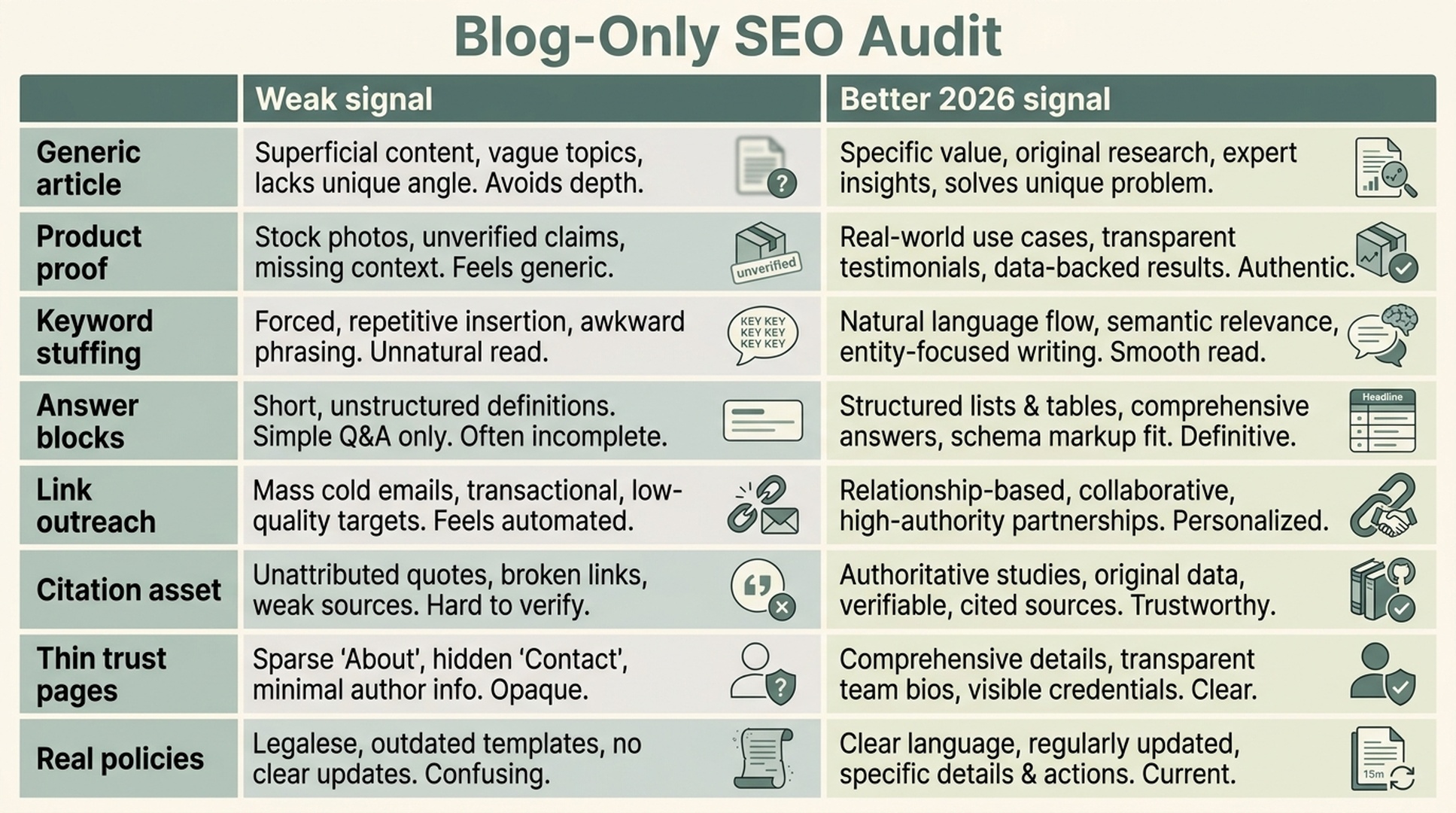
Caption: A blog-only SEO plan usually misses proof, packaging, citation assets, and trust pages.
A 10-question SEO audit for 2026
Use this quick audit before you commission another batch of blog posts.
- Are the pages that drive revenue indexable, canonicalized correctly, and internally linked?
- Does each core topic have a clear hub, supporting pages, and a conversion path?
- Are product and category pages doing SEO work, or is all search demand pushed into the blog?
- Does the content include first-hand experience, data, examples, or product proof?
- Can a section be quoted directly in a snippet or AI answer without rewriting it?
- Are titles and meta descriptions specific enough to earn the click?
- Do images, videos, and diagrams answer real buyer questions?
- Does the site have at least one asset worth being cited by another site?
- Do trust pages answer the questions buyers ask before paying?
- Can you measure branded search, organic conversions, AI citations, and assisted revenue instead of only blog traffic?
If the answer to most of these is "not yet," publishing more articles may help a little. Fixing the system will help more.
What Auspia would fix first
When we look at an SEO program that depends too much on blogs and links, we usually do not start by writing another article.
We start with a map:
- Which pages can already rank or convert if technical friction is removed?
- Which topics deserve a hub rather than scattered posts?
- Which pages need proof, visuals, or comparison tables?
- Which search results need better titles, direct answers, or schema cleanup?
- Which brand facts should be turned into citation assets?
Then we prioritize the work by business value. A product category with revenue potential usually deserves attention before a low-intent blog keyword. A trust page that removes checkout anxiety may be worth more than another 2,000-word guide.
You can use Auspia's Website SEO Score Checker as a starting point, then review the results manually. Tools can flag issues. Humans still need to decide what matters.
FAQ
Is blogging still useful for SEO in 2026?
Yes. Blogging is useful when it supports a real topic system, answers specific search intent, and contains experience or evidence. Blogging is weak when it becomes a volume game with generic articles that do not help users decide.
Do backlinks still matter?
Yes, but links work best when they point to pages or assets worth citing. A site built on thin content and weak trust signals will not become strong just because it gets more outreach links.
What should ecommerce brands optimize besides blog posts?
Optimize category pages, product pages, comparison pages, buying guides, reviews, images, video, structured data, internal links, and trust pages such as shipping, returns, contact, and about pages.
How does AI search change SEO work?
AI search rewards clear, citable information. Pages need direct answers, structured comparisons, definitions, evidence, and clean entity signals. Long generic introductions are less useful because AI systems need facts they can quote.
What is the first step if our SEO is stuck?
Audit the site before adding more content. Check indexability, page intent, technical speed, duplicate pages, topic gaps, content proof, SERP appearance, and trust signals. Then fix the highest-value pages first.
Final take
SEO is not moving away from content and links. It is moving beyond the idea that content and links are the whole job.
In 2026, the stronger question is not "What should we publish next?" It is:
"Does this website deserve to be recommended by search engines, cited by AI answers, and trusted by buyers?"
That question is harder. It is also where the durable traffic comes from.