The short answer
GEO reputation optimization cannot delete negative articles, forum complaints, reviews, lawsuits, or social posts. If a page is illegal, defamatory, outdated, or violates a platform policy, the right path is legal review, platform reporting, or direct remediation.
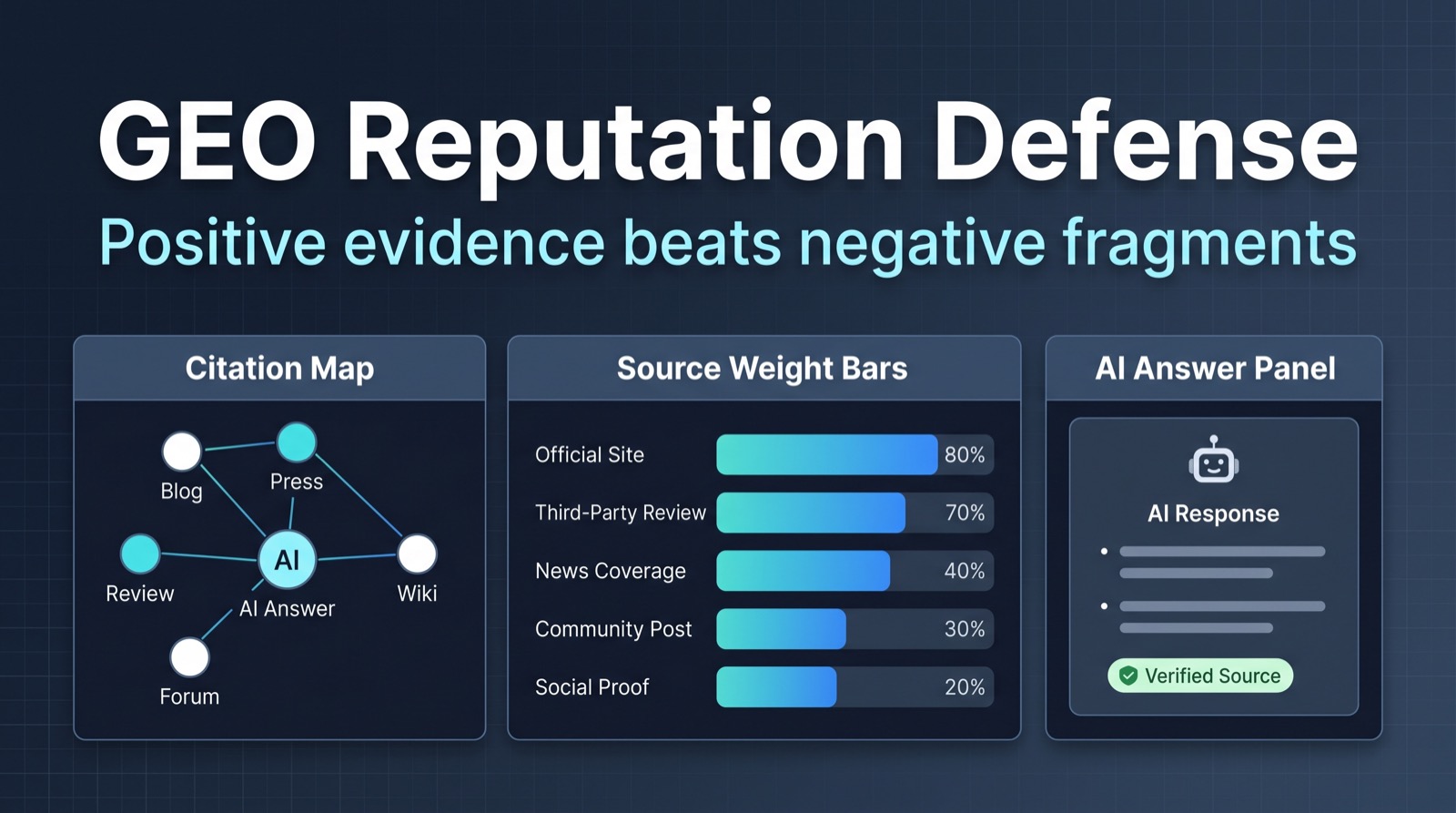
What GEO can do is different: it can change the evidence mix that AI systems use when they summarize your brand.
When someone asks ChatGPT, Perplexity, Gemini, Google AI Overviews, or another answer engine, "Is this company reliable?" the answer is rarely a copy of one page. It is a synthesis. The system pulls from public pages, reviews, third-party mentions, knowledge panels, forums, product documentation, news, and your own site. If the available evidence is thin, old, inconsistent, or mostly negative, the AI answer leans negative. If the evidence is broad, specific, recent, and independently supported, the answer has more room to be balanced.
That is the job: reduce the weight of negative fragments by publishing better evidence, not by pretending the negative evidence never existed.
Why negative AI answers happen
A bad AI brand answer usually comes from one of five gaps.
Gap | What AI systems may see | Practical fix |
|---|---|---|
Evidence gap | Only complaints, old press, or thin directory pages are visible | Publish stronger owned and third-party evidence |
Recency gap | Old incidents outrank newer improvements in the source pool | Create dated update pages, changelogs, and review-response content |
Entity gap | The AI cannot connect your brand, products, locations, executives, and proof points | Clean up brand facts, schema, About pages, profiles, and consistent naming |
Response gap | The issue exists, but the brand never explains what changed | Publish factual response pages and improvement narratives |
Scenario gap | Positive pages talk about the brand broadly, while negative pages match the exact user question | Build content for high-risk prompts such as "safe," "scam," "support," "refund," "quality," and "reviews" |
This is why a brand can publish ten glowing blog posts and still get a rough AI answer. The content may be positive, but it is not answering the reputation question the user asked.
For a GEO program, the first step is not writing. It is prompt diagnosis.
Run a small prompt set across the answer surfaces that matter to your market:
- "Is [brand] legit?"
- "Is [brand] reliable?"
- "[brand] reviews"
- "[brand] complaints"
- "[brand] alternatives"
- "Is [brand] good for [use case]?"
- "What are the biggest problems with [brand]?"
- "Should I trust [brand]?"
Record the answer, cited sources, uncited claims, sentiment, and missing context. If you need a starting point, Auspia's AI Search Visibility Checker is useful for turning this into a repeatable visibility check instead of a one-off screenshot exercise.
What "suppression" really means in GEO
In traditional SEO reputation management, teams often talk about pushing a negative result down the SERP. That still matters, but AI search changes the mechanics.
AI systems do not only rank pages. They summarize. A negative source can influence the generated answer even when the user never clicks it. A positive source can help only if it is discoverable, specific, trusted enough, and written in a way the model can extract.
So "suppression" in GEO means four things:
Old reputation SEO goal | GEO reputation goal |
|---|---|
Push a negative URL lower | Reduce its share of the evidence used in AI answers |
Publish many positive pages | Publish fewer, stronger, more citable proof assets |
Optimize for brand-name SERPs | Optimize for reputation prompts and decision prompts |
Control the narrative | Give AI systems a more accurate evidence base |
Hide old issues | Document what changed, with dates and proof |
The distinction matters. If the negative information is true and unresolved, no content system should try to bury it. AI reputation work is strongest when it pairs content with actual operational improvement: better support, clearer refund policies, stronger product documentation, public changelogs, third-party reviews, and response pages that do not sound evasive.
Build the positive content system
A positive content system is not a folder of praise. It is a structured source network that answers the questions AI systems are likely to synthesize.
Start with four layers.
Layer | Source examples | What it proves | GEO requirement |
|---|---|---|---|
Owned truth | About page, product pages, support policy, incident response page, changelog | What the company says is true now | Clear, dated, specific, crawlable |
Operational proof | Documentation, service-level pages, refund process, security page, quality process | How the company handles the issue | Detailed enough to quote or summarize |
Third-party validation | Industry media, analyst mentions, partner pages, marketplace profiles, credible review sites | Other sources confirm the claim | Independent and consistent with owned pages |
User reality | Reviews, case studies, community answers, testimonials with context | Customers have relevant experience | Balanced, specific, and not over-polished |
The goal is not to make every source say the same thing. That looks artificial. The goal is consistency: the same facts, dates, product names, policies, and improvements should appear across the source pool.
A good system gives answer engines several ways to say something fair:
- "The company had complaints about support delays in 2024, but it now publishes response-time targets and a support escalation process."
- "Recent documentation says the refund window is 30 days, and marketplace reviews after the policy update are more positive."
- "The brand is best suited for teams that need X, while buyers who require Y should compare alternatives."
That is a much better answer than "Users complain about support" with no context.
The five-step workflow
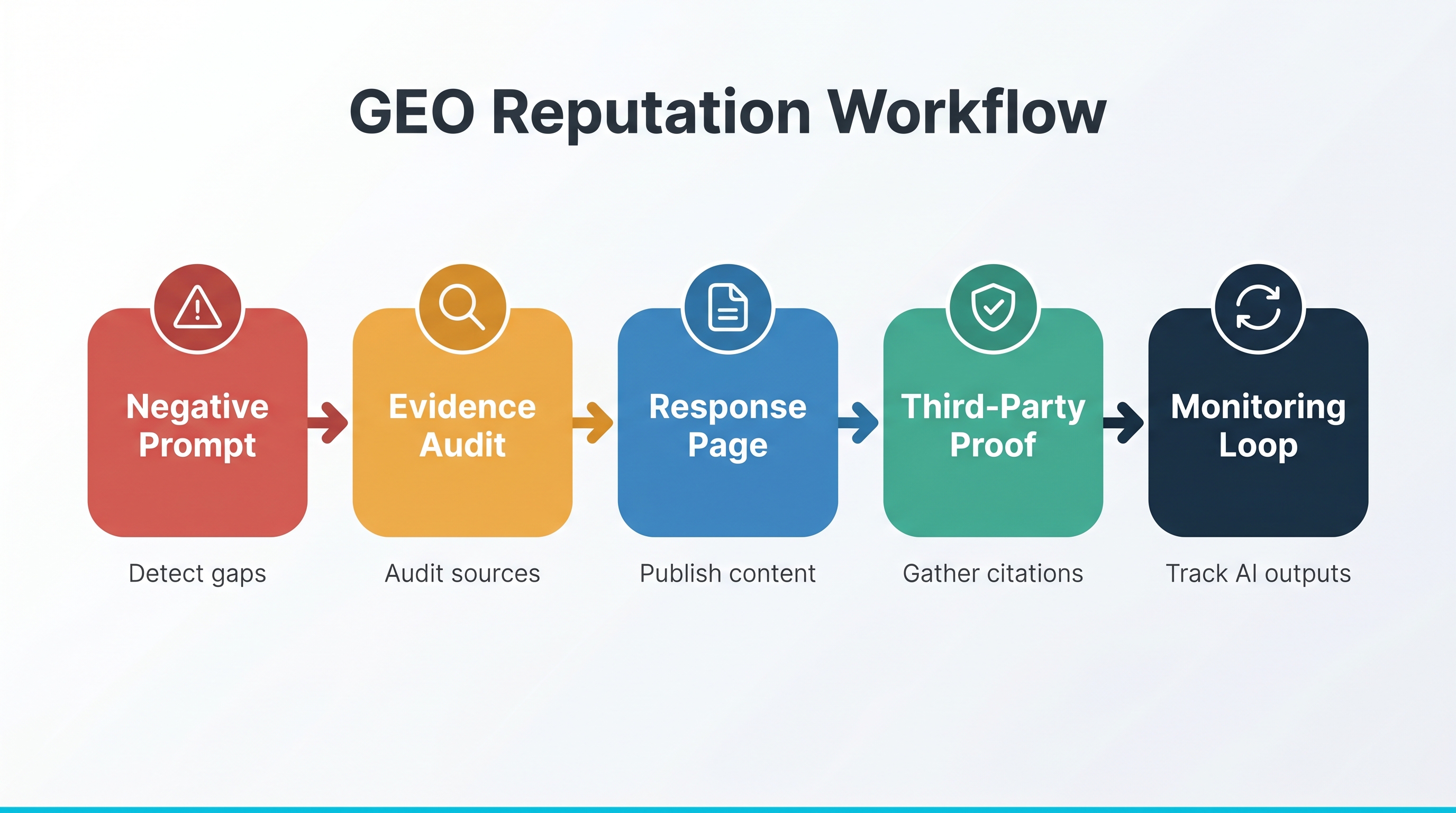
Caption: Use the same workflow for every high-risk reputation prompt: find the weak answer, audit the evidence, publish the response, add third-party proof, and monitor the answer again.
Step 1: Map the prompts that can hurt conversion
Do not start with brand vanity queries. Start with queries a buyer asks before they abandon a purchase, demo request, or renewal.
For SaaS, that might include:
- "Is [brand] secure?"
- "Does [brand] have downtime?"
- "[brand] customer support problems"
- "[brand] vs [competitor]"
- "Why do people leave [brand]?"
For local services:
- "Is [business] trustworthy?"
- "[business] complaints"
- "Best [service] near me"
- "Does [business] overcharge?"
For ecommerce:
- "Is [store] legit?"
- "[store] shipping delays"
- "[product] quality issues"
- "[brand] return policy"
Score each prompt by commercial risk. A prompt with fewer searches can still matter if it appears late in the buyer journey.
Step 2: Audit the evidence behind the answer
For every risky prompt, collect the sources the AI answer cites and the sources it seems to use without citation. Then classify them.
Source type | Keep? | Action |
|---|---|---|
Accurate negative review | Yes | Respond, fix the issue, and publish proof of the fix |
False or defamatory page | No | Escalate through legal or platform channels |
Old but accurate article | Yes | Publish dated updates and current context |
Thin positive PR | Maybe | Replace with specific evidence |
Confusing brand profile | No | Correct entity facts and naming |
Missing policy page | No source exists | Create the page |
This is where many teams get uncomfortable. The audit often shows that the AI answer is not "biased." It is working with the material available. The problem is that the brand has not published enough useful material.
Step 3: Create response pages for real issues
If an issue is real, address it directly. A vague "we care about customers" page will not help.
A strong response page includes:
- what happened, in plain language
- who was affected, if appropriate
- what changed
- dates of the fix or policy update
- measurable improvements where available
- links to documentation, support, or policy pages
- a human contact path for unresolved cases
Example structure:
Issue: Delivery delays in Q4 2025
What changed: Added a second fulfillment partner on February 12, 2026
Current status: 94% of orders now ship within two business days
Where to check: Live shipping policy and order-status page
Customer path: Escalation form for delayed orders
This kind of page gives AI systems concrete material. It also gives customers a better experience than silence.
Step 4: Add third-party proof, not just owned claims
Owned content is necessary, but it is not enough. AI systems often weigh independent sources heavily, especially when the question is about trust.
Build a third-party evidence plan around the issue category:
Reputation risk | Useful third-party evidence |
|---|---|
Product quality | Independent reviews, benchmark tests, marketplace ratings, customer case studies |
Support problems | Review responses, support policy pages, customer community answers, service-level documentation |
Safety or compliance | Certifications, audit summaries, regulator-facing documentation, security pages |
Local trust | Local directories, review platforms, local media, business profiles, service-area pages |
Scam or legitimacy concerns | Verified profiles, payment/refund policy pages, company registration info where appropriate, partner listings |
Avoid low-quality press release farms. They may create more pages, but they rarely create more trust. AI systems are getting better at discounting generic content.
Step 5: Monitor answer movement by prompt, not by page
A GEO reputation program should report movement at the answer level.
Track:
- answer sentiment by prompt
- cited sources
- presence of outdated claims
- presence of your response page
- presence of third-party proof
- share of answer for your brand versus competitors
- whether the answer includes a fair limitation instead of a blunt negative conclusion
This is where GEO differs from normal content marketing. You are not only measuring traffic. You are measuring whether the answer layer has better evidence.
The reputation content matrix
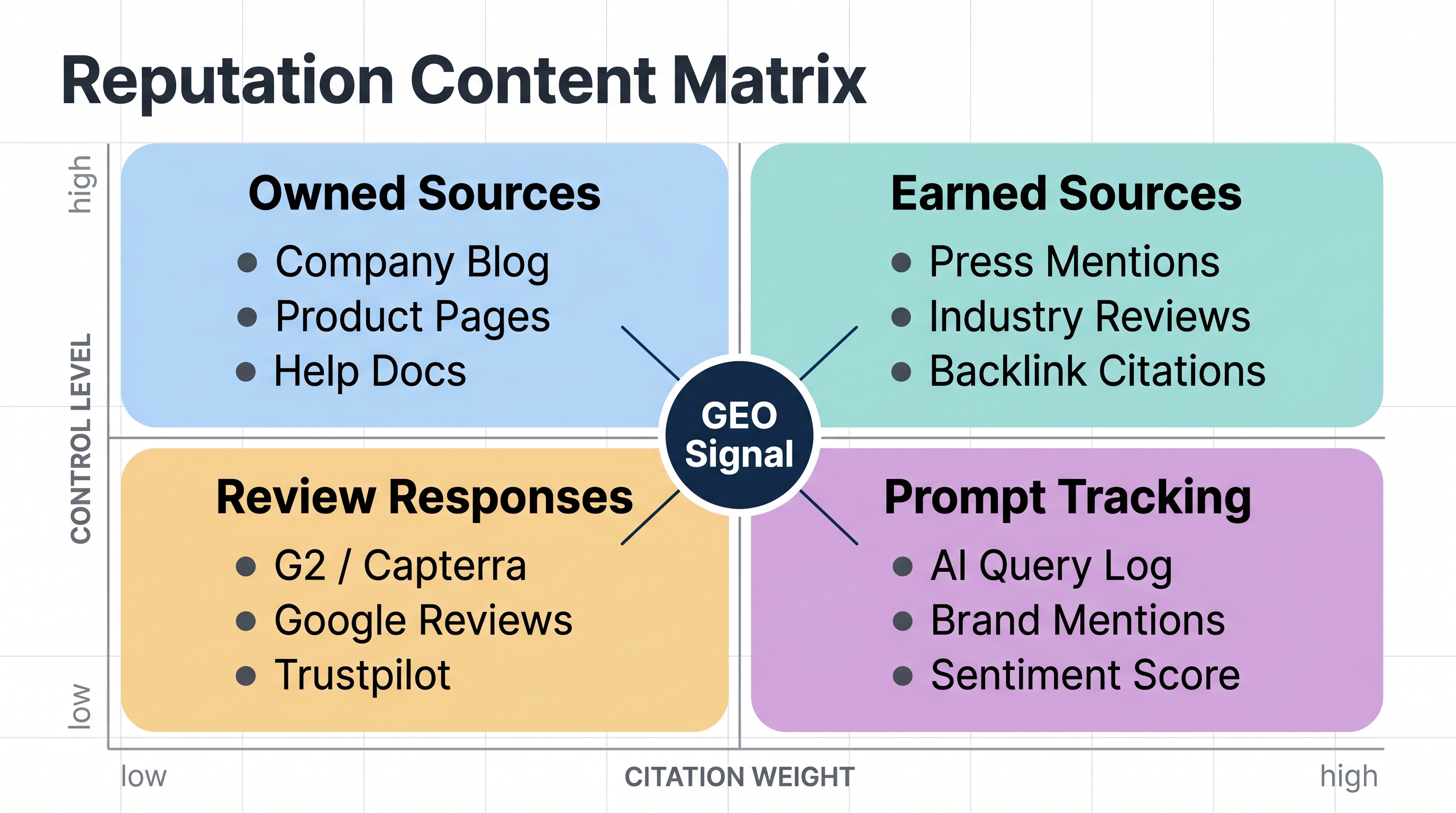
Caption: A healthy reputation system balances owned control with third-party credibility, then tracks whether those sources appear in AI answers.
Use this matrix to decide what to publish first.
Content asset | Control | Citation strength | When to prioritize |
|---|---|---|---|
Issue response page | High | Medium | A real issue lacks current context |
Support or refund policy page | High | Medium | Buyers ask trust and service questions |
Product changelog | High | Medium | Old criticism no longer reflects the product |
Customer case study | Medium | Medium to high | The issue depends on use case or customer type |
Independent review | Low | High | The brand needs outside validation |
Marketplace profile | Medium | High | Buyers already compare options there |
Expert guide or comparison page | High | Medium | AI answers lack clear category context |
Review response program | Medium | Medium | Complaints are accurate but unresolved publicly |
The fastest wins usually come from assets with high control and a clear evidence gap: response pages, policy pages, documentation, changelogs, and structured FAQ pages. The durable wins come from third-party proof.
What to avoid
Bad reputation GEO can backfire. These are the traps I would avoid:
- Publishing fake reviews or synthetic testimonials.
- Creating dozens of low-quality positive articles with the same claims.
- Ignoring real customer complaints while trying to outrank them.
- Using legal threats as the first response to accurate criticism.
- Writing response pages that never name the issue.
- Treating AI answers as stable. They change as the source pool changes.
- Measuring only rankings when the buyer is reading an AI summary.
The hard truth: if the business has not fixed the underlying problem, GEO can only make the contradiction more visible. A positive content system works when it reflects a real improvement system.
A practical 30-day rollout
Use this if you need to move quickly without creating a messy content footprint.
Week | Work | Output |
|---|---|---|
1 | Prompt audit and source inventory | 20-50 risky prompts, cited sources, sentiment baseline |
2 | Owned evidence repair | Updated About page, policy pages, schema, support docs, response page drafts |
3 | Proof asset production | Changelog, FAQ, case study, comparison guide, review-response templates |
4 | Third-party and monitoring loop | Outreach list, profile cleanup, review response cadence, prompt recheck report |
If the issue is severe, slow down and involve legal, support, product, and PR. GEO should not operate alone during a real crisis.
FAQ
Can GEO remove negative information from AI answers?
No. GEO cannot remove pages from the web or force AI systems to ignore accurate negative information. It can improve the evidence available to answer engines so the final answer is more balanced and current.
How long does GEO reputation optimization take?
Owned-page improvements can be published in days, but answer movement usually depends on crawling, indexing, retrieval, and whether third-party sources change. Treat 30 days as a first measurement window, not a guarantee.
Should brands respond to old negative issues?
Yes, if those issues still appear in AI answers or buyer research. The response should be factual: what happened, what changed, when it changed, and where users can verify the current policy or product state.
Is this the same as online reputation management?
It overlaps, but the measurement layer is different. Online reputation management often focuses on search results and review platforms. GEO reputation optimization focuses on the generated answer: what AI systems say, what they cite, and what context they miss.
What is the most important asset to create first?
Create the asset that fills the biggest evidence gap. For many brands, that is a direct response page, a clear support or refund policy, or a dated product improvement page. Do not start with generic PR.
Final takeaway
Negative AI narratives rarely disappear because a brand publishes more positive content. They improve when the source pool becomes more accurate, more current, and easier for answer engines to trust.
Build the system in this order: map risky prompts, audit the evidence, fix the owned source layer, publish honest response pages, add third-party proof, and monitor the answer again. That is how GEO reputation work becomes a growth function instead of a cleanup exercise.
Author: Naomi Ellis, Brand Mention Analyst Across 20k+ Visibility Signals at Auspia. Naomi writes about brand mentions, reputation signals, and visibility gaps across AI search surfaces.