The short answer
In 2026, the useful question is no longer "Is GEO dead?" It is sharper than that: what happens after an AI system has already understood your brand?
GEO still matters for being cited in AI answers. AEO, which we define here as Agent Engine Optimization, matters when an AI agent needs to choose a service, call an interface, complete a task, and recover when something goes wrong.
That shift changes the work. A page that explains your product may help a model answer a question. A machine-readable service description, a clean action schema, and a reliable recovery loop help an agent actually use your product.
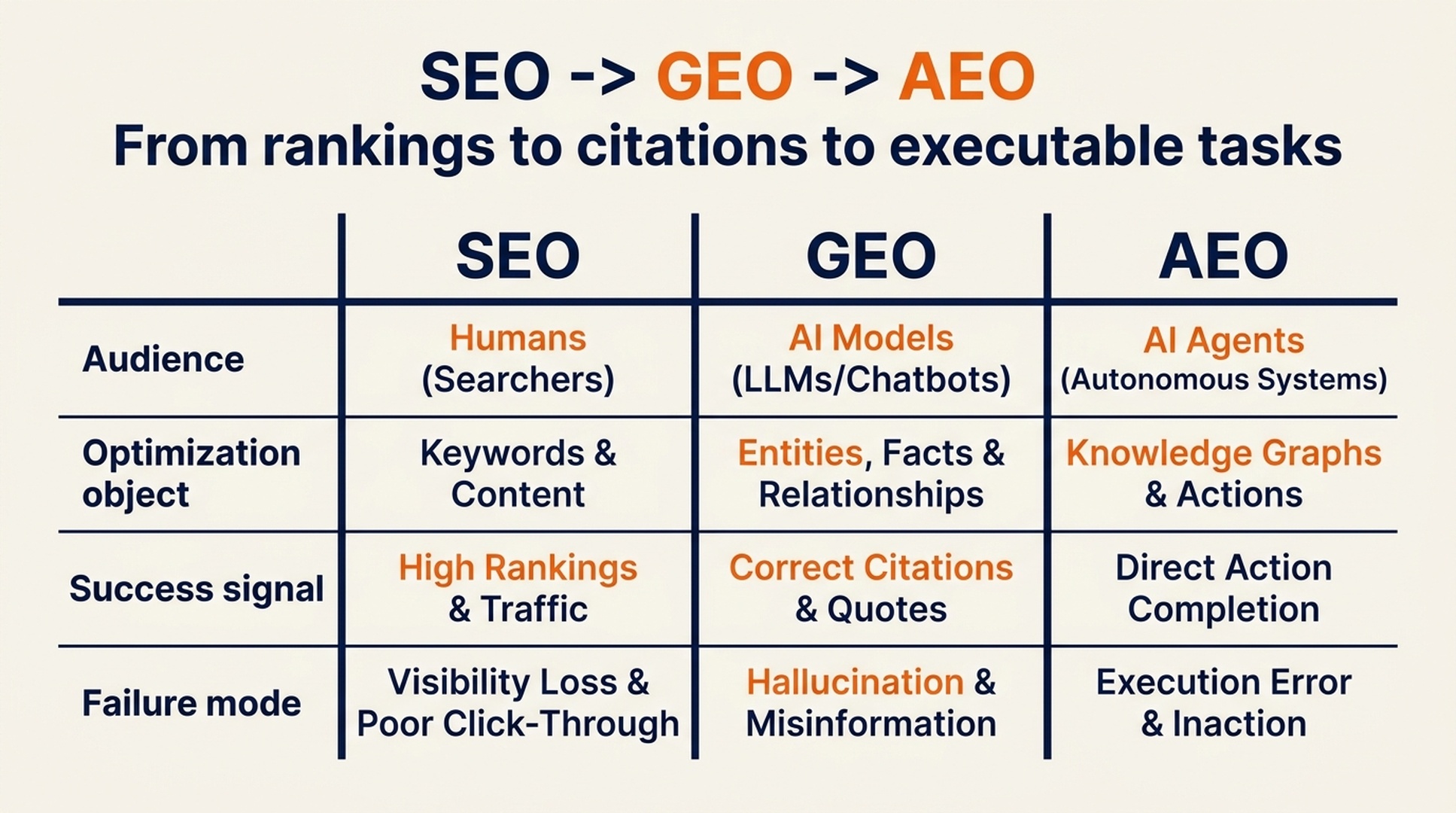
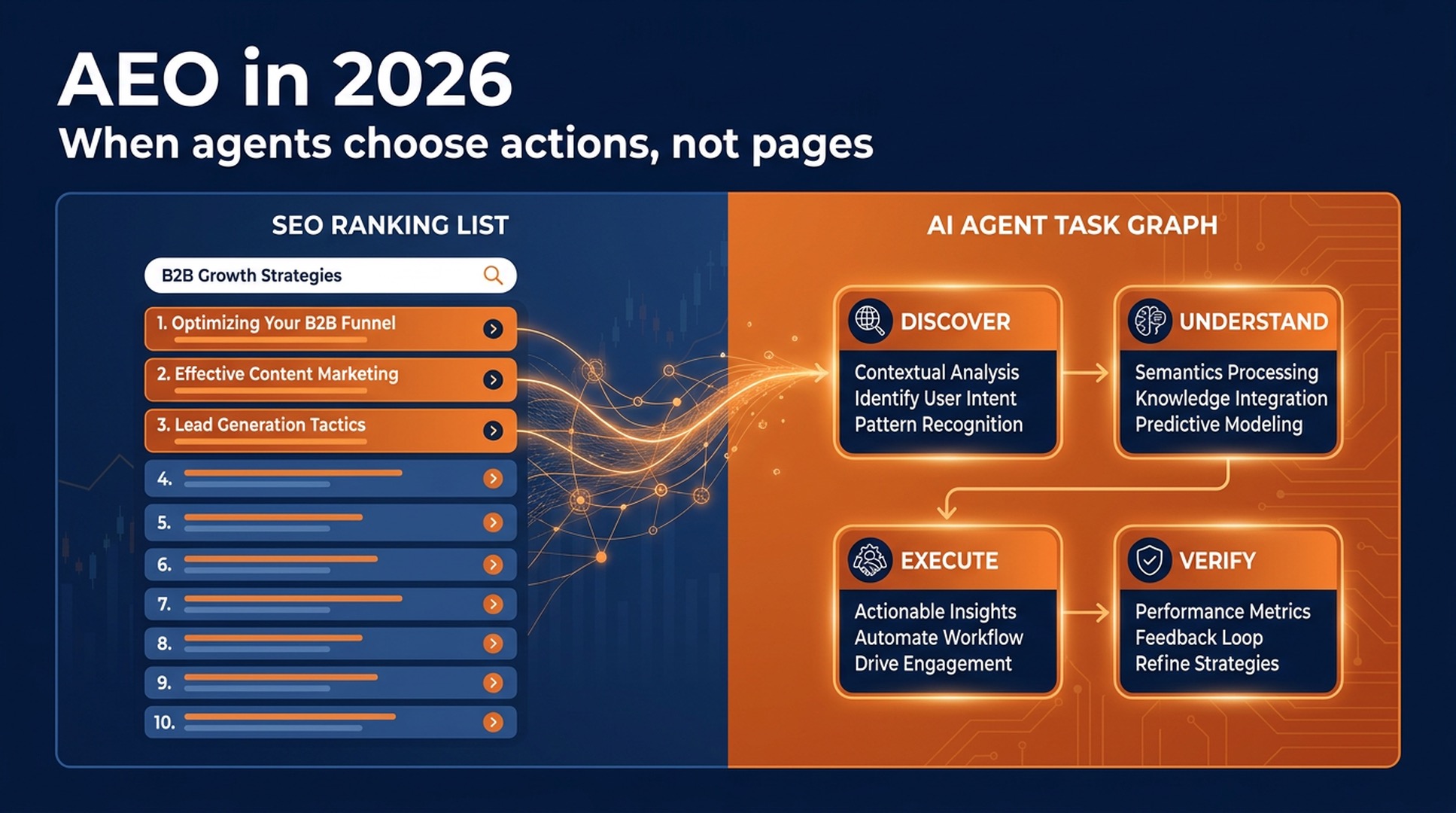
The practical shift: SEO wins rankings, GEO earns citations, AEO prepares a service for agent execution.
Why this matters now
For years, growth teams optimized for human attention. Search snippets, landing pages, comparison posts, pricing pages, reviews, demos, CTAs, sticky nav bars. The default assumption was simple: a person would search, click, read, compare, and decide.
AI search already weakened that path. Many users now ask a model for the answer directly. That pushed teams toward GEO: clearer entities, better source pages, structured claims, comparison assets, and answer-friendly pages.
Agentic systems push the change one step further. Instead of asking, "Which tool should I use?" a user increasingly asks, "Find the right tool and do the job." The agent may compare options, inspect documentation, check permissions, call APIs, fill forms, ask follow-up questions, and report back.
At that point, visibility is not enough. The product has to be usable by software acting on behalf of a person.
OpenAI's public work on ChatGPT agent, Anthropic's Claude Skills model, Google's developer ecosystem around Gemini CLI, and the broader Model Context Protocol conversation all point in the same direction: AI systems are moving from answer generation toward delegated work. The winning web asset is no longer just a good article or a polished UI. It is a trustworthy capability that an agent can discover, understand, invoke, and verify.
GEO is not dead. It is becoming the trust layer
The easiest mistake is to turn this into a fake funeral for GEO. GEO is not dead in 2026. Bad GEO is.
Bad GEO tries to flood the web with weak mentions, artificial comparisons, and pages written only to be scraped by AI systems. That may produce noise for a while, but it creates a trust problem. Models, search engines, and users all have incentives to discount spammy claims.
Useful GEO does something different. It makes a brand, product, method, or dataset easier to understand and cite. It answers real questions. It uses consistent entity names. It puts evidence close to claims. It helps both humans and AI systems know what is true, what is uncertain, and what action should follow.
AEO depends on that trust layer. An agent should not call a service it cannot understand. It should not recommend a workflow if the source pages are vague, contradictory, or unsupported. In that sense, GEO becomes the reputation and context layer beneath AEO.
A simple way to separate them:
Layer | Main audience | What you optimize | Success signal |
|---|---|---|---|
SEO | Searchers | Pages, queries, links, technical health | Rankings, clicks, qualified sessions |
GEO | Answer engines | Entities, evidence, summaries, source quality | Mentions, citations, inclusion in AI answers |
AEO | AI agents | Actions, schemas, permissions, recovery paths | Successful task completion through an agent |
Auspia's view is practical: do not replace SEO with GEO, and do not replace GEO with AEO. Stack them. If your pages cannot be crawled, understood, and trusted, your agent layer starts on weak ground.
The real shift: from attention to execution
A human visitor can tolerate ambiguity. They can infer that "book a call" means a sales form. They can scroll past a broken section. They can decide whether a vague plan still sounds useful.
Agents are less forgiving. They need boundaries.
If an agent is asked to "audit this site and prepare a traffic growth plan," it needs to know which service can do the audit, what input is required, what output will be returned, what the cost or permission risk is, and what to do if a required field is missing.
This is where many websites fail. They are full of persuasive language but short on executable clarity.
A human-facing claim might say:
We help brands grow visibility across AI search.
An agent-ready description needs to say more:
Use this service when a website owner needs an AI search visibility audit. Required inputs: domain, target market, language, and competitor list. Output: visibility score, cited-source gaps, page-level fixes, and prioritized next actions. Do not use this service for paid media reporting or social listening.
The second version is not prettier. It is more useful.
What an AEO-ready asset looks like in 2026
AEO is not one file or one protocol. It is a set of habits that make your product easier for agents to use safely.
The strongest assets usually include four pieces.
1. Intent mapping
Keyword mapping asks, "What does the user search?" Intent mapping asks, "What job is the user trying to delegate?"
For example, a team may not search for "AI crawler robots.txt checker" every day. But an agent may receive a task like: "Check whether our site blocks important AI crawlers and tell me what to change." That delegated job maps naturally to a crawler-access diagnostic.
Good intent mapping should include:
- The user goal in plain English
- The trigger conditions that make your service relevant
- The cases where your service should not be used
- The minimum inputs required to act
- The expected output and next step
This is why Auspia tools such as the AI Search Visibility Checker and Robots.txt AI Crawler Checker should be described as task endpoints, not only as web pages.
2. Deterministic service descriptions
Agents need less poetry and more precision. Your product documentation should define capabilities, limits, input formats, error states, and examples.
A useful service description answers:
- What can this service do?
- What can it not do?
- Which inputs are required?
- Which inputs are optional?
- What output should the caller expect?
- What errors are recoverable?
- When should the agent ask the user before continuing?
The "what not to do" section is more important than most teams think. A narrow, honest capability often earns more trust than a broad claim.
3. Action schemas
AEO becomes real when the agent can take action. That usually means structured inputs, clear permissions, stable endpoints, and examples an agent can follow.
For a SaaS company, this may be API docs, OpenAPI specs, MCP servers, tool manifests, plugin instructions, or agent skill files. For a service business, it may be a structured intake flow, quote request endpoint, booking workflow, or diagnostic form that can be completed programmatically.
The format matters less than the clarity. If an agent has to guess which field means "target market," the workflow is not agent-ready.
4. Recovery loops
Most teams document the happy path. Agents need the unhappy path.
If a required input is missing, say which input is missing and how to get it. If a permission is unsafe, explain the safer alternative. If a request cannot be completed, return a useful next action instead of a dead end.
A weak error says:
400 Bad Request
A useful recovery message says:
Missing target_market. Ask the user to choose one primary market, such as United States, United Kingdom, Canada, or Australia, then retry the audit.
That small difference decides whether the agent can finish the job.
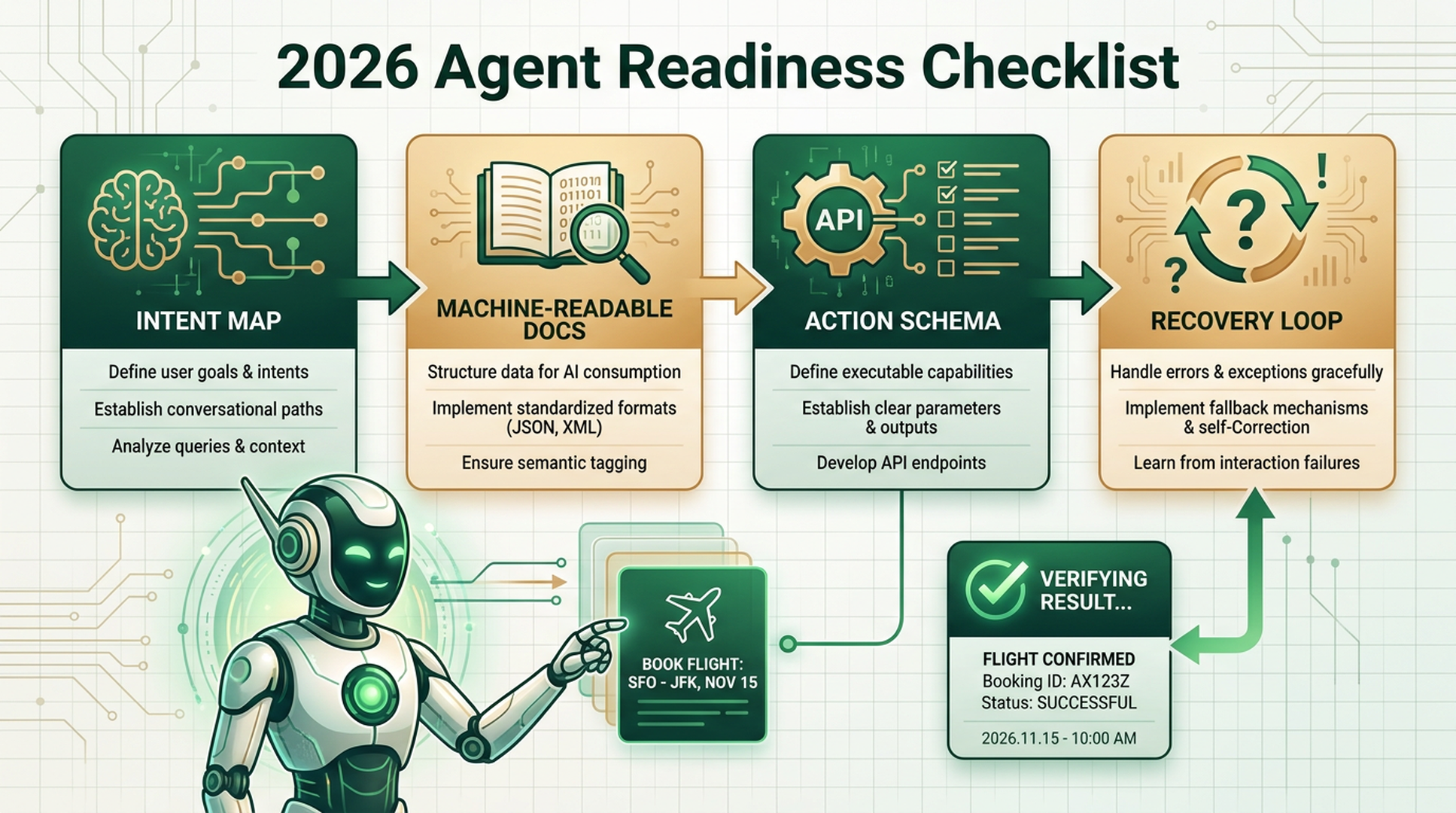
An AEO-ready service gives agents enough context to choose the right action and recover from common failures.
Skills, APIs, and MCP: where each one fits
It is tempting to say, "AEO means building an API." That is too narrow.
APIs are useful when the agent already knows what to do and needs a stable way to do it. MCP is useful when tools, resources, and prompts need to be exposed to compatible AI clients. Skills are useful when the agent needs a compact task package: when to use the capability, how to use it, what files or scripts matter, and what mistakes to avoid.
A practical 2026 model looks like this:
Asset | Best use | AEO role |
|---|---|---|
Web page | Human reading, search discovery, brand trust | Explains the entity and earns citations |
API | Structured execution | Lets an agent perform the task |
MCP server | Tool/resource access in compatible clients | Makes capabilities available in agent environments |
Skill or task package | Procedural guidance | Teaches the agent when and how to act |
Error/recovery docs | Workflow repair | Helps the agent complete the task without giving up |
A mature company may need several of these. A smaller team can start with one narrow task and document it well.
A 2026 AEO checklist for growth teams
Use this checklist before building another batch of AI-search content.
Question | If the answer is no, fix this first |
|---|---|
Can an AI system identify your company, product, market, and use cases from your site? | Improve entity pages, product pages, schema, and source clarity. |
Do your pages explain what your product does and does not do? | Add boundaries, exclusions, and examples. |
Can a delegated task be mapped to your service? | Write task-based use cases, not only feature copy. |
Are required inputs and outputs documented? | Create a clear input/output table or schema. |
Can an agent complete a meaningful action without reading five pages? | Create a focused endpoint, form, tool, or workflow. |
Do errors teach the caller how to recover? | Replace generic errors with corrective instructions. |
Can you measure successful agent-driven completion? | Track completed tasks, not only sessions and pageviews. |
This is also a useful filter for content planning. If an article cannot connect to an action, it may still be valuable for awareness. But it is not an AEO asset yet.
What most teams will get wrong
The first mistake is treating AEO as a new name for content marketing. Publishing 50 more pages with "AI agent" in the title will not make a product agent-ready.
The second mistake is hiding the product behind vague positioning. Agents do not need mystery. They need accurate capability matching.
The third mistake is optimizing only for the model's answer. A cited answer can create demand, but the agent layer decides whether demand turns into completed work.
The fourth mistake is ignoring safety. Agents acting for users should be cautious with payments, personal data, destructive actions, legal claims, and medical or financial decisions. AEO documentation should make consent points and risk boundaries explicit.
The fifth mistake is forgetting the human. People still evaluate brands, read pages, approve actions, and judge outcomes. AEO does not remove the website. It changes the website's job.
How to start without overbuilding
Start with one task. Not a product, not a whole category, not a 90-page documentation hub. One task that a real user would delegate.
For example:
- "Check whether our website is visible in AI answers."
- "Find pages that are hard for AI crawlers to access."
- "Generate an llms.txt file for this site."
- "Compare our product page against the top cited sources in our category."
Then create five assets around that task:
- A human-readable page that explains the task and who it is for.
- A machine-readable description of inputs, outputs, limits, and examples.
- A simple execution path, such as a tool, endpoint, form, or API.
- A recovery guide for missing inputs and common failures.
- A measurement plan for task completion, not just traffic.
Auspia's SEO/GEO/AEO tools are built around this idea: each tool should help a team move from a vague visibility problem to a specific diagnostic or action.
Auspia takeaway
The 2026 version of AI visibility is not only about being mentioned. It is about being usable.
SEO helps people and crawlers find you. GEO helps answer engines understand and cite you. AEO helps agents decide whether they can safely act through you.
That is the operating model worth building toward. Keep the content layer, but stop there and you will be stuck fighting for attention. Add the action layer, and your website starts to look less like a brochure and more like a set of capabilities agents can trust.
FAQ
Is GEO dead in 2026?
No. Low-quality GEO is losing value, but useful GEO still matters. Brands need clear entities, credible source pages, structured claims, and answer-ready explanations. AEO builds on that foundation by preparing the product for agent-led tasks.
What is AEO in this article?
Here, AEO means Agent Engine Optimization: the work of making a website, product, service, or tool discoverable, understandable, executable, and recoverable for AI agents acting on behalf of users.
How is AEO different from SEO?
SEO optimizes pages for search discovery and human clicks. AEO optimizes capabilities for delegated execution. The success metric moves from ranking and traffic toward completed tasks, safe handoffs, and reliable agent workflows.
Do I need an API to do AEO?
Not always. APIs help, but AEO can also start with structured documentation, clear forms, tool pages, task-specific workflows, MCP resources, or skill-style instruction packages. The key is whether an agent can understand when to use you and what to do next.
What should a small team do first?
Pick one high-intent delegated task and document it clearly. Define the required inputs, expected output, limits, and recovery instructions. Then connect that task to a page, tool, form, or endpoint that can produce a real result.