Quick answer: GEO content planning in 2026 is citation planning
GEO content planning in 2026 means designing pages so AI answer systems can understand them, verify them, and reuse small pieces of them in generated answers. The goal is not simply to rank for a keyword. The goal is to become a clean, trusted source for a specific question.
That changes how teams should brief, write, and refresh content.
A page built for AI citation needs four things:
- A direct answer near the top.
- Evidence that a retrieval system can verify.
- A structure that is easy to parse.
- Original value that is worth citing instead of summarizing from someone else.
Traditional SEO still matters. Google says site owners should keep focusing on helpful, reliable, people-first content, make pages accessible to Google, and manage preview controls for AI features through the same technical foundations used in Search. But in AI search, the first reader is often a retrieval and synthesis system before it is a human visitor. That means your page has to work as both a readable article and a machine-readable source.
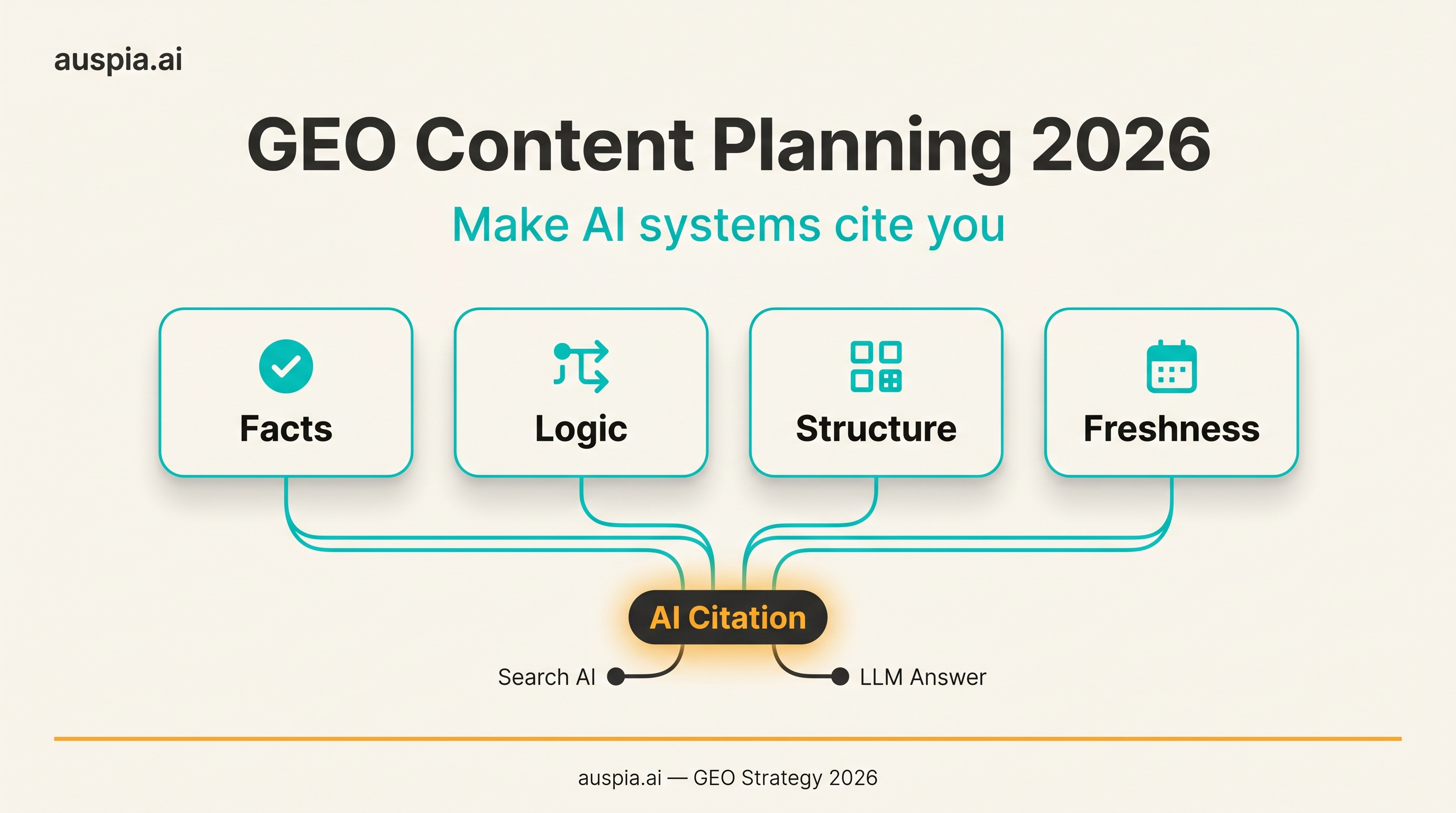
This guide adapts the useful idea from older GEO playbooks: content becomes easier to cite when it combines facts, logic, and style. For 2026, we would update that into a more operational formula:
Citation-ready content = verified facts + clear logic + extractable structure + fresh context.
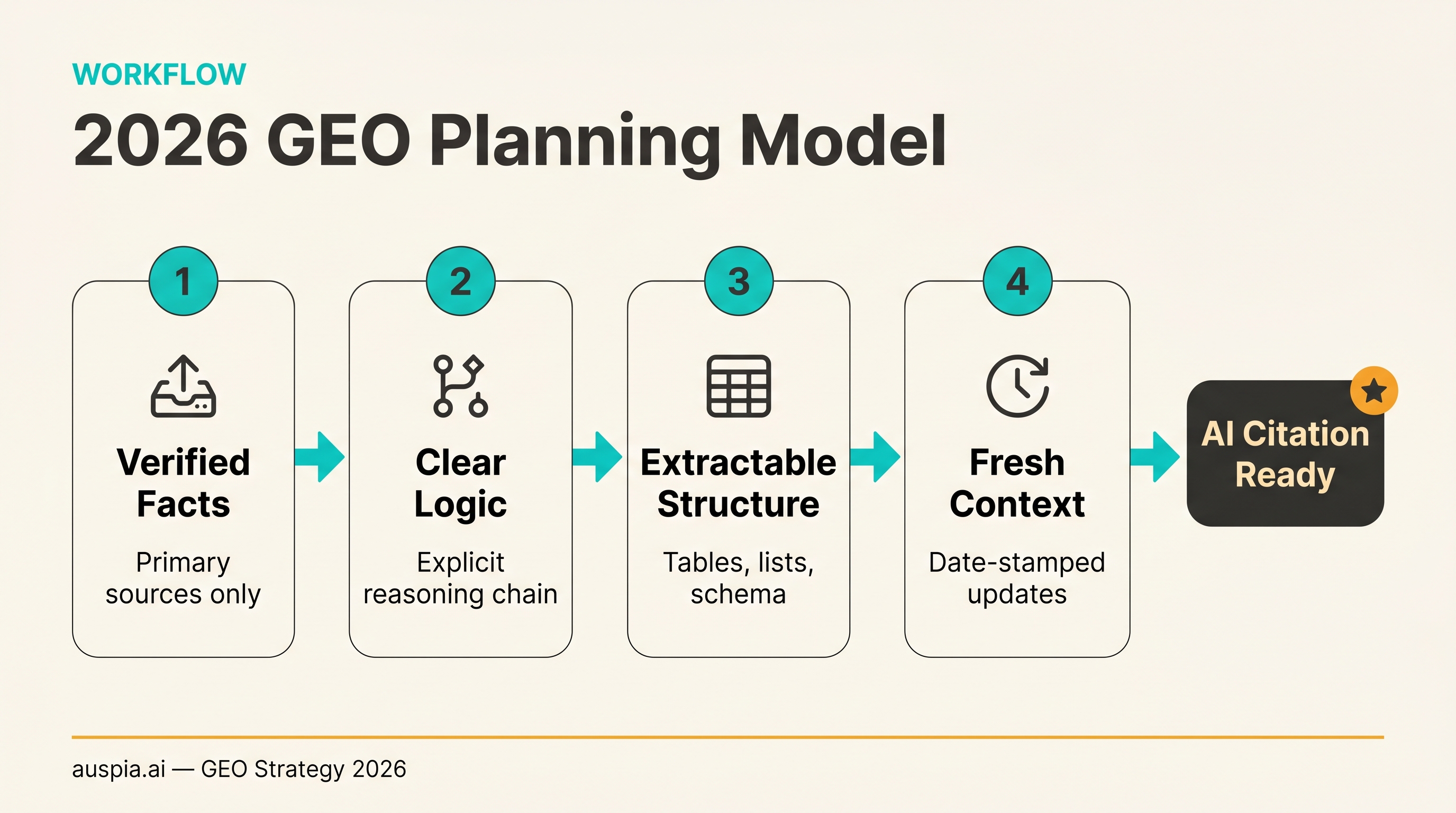
Caption: A practical 2026 GEO planning model: make every important claim verifiable, connected, extractable, and current.
Why GEO content is different from normal SEO content
SEO content and GEO content overlap, but they are not identical.
SEO asks: "Can this page rank and earn clicks?"
GEO asks: "Can this page become a cited source inside an AI answer?"
That distinction sounds small until you sit down to write. A normal blog post can be persuasive, narrative, and broad. A citation-ready page has to be more modular. AI systems often need a 40-word definition, a table row, a step, a named statistic, or a concise comparison. If the page hides the answer inside long paragraphs, the source may be useful to humans but hard for AI systems to quote or summarize accurately.
Planning choice | Traditional SEO content | GEO-ready content in 2026 |
|---|---|---|
Primary goal | Rank and attract clicks | Be cited, summarized, or recommended in AI answers |
Topic source | Keywords, SERPs, competitor gaps | Buyer questions, AI prompts, support questions, comparison tasks |
Winning format | Helpful page with strong relevance | Extractable answer blocks with evidence and structure |
Success signal | Rankings, clicks, CTR, conversions | Mentions, citations, share of answer, referral quality, conversions |
Content risk | Thin content or poor intent match | Vague claims, unverifiable facts, unclear entity signals |
The best teams do not replace SEO with GEO. They layer GEO on top of SEO. Search engines, AI Overviews, Perplexity-style answer engines, and ChatGPT browsing experiences still depend on crawlability, indexable pages, clear entities, and useful content. GEO simply forces the page to become easier to extract from.
The 2026 citation-readiness test
Before writing a GEO article, ask one blunt question:
Could an AI system safely quote this page without making the user less informed?
If the answer is no, the page needs more planning. Use this test:
- Can the page answer the target question in one short passage? If not, add an answer capsule near the top.
- Can every important claim be checked? If not, add sources, dates, definitions, methodology notes, or first-party evidence.
- Can the page be broken into standalone information units? If not, add tables, lists, FAQs, definitions, and step blocks.
- Can a model understand who the brand is and what category it belongs to? If not, improve entity clarity.
- Can a reader tell when the advice was last updated? If not, add a freshness cue and review cadence.
This is where many companies get GEO wrong. They write "AI-friendly" copy but keep it vague. AI systems do not need more adjectives. They need stable facts, clear relationships, and low-risk claims.
Step 1: Build topics from prompts, not only keywords
Keyword research is still useful, but GEO planning should start with the questions people ask AI tools.
A good GEO topic usually has one of these shapes:
- "What is X?"
- "How do I do X?"
- "X vs Y: which is better for my situation?"
- "What are the best tools for X?"
- "Why is my brand not showing up in AI answers?"
- "What should I check before choosing a vendor?"
For a B2B growth team, that means your topic map should include prompt-style questions across the buying journey:
Buyer stage | GEO prompt examples | Best content type |
|---|---|---|
Problem discovery | "Why is organic traffic dropping after AI search changes?" | Explainer, diagnosis guide |
Education | "What is GEO and how is it different from SEO?" | Definition page, glossary, comparison |
Evaluation | "Which GEO tools can audit AI search visibility?" | Tool comparison, checklist |
Implementation | "How should a SaaS team structure content for AI citations?" | Playbook, template, workflow |
Validation | "How do I measure whether AI engines cite my brand?" | Measurement guide, dashboard framework |
A simple workflow works well:
- List 20 customer questions from sales calls, support tickets, demo requests, and community discussions.
- Convert each question into a natural AI prompt.
- Ask that prompt in ChatGPT, Perplexity, Gemini, and Google Search where relevant.
- Record which sources appear, which claims repeat, and where your brand is missing.
- Choose topics where you can add a better answer than the sources currently cited.
Do not chase every prompt. Prioritize questions where citation would influence a real business decision.
Step 2: Write the answer capsule first
The answer capsule is the short, direct answer at the top of the page. It tells both humans and AI systems what the page is about before the article expands.
A strong answer capsule has three qualities:
- It answers the main question in plain language.
- It includes the year or context when freshness matters.
- It avoids unsupported claims and marketing language.
Weak answer capsule:
GEO content is a revolutionary strategy that helps brands dominate AI search and transform visibility across the digital ecosystem.
Better answer capsule:
GEO content planning in 2026 means creating structured, verifiable content that AI answer systems can extract and cite. A strong GEO page includes a direct answer, clear evidence, tables or lists, entity clarity, and regular freshness checks.
The second version is less dramatic. It is also more usable. An AI system can quote it without cleaning up the sentence.
Step 3: Turn each section into an information unit
Large language models do not only evaluate a page as a whole. Retrieval systems often break content into chunks. Your job is to make those chunks useful.
Think in units:
- Definition unit: one concept, one clean definition.
- Comparison unit: one table with stable comparison dimensions.
- Process unit: one numbered workflow.
- Evidence unit: one claim with a source, date, and context.
- FAQ unit: one real question with a direct answer.
- Example unit: one scenario with background, action, and result.
A page becomes more citable when each unit can stand alone.
For example, instead of writing a long section called "Content quality," split it into:
- What counts as evidence for GEO content?
- How should teams cite sources?
- What makes a claim unsafe for AI reuse?
- How often should GEO content be refreshed in 2026?
That structure gives AI systems more precise passages to retrieve.
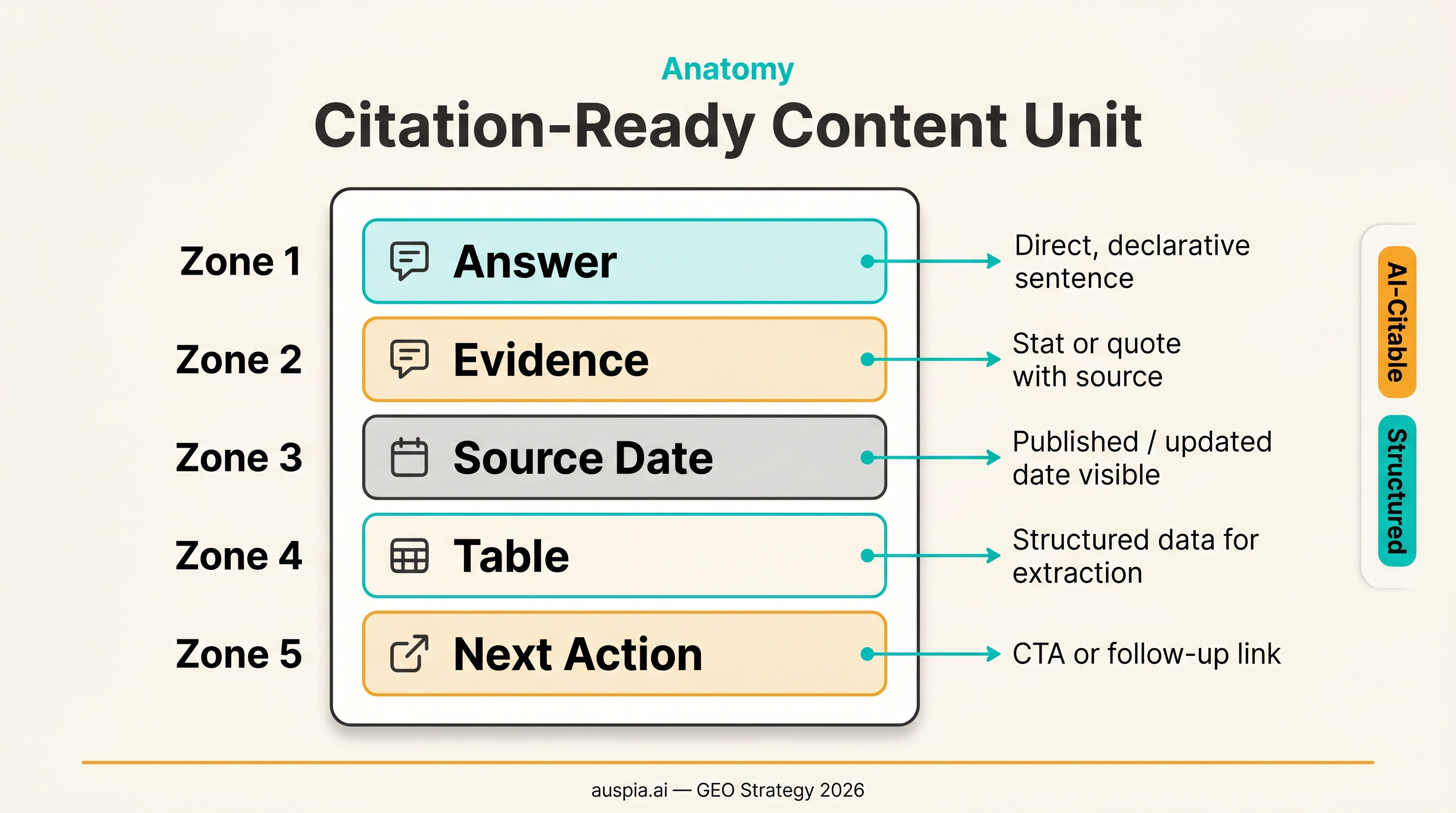
Caption: A citation-ready unit is short enough to extract, but complete enough to stand alone.
Step 4: Use the F.L.S. model, but make it stricter for 2026
The source article this piece is inspired by uses a useful model: Facts, Logic, Style. It still works. For global GEO in 2026, it needs stricter definitions.
Layer | What it means in GEO | What to add in 2026 |
|---|---|---|
Facts | Definitions, data, dates, examples, methodology | Source links, update dates, first-party observations, named entities |
Logic | Clear cause-and-effect, comparisons, step order | Explicit reasoning, assumptions, limits, decision rules |
Style | Readable, consistent, brand-aware writing | Short answer blocks, scannable headings, no exaggerated claims |
Here is how that looks for a SaaS company writing about customer support automation:
- Facts: Define "AI customer support automation," describe supported channels, cite product documentation, show a table of common automation use cases, and state what the tool cannot do.
- Logic: Explain when automation improves response time, when human escalation is still needed, and which setup steps come first.
- Style: Use short paragraphs, concrete examples, and neutral wording. Avoid claiming the tool "replaces support teams" unless that is genuinely true and defensible.
The point is not to sound robotic. It is to remove ambiguity where ambiguity would cause AI systems to misread you.
Step 5: Add evidence without turning the article into a footnote dump
AI systems are more likely to trust a page when claims can be checked, but more links do not automatically mean better content.
Use evidence where it changes the reader's decision:
- Official documentation for platform behavior.
- Original research, surveys, or benchmark pages.
- Product documentation for product-specific claims.
- Clear methodology notes for first-party observations.
- Named examples instead of anonymous "many companies" statements.
For example, if you mention Google AI features, link to Google Search Central guidance rather than a secondhand summary. If you discuss your own audit, explain the prompt set, date range, platforms tested, and scoring method.
A useful evidence block looks like this:
Claim | Evidence needed | Better GEO format |
|---|---|---|
"AI systems prefer structured content" | Examples, tests, or platform guidance | Show a before/after section and explain what changed |
"Our brand appears in Perplexity" | Prompt, location, date, screenshot or citation URL | Add a dated visibility log |
"This tool checks GEO readiness" | Product workflow and criteria | List the criteria and link to the tool |
"This page was updated for 2026" | Actual editorial update | Add a short freshness note and changed sections |
Good evidence makes a page safer to cite. Weak evidence makes it look like marketing copy with links attached.
Step 6: Format for extraction, not decoration
Structured formatting helps because it reduces interpretation work.
Use:
- Descriptive H2 and H3 headings.
- Numbered lists for workflows.
- Tables for comparisons and criteria.
- Short paragraphs for dense ideas.
- FAQ blocks for conversational follow-up questions.
- Schema where it genuinely matches the page type.
Avoid:
- Clever headings that hide the topic.
- Long introductions before the answer.
- Tables with vague column names.
- Overstuffed FAQs written only for search volume.
- Claims that sound impressive but cannot be verified.
A practical rule: if a section heading would make sense as a prompt, it is probably useful. "How do I make GEO content citable?" is better than "The new frontier of visibility."
Step 7: Create a multi-format distribution plan
AI answer systems learn from and retrieve across many web surfaces. Your original article should be the source of truth, but it can feed other formats:
Format | Purpose | GEO adaptation |
|---|---|---|
Blog post | Deep source of truth | Full evidence, definitions, tables, FAQ |
Help center page | Product facts | Short answers, setup steps, limitations |
Comparison page | Buyer evaluation | Stable criteria, honest fit/no-fit notes |
LinkedIn post | Expert distribution | One sharp insight, link back to source |
Video transcript | Multimedia discovery | Clean transcript, chapters, product names |
Dataset or benchmark page | Evidence asset | Methodology, downloadable or repeatable data |
Do not scatter different facts across every channel. AI systems may synthesize conflicting claims. Keep product descriptions, category labels, pricing notes, and positioning consistent.
This is where entity work matters. If your homepage says you are an "AI SEO platform," your comparison pages say "GEO automation software," and your social profiles say "content growth agent," AI systems may struggle to describe you consistently.
Step 8: Refresh GEO pages on a real cadence
The 2026 marker should not be cosmetic. If a title says "2026," the content has to earn it.
Refresh GEO pages when:
- A platform changes citation behavior or source display.
- A major AI search feature changes how links appear.
- Your product positioning or capabilities change.
- Competitors begin appearing in AI answers you monitor.
- The page contains statistics, pricing, screenshots, or workflow advice that may age quickly.
A quarterly review is a reasonable default for strategic GEO pages. High-value comparison pages and tool pages may need monthly checks.
Use this refresh checklist:
- Re-run the target prompts in your selected AI platforms.
- Record whether your brand appears, how it is described, and which sources are cited.
- Update outdated claims, screenshots, and product facts.
- Add missing answer capsules where users ask follow-up questions.
- Improve weak evidence blocks.
- Check whether internal links still support the next action.
A 2026 GEO content brief template
Use this before drafting any new page.
Brief field | What to fill in |
|---|---|
Target AI prompt | The exact question you want the page to answer |
Human search query | The closest Google-style keyword or phrase |
Buyer stage | Discovery, education, evaluation, implementation, validation |
Answer capsule | 40-70 words that answer the prompt directly |
Required evidence | Sources, docs, data, screenshots, examples, methodology |
Information units | Definition, table, checklist, FAQ, example, comparison |
Entity facts | Brand name, product category, audience, geography, use case |
Internal link | The next useful Auspia page or tool |
Refresh trigger | What would make the page stale |
Success metric | Citation, mention, referral, conversion, ranking, or assisted pipeline |
This brief forces the writer to plan citation value before writing paragraphs. It also makes editorial review easier. If the brief cannot name the target prompt or required evidence, the topic is not ready.
Common mistakes that stop AI systems from citing your content
The most common GEO mistakes are boring, but they matter.
- Writing around the answer instead of giving the answer. Put the direct answer near the top.
- Using claims that no one can verify. Replace "industry leaders agree" with named sources, data, or your own methodology.
- Publishing generic summaries. AI systems already have plenty of generic summaries. Add original examples, tests, templates, or decision rules.
- Hiding product facts. If you want AI systems to understand your product, state the category, use cases, audience, and limitations clearly.
- Using inconsistent brand language. Keep entity facts aligned across your site.
- Treating GEO as a one-time rewrite. AI visibility changes. Re-run prompts and refresh the page.
Where Auspia fits into this workflow
If you want a quick way to see whether a page is ready for AI search, try Auspia's GEO Score Checker. It is useful before publishing a new GEO article or refreshing an existing page because it helps you review citation-readiness signals such as structure, AI visibility, and content clarity.
Use it after you draft the page, not before you think. A tool can flag gaps, but the strongest GEO pages still come from sharp positioning, real evidence, and useful answers.
FAQ
What is GEO content planning?
GEO content planning is the process of choosing, briefing, structuring, and refreshing content so generative AI systems can understand and cite it in answers. It focuses on prompt-style questions, clear evidence, structured information units, and entity clarity.
Is GEO replacing SEO in 2026?
No. GEO does not replace SEO. It extends SEO for AI answer environments. Crawlability, helpful content, internal links, page experience, and authority still matter. GEO adds a stronger focus on extractable answers, verifiable claims, and AI citation tracking.
What content formats are easiest for AI systems to cite?
Definitions, comparison tables, numbered workflows, FAQ answers, methodology notes, benchmark summaries, and concise evidence-backed explanations are often easier for AI systems to extract than long narrative paragraphs.
How often should GEO content be updated?
Strategic GEO pages should usually be reviewed quarterly. Pages about AI search platforms, product comparisons, pricing, tool workflows, and 2026 trends may need monthly checks because the underlying facts change faster.
How do I know whether my brand is being cited by AI systems?
Create a prompt library, run the same prompts across AI platforms, record mentions and citations, and compare the results over time. Track not only whether your brand appears, but how it is described and which sources support the answer.
Author: Priya Nair, LLM Content Optimization Researcher, 700+ Prompts Studied at Auspia. Priya writes about LLM-ready content, answer synthesis, and practical content structures for AI search visibility.