The short answer
Zero-click search is not the end of organic growth. It is the end of treating a click as the only proof that search worked.
In AI search, a user may ask one detailed question, read one synthesized answer, compare two or three cited sources, and never visit the ten blue links that used to define SEO. That feels threatening because it is threatening. But it also opens a more useful goal for brands: become the source that AI systems trust enough to name, cite, compare, and remember.
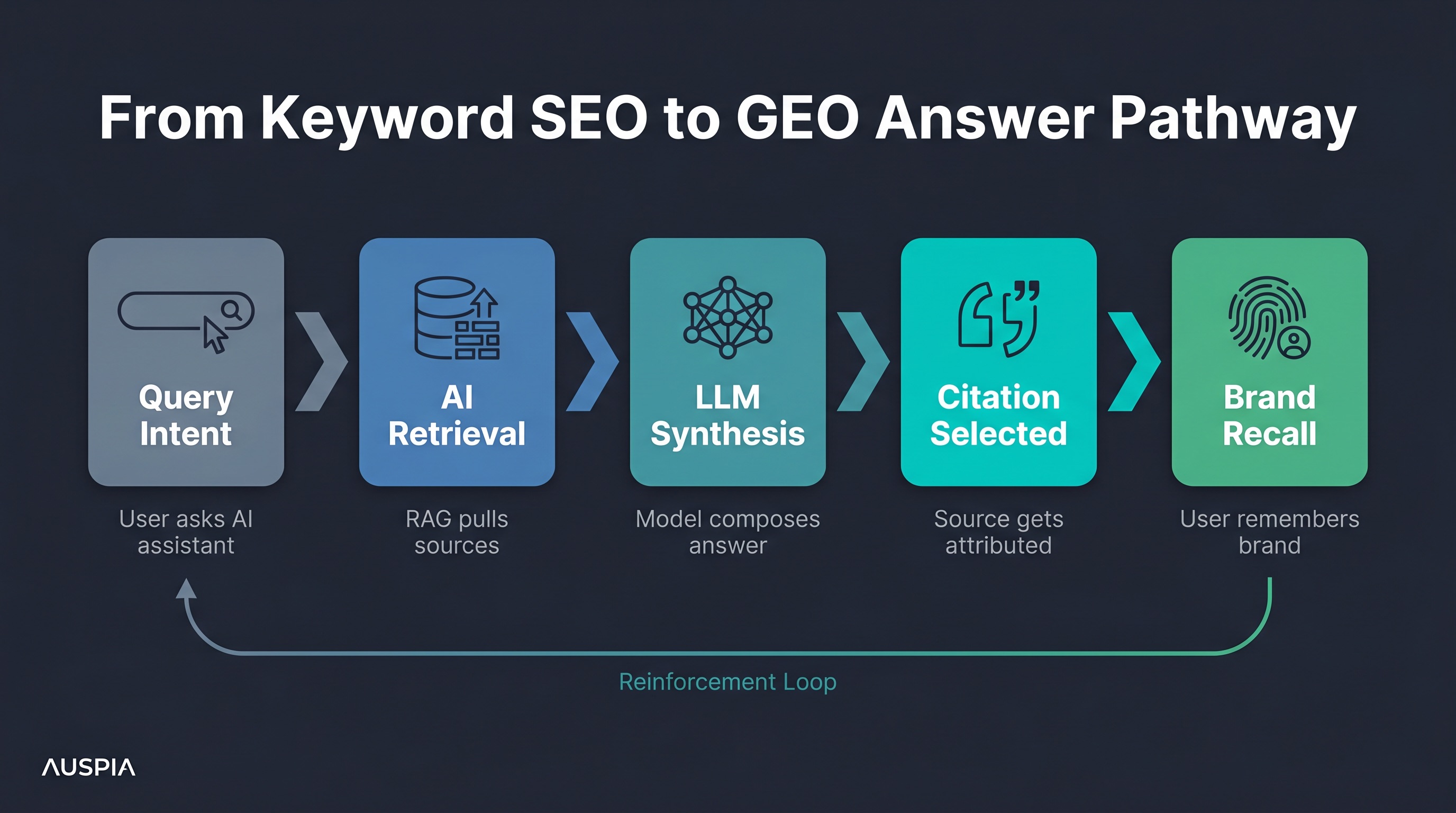
That is where Generative Engine Optimization, or GEO, fits. Traditional SEO helps a page rank. GEO helps a brand become retrievable, understandable, and cite-worthy inside AI answers across Google AI Overviews, AI Mode, ChatGPT, Perplexity, Gemini, and other answer surfaces.
The practical move is not to abandon SEO. The practical move is to stop measuring SEO only as rankings and sessions. In the zero-click era, the new growth stack is rankings plus citations, brand entity clarity, answer quality, and prompt-level measurement.

GEO changes the target from "rank and wait for the click" to "be retrieved, cited, and remembered in the answer path."
Why zero-click anxiety is real
Zero-click behavior was already rising before generative AI became part of search. Featured snippets, knowledge panels, local packs, shopping modules, and map answers all taught users that Google could answer many questions without sending them elsewhere.
AI answers make that behavior more intense. Instead of showing a small answer box above links, AI search can synthesize a full recommendation, add citations, compare options, and let the user continue the conversation. A visitor who once clicked three pages may now ask one follow-up question.
Research from SparkToro and Datos has repeatedly tracked how many Google searches end without a click to the open web. Pew Research Center also found in 2025 that users were less likely to click result links when a Google AI summary appeared. The exact percentage varies by market, query type, device, and methodology, but the direction is clear: search volume can rise while publisher and brand traffic falls.
That is the uncomfortable part. A marketing team can publish useful content, keep rankings, and still see fewer sessions because the answer layer absorbs the visit.
The article that inspired this piece made a similar point for the Asian digital marketing market: when AI systems offer one integrated answer instead of ten links, a brand that is not included in the answer may feel invisible even if it has a decent website. That is a useful framing, as long as we take it one step further. The problem is not only "AI stole the click." The problem is that many brands were never structured to be chosen as sources in the first place.
GEO is not a replacement for SEO
GEO is often presented as a new discipline, but in day-to-day work it is closer to an upgrade layer on top of SEO.
SEO asks: can search engines crawl, index, rank, and send traffic to this page?
GEO asks a different set of questions:
- Can an AI system understand exactly what this brand does?
- Can it verify the claim from the page, schema, third-party mentions, and consistent entity data?
- Can it quote or summarize the answer without guessing?
- Can it compare the brand against alternatives using concrete facts?
- Can the team measure whether the brand appears across real buyer prompts?
A page can rank and still fail those GEO tests. It may have a vague hero section, thin product details, no comparison table, no named use cases, no author or evidence trail, and no external references that support the brand entity. Humans may tolerate that. AI systems usually need cleaner signals.
The original Generative Engine Optimization research paper, published by researchers from Princeton, Georgia Tech, The Allen Institute for AI, and IIT Delhi, tested methods such as adding citations, statistics, quotations, and clearer source signals. The paper reported that GEO methods could improve visibility in generative engine responses, with gains depending on the domain and tactic. The exact number is less important than the lesson: answer systems respond to evidence density and source clarity.
The zero-click funnel still has value
A click is easy to count. A citation is harder. That is why many teams panic when clicks decline.
But zero-click exposure can still shape demand. If a buyer asks "best AI search visibility tools for B2B SaaS" and an answer mentions your brand, that interaction can influence later branded search, direct visits, comparison-page clicks, sales calls, or procurement shortlists. The value moved upstream.
This is especially true for high-consideration categories. A user may not click during the first AI answer, but they may remember which brands were repeatedly mentioned across prompts. They may later search the brand name directly. They may ask ChatGPT or Perplexity to compare the same shortlist again. They may send the cited source to a colleague.
That is why the goal is not "get every click back." Some lost clicks were low-intent visits that never converted. The better goal is to protect the moments where AI answers influence who gets considered.
Auspia's view is simple: teams should treat AI citations as pre-click demand signals. They are not the same as traffic, but they can explain why traffic, branded search, and pipeline shift later.
What AI systems need before they cite a brand
Most GEO work comes down to reducing uncertainty. AI systems are less likely to mention a brand when the available evidence is vague, conflicting, stale, or hard to extract.
Here is the practical checklist.
GEO signal | What to fix | What good looks like |
|---|---|---|
Brand entity | Inconsistent descriptions across site, social profiles, directories, and media | The same category, audience, product names, and proof points appear everywhere |
Answer structure | Long promotional pages with no direct answers | Pages include short definitions, comparison tables, FAQs, pricing or use-case details where appropriate |
Evidence | Claims without sources, examples, data, or named customers | Claims are supported by original data, public docs, reviews, case studies, benchmarks, or credible third-party mentions |
Technical access | Important content hidden behind scripts, blocked crawlers, or messy canonical signals | Content is crawlable, indexable, structured, and consistent with schema markup |
Prompt coverage | Teams only track keyword rankings | Teams test buyer prompts, competitor prompts, category prompts, and problem prompts |
None of this requires gimmicks. It requires cleaner information architecture.
The five-part GEO survival plan
1. Keep SEO fundamentals, but change the success metric
Do not stop doing technical SEO, content refreshes, internal linking, and search intent work. AI systems still draw from the web, and Google still uses crawling, indexing, ranking, and quality systems.
Google's Search Central guidance for AI features points site owners back to the same fundamentals: make useful, unique content that can be crawled and indexed, and use standard preview controls if needed. In other words, there is no magic AI-only tag that buys inclusion.
The change is measurement. Keep rankings and organic sessions, but add:
- AI citation count by prompt set
- Share of answer against competitors
- Sentiment and accuracy of AI summaries
- Cited source URLs
- Branded search changes after citation gains
- Conversion behavior from users who arrive after branded or direct searches
If your dashboard only shows sessions, zero-click search looks like pure loss. If it also shows citations and branded demand, you can see which topics still build market memory.
2. Build extractable answer assets
AI systems prefer content they can parse. That does not mean every page should become a bland FAQ. It means important facts should not be buried in copy that sounds good but says little.
For each priority topic, create answer assets such as:
- A 40 to 80 word direct answer near the top
- A comparison table with clear criteria
- A numbered workflow
- A glossary block for category terms
- A concise FAQ section with non-duplicate questions
- A "who this is for" section
- A "when not to use this" section
For example, a page about GEO should not only say that GEO improves AI visibility. It should explain which AI surfaces are being targeted, what signals are being improved, how citations are measured, and what a realistic timeline looks like.
3. Make the brand entity boringly consistent
AI answers often fail when a brand's identity is fuzzy. One profile says the company is an SEO tool. Another says it is an AI marketing platform. A product page says it is for enterprises. A directory says it is for freelancers. The model has to guess.
Fix the basics first:
- One canonical company description
- One primary category
- Consistent product names
- Clear founder or company facts where public
- Updated About, Contact, Pricing, and Product pages
- Schema markup that matches the visible content
- Third-party profiles that repeat the same category language
This is not glamorous work. It is the work that keeps AI systems from confusing you with a competitor or describing your product in an outdated way.
4. Earn sources outside your own site
The referenced myMKC article notes that different AI systems appear to lean on different source types, from user-generated discussions to news, Wikipedia, professional reports, and community content. The exact weighting changes, but the principle holds: your website is not the whole evidence graph.
That means GEO needs distribution and proof, not just on-page edits.
For B2B brands, useful source channels include:
- Original research reports
- Public benchmarks
- Partner pages
- Analyst or practitioner mentions
- Comparison pages with clear criteria
- Documentation and help-center pages
- Podcast transcripts or webinar pages with useful claims
- Industry directories and review platforms where the data is accurate
For consumer brands, community proof, reviews, creator testing, product details, and transparent policies can matter more. The point is not to chase every platform. The point is to make sure AI systems can find corroborating evidence in more than one place.
5. Test prompts like you test rankings
Keyword tracking tells you what happens in classic SERPs. It does not tell you whether an AI answer recommends you for a buyer's real question.
Build a prompt library around how people make decisions:
- Problem prompts: "How do I improve AI search visibility for a SaaS brand?"
- Comparison prompts: "Compare GEO tools for mid-market B2B teams."
- Category prompts: "What are the main types of AI search optimization software?"
- Competitor prompts: "What are alternatives to [competitor]?"
- Risk prompts: "What should I watch out for before hiring a GEO agency?"
- Local or vertical prompts if relevant
Run these prompts across the AI surfaces that matter to your audience. Record whether the brand appears, what sources are cited, whether claims are accurate, which competitors appear, and what content gaps the answer reveals.
A tool like Auspia's AI Search Visibility Checker can help teams turn this from occasional curiosity into a repeatable visibility check.
What to do when traffic is already falling
If organic traffic is dropping, do not jump straight to publishing more articles. Diagnose where the drop is happening.
First, separate informational queries from commercial queries. If AI answers are absorbing low-intent informational visits, the business impact may be smaller than the traffic chart suggests. If commercial comparison pages, product-led pages, or bottom-funnel guides are losing visibility, the risk is more serious.
Second, compare rankings against clicks. If impressions are stable but CTR is falling, the SERP or AI answer layer may be taking the click. If rankings are falling too, the issue is broader than zero-click behavior.
Third, check whether AI systems are citing anyone for those topics. If competitors are cited and you are absent, you have a GEO gap. If no brands are cited, the query may be answered generically and may need a different content angle.
Fourth, repair source quality before scaling content. A new article will not fix a confusing brand entity, thin product pages, outdated schema, or unsupported claims.
A practical 30-day GEO sprint
Here is a simple sprint for a growth team that wants to move without turning GEO into a six-month strategy deck.
Week | Action | Output |
|---|---|---|
1 | Audit 30 to 50 buyer prompts across Google AI Overviews, AI Mode if available, ChatGPT, Perplexity, and Gemini | Baseline citation report and competitor share-of-answer |
2 | Rewrite 5 priority pages for extractable answers, comparison tables, definitions, and evidence blocks | Updated pages with clearer answer structure |
3 | Fix brand entity consistency across About page, schema, profiles, directories, and product descriptions | Cleaner entity graph and fewer conflicting descriptions |
4 | Publish one original evidence asset and pitch or distribute it to credible third-party channels | A source that AI systems and humans can cite |
The sprint should end with another prompt test. Do not assume the edits worked. Measure again, then decide whether to refresh pages, build new evidence, or improve distribution.
Common mistakes
The first mistake is treating GEO as keyword stuffing for AI. Repeating "best," "top," and category terms will not make a weak page trustworthy.
The second mistake is optimizing only the blog. AI systems may prefer product pages, documentation, reviews, community threads, reports, or third-party profiles depending on the query. Blog content is only one source type.
The third mistake is chasing every AI platform with the same tactic. ChatGPT, Perplexity, Gemini, Google AI Overviews, and AI Mode do not behave identically. Your measurement should reflect that.
The fourth mistake is reporting citations without checking accuracy. Being mentioned is not enough if the answer misstates your pricing, audience, product category, or limitations.
The fifth mistake is giving up on clicks. Zero-click does not mean zero-click forever. AI visibility often works as a consideration layer before the user searches your brand directly, compares vendors, or visits a cited source later.
FAQ
What is GEO?
GEO stands for Generative Engine Optimization. It is the practice of improving a brand's chances of being retrieved, summarized, cited, and recommended by AI answer systems.
Is GEO the same as SEO?
No. SEO focuses on crawlability, indexation, rankings, and search traffic. GEO uses many SEO foundations, but it also focuses on AI citations, brand entity clarity, answer structure, evidence quality, and prompt-level visibility.
Does zero-click search mean SEO is dead?
No. It means SEO has to carry more than one job. Pages still need to rank and earn qualified visits, but they also need to feed AI answers, support branded demand, and create citation-worthy evidence.
How do I know whether my brand has a GEO problem?
Run real buyer prompts across the AI platforms your audience uses. If competitors appear and your brand does not, or if your brand is described inaccurately, you have a GEO problem.
What should I optimize first?
Start with pages that influence buying decisions: product pages, comparison pages, category explainers, pricing pages, documentation, case studies, and high-intent guides. Make them specific, structured, evidence-backed, and easy to cite.
Sources referenced
- SparkToro and Datos: https://sparktoro.com/blog/in-2026-less-than-one-third-of-google-searches-still-send-a-click/
- Pew Research Center: https://www.pewresearch.org/short-reads/2025/07/22/google-users-are-less-likely-to-click-on-links-when-an-ai-summary-appears-in-the-results/
- Generative Engine Optimization research paper: https://arxiv.org/abs/2311.09735
- Google Search Central AI features guidance: https://developers.google.com/search/docs/appearance/ai-features
- myMKC article used as topic reference: https://mymkc.com/article/content/25605
Final takeaway
Zero-click search is painful because it breaks the old bargain: publish useful content, rank well, get the visit. AI search adds a new bargain: be clear enough to retrieve, credible enough to cite, and memorable enough to become part of the buyer's shortlist.
That is a harder game, but it is also a better one for brands that have real evidence, clear positioning, and disciplined measurement. GEO helps those brands stop asking only "Where did the click go?" and start asking the more useful question: "Are we present when AI shapes the decision?"
Author: Maya Ellison, 12-Year GEO Strategy Researcher at Auspia. Maya writes about AI search visibility, brand entity clarity, and practical GEO operating systems for growth teams.