The short version
GEO is not a replacement for SEO. It is the next layer of organic visibility: the work that helps AI answer engines understand your brand, trust your evidence, and include you when buyers ask for recommendations.
The practical case is simple. Paid traffic disappears when the budget stops. Classic SEO still matters, but many buyers now ask ChatGPT, Perplexity, Gemini, Google AI Overviews, or another AI answer surface before they click a search result. If your brand is not part of those answers, you may be invisible at the exact moment a buyer is narrowing the shortlist.
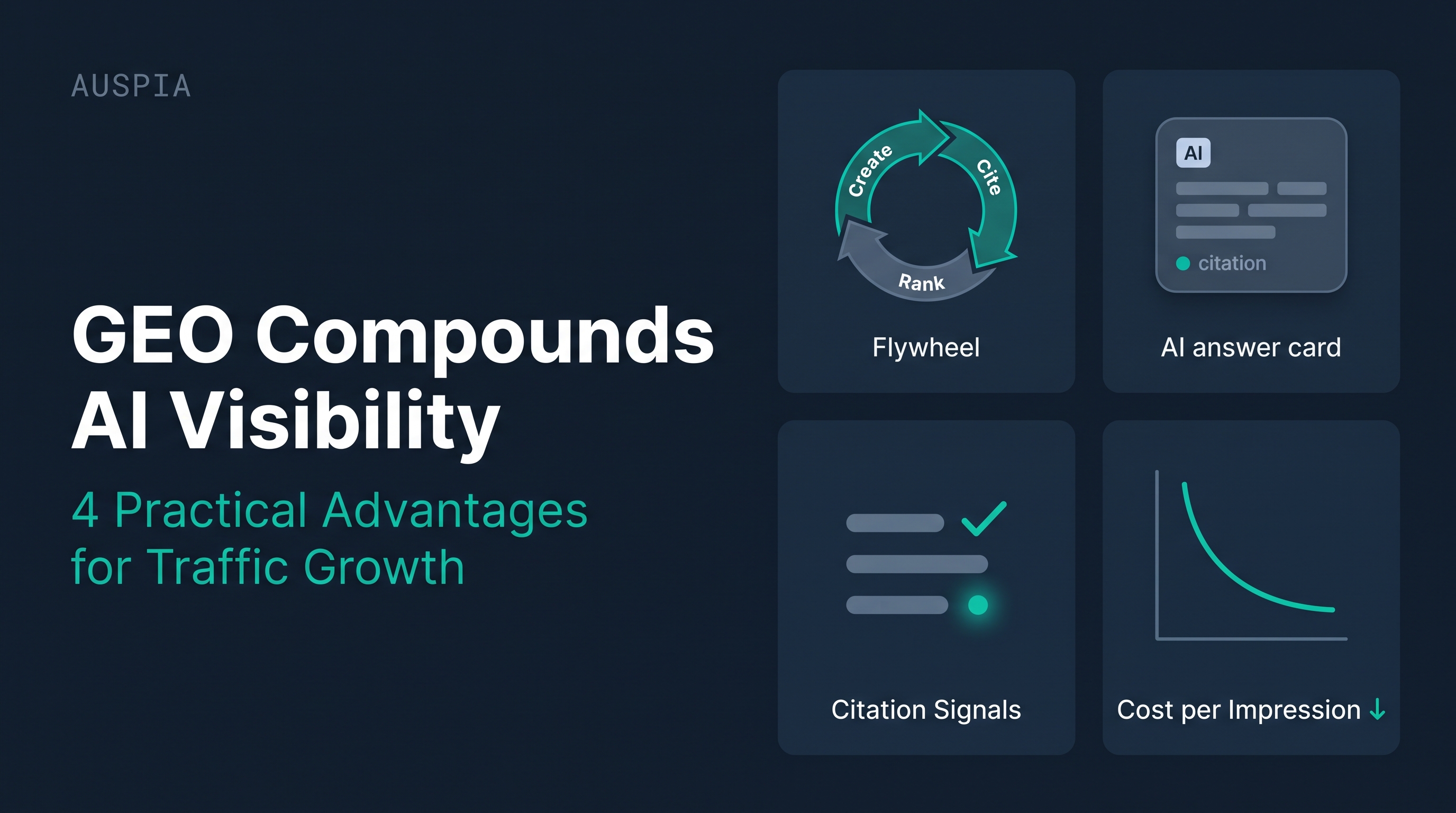
This article breaks down four advantages of GEO for growth teams:
GEO advantage | What it changes | What to build first |
|---|---|---|
Compounding visibility | Your best evidence can keep being retrieved and reused | Clear service pages, comparison pages, proof pages |
Multi-platform coverage | Buyers can find you across more than one AI answer surface | Prompt checks across ChatGPT, Perplexity, Gemini, and Google AI results |
Structured trust | AI systems can parse what you do and why you are credible | Entity facts, schema, FAQs, examples, and cited claims |
Early moat | Competitors cannot copy a trusted content footprint overnight | A repeatable GEO content and measurement loop |
Why GEO is suddenly a board-level traffic problem
The old search bargain was fairly easy to explain: rank for the query, earn the click, convert the visitor. That path still exists, and it is still worth defending. But it no longer covers the full buyer journey.
A growing share of research now happens inside answer engines. A user may ask, "best AI visibility tools for a B2B SaaS team," read a synthesized answer, compare two or three recommended vendors, and only then visit a website. The click happens later. Sometimes it does not happen at all.
That changes the job. Growth teams are no longer optimizing only for a blue-link ranking. They are also optimizing for whether an AI system can confidently say:
- what the company does;
- who the product is for;
- what proof supports the claim;
- how the brand compares with alternatives;
- whether the source is safe to cite or summarize.
That is the real purpose of GEO. It makes your website and surrounding evidence easier for AI systems to retrieve, interpret, and use in answers.
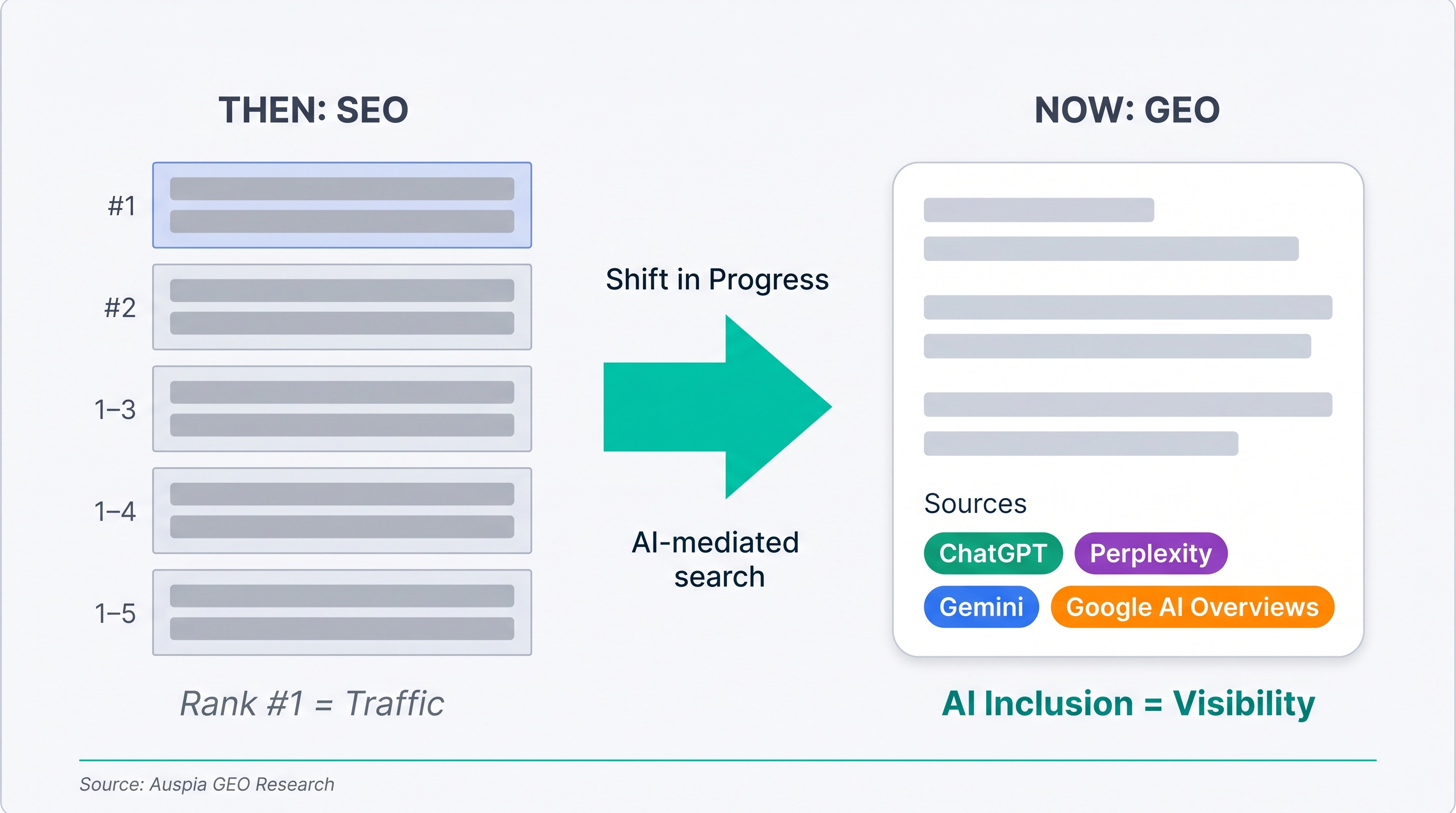
Caption: GEO does not remove SEO work. It adds a new visibility target: inclusion in synthesized AI answers.
Advantage 1: GEO can compound instead of resetting every month
Paid acquisition has a harsh rhythm. Spend more and you get more reach. Spend less and the graph falls. That can be fine for testing offers or scaling a proven funnel, but it is a weak foundation for long-term category visibility.
GEO behaves more like an organic asset base when it is done well. A clear product page, a credible comparison article, a source-backed case page, and a clean FAQ can keep helping AI systems understand your brand long after the publication date. The work still needs maintenance, but it does not reset to zero every morning.
The mistake is treating GEO as a trick for "getting mentioned by AI." A better model is evidence architecture. You are building the public material an answer engine can use without guessing.
Good GEO assets usually answer questions like:
- What category does this company belong to?
- What problems does it solve?
- Which audiences is it built for?
- What proof, examples, or data support those claims?
- What should a buyer compare it against?
If the answer is scattered across vague homepage copy, thin blog posts, and unsupported claims, an AI system has little to work with. If the answer is structured and consistent, your odds improve.
Auspia's view: the compounding effect comes from clarity, not volume. Ten well-structured pages often beat fifty generic posts because AI systems need stable facts and reusable evidence.
Advantage 2: GEO follows the buyer across answer surfaces
Traditional SEO often starts with Google. GEO has to think wider.
A buyer might use Google AI Overviews for a quick definition, Perplexity for source-heavy research, ChatGPT for vendor shortlisting, Gemini inside a work account, or another AI assistant embedded in a browser or productivity suite. Each surface retrieves and summarizes information differently.
That does not mean you need a separate strategy for every platform. It means your brand facts, content structure, and evidence should be portable.
A useful GEO workflow checks a small set of buyer prompts across several answer surfaces:
Prompt type | Example | What to inspect |
|---|---|---|
Category discovery | "What are the best GEO tools for SaaS teams?" | Is your brand mentioned? Are competitors named instead? |
Problem diagnosis | "How do I know if my brand appears in AI search?" | Does the answer cite your educational content? |
Comparison | "Auspia vs other AI search visibility tools" | Are your differentiators accurate? |
Implementation | "How do I improve AI citation visibility?" | Does the answer recommend actions your content supports? |
Run the same prompts monthly. Save the answers. Note which sources are cited, which competitors appear, and which claims are wrong or missing. This turns GEO from a slogan into an operating system.
For teams starting from scratch, Auspia's AI Search Visibility Checker is a practical first step because it forces the question that matters: where does the brand actually appear today?
Advantage 3: structured content makes the brand easier to trust
AI systems do not "trust" a brand in the human sense. They work with retrievable text, source patterns, citations, entity consistency, and context. If your content is loose, promotional, or hard to parse, the system has to fill gaps. That is bad for accuracy and bad for visibility.
Structured content helps because it reduces ambiguity.
For GEO, structure means more than adding headings. It includes:
- a clear definition of the brand and product category;
- consistent entity facts across the homepage, about page, product pages, and third-party profiles;
- comparison tables that state fit, limits, and alternatives;
- FAQ sections that answer real buyer questions directly;
- schema markup where it helps machines interpret the page;
- examples, benchmarks, screenshots, or case evidence that support claims;
- source links when you refer to external facts.
The goal is not to write for robots. The goal is to make the human answer so clear that machines can quote, summarize, and route it correctly.
Here is a simple before-and-after pattern:
Weak copy | GEO-ready copy |
|---|---|
"We help brands grow with AI." | "Auspia helps growth teams measure and improve brand visibility across AI answer engines such as ChatGPT, Perplexity, Gemini, and Google AI Overviews." |
"Our platform is powerful and easy to use." | "Teams use Auspia to run prompt checks, identify missing citations, audit entity consistency, and prioritize GEO fixes." |
"Trusted by modern teams." | "Use cases include B2B SaaS category visibility, service-brand recommendations, AI citation tracking, and SEO-to-GEO content refreshes." |
Notice the difference. The second column gives an answer engine usable facts. No drama, no fog.
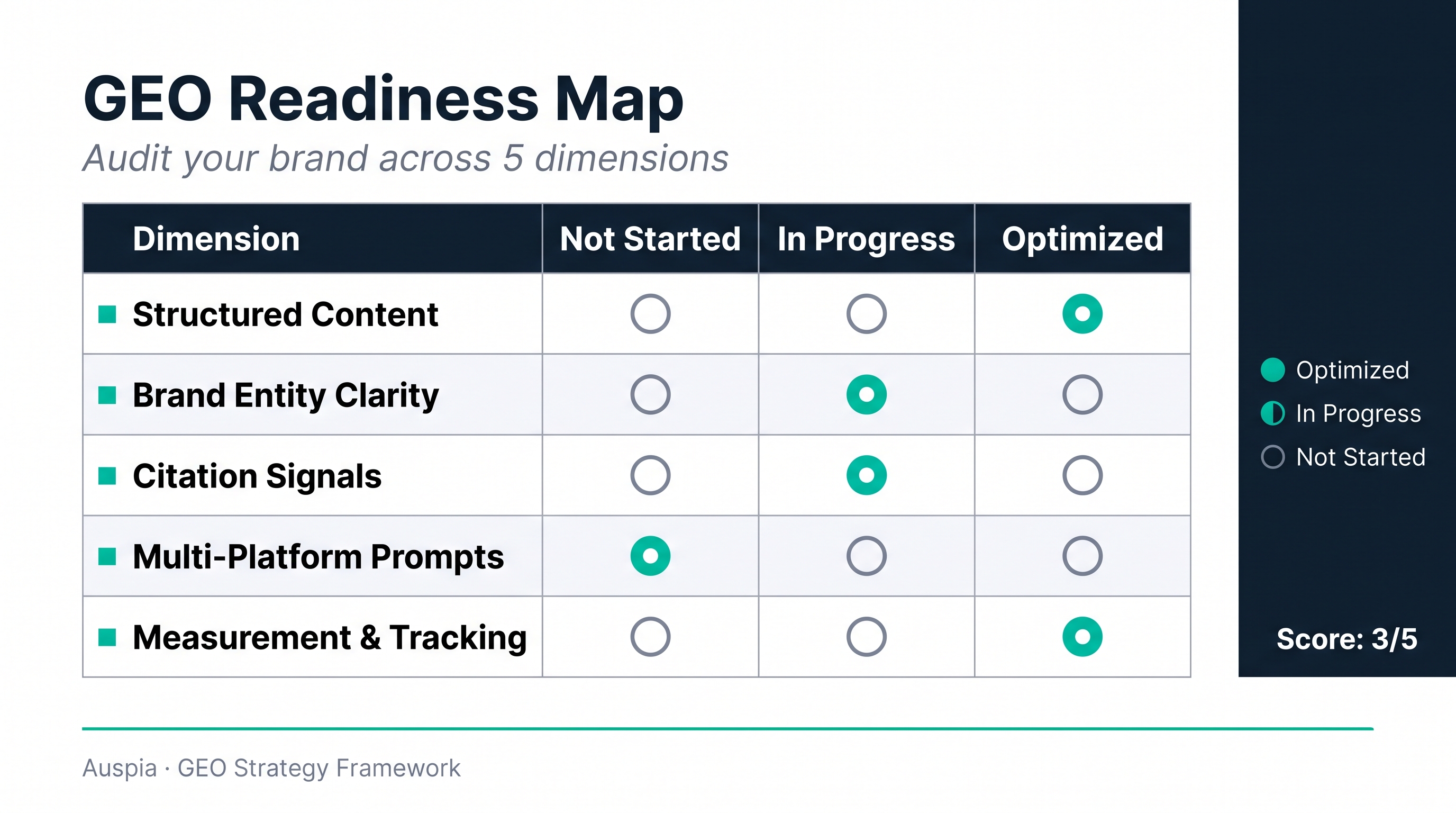
Caption: A practical GEO audit should check content structure, entity clarity, citation strength, platform coverage, and measurement.
Advantage 4: early GEO work builds a harder-to-copy moat
There is a short window in every channel where disciplined teams can build an advantage before the playbook becomes obvious. GEO is in that phase now.
The advantage is not that early movers can publish a few AI-written pages and win. That kind of content will be easy to copy and easy to ignore. The stronger moat is a body of evidence that takes time to assemble:
- clear brand positioning;
- strong owned pages;
- third-party mentions and citations;
- original examples or data;
- consistent answers across buyer prompts;
- regular measurement and refresh cycles.
Competitors can copy a headline. They cannot instantly copy a trusted footprint.
This matters most in categories where buyers already ask AI for recommendations: SaaS tools, agencies, professional services, local services, ecommerce categories, healthcare-adjacent research, finance-adjacent research, and technical B2B products. If the AI answer becomes the first shortlist, late entrants will pay more to correct the narrative.
Auspia's take is blunt: the cheapest time to improve AI visibility is before the market notices the gap. Once competitors occupy the answer set, your work shifts from building presence to displacing someone else.
A practical GEO build order
If your team wants to start this quarter, do not begin with a 60-page strategy deck. Start with a visible, measurable loop.
- Audit the current answer set. Test 20 to 50 buyer prompts across the AI platforms your audience actually uses.
- Fix entity basics. Make the homepage, about page, product pages, author pages, and profiles describe the company consistently.
- Build proof pages. Publish comparison pages, use-case pages, methodology pages, case-style evidence, and FAQ hubs.
- Add structure. Use concise summaries, tables, schema, definitions, and direct answers where they help readers.
- Track changes monthly. Record brand mentions, citation sources, competitor mentions, answer accuracy, and page-level gaps.
- Refresh based on evidence. Update pages that AI systems misunderstand or ignore.
This is not glamorous work. It is closer to maintaining a public knowledge base for your market. But that is why it works.
Common mistakes to avoid
The most common GEO mistake is chasing mentions before fixing the source material. If your website cannot explain the brand clearly, external mentions will not save you.
The second mistake is copying SEO habits too literally. Keyword research still helps, but GEO also needs prompt research, entity consistency, and citation analysis. A page can rank and still fail to appear in AI answers.
The third mistake is publishing generic AI content at scale. Answer engines do not need more recycled explanations. They need useful, specific, verifiable material that helps them answer a buyer's question with confidence.
FAQ
Is GEO replacing SEO?
No. SEO still matters because search engines, crawlers, and web pages remain part of the retrieval layer. GEO extends SEO by optimizing for AI-generated answers, citations, and brand inclusion across answer surfaces.
How long does GEO take to work?
It depends on the category, crawl frequency, content quality, and the strength of third-party evidence. Teams should usually measure progress monthly, not daily. Early wins often come from fixing unclear brand facts and publishing better answer-ready pages.
What should a small team do first?
Run a prompt audit. Ask the same buyer questions your prospects ask, then check whether your brand appears, whether competitors appear, and which sources the answer uses. That audit will show whether the first fix should be content structure, entity clarity, citations, or comparison coverage.
What is the difference between GEO and AEO?
AEO focuses on making content answer-ready for direct answers, snippets, assistants, and FAQ-style retrieval. GEO is broader: it focuses on how generative engines understand, cite, compare, and recommend brands in synthesized answers.
Final takeaway
GEO is a visibility discipline for a market where buyers ask AI before they click. The brands that win will not be the loudest. They will be the easiest to understand, verify, compare, and recommend.
One good GEO pass can keep paying back because it improves the evidence AI systems use to describe your brand. That is the real prize: not a one-time mention, but a stronger position in the answers that shape demand.
Author: Maya Ellison, 12-Year GEO Strategy Researcher at Auspia. Maya writes about AI search visibility, brand entity clarity, and practical GEO operating systems for growth teams.