Quick answer
The best SEO OpenClaw Skill for 2026 is not a single-purpose keyword writer. It is an audit-to-backlog skill: an agent workflow that crawls a site, compares the SERP, checks schema and sitemap signals, then turns the findings into a ranked SEO work queue.
That answer may sound less flashy than "one-click SEO automation," but it is the practical one. SEO teams do not lose time because they cannot generate another title tag. They lose time because technical issues, content gaps, schema errors, and ownership decisions sit in separate tools. A good OpenClaw Skill should close that gap.
For most growth teams, the winning setup is:
SEO job | Best OpenClaw Skill pattern | What it should produce |
|---|---|---|
Technical SEO | Site audit and crawl monitor | Critical fixes, affected URLs, owners, severity |
Content planning | SERP competitor analyzer | Search intent map, content gaps, brief outline |
AI search readiness | Entity and citation checker | Missing facts, source gaps, citable page suggestions |
Structured data | Schema generator and validator | JSON-LD drafts, validation errors, page-type rules |
Index management | Sitemap and robots checker | Coverage gaps, blocked pages, freshness issues |
If you only install or build one SEO Skill, make it the first row: a site audit and crawl monitor that outputs a prioritized backlog. Everything else becomes easier once the site is clean enough to trust.
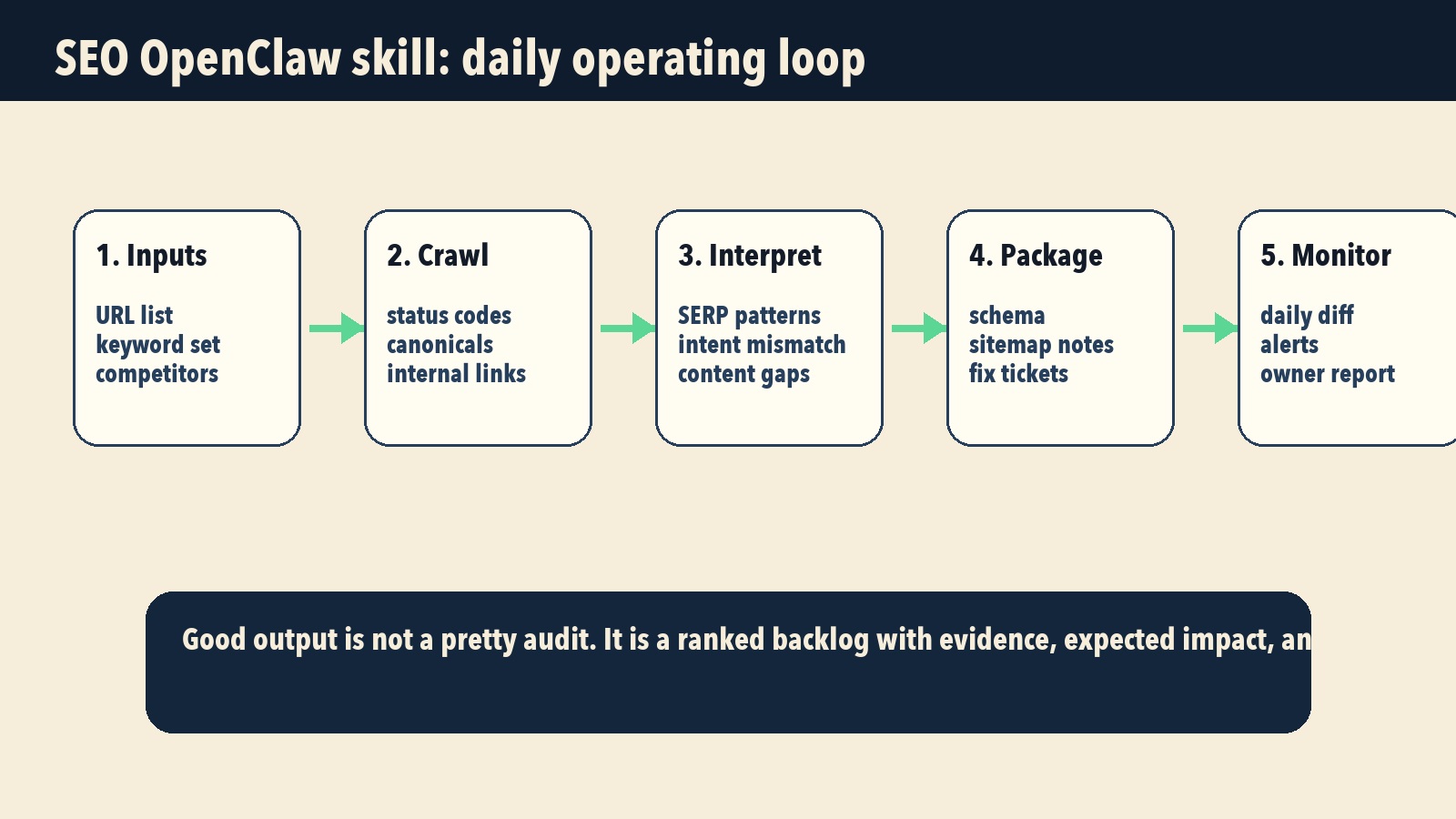
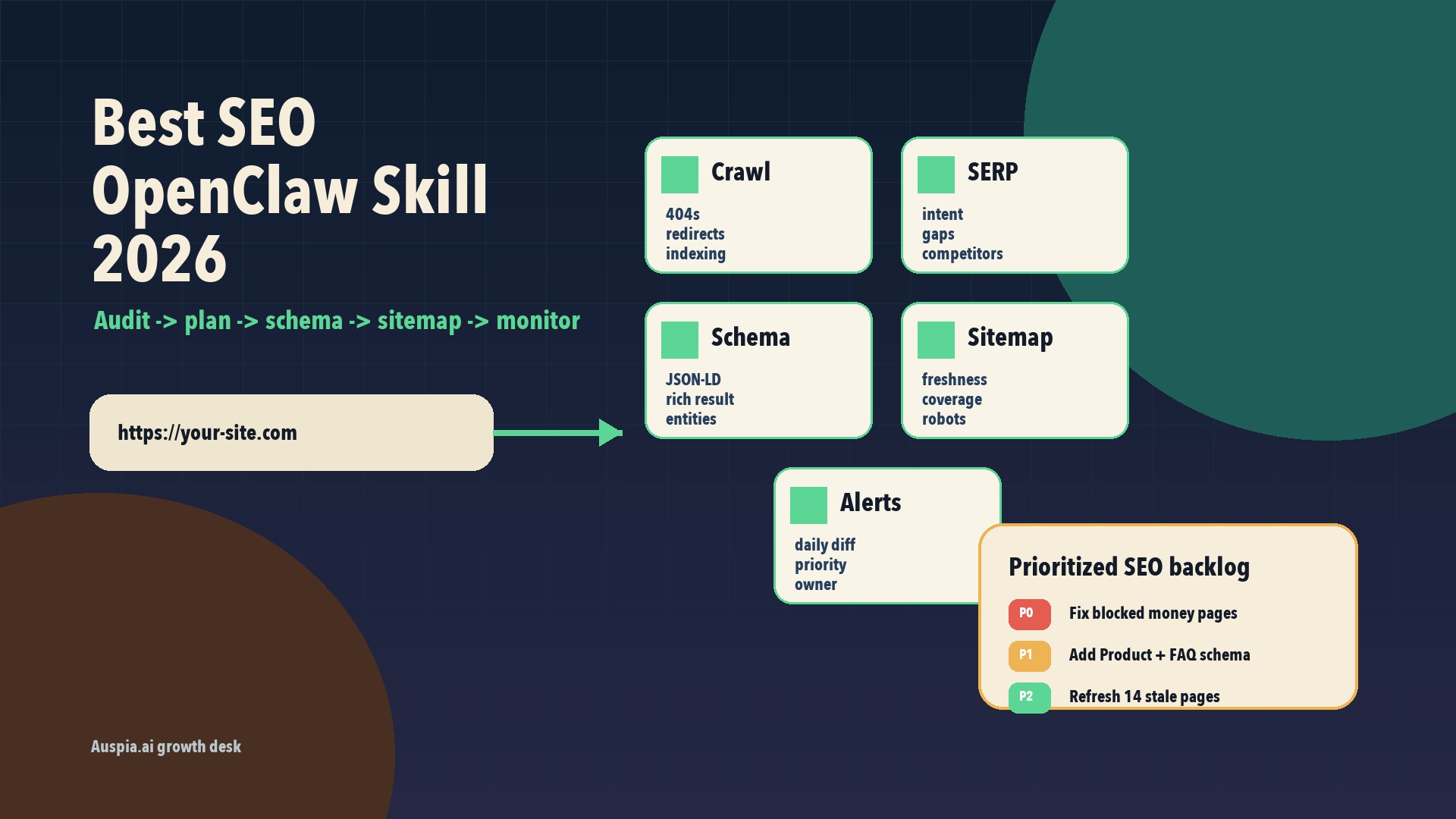
Caption: A useful SEO OpenClaw Skill should move from inputs to crawl data, interpretation, packaged fixes, and ongoing monitoring.
Why OpenClaw Skills matter for SEO in 2026
OpenClaw Skills are useful for SEO because they package repeatable agent behavior into a workflow. Instead of asking an AI assistant to "analyze this page" every time, a Skill can define the steps, tools, checks, output format, and safety rules for a recurring job.
That matters because SEO work has become more operational. A modern SEO team is expected to watch classic Google search, AI Overviews, ChatGPT-style answers, Perplexity citations, technical crawl health, structured data, content freshness, and conversion paths. No human team wants to manually re-check all of that every morning.
Research results for OpenClaw SEO workflows in 2026 point to the same pattern: the useful Skills are not just content generators. They handle tasks like content gap analysis, broken link prospecting, unlinked brand mention discovery, SERP competitor research, schema generation, rank monitoring, and technical audits. The common thread is execution. The agent collects data, compares it, and gives the operator a next action.
That is also the standard Auspia uses when judging AI SEO tooling. If a workflow does not create a better decision or a cleaner handoff, it is probably just automation theater.
The best overall choice: an SEO audit-to-backlog Skill
An audit-to-backlog Skill is the best general-purpose SEO OpenClaw Skill because it touches the highest-leverage layer of the SEO system: diagnosis.
A weak SEO audit says:
- 38 pages are missing meta descriptions.
- 12 pages have long titles.
- 4 URLs return 404.
- 9 pages have schema warnings.
A strong SEO OpenClaw Skill says:
- These 3 blocked commercial pages need a same-day fix.
- These 12 stale comparison pages should be refreshed before the next crawl window.
- This product page template is missing required schema properties.
- These 6 blog posts compete for the same intent and should be consolidated.
- This sitemap includes outdated URLs that are no longer internally linked.
The second output is better because it respects the real constraint: SEO teams have limited developer time, editorial time, and stakeholder patience.
A good audit-to-backlog Skill should include five modules.
1. Crawl and technical health
The Skill should crawl the site or ingest crawl exports and identify status code issues, redirect chains, canonical mismatches, indexability problems, missing metadata, internal link breaks, orphaned pages, and slow page clusters.
The important feature is not the checklist itself. Screaming Frog, Sitebulb, Ahrefs, Semrush, and Search Console can already surface many of these issues. The useful agent layer is interpretation: grouping related findings into fixable work packages.
For example, "41 duplicate titles" is a weak finding. "The /features/ template generates duplicate titles across all integration pages" is a useful finding.
2. SERP competitor context
Technical SEO does not happen in isolation. The Skill should be able to take a target query, inspect the current ranking pages, and summarize what the SERP appears to reward.
Useful checks include:
- Which page types dominate: guides, tools, category pages, comparison pages, Reddit threads, documentation, marketplaces.
- What search intent is visible: informational, commercial, local, transactional, troubleshooting.
- Which schema types appear on ranking pages.
- Which headings, examples, calculators, comparison tables, or templates are common.
- Whether the target page is competing with another page on the same site.
The output should be a brief, not a dump. An SEO operator needs to know what to change on the page and why.
3. Schema generation and validation
Schema is a good use case for agentic help because it is structured, repetitive, and easy to validate. A Skill can generate JSON-LD for article, product, organization, software application, FAQ, breadcrumb, and local business pages, then check the output against the page content.
The guardrail is simple: never let the Skill invent facts. Schema should describe what is actually on the page. If the page does not contain pricing, ratings, author information, or product availability, the Skill should flag the missing content instead of fabricating markup.
4. Sitemap, robots, and indexing checks
Many SEO failures are boring. A staging rule blocks a page. A sitemap keeps old URLs. A canonical points to the wrong version. A page is internally linked but excluded from the indexable set.
A useful OpenClaw Skill should compare:
- XML sitemap URLs.
- Indexable URLs from the crawl.
- Important URLs from analytics or Search Console exports.
- Robots.txt and meta robots rules.
- Canonical targets.
- Internal link paths.
The best output is a coverage map: what should be indexed, what is currently indexable, and what needs a fix.
5. Monitoring and alerts
A one-time audit is helpful. A scheduled audit is more useful.
For 2026 SEO operations, the Skill should support daily or weekly runs with a diff view. The team should not receive the same 200 warnings every Monday. They should see what changed since the last run:
- New 5xx errors.
- New noindex tags.
- New pages added to sitemap.
- Important pages removed from internal navigation.
- New schema validation failures.
- New title or canonical duplication.
This is where an agent Skill starts to feel different from a static tool. It can watch, compare, summarize, and route.
The best specialist SEO OpenClaw Skills
The audit-to-backlog Skill is the best first choice, but teams with mature SEO operations will want specialist Skills around it.
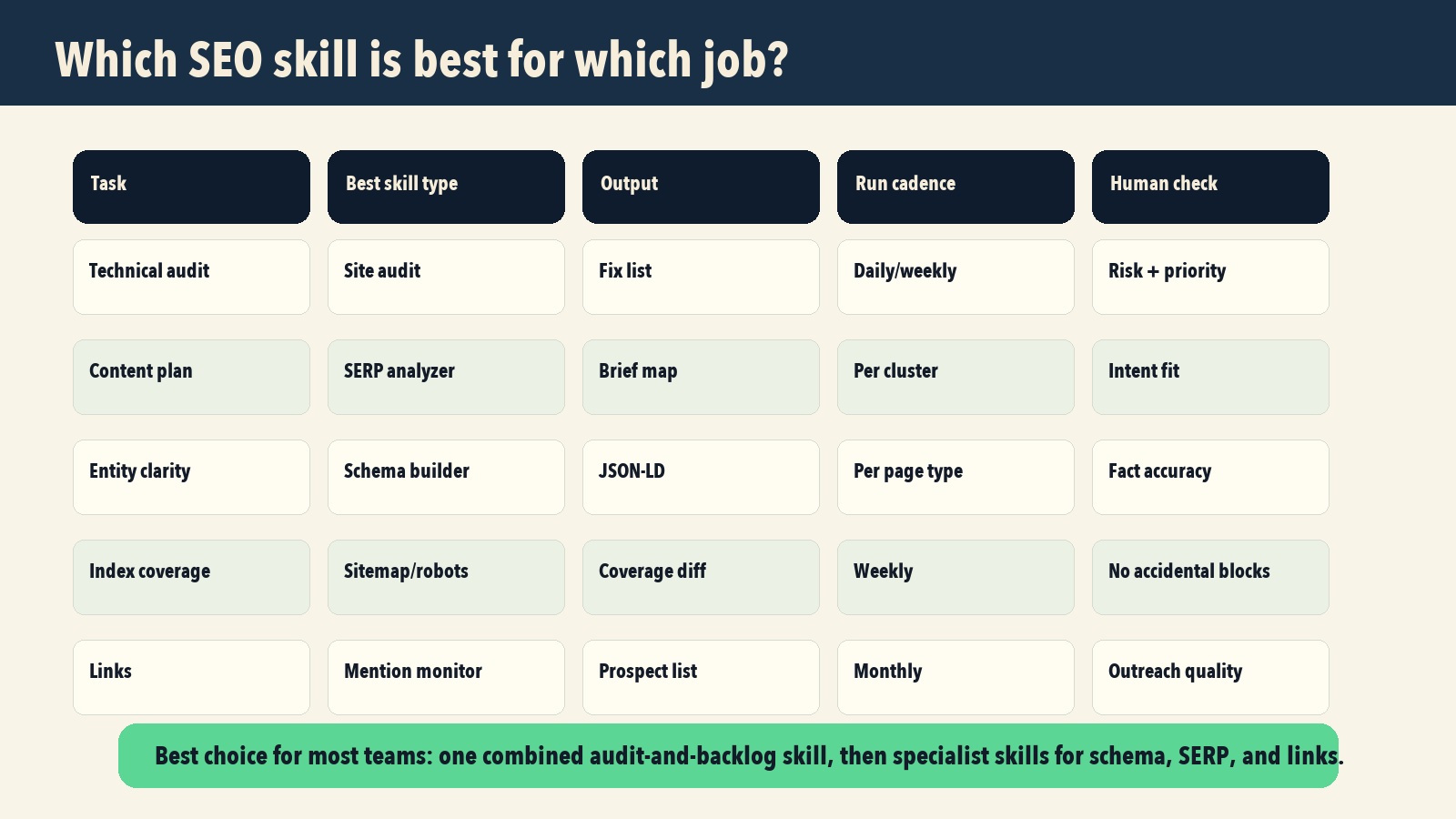
Caption: Different SEO jobs need different Skill patterns. The best stack usually starts with audit and backlog automation, then adds specialist modules.
SERPAnalyzer-style Skill for content briefs
Use this when your editorial team needs better briefs. The Skill should inspect ranking pages, extract the search intent, identify common sections, find missing examples, and propose an outline.
The output should not be "write a 2,000-word article." It should say something more specific:
- The query is comparison-heavy, so the page needs a decision table.
- Top pages answer pricing in the first half of the article.
- The current page lacks a direct answer block.
- Two existing articles overlap and should be consolidated.
- Competitors use product screenshots, while your page is text-only.
This kind of Skill pairs well with Auspia's SEO and GEO tools, because the workflow can move from diagnosis to page-level scoring and AI search visibility checks.
LinkFinder-style Skill for broken link prospecting
Broken link building is tedious enough to deserve automation. A LinkFinder-style Skill can crawl a list of target sites, find outbound 404s, inspect the surrounding context, and match the broken reference to a relevant page on your site.
The Skill should produce a prospect list with:
- Source page URL.
- Broken outbound URL.
- Anchor text and surrounding context.
- Suggested replacement URL.
- Contact or author information when available.
- Outreach angle.
The human still needs to approve the outreach. That matters. Link building touches reputation, and no agent should email strangers without a review step.
MentionMonitor-style Skill for unlinked brand mentions
Unlinked brand mentions are often easier wins than cold link outreach. A MentionMonitor-style Skill can find pages that mention your brand, product, study, or executive team without linking to your domain.
The Skill should filter low-quality pages, group mentions by publisher, and flag the strongest opportunities. The best version also checks whether the mentioned page is relevant to a useful destination: homepage, study, tool, product page, or case study.
Schema builder Skill for page templates
A schema Skill is useful when a site has repeatable page types: product pages, tool pages, glossary pages, blog posts, location pages, or comparison pages.
The Skill should generate template-level rules rather than one-off snippets. For example:
Page type | Schema pattern | Human review needed |
|---|---|---|
Blog article | Article + BreadcrumbList | Author, date, headline, image |
SaaS tool page | SoftwareApplication + FAQPage | Pricing, feature claims, ratings |
Local service page | LocalBusiness + Service | Address, service area, opening hours |
Product page | Product + Offer | Availability, price, reviews |
The agent can draft. The operator verifies.
GEO and AI citation Skill
Classic SEO is no longer the whole visibility picture. A useful 2026 stack should include a Skill that checks whether a brand's pages are easy for answer engines to cite.
That means checking for:
- Clear entity facts: company name, product name, category, audience, geography, founder, pricing, integrations.
- Source-backed claims.
- Extractable answer blocks.
- Comparison pages that answer buyer questions directly.
- Consistent information across the homepage, About page, docs, profiles, and third-party listings.
For this part of the workflow, teams can start with an AI Search Visibility Checker and then use OpenClaw to turn repeated checks into an operating loop.
What the Skill prompt should include
A good OpenClaw Skill is partly a workflow and partly an editorial standard. If you are building one, include these instructions in the Skill design.
Inputs
Require the operator to provide:
- Domain or URL list.
- Target country and language.
- Priority page types.
- Competitor domains or SERP keywords.
- Business priority: traffic, leads, trial signups, ecommerce revenue, local calls, or AI visibility.
- Approved data sources.
- Actions the agent is allowed to take.
The last item is not optional. A safe Skill should know whether it can only report, create draft files, open pull requests, update a CMS draft, or modify production settings.
Output format
Force the Skill to return a ranked backlog. A simple format works:
Priority | Issue | Evidence | Affected URLs | Fix | Owner |
|---|---|---|---|---|---|
P0 | Important page blocked by robots.txt | Crawl + robots check | 3 | Remove block, re-test crawl | Dev |
P1 | Comparison pages have intent mismatch | SERP review | 8 | Add decision tables and direct answer blocks | Content |
P1 | Product schema missing price field | Schema validation | 14 | Update template schema or add visible pricing | Dev + SEO |
P2 | Old articles still in sitemap | Sitemap diff | 32 | Remove or redirect stale URLs | SEO |
This format makes the Skill useful inside a real team. It also stops the agent from filling the report with low-value warnings.
Safety rules
OpenClaw-style agent systems are powerful because they can read files, browse pages, call APIs, and sometimes run shell commands. That same power creates risk.
Security research around OpenClaw in 2026 has repeatedly pointed to problems with exposed instances, malicious community Skills, over-permissive tool access, and prompt injection. Whether every public claim is relevant to your environment or not, the operating lesson is clear: treat Skills as executable supply-chain assets, not harmless prompt templates.
Minimum rules for SEO teams:
- Install Skills only from sources you can inspect.
- Run new Skills in a sandbox or isolated workspace.
- Do not give an SEO Skill unrestricted shell, credential, CMS, email, or production deploy access.
- Keep API keys in a vault or environment manager, not in prompt files.
- Require human approval before outreach, publishing, redirects, robots changes, or CMS updates.
- Log every external URL the agent reads and every file it changes.
- Watch for indirect prompt injection in webpages, PDFs, emails, and scraped content.
This is not paranoia. SEO agents read the open web all day. The open web can contain hostile instructions.
How to choose the best Skill for your team
Use this short decision model.
If your site has technical debt, choose the audit-to-backlog Skill first. Broken indexing, bad canonicals, 404s, and template errors can waste every content investment that follows.
If your content team publishes often but struggles to rank, choose the SERPAnalyzer-style Skill. Better briefs will usually beat faster drafts.
If your site already has strong content but weak authority, choose MentionMonitor or LinkFinder. These Skills help surface link opportunities that would otherwise stay buried.
If you operate many page templates, choose the schema builder. Template-level schema fixes scale better than one-off page edits.
If your brand depends on AI answer visibility, add a GEO and citation Skill. AI search systems need clear entity facts, strong source pages, and consistent third-party evidence.
For most teams, the right sequence is:
- Audit-to-backlog Skill.
- SERPAnalyzer-style content brief Skill.
- Schema builder and validator.
- MentionMonitor or LinkFinder.
- GEO and AI citation checker.
That sequence starts with site health, then improves content decisions, then expands authority and AI visibility.
A practical Skill blueprint
Here is a simple blueprint for a 2026 SEO OpenClaw Skill.
Skill name: SEO Audit Backlog Operator
Purpose: Turn crawl, SERP, schema, sitemap, and AI-readiness checks into a prioritized SEO backlog.
Allowed actions: Read public URLs, read approved exports, create local reports, draft CMS recommendations. No production writes without approval.
Workflow:
- Confirm domain, market, language, and business goal.
- Crawl priority URLs and collect status, indexability, canonicals, titles, descriptions, headings, internal links, and schema.
- Compare sitemap, robots.txt, and crawlable URLs.
- Run SERP review for priority keywords.
- Check page-level schema opportunities.
- Check AI answer readiness for core brand and product pages.
- Group findings by root cause.
- Rank findings by business impact and fix difficulty.
- Produce a backlog table and a one-page executive summary.
- Store the report and compare it with the next scheduled run.
Best output: not a 40-page audit. A 15-item backlog with evidence.
Common mistakes
The first mistake is using OpenClaw as a content spam machine. Publishing more pages does not fix weak intent matching, thin information, or broken indexing.
The second mistake is giving the agent too much access too soon. A Skill that can crawl and report is useful. A Skill that can rewrite production pages, change robots.txt, email prospects, and commit code without approval is a liability.
The third mistake is trusting the report without checking the source data. Agents can misread JavaScript-rendered pages, gated content, noisy SERPs, or messy crawl exports. Every high-priority recommendation should point back to evidence.
The fourth mistake is treating AI search readiness as a separate project. GEO and classic SEO share many foundations: clear pages, clean entities, strong internal links, credible sources, and crawlable content. The difference is that AI answers reward extractable facts and citation-worthy pages more visibly.
Auspia take
The best SEO OpenClaw Skill in 2026 is the one that behaves like a calm SEO operator. It checks the boring things, notices what changed, compares the market, and hands the team a ranked list of fixes.
That is a higher bar than "write meta descriptions." It is also more valuable.
If you are testing OpenClaw for SEO, start with a read-only audit-to-backlog Skill. Connect it to crawl data, SERP review, schema validation, sitemap checks, and AI visibility checks. Keep publishing, outreach, and production changes behind human approval until the workflow has earned trust.
For teams that want to benchmark the same ideas without building an agent first, run a page through Auspia's Website SEO Score Checker, then use the findings as the starting point for your backlog.
FAQ
What is the best SEO OpenClaw Skill in 2026?
The best general-purpose SEO OpenClaw Skill is an audit-to-backlog Skill. It crawls a site, checks technical SEO, reviews SERP context, validates schema, compares sitemap and robots signals, then outputs a prioritized backlog.
Is an SEO OpenClaw Skill better than Ahrefs or Semrush?
Not directly. Ahrefs, Semrush, Screaming Frog, Sitebulb, and Search Console are data sources and analysis tools. An OpenClaw Skill is better understood as an automation layer that can connect tools, summarize findings, and turn repeated checks into an operating workflow.
Can OpenClaw write SEO articles automatically?
It can draft content, but that is not the best first use case. Most teams get more value from using a Skill to create better briefs, identify gaps, refresh stale pages, and produce a clear editorial backlog. Human review still matters for expertise, brand voice, and accuracy.
What should an SEO Skill never do without approval?
It should not publish pages, change robots.txt, edit canonical tags, redirect URLs, send outreach emails, commit code, or access private credentials without explicit human approval.
How does this connect to GEO and AI search?
A good SEO Skill can also check whether pages are clear enough for AI answer systems to understand and cite. That means entity facts, direct answers, schema, source-backed claims, and consistent information across the web.