The Short Answer
Most dealership websites generate traffic but fail to convert it into lot visits. The fix is not more content. It is better-structured pages that match how car buyers actually search.
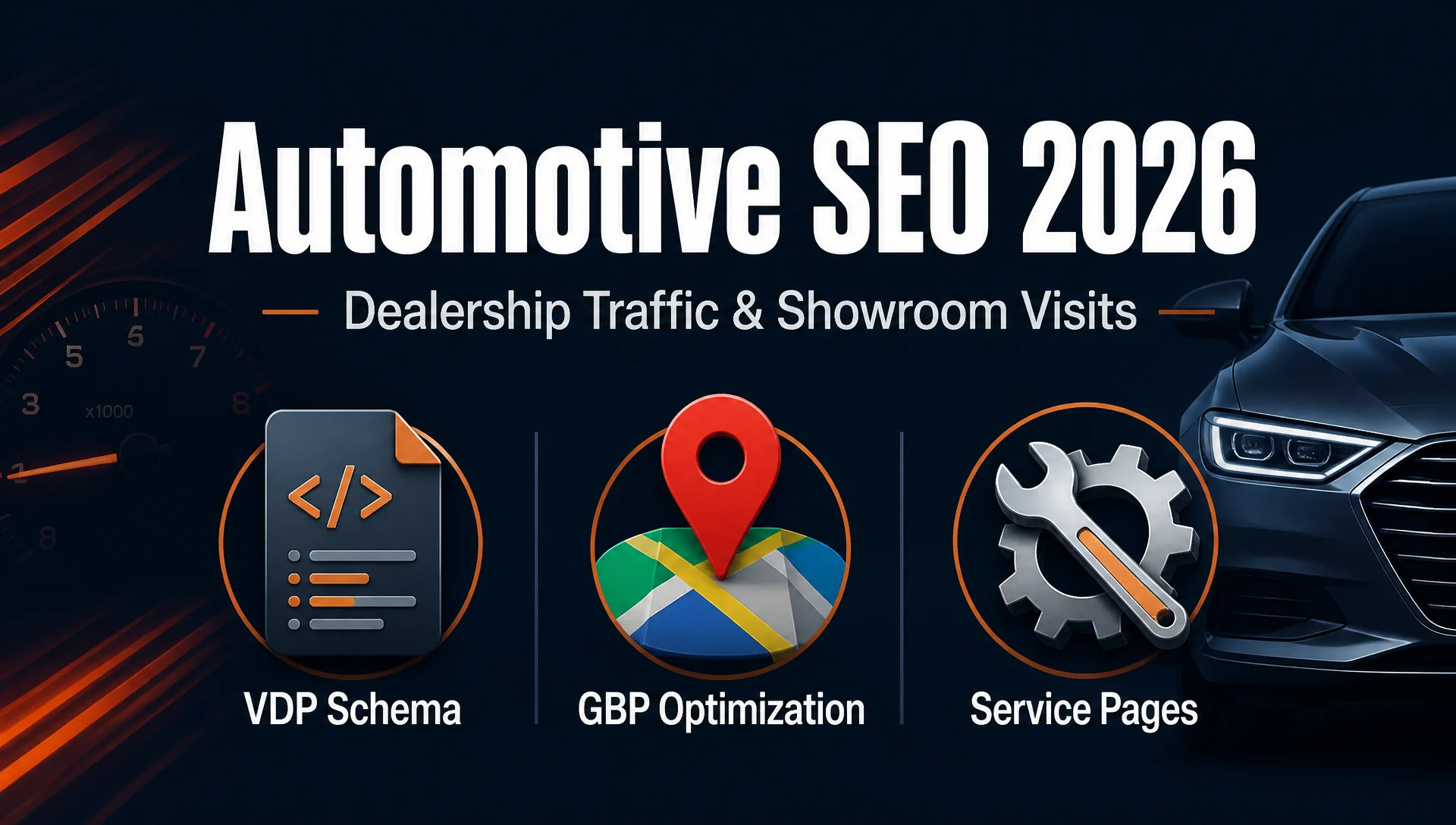
In 2026, automotive SEO splits into three assets that outperform everything else:
- Inventory pages with vehicle schema. These rank for the exact make/model/trim/location queries buyers use in their final 48 hours before visiting a dealership.
- Google Business Profile. For dealerships and service centers, GBP drives more qualified calls and direction requests than organic rankings alone.
- Service and parts pages. High-intent local searches like "brake repair near me" or "OEM Toyota parts Phoenix" convert at rates organic blog content rarely touches.
If your automotive SEO strategy starts with blog posts about "best SUVs for families," you are optimizing for awareness traffic that may never visit a showroom. Start with inventory, GBP, and service pages instead.
How Car Buyers Search in 2026
Automotive search behavior does not follow the typical content-marketing funnel. A car buyer's journey typically spans 20 to 30 search queries across multiple devices over a two-week window, with the final 48 hours concentrated on inventory availability, pricing, and dealership location.
The query pattern breaks into four stages:
Stage | Typical Queries | SEO Asset That Captures It |
|---|---|---|
Discovery | "best midsize SUV 2026," "Honda CR-V vs Toyota RAV4" | Comparison content, model guide pages |
Consideration | "2024 Honda CR-V EX-L review," "CR-V reliability" | Model-specific pages, review integration |
Purchase intent | "2024 Honda CR-V EX-L for sale Phoenix," "Honda CR-V price near me" | Inventory VDPs with vehicle schema |
Service | "oil change Phoenix," "Honda service center near me" | Service pages, GBP service listings |
The mistake most dealerships make: they invest heavily in discovery-stage content and underinvest in the purchase-intent and service pages that actually drive lot visits. Discovery content has its place for brand building, but inventory and service pages generate the phone calls and direction requests that show up in your CRM.
What changed in 2026: Google's local pack now surfaces inventory availability directly from vehicle detail pages with proper schema markup. If your VDPs lack vehicle schema, your cars do not appear in the local pack, even if your GBP is fully optimized.
Inventory Pages: Your Highest-ROI SEO Asset
A properly built vehicle detail page (VDP) ranks for the exact long-tail queries that buyers type in their final hours before purchasing: "2024 Honda CR-V EX-L AWD for sale in Scottsdale."
Most dealership VDPs are dynamically generated from inventory feeds. The SEO problem is not that they are dynamic. It is that they are dynamically identical. A page for a 2024 CR-V EX-L and a 2025 Pilot TrailSport often share the same title tag template, the same meta description, and zero differentiating structured data.
What a well-optimized VDP includes
Title tag: [Year] [Make] [Model] [Trim] for Sale in [City] | [Dealership Name]
Example: 2024 Honda CR-V EX-L AWD for Sale in Scottsdale | Valley Honda Dealers
Every element serves a purpose: year, make, model, and trim capture the exact query; "for sale" matches purchase intent; the city targets local search; the dealership name provides brand signal.
Vehicle schema markup: This is not optional in 2026. Google uses Vehicle structured data to populate the local pack, vehicle rich results, and AI Overviews for car-shopping queries. A VDP without vehicle schema is invisible to these surfaces.
Minimum schema properties for every VDP:
{
  "@type": "Vehicle",
  "name": "2024 Honda CR-V EX-L AWD",
  "modelDate": "2024",
  "manufacturer": {"@type": "Organization", "name": "Honda"},
  "vehicleModelDate": "2024",
  "vehicleConfiguration": "EX-L AWD",
  "offers": {
    "@type": "Offer",
    "price": "32995",
    "priceCurrency": "USD",
    "availability": "https://schema.org/InStock",
    "itemCondition": "https://schema.org/UsedCondition"
  },
  "mileageFromOdometer": {"@type": "QuantitativeValue", "value": "23450", "unitCode": "SMI"},
  "vehicleEngine": {"@type": "EngineSpecification", "fuelType": "Gasoline"},
  "color": "Crystal Black Pearl",
  "productionDate": "2023-11",
  "numberOfDoors": 4,
  "vehicleTransmission": "Automatic",
  "sku": "VIN-2HKRW2H59RH123456",
  "image": "https://www.dealership.com/inventory/crv-exl-2024.jpg"
}
Do not stop at Vehicle schema. Layer in AutoDealer schema on your dealership location page and LocalBusiness schema with service department hours on your service pages.
Unique, feed-generated content that passes the "would a human read this" test: Dynamic pages do not need hand-written descriptions to rank. But they need more than a raw dump of trim codes. Write a template that assembles a readable sentence from feed fields:
This 2024 Honda CR-V EX-L AWD in Crystal Black Pearl has 23,450 miles. Equipped with Honda Sensing, leather-trimmed interior, and a power tailgate. Available now at Valley Honda Dealers in Scottsdale. Schedule a test drive or call (480) 555-0100.
That sentence is entirely template-driven, every field comes from the inventory feed, but it reads like a human wrote it. Google's helpful content system evaluates pages holistically. A VDP that reads like a database row is a thin-content liability.
Inventory SEO Checklist
- [ ] Unique title tag per vehicle: year + make + model + trim + "for sale" + city
- [ ] Vehicle schema on every VDP with price, mileage, availability, VIN
- [ ] AutoDealer schema on dealership location page
- [ ] Unique, readable description assembled from feed fields (not just trim codes)
- [ ] Compressed, properly sized vehicle images with descriptive filenames and alt text
- [ ] Canonical tag pointing to the VDP URL (not the search results page)
- [ ] Page loads under 2.5 seconds on mobile (car shoppers abandon slow pages at higher rates than the general population)
- [ ] Click-to-call button and "Get Directions" link visible without scrolling
Google Business Profile: The Local Pack Engine
For dealerships, GBP drives more qualified actions (calls, direction requests, website clicks) than organic rankings for most non-inventory queries. A buyer searching "Honda dealer near me" sees the local pack before any organic result.
GBP optimization that moves the needle
Hours accuracy, including service hours. A dealership whose GBP still shows pandemic-era hours loses calls. Update sales, service, and parts department hours separately when Google supports it.
Vehicle inventory posts. GBP allows inventory posts that appear directly in your business profile. Each post should feature one vehicle with a photo, price, and a link to the VDP. Post weekly, rotating through your highest-margin or fastest-moving inventory.
Review volume and response cadence. Car buyers read reviews obsessively. Dealerships with 100+ Google reviews and a 4.3+ average rating dominate the local pack. More importantly: respond to every review, positive and negative, within 48 hours. Google's local ranking factors weight review responses as a freshness and engagement signal.
Q&A seeding. The GBP Q&A section is user-generated, but you can (and should) seed it with the questions your sales team answers daily:
- "Do you offer financing for buyers with credit scores under 650?"
- "What are your Saturday service hours?"
- "Can I schedule a test drive online?"
Answer each question from the business account. These Q&A pairs often surface directly in the local knowledge panel and AI-generated local answers.
Photo freshness. Upload new exterior and interior photos monthly. Google favors profiles with recent photo activity. Include photos of the service waiting area, the showroom, and vehicle inventory on the lot.
Vehicle Schema: Technical Implementation Guide
Vehicle schema is the single highest-impact technical SEO tactic for automotive sites. It enables rich results that show price, mileage, and availability directly in the SERP, before a user clicks.
The three schema layers every dealership site needs
Schema Type | Where It Goes | What It Enables |
|---|---|---|
| Every VDP | Vehicle rich results: price, mileage, color, availability in SERP |
| Dealership location page(s) | Dealer info, service options, curbside pickup availability in SERP |
| Service center pages | Service rich results for "oil change," "brake repair" queries |
Common schema mistakes
- Missing `offers.price`. Without a price in schema, Google cannot display the price in rich results. Even for "Call for Price" inventory, include
"price": "0"with"priceValidUntil"rather than omitting the field. - Wrong `availability` value. Marking every vehicle as
InStockwhen some are in transit or on hold creates a trust problem when the buyer calls. - No `sku` or VIN in schema. The VIN is the unique identifier Google uses to match your inventory to third-party listing aggregators. Without it, your VDP competes against your own Cars.com and AutoTrader listings.
- Stale schema on sold vehicles. When a vehicle sells, update the schema to
SoldOutand keep the page live for 30 days before 301-redirecting to a related inventory search.
How to validate your schema
Paste any VDP URL into Google's Rich Results Test. Fix every error and warning. Then use the URL Inspection tool in Google Search Console to request indexing for the corrected page. Do this for your top 20 inventory pages first — the ones for your highest-volume makes and models.
Service and Parts Pages: The Conversion Engine
Service and parts pages capture the highest-intent local searches in automotive: people who need a specific repair, right now, near their location. These queries have commercial urgency that comparison-shopping content lacks.
Page architecture that works
Each service should have a dedicated page, not a single "Service" page that lists every repair. Separate pages for:
- Oil change
- Brake repair and replacement
- Transmission service
- Engine diagnostics
- Tire rotation and replacement
- OEM parts ([make] specific)
- Collision repair
What a high-performing service page includes
Local intent in the title and H2: Oil Change Phoenix AZ | Same-Day Service | Valley Honda
Pricing transparency: State the price or price range for common services. "Oil change starting at $49.95" converts better than "Call for pricing." Even a price range ("Brake pad replacement: $250-$450 per axle") reduces the anxiety that prevents a phone call.
Online scheduling: Embed your service scheduling tool directly on the page. Every extra click between "I need this service" and "I booked it" costs conversions.
Service schema: Add Service schema with areaServed, provider, serviceType, and price information when available. Google surfaces service pricing in the local pack for supported categories.
FAQ section specific to the service: "How long does an oil change take?" "Do you use OEM or aftermarket brake pads?" "Can I wait while you service my car?" These answer the pre-call questions that determine whether someone picks up the phone.
Reviews: A Ranking Signal and a Conversion Tool
Car buyers trust reviews more than dealer claims. A 2025 automotive consumer survey found that 82% of buyers read Google reviews before visiting a dealership, and 67% will not consider a dealer with a rating below 4.0.
Building review velocity
The sweet spot for review requests: 3 days after purchase or service completion, via SMS (not email). SMS review requests see 3-4× higher completion rates than email.
One dealership group tested two messages:
- A: "Please leave us a review on Google." → 4% response rate
- B: "Your 2024 CR-V had a minor alignment issue we fixed during prep. If everything feels good, a quick Google review helps other buyers find us. Here is the link: [URL]" → 18% response rate
The difference: message B reminds the buyer of a specific service detail, which triggers reciprocity and makes the request feel personal rather than automated.
Managing negative reviews
Do not argue. Do not get defensive. Instead:
- Acknowledge the specific complaint ("I understand the finance process took longer than expected").
- Explain what you have changed ("We have added a second finance manager on Saturdays").
- Offer to make it right offline ("Please call me directly at...") — then actually take the call.
- Never ask a customer to modify or remove a review. It violates Google's policy and can get your listing suspended.
Common Mistakes That Kill Automotive SEO
Mistake 1: Blog-first strategy. Publishing "Top 10 SUVs for 2026" before optimizing inventory VDPs and service pages. Blog content ranks for informational queries; inventory and service pages rank for purchase-intent queries. Prioritize the pages that drive lot visits.
Mistake 2: Identical title tags across VDPs. When every VDP has the title "[Dealership] | New & Used Cars | [City]," none of them rank for specific vehicle queries. Each VDP needs a unique title tag containing year, make, model, and trim.
Mistake 3: No schema or broken schema. Missing vehicle schema, stale pricing, or schema that fails Google's Rich Results Test. This is the easiest technical win and the most commonly overlooked.
Mistake 4: GBP neglect. Wrong hours, no review responses, no photo updates, no inventory posts. A neglected GBP hands local-pack visibility to competitors who manage theirs.
Mistake 5: Service pages built as an afterthought. A single "Service" page with a phone number loses to competitors with dedicated, schema-optimized pages for each service category.
Mistake 6: Slow mobile pages. Car shoppers browse on mobile while visiting competitor lots. A VDP that loads in 4+ seconds on mobile loses the shopper before they see your price.
Self-Audit Checklist
Run this 10-point audit on your dealership site:
- [ ] Every VDP has a unique title tag with year, make, model, trim, "for sale," and city
- [ ] Vehicle schema validates in Google's Rich Results Test for the top 20 VDPs
- [ ] AutoDealer schema is present on the dealership location page
- [ ] GBP hours, photos, and inventory posts updated within the last 30 days
- [ ] 80%+ of Google reviews have a response from the business
- [ ] Each core service (oil change, brakes, transmission, tires) has a dedicated page
- [ ] Service pages include pricing or price ranges
- [ ] Service schema is present on service pages
- [ ] Mobile page load under 2.5 seconds for top VDPs (test with PageSpeed Insights)
- [ ] Sold vehicles redirect to a related inventory search within 30 days
If you score below 7, start with vehicle schema and GBP. Those two alone drive more qualified traffic than everything else combined.
FAQ
What is the single most impactful automotive SEO change I can make this week?
Add Vehicle schema with price, mileage, availability, and VIN to your top 20 VDPs. Validate every page in Google's Rich Results Test, then request re-indexing in Search Console. This is a one-day project that directly impacts local pack and rich-result visibility.
How important is vehicle inventory schema compared to blog content?
Vehicle inventory schema on VDPs drives purchase-intent traffic; blog content drives research-intent traffic. For a dealership measuring lot visits and phone calls, schema-optimized VDPs are the higher-ROI investment. Both matter, but fix schema first.
How many Google reviews does a dealership need to compete in the local pack?
There is no fixed threshold, but dealerships with 100+ reviews and a 4.3+ average consistently outrank those with fewer. Review velocity (the rate at which you earn new reviews) appears to matter more than total count. A dealer earning 5-10 reviews per month with an 80%+ response rate will outperform a dealer with 200 stale reviews and no recent activity.
Should I keep sold vehicle pages live or remove them?
Keep them live for 30 days with the schema updated to SoldOut, then 301-redirect to the closest matching inventory search (same make and model). Removing the page immediately loses any link equity. A 301 to a related inventory search preserves it.
What about AI search — does automotive SEO need GEO?
For now, Google's AI Overviews and AI Mode surface vehicle information primarily from GBP, manufacturer pages, and third-party review sites, not individual dealership VDPs. The highest-ROI GEO play for dealerships is ensuring your GBP information is accurate and complete. AI answers draw heavily from Google Business Profile data for local queries. Vehicle schema also improves your eligibility for AI-driven product results. If you have well-optimized VDPs and an active GBP, you are already doing 80% of what current AI search requires.
Author: Julian Mercer, 14-Year Technical SEO Practitioner at Auspia. Julian writes about crawlability, schema, site architecture, and technical foundations that make websites discoverable in both traditional search and AI answer engines.