


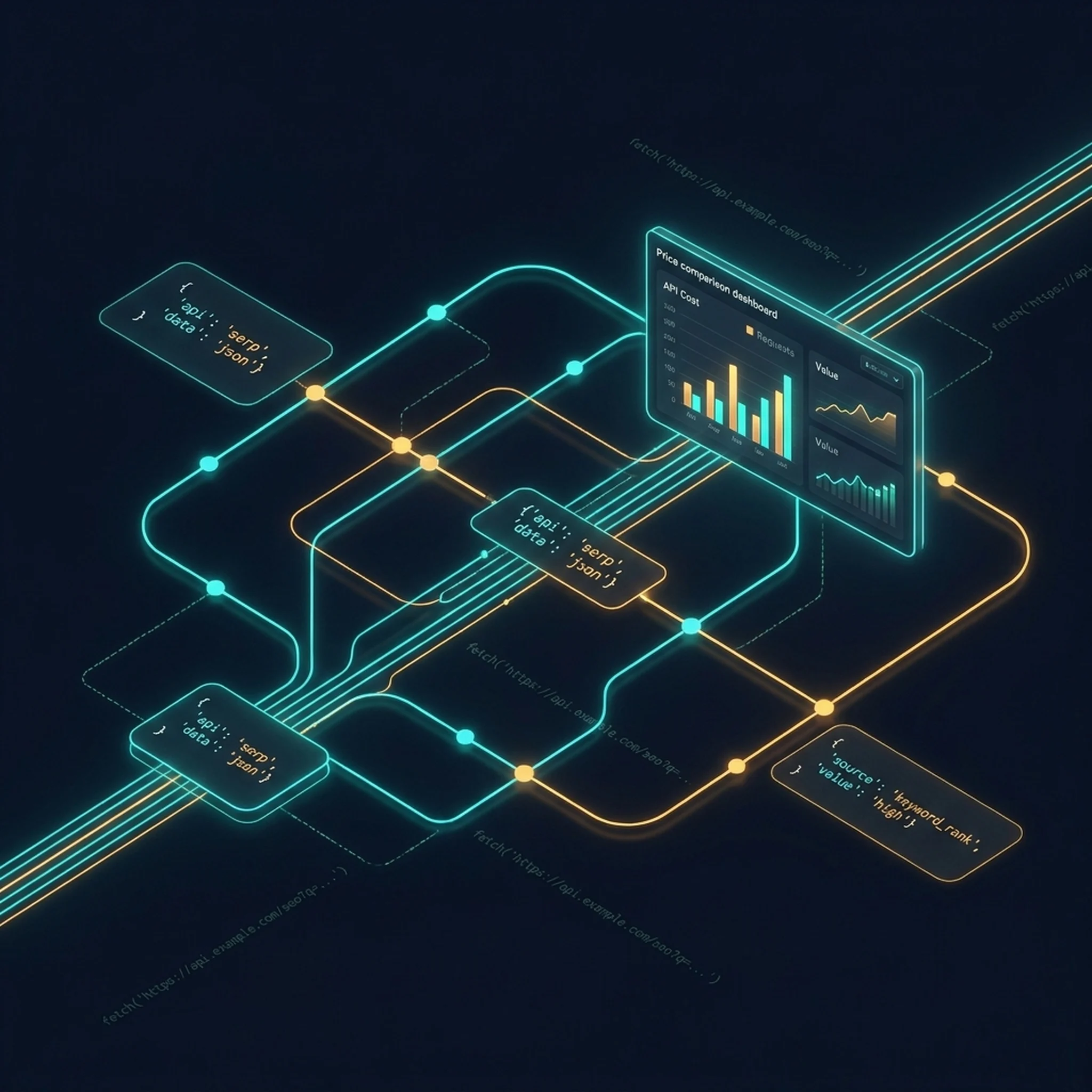
A viral tweet, a hidden $14,990 price tag
On August 4, 2026, SEO practitioner Hridoy Reh (31.8K followers) posted a thread recommending "7 SEO data APIs" for developers building SEO tools. It pulled 82 likes and over 12,000 views in a day — a strong signal that the SEO developer community is hungry for this information. The promise is appealing: stop scraping, stop guessing, plug into a clean JSON endpoint and ship.
Here is the part the thread did not dwell on. The single most famous API on any "best SEO API" list — Ahrefs — now requires an Enterprise plan at $1,499/month with an annual commitment, totaling $14,990 per year, just to get programmatic access. The cheapest credible alternative, DataForSEO, starts at a $50 one-time deposit with pay-as-you-go pricing from roughly $0.0006 per request. That is a 300x spread for tools that, for many use cases, return structurally similar data.
This article is not another list. It is a stress test of the seven APIs that come up again and again in 2026 SEO discussions — including the ones implied by the viral tweet — evaluated on the four dimensions that actually decide whether an integration ships or quietly bleeds your budget: pricing model, data depth, AI-search readiness, and the hidden costs the marketing pages bury in footnotes.
Why this matters more in 2026 than in 2024
Two shifts have changed the calculus for anyone buying SEO data this year.
First, more than 55% of Google SERPs now contain an AI Overview layer. A keyword tracker that only returns the ten blue links is increasingly tracking a viewport that no human user actually sees. If your API cannot return AI Overview citations, AI Mode snapshots, or generative engine visibility, you are paying for a 2022-grade answer to a 2026 question.
Second, the economics of building SEO tooling have inverted. A small SaaS founder used to need a $249/month Semrush subscription to look professional. In 2026, the same founder can assemble a credible internal SEO stack from a $50 DataForSEO deposit, free Google Search Console API access, and a $25/month SerpApi plan — under $75/month total for a prototype that would have cost $500+ a few years ago. The question is no longer "can I afford an SEO API" but "which combination avoids the three traps below."
The seven APIs, pressure-tested

1. DataForSEO — the developer-default for pay-as-you-go
DataForSEO is the API most often recommended on r/SEO and r/TechSEO when someone asks "how do I build a rank tracker without going broke." The model is simple: deposit $50, pay per request, no monthly commitment. SERP requests cost roughly $0.05 (standard) to $0.075 (live), and the catalog spans keyword data, backlinks, on-page, and — critically for 2026 — a Google AI Mode SERP endpoint.
What the marketing page does not emphasize. Pricing varies materially across endpoints. The headline "$0.0006 per request" applies to specific bulk keyword-data calls; SERP and backlink endpoints are an order of magnitude more expensive. Teams that naively price a "rank tracker for 10,000 keywords" off the cheapest endpoint will burn through their deposit in days. Model your actual endpoint mix before committing.
Verdict. Best fit for developers who want raw data pipelines at scale and are willing to read the docs. Worst fit for non-technical users who expect a dashboard — there is effectively none.
2. Ahrefs API — the deepest index, at the steepest price
No one disputes that Ahrefs has the deepest backlink index in the market — over 35 trillion unique link points, with a historical index roughly 30% larger than the next competitor. If you are building a competitive backlink intelligence product, Ahrefs is the reference dataset.
The trap. API access is gated behind the Enterprise plan ($1,499/month, annual commitment) or a separate $500–$10,000/month subscription. The standard $29–$499/month Ahrefs plans do not include API access at all — a detail that catches founders off guard after they have already subscribed. Multiple Reddit threads on r/SEO document this exact frustration. Additionally, Ahrefs charges per metric returned, so requesting every available field on a backlink lookup can multiply your effective cost several times over.
Verdict. Justified only if backlink depth is your core product moat and you have the budget to match. For everyone else, this is the API the viral tweet should have come with a price warning on.
3. Semrush API — mature, but subscription-locked
Semrush's API is the most "enterprise-ready" option on this list: keyword, backlink, competitor, domain, and traffic datasets, all under a predictable subscription model. Teams already embedded in the Semrush ecosystem will find the API a natural extension.
The trade-off. Subscription pricing means you pay the same whether you make 100 calls or 100,000 — fine for steady-state workloads, painful for a startup whose usage is spiky or seasonal. The API also lags DataForSEO on AI Overview tracking, which matters more each quarter in 2026.
Verdict. Choose Semrush if you already pay for the platform and want to automate reporting. Skip it if you are greenfield and cost-sensitive.
4. SE Ranking API — the 2026 value pick
SE Ranking is the API that has quietly become the most recommended "balanced" option in 2026 comparisons. For $103/month (billed annually) you get API access plus a full SaaS dashboard, 2,000 tracked keywords, 100 daily AI prompts, 250,000 API calls, and AI engine tracking. The Growth plan at $279/month adds historical data and collaboration tools.
Why this matters. Most SEO APIs force a choice: pay for raw data (DataForSEO) and build everything yourself, or pay for a dashboard (Semrush) and accept limited programmatic access. SE Ranking is one of the few that bundles both, with official MCP server support, n8n/Make.com/Looker Studio connectors, and AI engine visibility built in.
Verdict. The strongest default for agencies and internal SEO teams who want API power without abandoning a usable UI.
5. SerpApi — SERP scraping, developer-first
SerpApi abstracts Google search results into a single GET request — no proxies, no CAPTCHA solving, no parser maintenance. Pricing starts at $25/month for 1,000 searches and scales cleanly to $275/month for 30,000. Developer experience is genuinely excellent; the company even staffs Developer Advocate roles, which signals where their priorities sit.
The limitation. SerpApi is a SERP scraper, not an SEO database. You get whatever Google returns right now, with no historical keyword volume, no backlink index, no competitor domain analytics. Pair it with DataForSEO for the database layer; do not expect it to replace one.
Verdict. Best-in-class for live SERP capture and AI Overview snapshot extraction. Use it as a complement, not a backbone.
6. ValueSERP — the budget SERP alternative
ValueSERP does what SerpApi does, cheaper: $2.50 per 1,000 requests, with 100 free requests daily on signup. For founders prototyping a rank tracker or a SERP feature on a shoestring, this is the fastest way to get JSON results without a credit card commitment.
The catch. Lower price means thinner infrastructure — expect more variance in latency and success rates under load, and a smaller feature surface (no first-class AI Overview expansion on par with SerpApi or Zenserp). It is a prototype tool, not a production backbone.
Verdict. Perfect for the first 1,000 calls of your MVP. Migrate before you ship to paying customers.
7. Google Search Console API + PageSpeed Insights API — the free baseline
The most underrated "API" on this list costs nothing. Google Search Console API gives you your own site's impressions, clicks, CTR, and position data via OAuth — the ground truth for any rank tracker, because it is Google's own accounting. PageSpeed Insights API adds Core Web Vitals and Lighthouse audits programmatically.
The constraints. GSC API only covers properties you own and verify, offers no competitor data, and has limited local SEO granularity. Backlink data is essentially absent. But for technical SEO audits, your own performance reporting, and zero-cost monitoring, it is unmatched.
Verdict. Always start here. Any paid API stack should layer on top of GSC, not replace it.
How to choose without burning months of runway
After stress-testing these seven, a simple decision framework emerges. Pick your row.
- You are a solo founder prototyping a SEO feature. Start with Google Search Console API (free) + ValueSERP (free tier) + a $50 DataForSEO deposit. Total burn: under $75 to validate the idea.
- You are an agency that needs reports clients will read. SE Ranking at $103/month gives you API access and a white-label-ready dashboard in one bill. Resist the urge to assemble a custom stack until revenue justifies it.
- You are building a backlink intelligence product. Ahrefs API is the only dataset deep enough to be your moat — but budget $14,990/year and treat it as a strategic cost, not a tooling expense.
- You are tracking AI search visibility in 2026. Prioritize DataForSEO and SE Ranking; both ship AI Mode / generative engine endpoints. Ahrefs and Semrush are catching up but lag on coverage today.
The meta-point: there is no single "best" SEO API in 2026, only the best fit for a workload. The viral tweet's framing — "7 APIs to save dev time" — is true but incomplete. The real savings come from matching the pricing model to your usage pattern, not from picking the API with the most endpoints.
What this means if you are not building a tool
Most readers of this blog are not shipping a SEO SaaS — they are running a website and trying to show up in Google and ChatGPT. For that audience, the API landscape matters for a different reason: it tells you which data is commoditized and which is still expensive.
Keyword volume, basic rank tracking, and technical audits are now effectively free or near-free. What is still expensive — and therefore still a competitive lever — is AI search visibility measurement. The APIs that can tell you whether your brand appears in ChatGPT, Perplexity, and Google AI Overview answers are the ones worth paying for in 2026, because that data is not available anywhere for free.
Before you spend on any API, run the free checks that already exist. Auspia's SEO Score Checker gives you an on-page and technical audit with no signup, and the GEO Checker shows whether your site is surfacing in AI answer engines — the exact visibility layer that the paid APIs above are scrambling to support. Use those to find out what you actually need before you deposit $50 anywhere.
The bottom line
The viral tweet was directionally right: SEO data APIs have never been more accessible or more affordable at the entry tier. It was silent on the part that hurts — that the famous names on these lists (Ahrefs, Semrush) gate their APIs behind enterprise contracts, that pay-as-you-go pricing explodes if you do not model your endpoint mix, and that 2026's AI Overview shift has made half the market's rank-tracking data structurally incomplete.
Treat any "best SEO API" list — including this one — as a starting hypothesis, not a purchase order. Deposit the minimum, model your real workload against the actual per-endpoint price sheet, and migrate the moment the bills stop matching the value. The founders who win on SEO tooling in 2026 are not the ones with the most expensive API subscription. They are the ones who read the pricing page carefully.


