The short answer
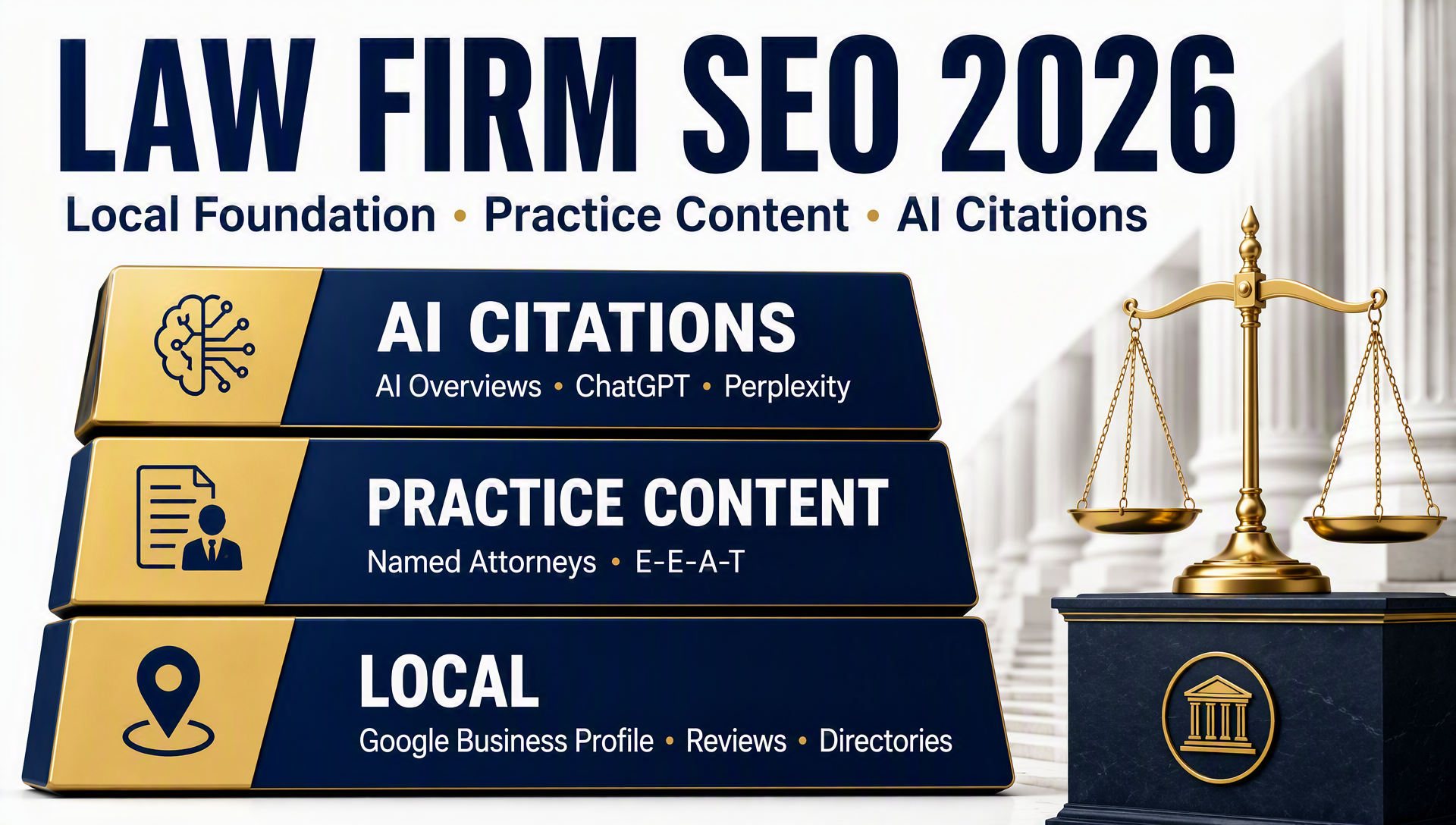
Law firm SEO in 2026 is the work of making your firm easy to find in three places at once: local search (Google Business Profile, reviews, directories), organic search (practice-area pages and authority), and AI answers (Google AI Overviews, AI Mode, ChatGPT, Perplexity). You no longer rank for "ten blue links" only. Legal is the category where Google AI Overviews appear most often, and third-party legal directories now receive most of the AI citations that introduce clients to law firms.
For a beginner, the fastest realistic path is not a 50-step program. It is this sequence:
- Fix the local foundation: claim and complete your Google Business Profile, keep your name/address/phone identical everywhere, and start a steady review routine.
- Add LegalService structured data so Google and AI engines understand your firm as a real, local entity.
- Build one strong page per practice area, written and credited to a named attorney, with answers to the questions clients actually type.
- Run a quick technical health check and let an AI coding agent (Codex) automate the audit.
- Earn citations and links from legal directories and your state bar — not from purchased link packages.
Below is the full beginner plan, followed by a complete Codex skill you can paste into a terminal session to run most of the checks automatically.
🎬 Prefer the short version? Watch the ~76-second narrated summary of this guide: the three search layers, the AI-citation reality, and the 30-day plan in motion.
Why law firm SEO changed in 2026
Most guides about "SEO for lawyers" still describe the world of 2023: rank in the top ten, get clicks, convert them to calls. That model still matters, but it now runs inside a bigger system. Three shifts happened between 2024 and 2026 that a beginner needs to understand before spending any money.
Shift 1: AI answers appear on most legal queries
Legal is the vertical where Google AI Overviews trigger most often. Industry research in early 2026 reports that roughly 78% of legal queries show an AI Overview, the highest rate of any search category (SE Ranking research cited by the American Bar Association's Law Practice Magazine, May–June 2026 issue). When an AI Overview appears, fewer people click the organic results below it. But firms that are cited inside the AI answer earn measurably more clicks than firms at the same position without a citation — one 2026 report puts the gain around 35% more organic clicks (Digital Authority Partners, State of Legal SEO 2026). The takeaway: being named inside the AI answer is now a real, separate goal, not a bonus.
Shift 2: Legal directories dominate AI citations
When AI engines answer "who is a good divorce lawyer near me," they do not build the answer only from law firm websites. InterCore's 2026 research across 540 high-intent legal queries and 18,900 citations found that a legal directory was the first-cited source in 77.8% of AI answers, and directories captured at least 51.8% of all citations (InterCore, State of AI Search Visibility for Law Firms 2026). The domains most often cited — Justia, Avvo, Super Lawyers, Martindale-Hubbell — are directories, not firm websites. The research also found that 34.2% of firms AI answers name have no firm page cited at all: the AI only "knows" them from directory listings.
This is the single most counterintuitive change for beginners. Most law firms spend all their effort on their own website, while the AI systems that introduce clients to law firms lean on directory profiles. That is why this guide treats "claim and complete your directory profiles" as a core step, not an afterthought.
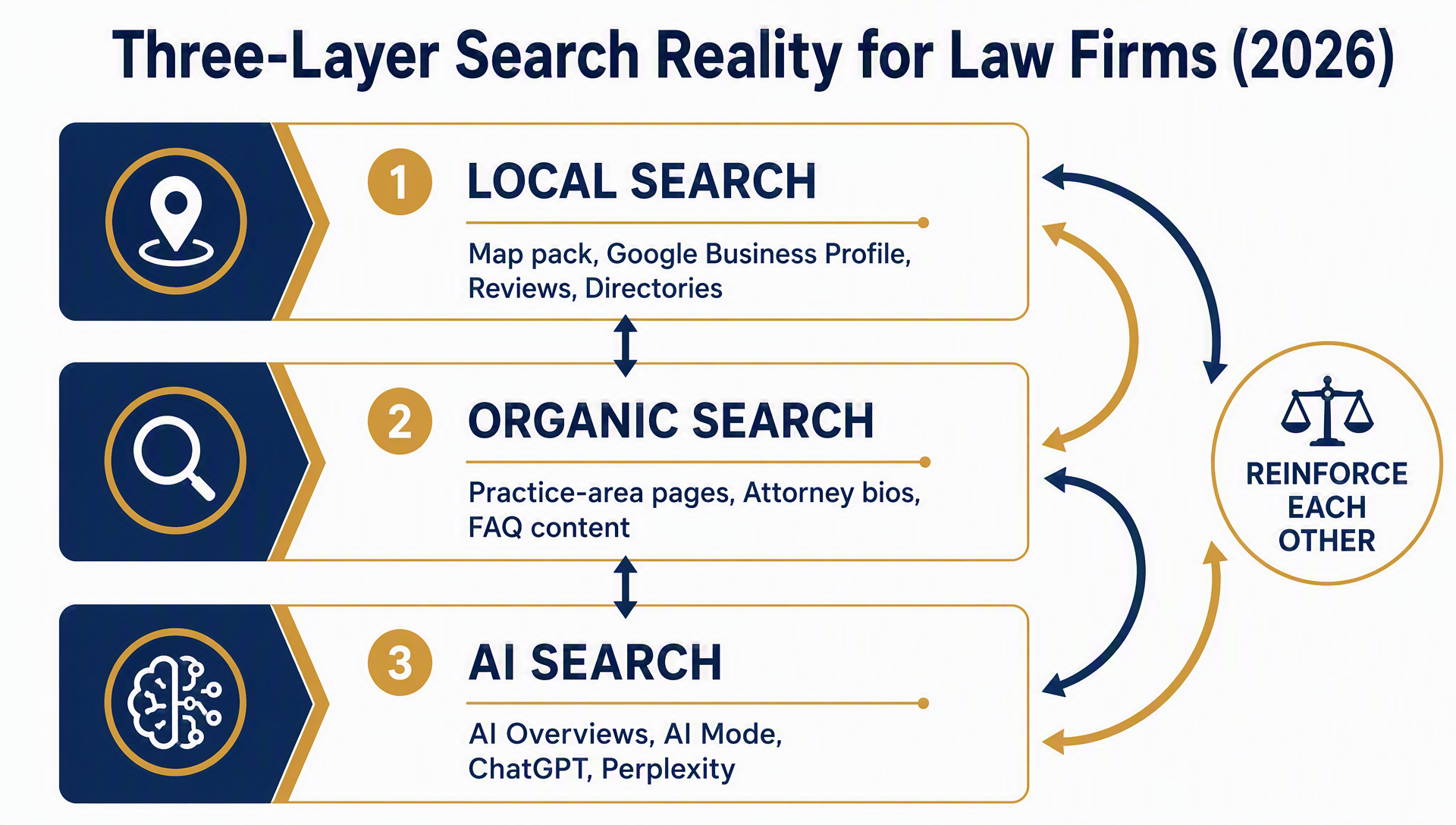
Shift 3: Search has three layers that reinforce each other
In 2026 a law firm competes in three layers at the same time:
Layer | What it looks like | What feeds it |
|---|---|---|
Local search | The map pack, Google Business Profile, reviews, directories | NAP consistency, GBP completeness, review velocity, directory claims |
Organic search | Practice-area pages, attorney bios, FAQ content | E-E-A-T, named authors, structured data, technical health |
AI search | AI Overviews, AI Mode, ChatGPT, Perplexity answers | Directory presence, extractable answers, LegalService schema, authoritative sources |
The layers reinforce each other. A strong Google Business Profile improves local AI recommendations. A deep, well-structured practice page gets cited by AI answers. A clean technical site makes both of those possible. Treating them as separate channels is the most common mistake beginners make.
Before you start: what you need
Who this is for: solo attorneys, small-firm owners, and law-firm marketers with no SEO experience and no paid SEO tool budget.
What you will finish with: a completed local foundation, at least one optimized practice-area page, a technical health report, and a written 30-day plan — plus a Codex skill that can re-run the audits for you.
What you need:
- Access to your website (any CMS: WordPress, Squarespace, Wix, custom).
- The owner credentials for your Google Business Profile (or a way to get them from the current owner).
- A list of your practice areas and the cities you actually serve.
- Optional: Codex installed on your computer (free tier is enough for every step here). All steps work without it too — you would just run the checks manually.
- Optional: Google Search Console and Bing Webmaster Tools, both free.
Time: roughly 6–8 hours spread over a month for a solo attorney doing the core steps. Ranking changes take 60–90 days to appear; that is normal for legal SEO.
Definition of done: your Google Business Profile is 100% complete with consistent NAP, you have claimed your main directory profiles, at least one practice-area page is published with a named attorney and client-style questions, your site passes the technical checks below, and you have a written monthly review routine.
Phase 1: Build the local foundation first
Local search is the highest-leverage investment for most practice types, and it is also the easiest to get wrong quietly. Beginners should start here because the fixes are visible in 60–90 days, much faster than competitive organic rankings.
1.1 Claim and complete your Google Business Profile
Go to business.google.com, claim your profile (or request ownership), and verify it. Then complete every editable field — not just the required ones. Research and Google's own guidance agree that the primary category is the single strongest local ranking factor; choose the most specific one ("Personal Injury Attorney" over "Lawyer"), and add up to nine relevant secondary categories.
GBP field | What to do | Why it matters |
|---|---|---|
Primary category | Most specific match to your main practice | Strongest single local ranking factor |
Services | Practice areas in client language ("car accident lawyer", not "motor vehicle tort representation") | Matches how people search |
Service area | Cities/counties you actually serve (up to 20) | Controls where you can appear |
Phone number | Local number, same as website and directories | NAP consistency |
Hours | Accurate, kept current | Open-now filters and AI summaries |
Photos | Office, attorneys, team, updated monthly | "Active" profile signal |
Posts | Weekly: case outcomes where allowed, firm news, legal FAQs | Engagement + freshness signal |
Q&A | Seed with common client questions and accurate answers | Answers surface in AI summaries |
Most profiles are only a third complete. Going deep on this one profile is often enough to move a firm's local visibility early on.
1.2 Keep NAP identical everywhere
NAP stands for Name, Address, Phone. It must be byte-identical across your website footer, your Google Business Profile, your contact page, and every directory where you are listed. "Byte-identical" means the same abbreviation decisions too — if your address says "Suite 400" on one site and "Ste. 400" on another, that is an inconsistency. Citation conflicts are a known local ranking suppressant, and they also weaken the entity signals that AI engines use.
1.3 Start a review routine that never stops
Review recency now matters as much as review volume. A firm with ten genuine reviews in the past month can outrank a firm with 200 reviews collected over three years. The behaviors that matter:
- Ask every satisfied client for a review (text requests get higher response rates than email).
- Respond to every review, positive and negative, within days — respond to at least 80% for the full signal.
- Never script the wording, offer incentives, or generate reviews — that violates bar rules and Google's policies, and AI-generated reviews from fake accounts are explicitly prohibited.
1.4 Claim your directory profiles (the "directory wall")
Because legal directories receive the majority of AI citations, you must claim and complete the main ones even if you never buy their paid placement. Start with the free, high-authority set:
- State bar association directory (the highest-authority legal citation a firm can hold)
- Justia, Avvo, FindLaw, Martindale-Hubbell, Super Lawyers
- Local Chamber of Commerce and any city-specific legal directories
- Google Business Profile, Bing Places, Apple Business Connect
On each profile, use the exact same NAP, practice-area descriptions, website URL, and office photo. A claimed, complete, consistent directory profile is what AI engines cite; an unclaimed half-empty one is why a firm gets "known" by AI but not linked.
Phase 2: Add LegalService schema and entity signals
Structured data is a way to tell Google and AI engines, in a machine-readable format, exactly what your firm is, where it is, and who works there. In 2026 this changed in an important way: schema.org deprecated the old Attorney type in favor of `LegalService`, which is more inclusive and less ambiguous. Personal attorneys should be marked up as Person entities, not as a nonexistent "Attorney" schema type.
Two honest boundaries before the code:
- Structured data is not a ranking signal. Google has stated this consistently. Schema determines eligibility for enhanced appearances and helps AI engines understand content; it does not guarantee an AI Overview, a rich result, or a ranking.
- Schema must match visible content. Never mark up invisible FAQs, fabricated aggregate ratings, or claims that are not on the page. Marking up things that do not exist on the page is a policy violation and backfires.
Here is a simplified, copy-paste starting point. Replace every placeholder in square brackets before putting it on your site. Add it as a <script type="application/ld+json"> block in the <head> of your homepage and contact page, or use your CMS's structured-data field.
{
  "@context": "https://schema.org",
  "@type": "LegalService",
  "@id": "https://www.[yourfirm].com/#organization",
  "name": "[Firm Name]",
  "url": "https://www.[yourfirm].com/",
  "telephone": "+1-[area-code]-[phone]",
  "address": {
    "@type": "PostalAddress",
    "streetAddress": "[Street Address]",
    "addressLocality": "[City]",
    "addressRegion": "[State]",
    "postalCode": "[ZIP]",
    "addressCountry": "US"
  },
  "geo": {
    "@type": "GeoCoordinates",
    "latitude": "[lat]",
    "longitude": "[lng]"
  },
  "openingHoursSpecification": [
    {
      "@type": "OpeningHoursSpecification",
      "dayOfWeek": ["Monday","Tuesday","Wednesday","Thursday","Friday"],
      "opens": "09:00",
      "closes": "17:00"
    }
  ],
  "priceRange": "$$",
  "sameAs": [
    "https://www.google.com/maps?cid=[your-gbp-cid]",
    "https://www.linkedin.com/company/[firm]",
    "https://www.justia.com/lawyers/[firm]",
    "https://www.avvo.com/attorneys/[firm]"
  ],
  "parentOrganization": {
    "@type": "Organization",
    "@id": "https://www.[yourfirm].com/#organization"
  }
}
Three things to understand about the fields above:
- `@id` anchors your entity. Use the same
@idon every page so Google and AI engines treat your firm as one entity instead of many disconnected snippets. - `sameAs` corroborates your identity. These links point to your Google Business Profile, LinkedIn, and legal directories — the profiles from Phase 1. This is one of the strongest trust signals because third-party profiles corroborate that your firm is real.
- `geo` needs real coordinates. Use the actual latitude/longitude of your office, ideally to five or more decimal places. A rough "city center" coordinate weakens the signal.
For practice-area pages, use Service schema within the same entity graph. For attorney bios, use Person with worksFor pointing back to your firm's @id and hasCredential for bar admission. After adding schema, validate it with Google's Rich Results Test and monitor it in Search Console under Enhancements.
Phase 3: Create practice-area pages with real E-E-A-T
One practice area deserves one dedicated page. A single "we handle everything" homepage ranks for nothing specific, and AI engines have nothing precise to cite. Legal content is classified as YMYL ("Your Money or Your Life") under Google's quality rater guidelines, which means E-E-A-T — Experience, Expertise, Authoritativeness, Trustworthiness — is required, not optional.
3.1 The single practice-page template
Every practice-area page should open with a direct answer, then explain, then prove, then convert:
Section | What to write | SEO/AEO role |
|---|---|---|
Opening summary | 2–4 sentences answering the main client question directly | Extractable answer for AI |
The problem | The legal situation in client language, with real stakes | Intent match |
How you handle it | Your firm's approach and process, concrete and specific | Differentiation |
Jurisdiction detail | State statutes, deadlines, local courts — "In California, under CCP § 335.1…" | Authority + AI citation-worthiness |
FAQ block | Question-formatted headings with direct answers | Answer engine extraction |
CTA | Call, form, or consultation next step | Conversion |
The jurisdiction detail is where small firms beat big templates. "Most states allow…" is weak. "In California, under Code of Civil Procedure § 335.1, the statute of limitations is two years" is specific, verifiable, and far more citable. This specificity is content AI engines cannot plausibly invent, which is exactly what they reward.
3.2 Name the attorney behind every page
Every article and practice page needs a named attorney with bar admissions, practice focus, and a real biography. "Written by the team at [Firm]" is a credibility negative in a YMYL category. Use Person schema on bio pages with hasCredential for bar admission, and connect the bio to the practice pages the attorney actually handles.
3.3 Write the FAQ as an answer asset
FAQ rich results stopped appearing in Google Search in May 2026 — Google restricted that feature to well-known, authoritative government and health sites. But that change makes the FAQ block more important for AI, not less: AI engines now pull clean question-and-answer pairs from FAQPage schema and from FAQ-formatted headings. The format AI extracts best is:
How long does a personal injury lawsuit take in Texas? Most personal injury lawsuits settle in 12 to 18 months, but a case that goes to trial can take two years or more.
One sentence answer first, then detail. Answer the question in the first one to two sentences, and let the rest of the section support it.
Phase 4: Write content that AI engines can cite
Beyond practice pages, the way you structure every article and page determines whether AI engines can cite you. Four writing rules matter more than keyword density:
- Write for fragment retrieval. AI engines pull specific sections, not whole pages. Each
##section should be self-contained: state its answer in the first one to two sentences, then expand. - Use descriptive headings. A heading like "Damages Available in a Rear-End Collision" is more citable than "Additional Considerations." Research on cited AI URLs finds AI frequently cites a subheading and the sentence immediately after it — so both must be meaningful.
- Cite authoritative sources. Link to statutes, court decisions, government pages, and bar association resources. Content that cites authoritative sources is trusted more by AI systems.
- Write conversationally. AI platforms rephrase and synthesize content. Stiff, formal legal writing produces garbled summaries; conversational, plain-English structure survives intact. Write for the client, not for a motion.
This is also the point where you create the content AI cannot invent: attorney commentary on new rulings, anonymized outcome data (presented without client names or confidential details), process diagrams, and jurisdiction-specific nuance. These are the "authority assets" that differentiate a real firm from boilerplate.
Phase 5: Run the technical health check
If Google or AI engines cannot crawl and render your site, nothing above matters. A beginner can run this check in about 30 minutes. The five checks:
Check | What to look for | Free tool |
|---|---|---|
Indexing | Your key pages are in Google's index | Google Search Console |
Crawlability | No accidental | Search Console + robots.txt viewer |
Page speed | LCP under 2.5 seconds on mobile | PageSpeed Insights |
Mobile rendering | Key content visible on mobile without scroll traps | Search Console + a phone |
Structure | XML sitemap submitted, canonicals correct | Search Console + your CMS |
Over 65% of legal searches happen on mobile, often in urgent moments (arrests, accidents). A slow or broken mobile experience does not just hurt rankings; it loses the exact client who needs you now. Fixing Core Web Vitals, one misconfigured canonical, or a blocked sitemap can unlock the rest of your work.
Phase 6: Earn authority and citations, not just links
Backlinks still matter, but in a YMYL category the emphasis is on quality and the right sources. You do not need hundreds of links; you need a defensible set from authoritative, locally relevant places:
- Your state bar association directory (highest authority, often just a profile).
- Legal directories (Justia, Avvo, FindLaw, Martindale-Hubbell, Super Lawyers) — already covered in Phase 1.
- Local press and legal commentary placements.
- Local Chamber of Commerce and community sponsorships.
Avoid: purchased link packages, private blog networks, and link exchanges. Google actively monitors the legal vertical for manipulative link practices, and the penalty risk in a YMYL niche is not worth it. One link from a law school or a local news outlet outweighs dozens of directory or spammy links.
For authority building, use digital PR and expert commentary the same way you would for any professional service: comment on new rulings, offer quotes to legal trade press, publish analysis of decisions that affect your local clients. These produce both links and the third-party mentions that reinforce E-E-A-T.
Hand the whole workflow to Codex
Every check above is repetitive, which makes it a good fit for an AI coding agent. Codex is OpenAI's terminal-based coding agent. You describe the task; it reads files, checks websites, and writes a report. It runs on your machine and only accesses what you allow. You do not need a paid SEO tool or an API key for the skill below.
To use it: create a project folder, start Codex with the codex command, and paste the skill below as your prompt. Then review its output before changing anything on your site.
---
name: law-firm-seo-beginner-audit
description: Run the six beginner law-firm SEO checks from the Auspia law firm SEO guide (local profile, LegalService schema, practice pages, AI-citability, technical health, directory citations) and produce a prioritized, plain-language fix list. Use when a solo attorney or small firm needs a first SEO pass with no paid tools.
---

# Law Firm SEO Beginner Audit

## Input
- Website URL(s) of the firm.
- Google Business Profile (GBP) URL or name.
- Practice areas and the cities the firm serves.
- Optional: Search Console export or sitemap URL; if absent, say so and do not guess metrics.

## Prerequisites
- Only fetch public pages and public directory profiles. No logins, no paid APIs.
- Do not request, read, print, or store API keys, tokens, passwords, or client data.
- Nothing you do changes the site. You only produce a report and a fix list; the human applies changes.

## Steps
1. **Local profile check.** Fetch the GBP page and the firm's homepage/contact page. Compare name, address, phone, primary category, service area, and hours. List any NAP mismatch in a table.
2. **Schema check.** Fetch the homepage HTML and look for a `LegalService` (or deprecated `Attorney`) JSON-LD block. Report whether it exists, whether `@id` is consistent, and whether `sameAs` links to the directories from Phase 1. Do not invent a schema block if none exists.
3. **Directory citation check.** For each of these — state bar directory, Justia, Avvo, FindLaw, Martindale-Hubbell, Super Lawyers — search the public web and note whether the firm has a claimed, complete profile and whether the NAP matches. Mark any profile you cannot verify as "unverified," not as absent.
4. **Practice-page check.** List the firm's practice areas. For each, note whether a dedicated page exists and whether it has: an opening direct answer, a named attorney, jurisdiction-specific detail, and an FAQ block. Report gaps, not "traffic" or "rankings."
5. **AI-citability check.** For 3-5 client-style questions (for example "how much does a DUI cost in Texas" or "what is the statute of limitations for personal injury in [state]"), assess whether the firm's content answers the question in the first two sentences of a headed section. Report which questions are answered and which are not.
6. **Technical check.** Fetch the homepage and report: HTTP status, presence of a viewport meta tag, a title tag, an h1, whether the page renders key text without JavaScript-only content, and (if a sitemap URL is available) whether key practice pages appear in it. Do not run heavy Lighthouse scans unless the user asks.
7. **Write the report.** Output a `law-firm-seo-audit-report.md` with: a summary table of findings, the NAP mismatch table, a schema verdict, the directory citation table, practice-page gaps, AI-citability gaps, and a prioritized fix list ordered by effort-to-impact (local fixes first, then schema, then content, then technical).

## Output
- `law-firm-seo-audit-report.md` covering every check above.
- Every data point labeled with its source (URL fetched) and whether it is "verified," "unverified," or "estimate."
- Any item you could not check listed explicitly as a gap, never filled from general knowledge.

## Limits
- Never fabricate search volume, rankings, traffic, reviews, case results, or competitor data.
- Never claim that schema, FAQ, or any single action guarantees an AI Overview, rich result, or ranking.
- Never log in to the firm's accounts or make any change to the website.
- If a check needs a paid tool or an API key, say it is out of scope for this free-tier audit.
After the skill runs, review its report, apply the fix list you agree with, and re-run the relevant checks in 30 days.
Your 30-day beginner plan
Here is the plan mapped to weeks. Keep the definition of done from the start of this guide in front of you.
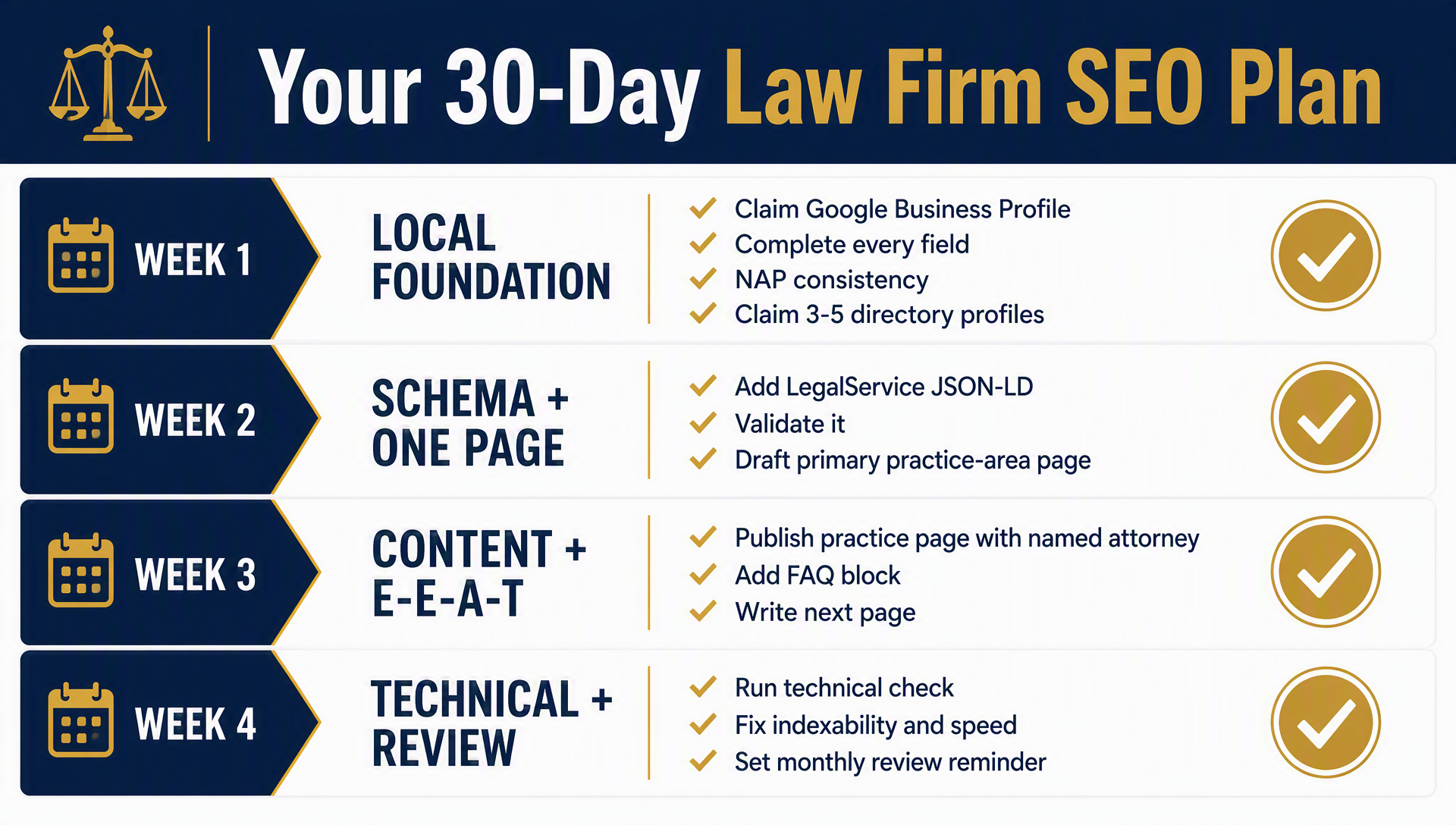
Week | Focus | Concrete actions | Done when |
|---|---|---|---|
1 | Local foundation | Claim/verify GBP, complete every field, write NAP list, claim 3–5 directory profiles | GBP 100% complete; NAP consistent; top directories claimed |
2 | Schema + one page | Add LegalService JSON-LD to homepage, validate it, draft your primary practice-area page | Schema validates; one practice page drafted |
3 | Content + E-E-A-T | Publish the practice page with named attorney, add FAQ block, write the next practice page | One page live with named attorney; second drafted |
4 | Technical + review routine | Run the technical check, fix indexability/speed issues, set a monthly review reminder | Site passes five checks; review routine written |
Then repeat the loop monthly: new review, new practice-area content, and a re-run of the Codex audit. Legal SEO compounds; the firms that start now and stay consistent are the ones that win the next 12 to 18 months.
What not to do (beginner mistakes)
- Ignore your directory profiles. The AI engines that introduce clients to law firms mostly cite directories. Skip them and you become "known but never cited."
- Buy links. Purchased link packages and link exchanges are high-risk in a YMYL category and can cost far more than they return.
- Publish generic AI content without an attorney's review. Undifferentiated, formulaic pages are exactly what Google's quality systems target. Use AI as a structural skeleton; a named attorney adds the case experience that makes the page real.
- Chase one keyword per page and stop. One keyword on one page is a 2020 habit. In 2026 the goal is a self-contained, answerable section that AI can cite for many related queries.
- Give up after 30 days. Legal SEO timelines run 60–90 days for local movement and months for competitive terms. Consistency beats intensity.
FAQ
Does law firm SEO still work in 2026? Yes, but it changed shape. Local search and practice-area content still bring the highest-intent clients, and AI answers now add a layer where being cited matters as much as ranking. Firms that win local + content + AI citations together grow; firms that only chase rankings get less of the click.
What is the most important first step for a small law firm? Complete your Google Business Profile and make your NAP identical everywhere. It is free, visible within 60–90 days, and the foundation every other local signal builds on.
Do I need to hire an SEO agency? Not at the start. A solo attorney with a full GBP, consistent citations, one or two strong practice-area pages, and a clean technical site is already ahead of most firms in a market. Agencies add speed and scale once you have leads to handle and a budget to protect.
Is schema guaranteed to get me into AI Overviews? No. Google states that structured data is not a ranking signal and does not guarantee an AI Overview or rich result. Schema helps AI engines understand your firm correctly; content, authority, and consistency do the rest.
Why do legal directories matter so much now? Because the AI engines that answer legal questions cite directories most often. Research in 2026 found directories were the first-cited source in about 78% of AI answers about lawyers. A claimed, complete, consistent directory profile is how you get named — and linked — by AI.
How much does law firm SEO cost? A focused do-it-yourself local strategy costs mostly your time (a few hours a week). Paid tools start around $100–$200 a month; agency retainers for small firms typically run $2,000–$5,000 a month. Avoid agencies that promise fast #1 rankings or use purchased links.
Author: Martin Hayes, GEO Playbook Builder for 200+ Execution Checklists at Auspia. Martin writes step-by-step search, GEO, and AI-visibility playbooks for teams that need an executable path, not another theory post.