Direct answer
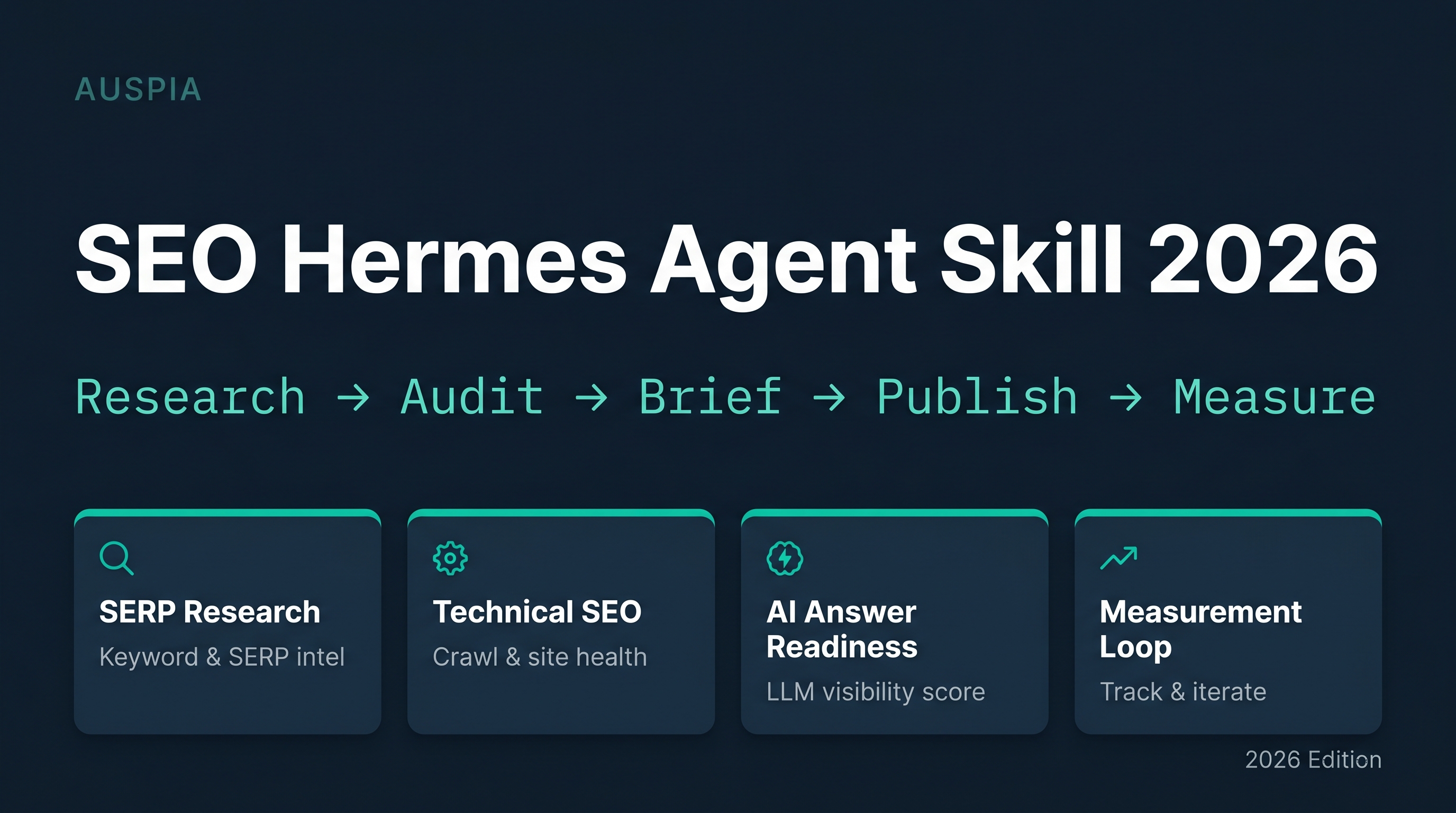
The best SEO Hermes Agent Skill for 2026 is a workflow skill, not a magic prompt. It should let Hermes Agent research a market, inspect a site, turn findings into an SEO or GEO brief, draft or update content, publish through a controlled CMS path, and run a review pass before the work goes live.
That matters because SEO work has changed. Teams still need crawlable pages, clear metadata, useful content, internal links, and clean technical foundations. But they also need pages that answer buyer questions clearly enough for AI search systems, answer engines, and human reviewers to trust them. A useful Hermes SEO skill should handle both sides: classic search hygiene and AI-answer readiness.
If you only install one SEO-related skill, install or build one around this operating loop:
Stage | What Hermes should do | Human approval needed? |
|---|---|---|
Research | Search SERPs, cluster intent, collect competitor patterns | No, unless paid data is used |
Audit | Check crawlability, titles, schema, internal links, answer extraction | No |
Brief | Produce a page brief with keyword, angle, evidence, visuals, FAQ | Usually no |
Create | Draft, refresh, or generate structured content | Yes before publishing |
Publish | Send content and media to CMS through a script or API | Yes for production |
Measure | Track rankings, AI citations, Search Console changes, conversions | No |
Learn | Save reusable patterns as Hermes skills or templates | Yes for broad reusable rules |
For Auspia users, this maps well to an AI SEO tools stack: one agent for research, one for page scoring, one for AI-search visibility checks, and one controlled publishing path.
Why Hermes Agent fits SEO work
Hermes Agent is interesting for SEO because it is built around skills, memory, tool use, and agent delegation. In public Hermes documentation, bundled skills include delegation to coding agents such as Codex, which means Hermes can hand bounded coding work to another CLI agent instead of trying to do everything in one chat. That is useful for SEO because a real SEO workflow touches content, code, data, and publishing.
A normal chat prompt can write a title tag. A useful SEO agent skill can remember how your site handles frontmatter, which CMS fields are required, how your blog categories work, which pages should never be edited without review, and which checks failed last time.
That is the difference.
For 2026, the best Hermes SEO setup has four jobs:
- Find opportunities that are worth acting on.
- Turn opportunities into content or technical changes.
- Protect the site from low-quality automation.
- Measure whether the work improved search and AI-search visibility.
The fourth point is easy to skip. Don't. A skill that produces pages but never measures outcomes is just a content machine with a nicer interface.
What the skill should include
A good SEO Hermes Agent Skill should be written like an operating procedure. The agent needs clear inputs, allowed tools, stop conditions, and output formats.
Here is the minimum spec I would use.
Module | Required capability | Output |
|---|---|---|
SERP research | Search target queries, detect intent, identify page types, note competitor gaps | SERP memo with cited URLs |
Keyword clustering | Group terms by intent and page type instead of raw keyword volume only | Keyword map |
Site audit | Inspect titles, headings, schema, canonicals, internal links, indexability, page speed signals | Fix list by severity |
GEO/AEO readiness | Check direct answers, entity clarity, citation-worthy facts, FAQ quality, source references | AI-answer readiness score |
Content brief | Define audience, promise, outline, evidence, visuals, internal links, CTA | CMS-ready brief |
Drafting | Write or refresh content in the site's voice | Markdown or CMS payload |
Review | Check factual claims, duplicate sections, thin claims, metadata, image alt text | Pass/fail review report |
Publishing | Upload images, create draft, attach taxonomy, set OG image | Draft or published URL |
Measurement | Track Search Console, rank data, AI citation checks, conversions | Weekly report |
This is also where Hermes should use specialist agents instead of pretending one model can do everything. Codex is useful for codebase changes, schema checks, route updates, and scripts. A search or SEO data tool is better for live SERP facts. A publishing script is safer than asking an agent to click around a CMS UI.
The 2026 skill architecture
Think of the Hermes SEO skill as a small production line.
Opportunity input
  -> SERP and site research
  -> keyword and intent map
  -> SEO/GEO brief
  -> content or technical task
  -> human approval gate
  -> CMS or codebase execution
  -> QA review
  -> measurement loop
  -> reusable skill notes
The approval gate is not bureaucracy. It prevents the two classic agent failures: publishing confident nonsense and making silent site-wide changes.
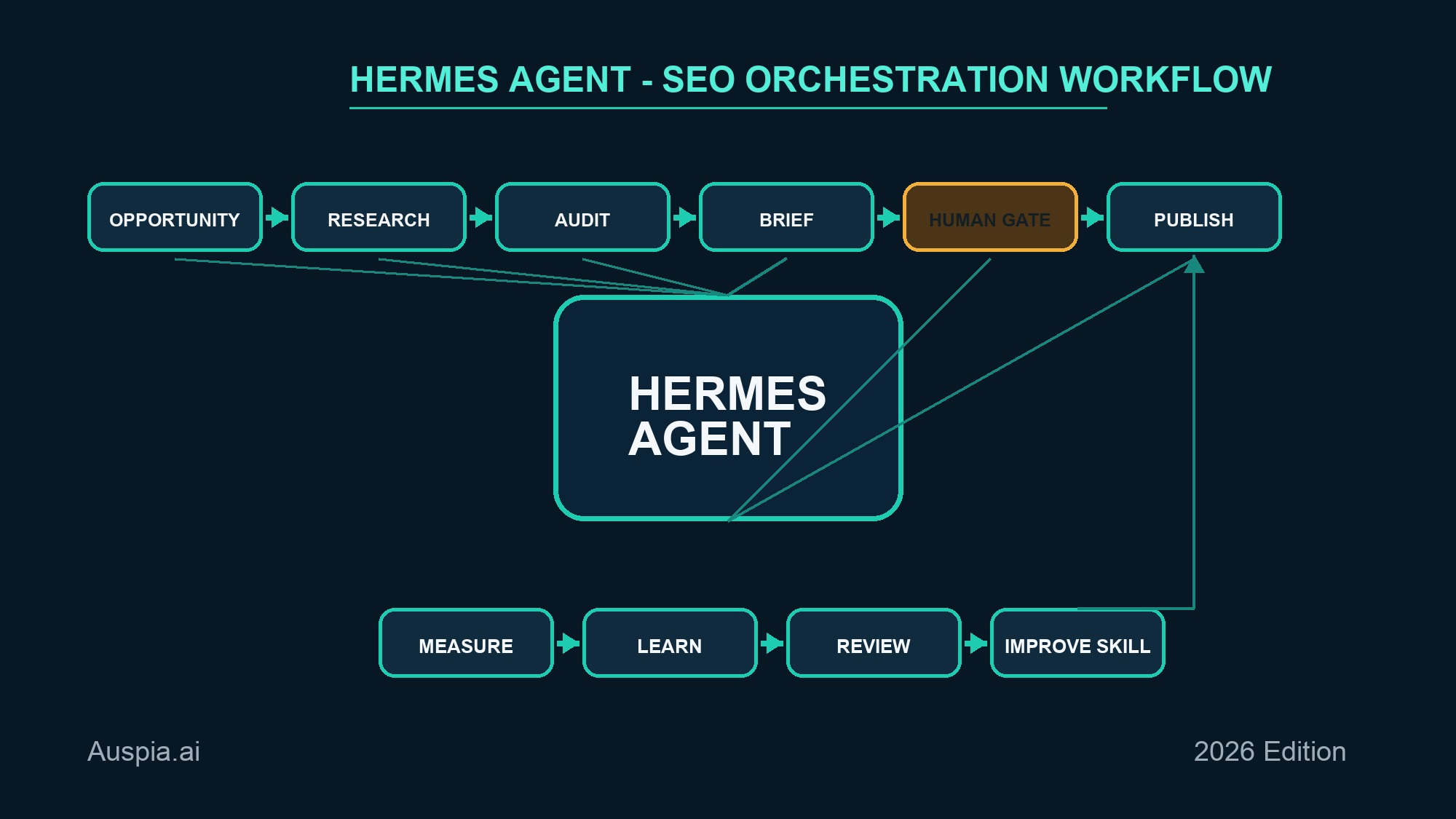
Hermes works best as the orchestrator: it keeps the SEO workflow moving, while specialist tools handle research, code, publishing, and measurement.
A practical file structure might look like this:
skills/seo-growth-operator/
  SKILL.md
  references/
    content-brief-template.md
    technical-audit-checklist.md
    geo-answer-readiness-checklist.md
    publishing-rules.md
  scripts/
    inspect-page.js
    build-brief.py
    validate-markdown.py
    search-console-report.py
The SKILL.md should tell Hermes when to use the skill, what evidence is required, which tools are allowed, and which tasks must stop for approval. The references keep the agent from improvising your whole SEO process every time.
Five workflows worth automating first
Do not start by automating everything. Start with the parts that are repetitive, structured, and easy to review.
1. SEO opportunity brief
Input: a seed topic, product page, competitor URL, or Search Console query group.
Output: a one-page brief with:
- primary intent
- target page type
- competing page patterns
- missing subtopics
- title and meta options
- recommended internal links
- FAQ candidates
- visual suggestions
- risk notes
This is the best first Hermes SEO skill because it helps humans make better decisions without giving the agent publishing power.
2. Technical SEO issue triage
Input: a URL or repository path.
Output: a severity-ranked issue list.
The agent should check obvious things first: missing titles, duplicate H1s, broken canonicals, blocked resources, poor heading structure, missing alt text, schema errors, thin internal links, and pages that cannot be indexed. For code-backed sites, Hermes can delegate implementation work to Codex, then run a second review.
3. Content refresh workflow
Input: an existing URL plus target query or performance issue.
Output: an updated article plan or draft.
The skill should identify what changed since the page was published, where the page is thin, what competitors now cover, and which sections should be cut. Refreshing old content usually beats publishing a weaker new article on the same topic.
4. AI-answer readiness audit
Input: a page or cluster.
Output: an answer-readiness score.
A page is easier for answer systems to use when it has a short direct answer, clear entity facts, cited claims, consistent terminology, structured sections, and extractable tables. Auspia's AI Search Visibility Checker is a natural companion here because it helps teams test how a brand or page appears in AI search surfaces.
5. Controlled publishing workflow
Input: approved Markdown, metadata, images, category, tags, and slug.
Output: a CMS draft or published URL.
This workflow should be strict. It should block publishing if the article lacks a featured image, excerpt, category, tags, canonical slug, alt text, or review note. Agents are fast enough to create mess at scale. Your publishing skill should be boring on purpose.
Guardrails that separate a useful skill from a risky one
SEO agents need constraints more than they need enthusiasm.
Use these guardrails in the skill:
Risk | Guardrail |
|---|---|
Fake facts | Require source URLs for market claims, tool claims, and statistics |
Keyword stuffing | Limit exact-match repetition and require natural headings |
Duplicate content | Compare against existing site pages before drafting |
Bad internal links | Allow only approved internal link targets or sitemap-derived URLs |
Broken CMS payloads | Validate required fields before publishing |
Unreviewed code changes | Require a diff summary and tests before merge |
Thin AI content | Require examples, tables, screenshots, or first-party analysis |
Unclear ownership | Add a final "human review needed" checklist |
The agent should also know what not to do. It should not invent case-study numbers, promise rankings, rewrite legal or medical claims without review, or publish hundreds of pages from a keyword list without quality checks.
A sample Hermes SEO Skill prompt
Use this as a starting point, not a finished installable skill.
# SEO growth operator

Use this skill when the user asks for SEO, GEO, AEO, content refresh, keyword research, technical SEO, or publishing workflow help.

## Inputs
- Target URL, domain, topic, keyword set, competitor URL, or content draft.
- Business model and audience when available.
- CMS or repository constraints when publishing or editing code.

## Required process
1. Identify the task type: research, audit, brief, draft, technical fix, publish, or measure.
2. For current SERP claims, run live research and save source URLs.
3. Check existing site context before recommending new pages.
4. Produce structured outputs: summary, evidence, actions, risks, and next step.
5. Stop for approval before publishing, editing production code, or creating pages at scale.
6. After execution, run a review pass and record reusable lessons.

## Output formats
- Brief: keyword intent, page type, angle, outline, evidence, internal links, visuals, FAQ.
- Audit: issue, severity, URL, evidence, fix, owner.
- Draft: Markdown with metadata, image alt text, FAQ, and source notes.
- Publish: slug, category, tags, media IDs, status, canonical URL.

## Quality bar
- No unsupported statistics.
- No generic filler sections.
- No exact-match keyword stuffing.
- No publishing without metadata and review.
This prompt is intentionally plain. Good agent skills are rarely fancy. They are specific.
How to evaluate "best"
A SEO Hermes Agent Skill is good if it improves the quality and speed of decisions. It is bad if it only produces more text.
Use this scorecard:
Criterion | Good sign | Bad sign |
|---|---|---|
Evidence | Links claims to sources and site data | Makes broad claims without citations |
Repeatability | Uses templates, scripts, and checklists | Starts from scratch every time |
Site awareness | Reads existing pages, routes, taxonomy, and CMS rules | Suggests pages that already exist |
Technical safety | Produces diffs, tests, and rollback notes | Edits code or CMS fields silently |
Search quality | Maps intent before writing | Starts drafting from a keyword only |
AI-search readiness | Adds direct answers, entity facts, tables, citations | Treats GEO as keyword stuffing for LLMs |
Measurement | Reports before/after metrics | Declares success at publish time |
If a skill scores low on evidence, site awareness, and measurement, it is not the best SEO skill. It is a writing shortcut.
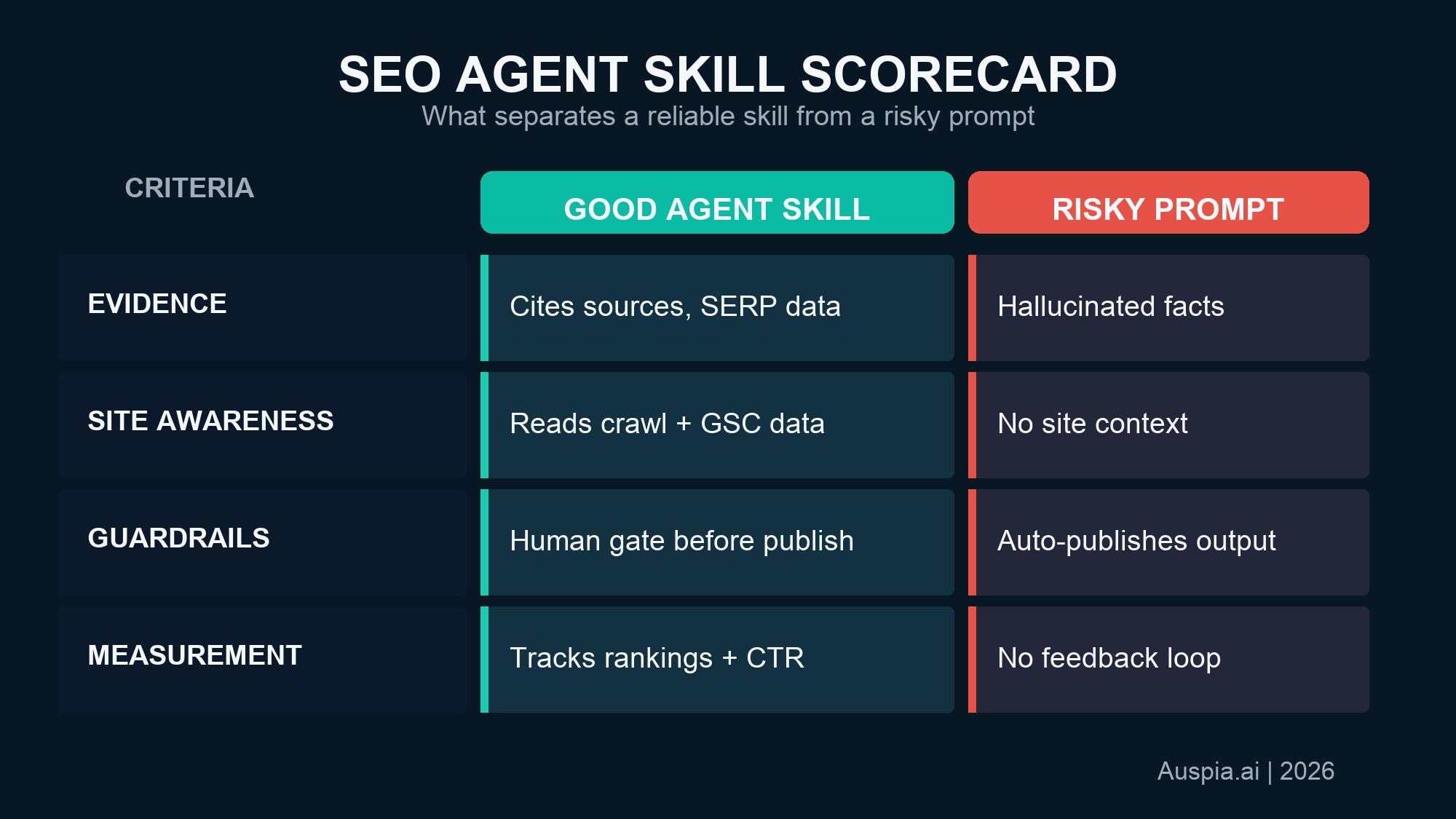
Use a scorecard before you call any SEO agent skill "production-ready." The weak spots usually show up in evidence, site awareness, and measurement.
What most teams should build first
For most teams, the best 2026 setup is:
- A research and brief skill.
- A technical audit skill.
- A content refresh skill.
- A publishing validator.
- A weekly measurement skill.
Only after those work should you automate full page generation. The temptation is to start with "write 100 articles." The better move is to build a system that knows which 10 pages are worth improving and why.
Auspia's view is simple: AI agents should increase editorial leverage, not lower the quality bar. The winning SEO teams will use agents to research faster, find gaps earlier, test AI-search visibility more often, and keep humans focused on judgment.
Implementation checklist
Before you call your Hermes SEO skill production-ready, check the following:
- The skill has separate modes for research, audit, brief, draft, publish, and measurement.
- It can read or receive the site's sitemap, CMS taxonomy, and internal link rules.
- It requires live sources for current claims.
- It checks whether a topic already has a page before proposing a new one.
- It blocks publishing when metadata, category, tags, images, or review notes are missing.
- It supports code delegation for technical SEO work, but asks for approval before production changes.
- It produces a measurement plan for every material SEO action.
- It saves reusable findings without turning every one-off preference into a permanent rule.
FAQ
Is Hermes Agent itself an SEO tool?
No. Hermes Agent is an agent framework. It becomes useful for SEO when you add skills, tools, scripts, data sources, and review rules that match your SEO process.
What is the best SEO Hermes Agent Skill for beginners?
Start with an SEO opportunity brief skill. It is safer than auto-publishing, easy to review, and immediately useful for content planning, page refreshes, and internal linking decisions.
Should Hermes write and publish SEO articles automatically?
It can draft and prepare CMS payloads, but production publishing should have an approval gate. Fully automated publishing is risky unless the site has strong validation, strict templates, and a clear review process.
How does this differ from a normal SEO prompt?
A prompt asks for one output. A skill defines a repeatable workflow with evidence rules, tools, templates, stop conditions, and a review step. That repeatability is the value.
Does this help with GEO and AI search visibility?
Yes, if the skill checks answer extraction, entity clarity, citation-worthy claims, source support, and visibility in AI answer surfaces. Traditional SEO checks alone are not enough for 2026.
Where should teams start if they already use Codex or Claude Code?
Use Hermes as the orchestrator and keep Codex or Claude Code focused on bounded code tasks: schema fixes, route updates, audit scripts, metadata validation, and testable technical SEO changes.