The short answer
AI can make startup backlink work much faster, but it should not turn it into a submission cannon. In 2026, the useful pattern is simple: let an agent research eligibility, organize your proof, draft a platform-specific listing or pitch, and prepare a submission. A person still reviews every claim, completes account verification, respects each site's rules, and decides whether a link actually belongs there.
That distinction matters. A backlink from a relevant, well-maintained profile, directory, launch page, community post, or editorial contribution can help people discover a young company. Hundreds of thin, copied submissions can damage trust, waste time, or get accounts removed. The goal is a tidy public footprint and real referral opportunities, not a DR spreadsheet full of URLs.
The 127 names in this guide are a starting inventory supplied for this article. Their DR figures are snapshots from that list, not live 2026 measurements or a guarantee that every site accepts self-service submissions, offers a followed link, or is appropriate for every startup. Check the current rules, audience, indexing status, and link attributes before you spend time there.
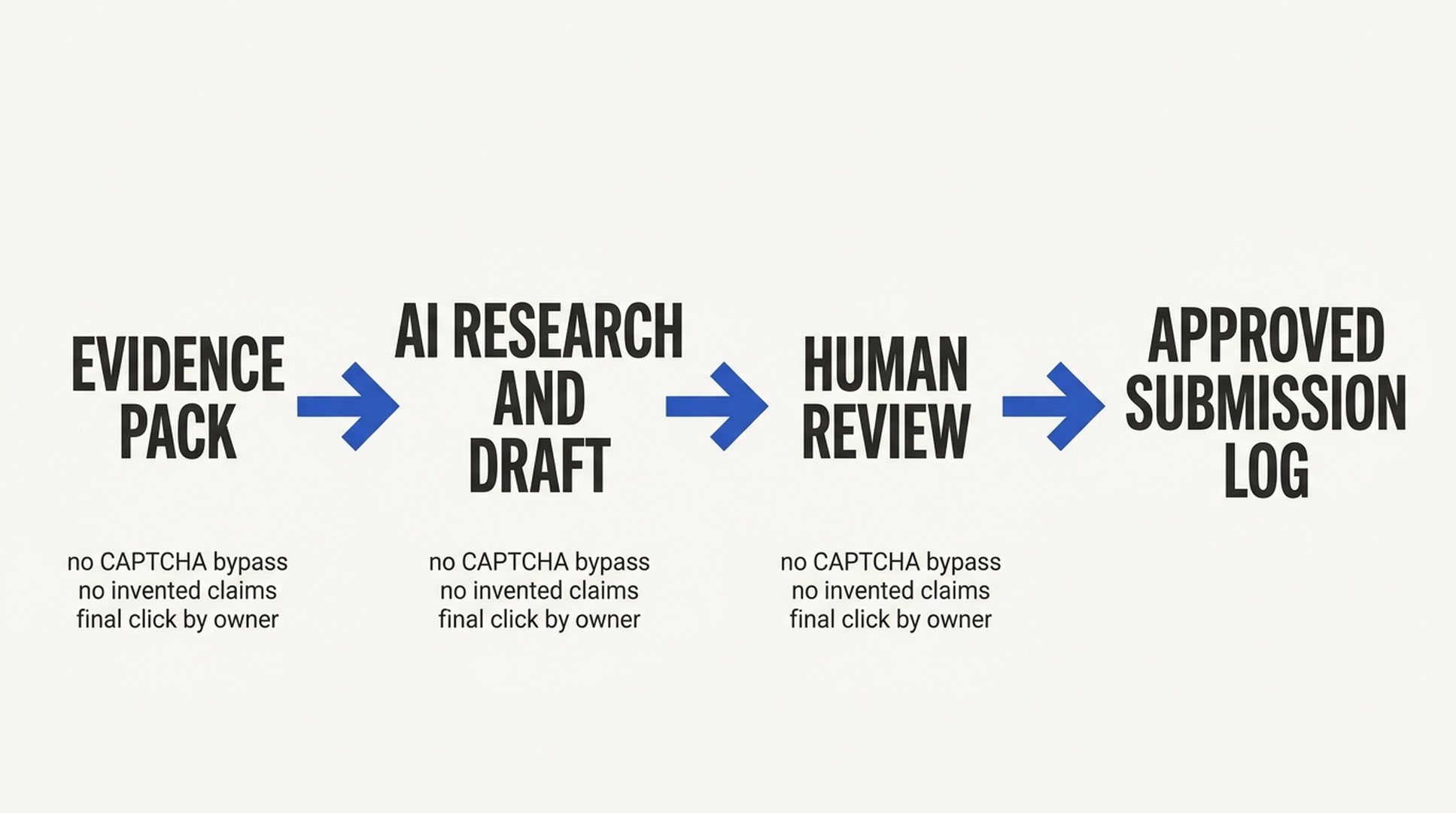
Suggested inline visual: a four-stage workflow showing Evidence Pack -> AI Research and Draft -> Human Review -> Approved Submission Log. Alt text: "A policy-aware AI workflow for researching and submitting startup backlink opportunities."
What an AI agent should do, and what it should not do
Tools such as Codex, Claude Code, and browser-based computer-use agents are good at repetitive preparation. Give them a bounded task and a clean source folder. They can turn a messy launch folder into a usable submission queue in an afternoon.
Let the agent handle | Keep a human in charge |
|---|---|
Extract product facts from your website and docs | Final claims, pricing, and customer promises |
Classify a site as directory, community, media, marketplace, or resource page | Whether the audience and policy make the opportunity worthwhile |
Draft a short, platform-specific description | Account creation, identity verification, and CAPTCHA challenges |
Find duplicate listings and inconsistent product descriptions | Consent to terms, payment, and any public submission |
Populate a spreadsheet or a local submission brief | Final publish or send action, unless the platform explicitly supports approved automation |
Create a follow-up and verification checklist | Dispute handling, editorial replies, and relationship building |
Do not ask an agent to bypass rate limits, CAPTCHAs, access restrictions, editorial gates, or platform terms. Do not create fake user accounts, impersonate founders, buy reviews, spin dozens of near-identical articles, or insert a startup into a public resource that has no relevant fit. Those tactics are easy to automate and usually easy to spot.
Build a source-of-truth pack before opening any directory
The bottleneck is rarely typing into a form. It is deciding what to say consistently, and having evidence ready when a platform asks for it. Create one short folder or document with the material below. This becomes the only source an agent may use for factual copy.
- Product name, canonical website, one-sentence description, and 50-word description.
- Category labels you actually use, plus three close alternatives for directories with fixed taxonomies.
- Pricing, supported platforms, location, launch date, and contact email where applicable.
- Two product screenshots or a short demo, a logo, and a founder bio that has been approved for public use.
- Three proof points with supporting URLs or documents: for example, an open-source repository, a public integration, a case study, or customer quotes you may legally publish.
- A list of prohibited claims. Include unverified metrics, customer names under NDA, and promises the product cannot support.
Here is a safe prompt shape for a coding or computer-use agent:
You are preparing a backlink opportunity queue for [Startup].
Use only the approved facts in ./evidence-pack.md.

For each named platform, research its current public submission path and rules.
Return: platform type, relevant audience, self-service availability, required assets,
link policy if publicly documented, draft copy tailored to its format, and a risk flag.

Do not create accounts, solve CAPTCHAs, accept terms, send messages, make payments,
or submit anything. Mark unknown facts as "needs human verification." Do not invent
metrics, testimonials, integrations, or editorial relationships.
This prompt does less than a fully autonomous browser bot, deliberately. A good agent can still collect the mundane work: current requirements, draft variants, asset checks, and a queue sorted by relevance. The person running growth owns the public action.
Turn 127 names into a realistic queue
Treat the list as different kinds of opportunities, not one giant to-do list. A developer tool could fit GitHub, GitHub Pages, DevTo, Hashnode, StackShare, SourceForge, LibHunt, Public APIs, and API List. An AI product might fit Futurepedia, Toolify AI, There's an AI for That, AIxploria, AI Agent Store, and That AI Collection. A startup with a strong launch narrative may have a case for Product Hunt, BetaList, Indie Hackers, Hacker News, or a carefully targeted editorial pitch.
The same startup does not belong on all of them. Start by scoring each candidate on three questions:
- Does the platform serve a person who could genuinely use, evaluate, or share this product?
- Can you provide a distinct, useful listing, post, launch, image, integration, or story there?
- Is the current submission route transparent and consistent with the platform's terms?
If the answer is no, archive it. Relevance and quality control beat quantity. A listing that drives one serious referral is more useful than a generic profile that never gets visited.
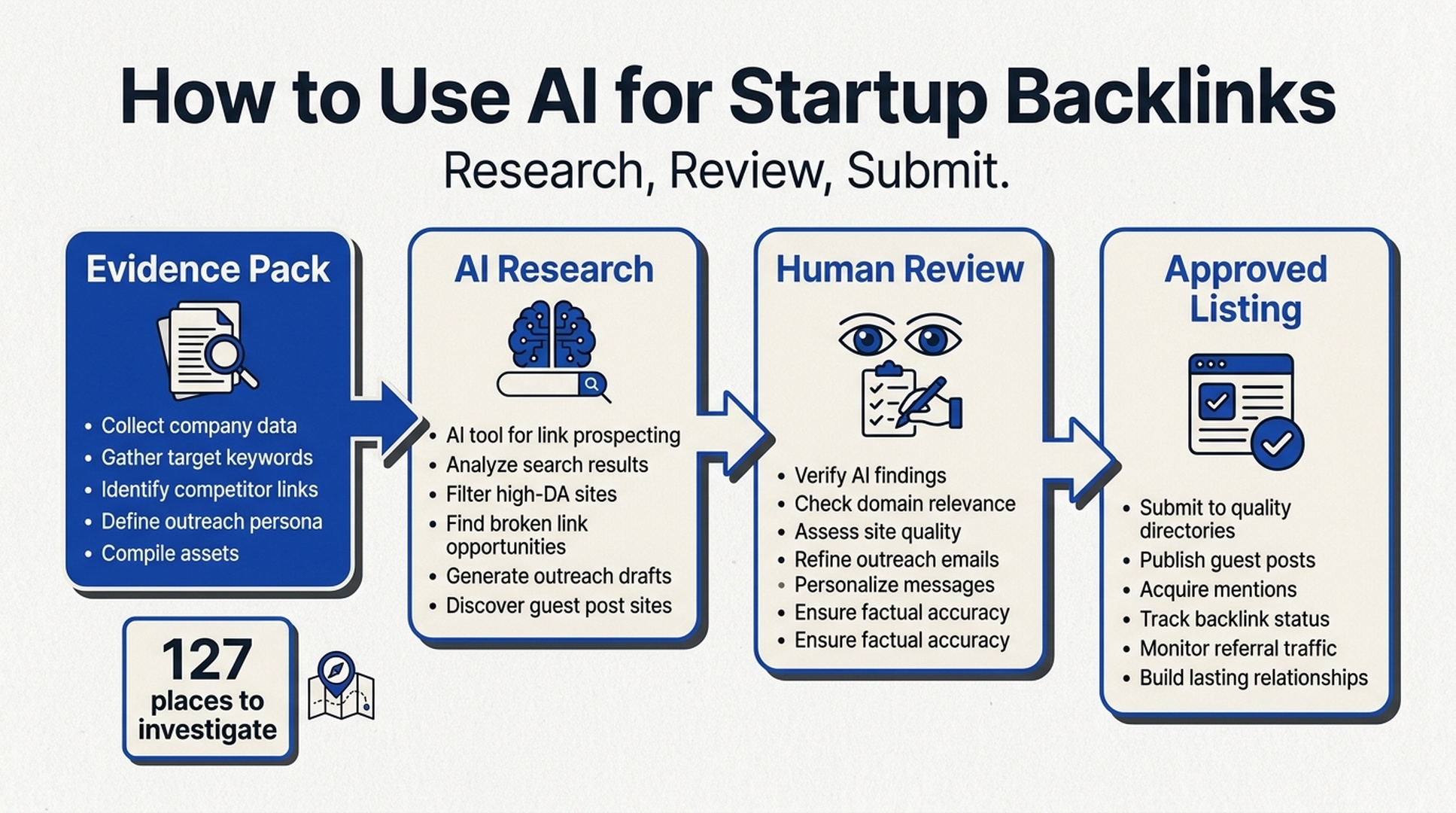
The 127 places to investigate
The names below intentionally appear as plain text, not clickable links. “DR” is retained exactly as the supplied list's reference value. Several entries repeat in the source list; keep a single working record per platform in your own submission tracker, but preserve the repeats here so the inventory remains complete.
# | Platform | Supplied DR |
|---|---|---|
1 | Chrome Web Store | 99 |
2 | Forbes | 94 |
3 | TrustMRR | 69 |
4 | GitHub Pages | 97 |
5 | TrustRadius | 84 |
6 | AlternativeTo | 79 |
7 | Product Hunt | 91 |
8 | Substack | 94 |
9 | Uneed | 75 |
10 | Indie Page | 66 |
11 | Privacy Tools | 73 |
12 | SourceForge | 92 |
13 | SEO Wins | 32 |
14 | TinyLaunch | 72 |
15 | OSS Gallery | 31 |
16 | BetaList | 76 |
17 | Alternative Me | 75 |
18 | SaaSHub | 79 |
19 | Medium | 94 |
20 | Indie Hackers | 81 |
21 | Hacker News | 91 |
22 | YourStory | 85 |
23 | Tiny Startup | 69 |
24 | GitHub | 97 |
25 | PeerPush | 69 |
26 | Imgur | 91 |
27 | 97 | |
28 | SEO Wins | 32 |
29 | SideProjectors | 70 |
30 | Pixabay | 92 |
31 | HackerNoon | 87 |
32 | DevHunt | 63 |
33 | Launch Directories | 64 |
34 | Microlaunch | 61 |
35 | StartupBase | 60 |
36 | ShowMeBestAI | 76 |
37 | 95 | |
38 | Quora | 91 |
39 | There's an AI for That | 77 |
40 | OpenAlternative | 51 |
41 | StackShare | 79 |
42 | Beehiiv | 91 |
43 | Substack | 94 |
44 | Patreon | 93 |
45 | Evernote | 90 |
46 | FoundrList | 72 |
47 | API List | 37 |
48 | GrowthMentor | 72 |
49 | Scroll Launch | 61 |
50 | PitchWall | 69 |
51 | Dan Recommends | 22 |
52 | Toolify AI | 73 |
53 | Starter Story | 76 |
54 | Niche Pursuits | 74 |
55 | SEO Wins | 32 |
56 | Flickr | 94 |
57 | Startup Buffer | 43 |
58 | AppSumo | 83 |
59 | TechCrunch | 92 |
60 | RocketHub | 69 |
61 | Boring Cash Cow | 28 |
62 | Micro Founder | 38 |
63 | SaaSZilla | 33 |
64 | WIP | 55 |
65 | Vocal Media | 82 |
66 | VentureBeat | 91 |
67 | Founder Reports | 64 |
68 | Fazier | 82 |
69 | Failory | 75 |
70 | Peerlist | 77 |
71 | Next Gen Tools | 67 |
72 | Mixergy | 75 |
73 | Hashnode | 83 |
74 | PromptZone | 18 |
75 | Latka | 72 |
76 | Futurepedia | 72 |
77 | Wikipedia | 97 |
78 | First Round Review | 82 |
79 | LaunchIgniter | 75 |
80 | AppSumo Blog | 83 |
81 | Firsto | 55 |
82 | SEO Wins | 32 |
83 | ToolFame | 74 |
84 | Aura Plus Plus | 71 |
85 | WikiHow | 91 |
86 | DevTo | 91 |
87 | FounderPass | 50 |
88 | SaaS Club | 58 |
89 | 500px | 90 |
90 | That AI Collection | 43 |
91 | SaaS Pirate | 67 |
92 | GIPHY | 91 |
93 | Product Canyon | 27 |
94 | DealMirror | 47 |
95 | Dealify | 59 |
96 | GoodFirms | 86 |
97 | AI Agent Store | 59 |
98 | Altern | 42 |
99 | BotsFloor | 49 |
100 | Wavel | 42 |
101 | My First Million | 63 |
102 | Gumroad | 92 |
103 | Bootstrappers | 37 |
104 | EarlyHunt | 58 |
105 | Serchen | 67 |
106 | Tekpon | 72 |
107 | SEO Wins | 32 |
108 | Appscribed | 42 |
109 | Toolfolio | 25 |
110 | LibHunt | 62 |
111 | SaaS Genius | 58 |
112 | Stacker News | 63 |
113 | AIxploria | 55 |
114 | Affiliate Watch | 52 |
115 | RankYourAI | 35 |
116 | Startups FYI | 31 |
117 | AI Parabellum | 32 |
118 | The SaaS Podcast | 58 |
119 | AI Tool Trek | 55 |
120 | Powerusers | 34 |
121 | IndieHunt | 59 |
122 | StackSocial | 73 |
123 | KEN Moo | 39 |
124 | SEOFAI | 18 |
125 | Public APIs | 45 |
126 | Open Tools | 68 |
127 | Fandom | 92 |
A note on editorial publications and community sites
Some names in this list are media brands, community platforms, or knowledge sites, not directory forms. Forbes, TechCrunch, VentureBeat, HackerNoon, Starter Story, Niche Pursuits, Mixergy, First Round Review, AppSumo Blog, WikiHow, and The SaaS Podcast are examples where a credible pitch, contribution, partnership, interview, or source-worthy story may be required. An agent can help make a concise pitch brief, identify a relevant editor or contributor guideline, and check your claims against the evidence pack. It cannot manufacture a newsworthy story.
Wikipedia is a special case. It is not a place for promotional startup submissions. Only contribute when you understand the neutral-point-of-view, notability, conflict-of-interest, and reliable-source requirements. Do not use an AI agent to add your own company page or promotional link. If the startup lacks independent coverage, the correct action is usually to do nothing.
Social and community products such as Reddit, Quora, Hacker News, Indie Hackers, Medium, Substack, Pinterest, Imgur, Flickr, 500px, GIPHY, and Fandom need the same restraint. Participate where you have something useful to show: an answer, a launch note, an integration walkthrough, an open-source project, an image asset, or a real lesson. A drive-by link is unlikely to build the reputation you want.
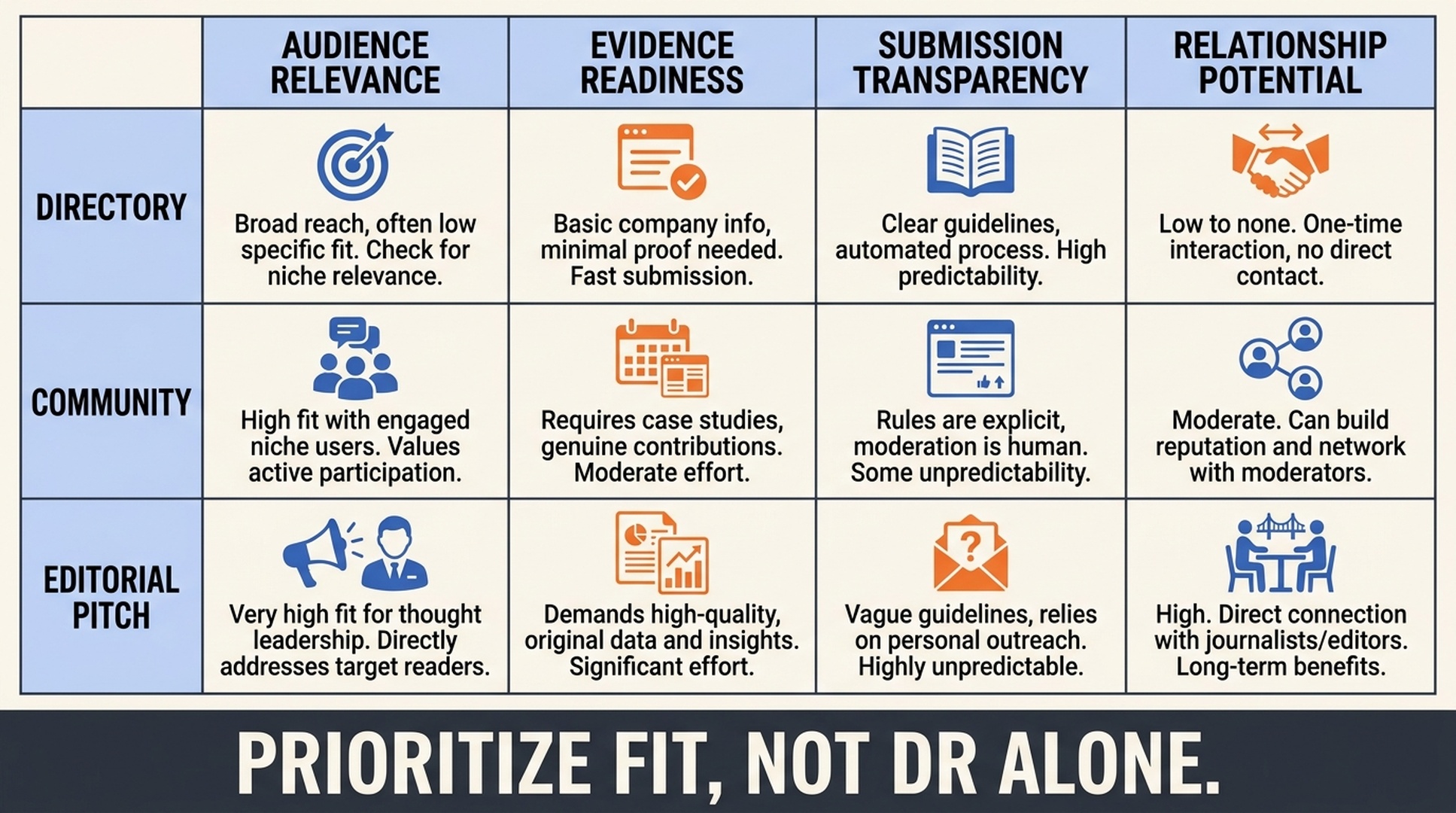
Suggested inline visual: a scored matrix with relevance, evidence readiness, submission transparency, and relationship potential. Alt text: "A scorecard for prioritizing startup backlink opportunities by relevance, proof, transparency, and relationship value."
A 90-minute AI-assisted operating loop
Run this in small batches of five to ten platforms. Small batches give you room to improve the product description after you see what each audience actually asks for.
1. Ask the agent to research current requirements
For each platform, have the agent record the official submission route, likely category, required files, current moderation language, and whether a paid placement is involved. The output should include direct quotations or screenshots for your internal review when available, plus a clear “unknown” label when it cannot verify a detail.
Do not infer that a high DR means a submission is open, a link is followed, or a listing will be indexed. Those are separate questions.
2. Generate a draft that matches the place
One 150-word product description will not work everywhere. A directory needs a clean description and category. A developer community may respond to code, architecture, and a reproducible demo. A reporter needs evidence, a timely angle, and a reason their readers should care.
Ask the agent for one draft per platform, not one draft repeated 127 times. Then use a human review to remove inflated language and make sure every statement is true on the day it becomes public.
3. Use computer use for navigation, not unsupervised publishing
A computer-use agent can open the public submission page, locate fields, compare them with the prepared brief, and prefill low-risk drafts where platform policy allows. Pause before any action that creates an account, accepts terms, passes a CAPTCHA, sends a message, pays a fee, or submits content. The human reviewer checks the exact preview and clicks the final button.
That handoff also makes recovery simple. If an editor asks for clarification or a platform rejects the listing, you have an accountable owner, the original facts, and a record of what was sent.
4. Log the result, then verify the page without chasing vanity metrics
Store the live page, date, platform type, destination URL, link attribute if visible, moderator outcome, and referral traffic. Check whether the page is genuinely indexed only when that matters to the opportunity. Then look for real signals: relevant visits, trials, community replies, partnership conversations, and stronger branded search.
This is where a simple internal dashboard earns its keep. It tells you which source types deserve another round and which are merely taking up space in a spreadsheet.
A submission record your agent can prepare
Use this schema in a CSV, Notion database, or local Markdown files. It makes review much easier than a browser tab pile.
Field | What to record |
|---|---|
Platform | Exact site name and platform type |
Fit score | 1-5, with a sentence explaining audience relevance |
Route | Official listing, editorial pitch, community contribution, integration, or not applicable |
Requirements | Current category, assets, pricing, lead time, and moderator rules |
Proposed asset | Listing copy, demo, launch note, article idea, or answer outline |
Claim check | Evidence-pack references for every factual assertion |
Human owner | Person responsible for account, review, and final action |
Status | Researching, ready for review, submitted, accepted, declined, or archived |
Outcome | Live URL, referral data, relationship notes, and next review date |
Quality gates that stop bad backlinks before they happen
Before approving any submission, ask five blunt questions:
- Would this page still be useful if the link were nofollowed?
- Does the copy give the platform's audience a reason to care beyond “we are a startup”?
- Can we prove every statement from our evidence pack?
- Does the site explicitly allow the type of listing, contribution, or pitch we are making?
- Would we be comfortable explaining this placement to a prospective customer or a search-quality reviewer?
If the answer to any one is no, do not force it. Improve the asset, choose a better channel, or archive the opportunity. This is less glamorous than automated bulk submission. It is also how a small team avoids building a link profile it later has to clean up.
The 2026 mindset: build proof, not just placements
AI has changed the mechanics of link prospecting. It can find possible homes for a product, make first drafts quickly, and keep the operational details from slipping. It has not changed the underlying test: does the page add useful information for a real reader?
Start with the ten most relevant candidates from the list. Build distinct assets for them. Review and submit them one by one. Measure the response. Then expand only where the evidence tells you to. That is slower than telling an agent to post everywhere tonight, but it produces a public footprint that is easier to defend, maintain, and grow.
FAQ
Can AI automatically create accounts and submit startup listings?
It may be technically possible on some sites, but it is a poor default. Account creation, terms acceptance, identity checks, CAPTCHAs, payments, and final submissions should stay with a human unless the platform explicitly provides an approved automation route. Let AI prepare the work and the reviewer approve it.
Are high-DR sites always the best backlink opportunities?
No. The supplied DR values are only reference snapshots. A relevant niche directory, developer ecosystem, or community can be more useful than a broad high-authority site where your product does not fit. Check audience relevance, editorial standards, link policy, and referral potential.
Should a startup submit to every directory in this list?
No. Use the list as a research pool. Prioritize the platforms where you can provide a useful, accurate, category-appropriate asset. Archive the rest rather than creating thin or duplicate entries.
Can I use an AI agent for Wikipedia backlinks?
Do not use an agent to place promotional Wikipedia content or links. Wikipedia has conflict-of-interest, neutral-point-of-view, notability, and reliable-source rules. If you do not have independent, significant coverage, focus on earning that coverage rather than trying to create a page.
Author: Grace Miller, AI Search Risk Analyst Tracking 200+ Policy Shifts at Auspia. Grace writes about platform rules, responsible automation, and sustainable visibility practices for growth teams.