GEO Testing Should Replace Listing Guesswork
Amazon Manage Your Experiments for GEO is the practice of turning buyer-question hypotheses into controlled listing tests. Instead of debating whether a title, image, bullet, description, or A+ Content module is more "AI ready," sellers can test whether a clearer answer actually improves customer response.
Amazon describes Manage Your Experiments as a tool for testing different versions of product images, titles, bullet points, descriptions, and A+ Content, including Brand Story, to see what resonates with customers and drives sales. For GEO, that matters because every optimization claim should eventually face evidence: did the answer-led variant help buyers understand, click, convert, or choose the right product?
The important caveat: Manage Your Experiments does not test whether Alexa will recommend a product. It tests customer response to listing content. Sellers can use that evidence to improve the product detail page that AI shopping systems, voice journeys, ads, and human buyers may depend on.
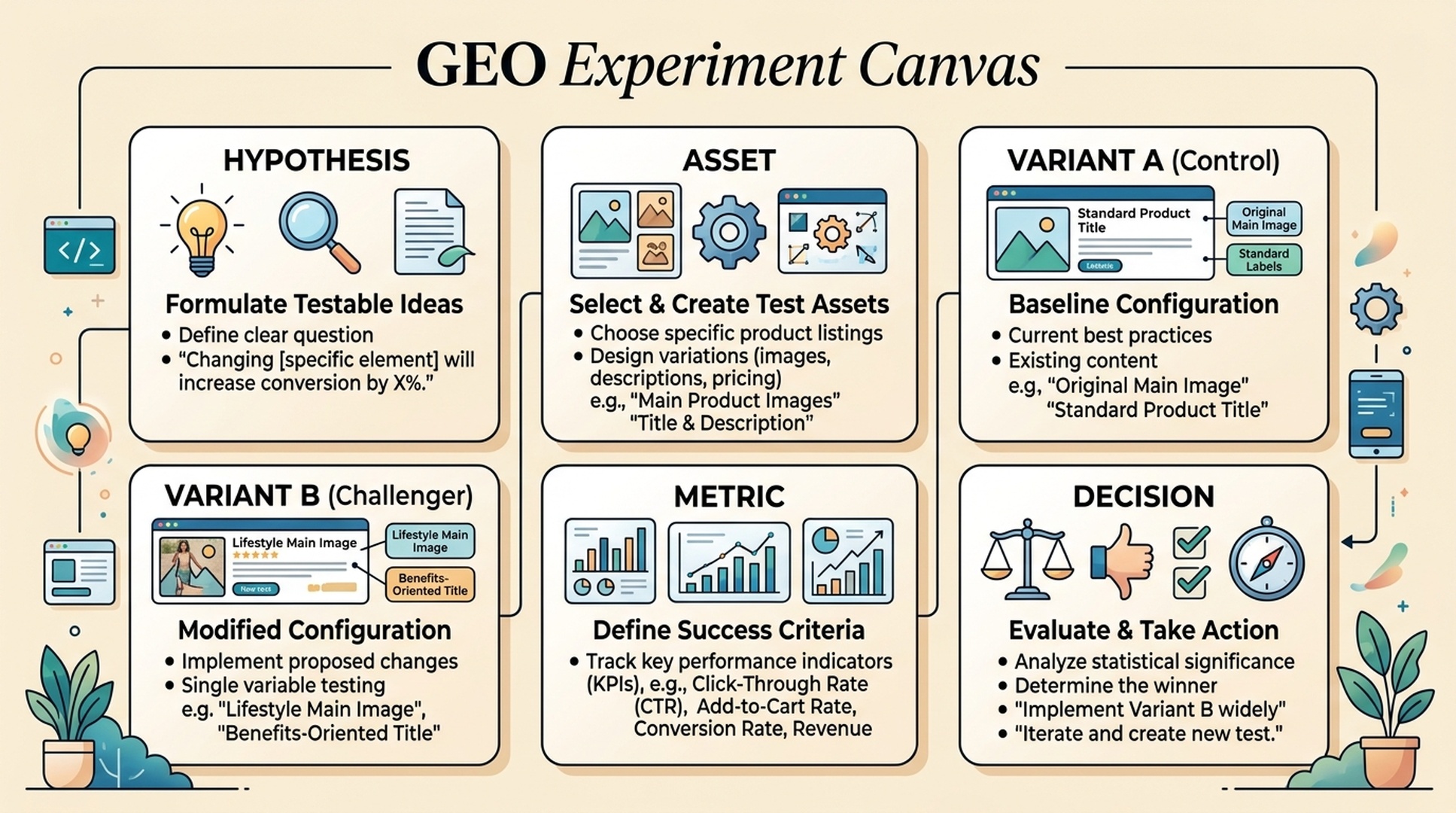
The GEO Experiment Canvas
Before changing a listing, write the test as a buyer-question hypothesis.
Canvas field | What to write | Example |
|---|---|---|
Hypothesis | The buyer question the new version should answer better | If the hero image shows pack size and use case, shoppers will choose the correct variant more often. |
Asset | The listing element being tested | Main image, title, bullet points, description, A+ Content, Brand Story |
Variant A | Current control | Existing title focused on category keywords |
Variant B | New answer-led version | Title that includes product type, count, compatibility, and use case |
Success metric | What should improve | Conversion rate, sales, click-through, return reasons, Q&A volume, variant mix |
Decision rule | What you will do after the test | Ship, refine, reject, or test a narrower hypothesis |
This prevents random testing. The goal is not to make a listing "feel better." The goal is to test whether a specific answer improves a specific buyer decision.
Which GEO Hypotheses Are Worth Testing?
A good GEO hypothesis starts with friction. Look for questions buyers already ask in reviews, Q&A, Sponsored Products search terms, returns, and customer support.
Buyer friction | Testable GEO hypothesis | Asset to test |
|---|---|---|
Buyers choose the wrong variant | A comparison image will reduce confusion | Image or A+ comparison chart |
Buyers ask if the product fits | A compatibility-led title will improve conversion | Title |
Buyers worry about safety | A bullet that answers ingredients/materials will reduce hesitation | Bullet points |
Buyers do not understand pack size | A main image with count and unit will improve click and conversion | Image |
Buyers compare two formulas | A+ Content with use-case modules will improve variant selection | A+ Content |
Buyers reorder the wrong item | Clearer variation names will support repeat purchase | Title, image, variation naming |
If the hypothesis cannot be tied to a buyer question, it is probably not a GEO test. It is just a design preference.
From Guesswork To Evidence
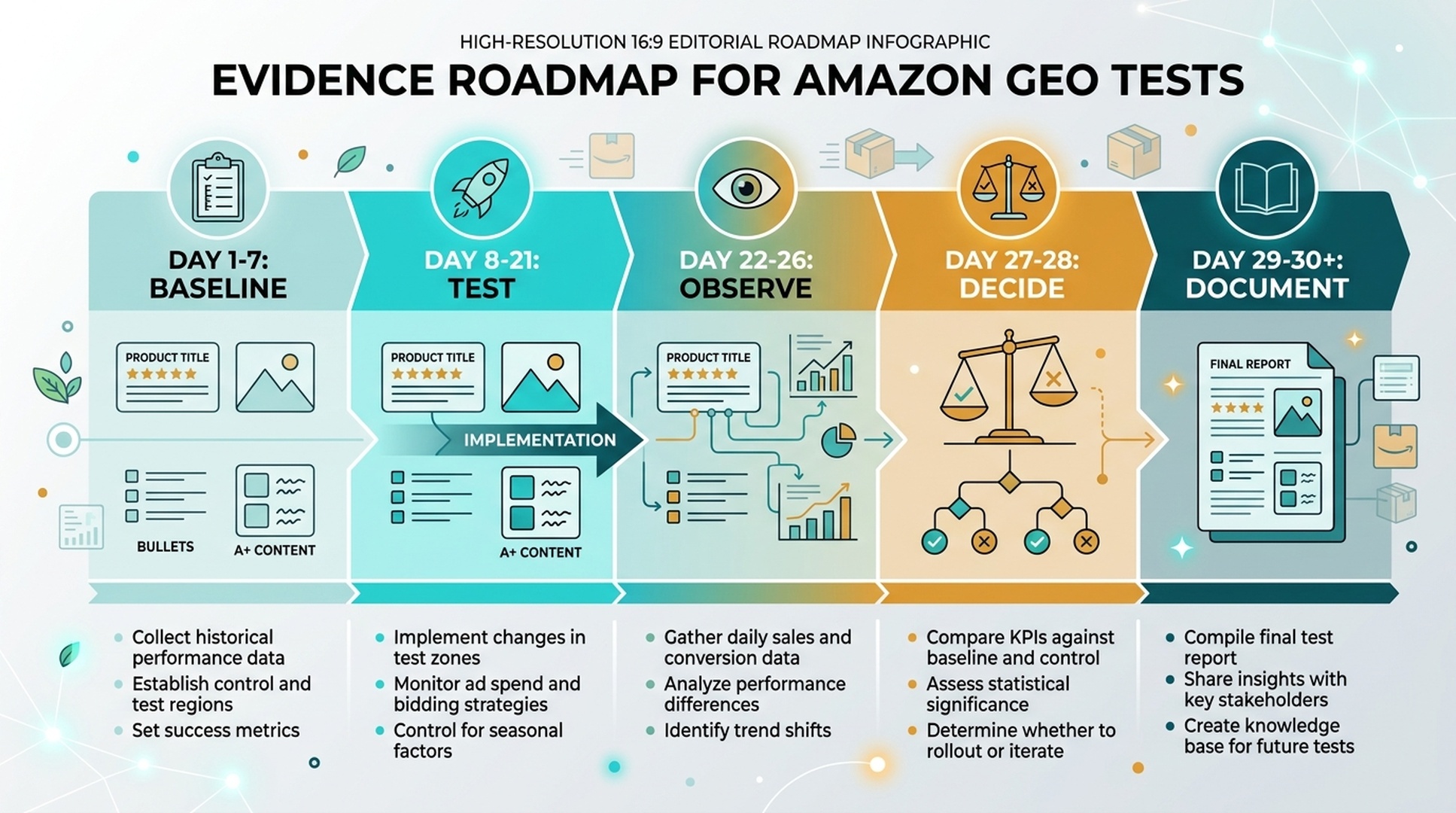
The practical workflow has six steps.
1. Build A Question Map
Start with 20-50 buyer questions for one ASIN family. Group them by discovery, comparison, objection, trust, and reorder intent. Use DataForSEO, Amazon search terms, Sponsored Products reports, reviews, Q&A, and returns.
2. Pick One Asset
Do not test everything at once. Choose the asset most likely to answer the question. If the buyer asks "Will this fit?" a title or compatibility image may be a better test than a brand story rewrite.
3. Rewrite One Variant
Variant B should change the answer, not just the wording. A weak test changes "premium" to "high quality." A stronger test adds compatibility, use case, pack size, safety, or comparison clarity.
4. Run The Experiment
Use Manage Your Experiments where eligible and available. Keep the test focused, and avoid changing other major variables at the same time if you want a cleaner read.
5. Read The Results Beyond Sales
Sales matter, but GEO learning also includes conversion rate, click-through, return reasons, Q&A patterns, review themes, variant selection, and ad query quality.
6. Ship, Refine, Or Reject
If the answer-led variant wins, ship it and document the principle. If it loses, do not assume GEO failed. The hypothesis may have been wrong, the copy may have been too dense, or the tested asset may not have been the right place for that answer.
Testing Product Titles For GEO
Titles classify the product. A GEO title test should not stuff more keywords into the title. It should test whether clearer classification helps buyers.
Weak title test | Stronger GEO title test |
|---|---|
Add more synonyms to the title | Add the most important use case or compatibility term |
Put every attribute in the title | Prioritize product type, count, variant, and primary intent |
Change word order randomly | Test whether buyer-first phrasing improves response |
Use vague modifiers | Replace "premium" with factual product details |
Example hypothesis:
If the title includes "Model 300 compatible" and "2 pack," shoppers looking for replacement filters will convert better because fit and quantity are clear before the click.
Testing Images For GEO
Images can answer questions faster than copy. They are especially useful for pack size, contents, compatibility, dimensions, before/after use, and variant differences.
Image test | Buyer question |
|---|---|
Add a scale image | How big is it? |
Add what-is-included image | What do I get? |
Add compatibility callout | Will it fit my device or use case? |
Add variant comparison | Which one should I choose? |
Add usage step image | Can I use or install it easily? |
Add pack count label | How much am I buying? |
For AI shopping and voice-led journeys, images support evidence. They make the listing easier to trust and summarize.
Testing Bullet Points For GEO
Bullets should answer high-intent questions, not repeat the same benefit five times. A bullet experiment can test which answer matters most.
Bullet role | Hypothesis example |
|---|---|
Use case | If the first bullet names bedroom use, air purifier buyers will understand fit faster. |
Specification | If the bullet states dimensions, returns for wrong size may decline. |
Safety | If the bullet clarifies fragrance-free materials, sensitive-skin buyers may convert better. |
Proof | If the bullet uses a specific performance detail, trust may improve. |
Reorder | If the bullet explains replacement timing, repeat purchase may improve. |
Keep the bullet readable. A bullet that answers one question well is usually stronger than a bullet that tries to answer six.
Testing A+ Content And Brand Story For GEO
A+ Content is ideal for more complex GEO hypotheses because it can compare, explain, and prove.
A+ test | What it can validate |
|---|---|
Variant comparison chart | Whether buyers need help choosing size, scent, formula, or pack |
How-it-works module | Whether mechanism clarity improves conversion |
Size and fit module | Whether dimensions reduce hesitation or returns |
Ingredient/material explainer | Whether safety clarity improves trust |
Routine-use module | Whether use frequency and replenishment cues support repeat purchase |
Brand proof module | Whether trust signals matter for a newer or premium product |
For Brand Story, avoid generic mission language only. Test whether brand proof, category expertise, quality standards, or product-line logic helps buyers trust the purchase.
What Metrics Should Sellers Watch?
Manage Your Experiments is designed to show which content resonates and drives sales, but sellers should build a broader GEO learning record.
Metric | Why it matters |
|---|---|
Sales | Shows commercial impact |
Conversion rate | Shows whether the answer helped buyers decide |
Click-through rate | Shows whether the asset improved initial interest |
Unit session percentage | Helps compare ASIN performance |
Return reasons | Reveals wrong-fit or expectation problems |
Q&A volume | Shows whether unanswered questions remain |
Review themes | Shows whether buyers understood the product better |
Sponsored Products search terms | Shows whether paid query quality changed |
Repeat purchase signals | Shows whether reorder clarity improved |
Do not overinterpret a single test. Use experiments as a learning system, not a one-time verdict.
Common GEO Experiment Mistakes
Mistake 1: Testing too many changes at once. If title, image, bullets, and A+ Content all change together, the result is harder to interpret.
Mistake 2: Testing wording instead of answers. GEO testing should validate whether a better answer improves behavior, not whether one adjective sounds nicer.
Mistake 3: Ignoring negative outcomes. A losing variant still teaches something about buyer priorities.
Mistake 4: Overfitting to one ASIN. A result from one product may not apply to every category, pack size, or price point.
Mistake 5: Treating GEO as separate from conversion. If AI-ready content makes the page less readable or less persuasive, it is not a good optimization.
A 30-Day Manage Your Experiments GEO Plan
Days | Work | Output |
|---|---|---|
1-3 | Pick one high-value ASIN family | Test candidate list |
4-6 | Build a buyer-question map | Question clusters |
7-8 | Choose one friction point | Test hypothesis |
9-12 | Create Variant B for title, image, bullet, or A+ Content | Experiment asset |
13-14 | Define success metrics and decision rule | Experiment canvas |
15-25 | Run or monitor the experiment | Performance data |
26-28 | Analyze sales, conversion, Q&A, returns, and review themes | Learning note |
29-30 | Ship winner or design next test | Iteration plan |
If Manage Your Experiments is not available for a specific asset or seller, use the same discipline with sequential changes and careful documentation. The test may be less controlled, but the hypothesis mindset still improves decision quality.
FAQ
What is Amazon Manage Your Experiments for GEO?
It is a workflow for using Amazon's listing A/B testing tool to validate GEO hypotheses about titles, images, bullet points, descriptions, A+ Content, and Brand Story.
Does Manage Your Experiments test Alexa recommendations?
No. It tests customer response to product detail page content. Sellers can use the results to improve listing clarity, which may support broader AI shopping and voice discovery readiness.
Which asset should I test first?
Start with the asset tied to the biggest buyer friction. If shoppers misunderstand fit, test title or images. If shoppers compare variants, test A+ Content. If shoppers ask safety questions, test bullets or Q&A-related content.
What makes a GEO experiment different from a normal listing test?
A GEO experiment starts with a buyer question and tests whether the listing answers it better. It is not just a cosmetic or keyword-density test.
How should sellers document experiment results?
Record the hypothesis, asset, variants, metric, decision rule, result, and next action. Over time, this becomes a category-specific GEO learning library.
Auspia Takeaway
Amazon Manage Your Experiments helps sellers move from listing opinions to evidence. For GEO, that evidence should answer one question: did the new version make the product easier to understand, trust, compare, or buy?
Test titles for classification. Test images for proof. Test bullets for direct answers. Test A+ Content for comparison and objections. Then document the learning and repeat.
Author: Marcus Ellery, Growth Experimenter Behind 150+ SEO Tests at Auspia. Marcus writes about experiments, benchmarks, learning loops, and evidence-led growth content.