

Quick answer for 2026
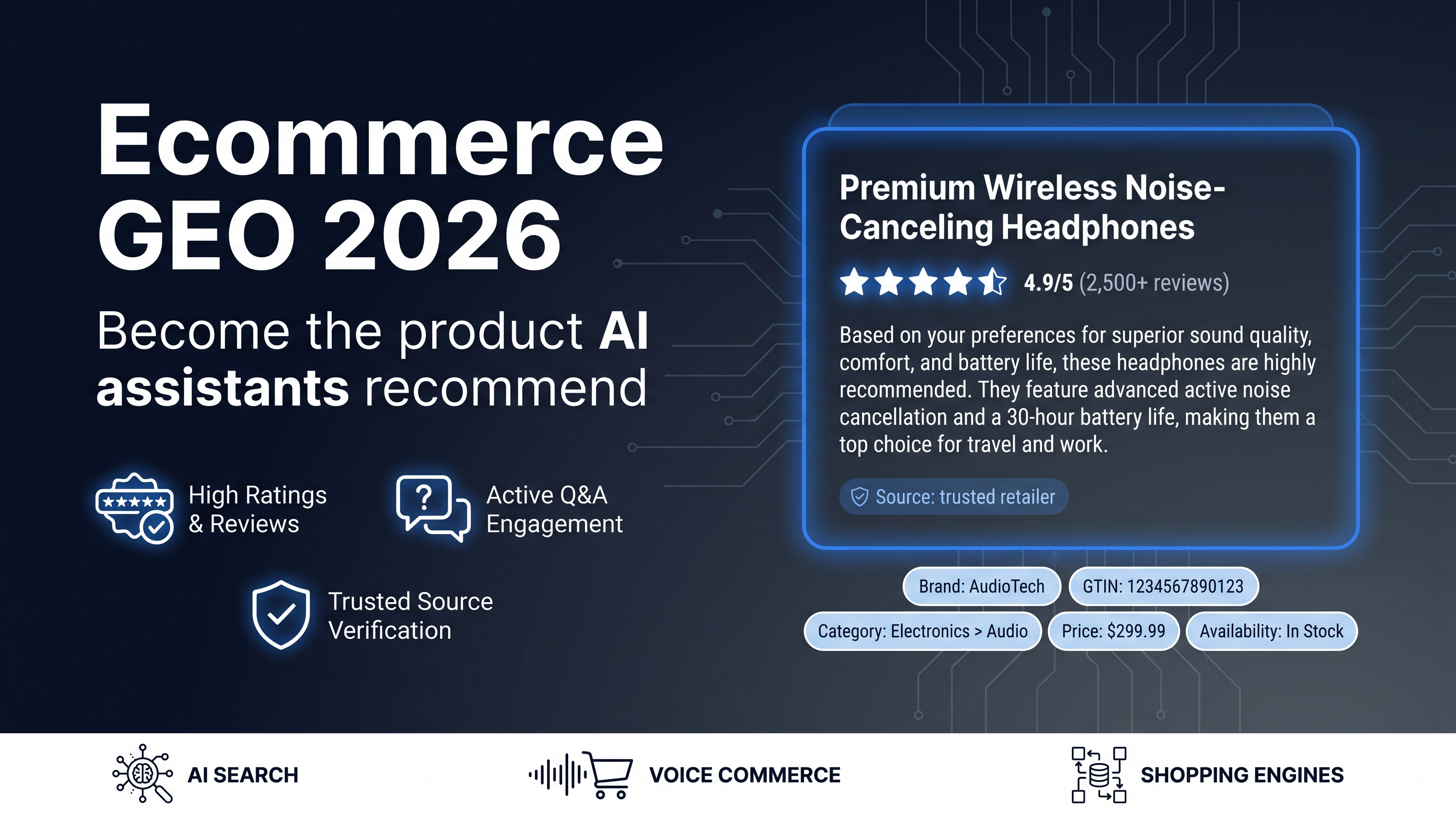
Ecommerce GEO in 2026 is the work of making your products easy for AI shopping assistants to understand, trust, compare, and recommend. The old playbook was to win a keyword position. The new playbook is to become the safest answer when someone asks ChatGPT, Google AI Mode, Amazon Alexa for Shopping or Rufus, Perplexity, Gemini, or another AI assistant: "Which product should I buy for this exact situation?"
That sounds abstract until a shopper asks a very normal question:
"I need a quiet air purifier for a baby's room, under $250, that does not blast bright light at night. Which one should I buy?"
A keyword page can rank for "best air purifier." An AI answer has to make a recommendation. To do that, it needs structured product facts, reviews that confirm the promise, third-party proof, and plain-language use cases. If those signals are missing, the assistant will usually pick a competitor with cleaner evidence.
This is why 2026 is not the year to "try GEO later." For ecommerce teams, GEO is becoming part product data cleanup, part review strategy, part content strategy, and part reputation work.
What ecommerce GEO actually means
GEO, or generative engine optimization, means shaping the information around your brand so AI answer systems can use it confidently. For ecommerce, the unit of optimization is not only a page. It is the product, the use case, the proof trail, and the comparison set.
Traditional SEO asks: can the page rank?
Ecommerce GEO asks a harder question: when an AI assistant compresses the market into three recommendations, does your product have enough clear evidence to appear?
Here is the practical difference.
Old ecommerce SEO habit | 2026 GEO replacement |
|---|---|
Repeat the target keyword in the title and bullets | Explain who the product is for, what problem it solves, and where it should not be used |
Treat product attributes as backend admin work | Treat attributes as machine-readable buying evidence |
Chase generic backlinks | Earn mentions in sources that AI systems can cite or summarize |
Hide awkward product limitations | State constraints clearly so the assistant does not have to guess |
Check only Google rank | Check AI answers, product cards, citations, and recommendation share |
Amazon describes Rufus as a generative AI shopping assistant that uses Amazon's product catalog, customer reviews, community Q&A, and information from across the web to answer shopping questions and make recommendations. OpenAI's shopping research in ChatGPT also pulls together price, availability, reviews, specs, images, and reliable sources to build buyer guides. Google says its AI Mode shopping experience combines Gemini capabilities with the Shopping Graph, which includes more than 50 billion product listings and details such as reviews, prices, colors, and availability.
The pattern is obvious. AI shopping systems want clean facts, current inventory, real user evidence, and sources that reduce recommendation risk.
The uncomfortable shift: AI is a cautious buyer, not a search crawler
A search crawler can rank a messy page if the signals are strong enough. A shopping assistant has a different problem. It has to answer a human with a recommendation that feels safe.
So think of AI as a cautious buyer with a clipboard.
It asks:
- What is this product exactly?
- Who is it best for?
- What are the hard specs?
- What do real customers complain about?
- Which sources outside the brand confirm the claim?
- Is the price, stock, return policy, and compatibility information current?
- Can I explain the recommendation in one sentence without sounding reckless?
If your product data cannot answer those questions, the model will not politely wait for your marketing team. It will move on.
This is where a lot of ecommerce teams get GEO wrong. They treat it as a new name for content marketing. It is more basic than that. Before you write a "best products" article, your PDPs, feeds, reviews, FAQs, schema, and off-site proof need to stop contradicting each other.
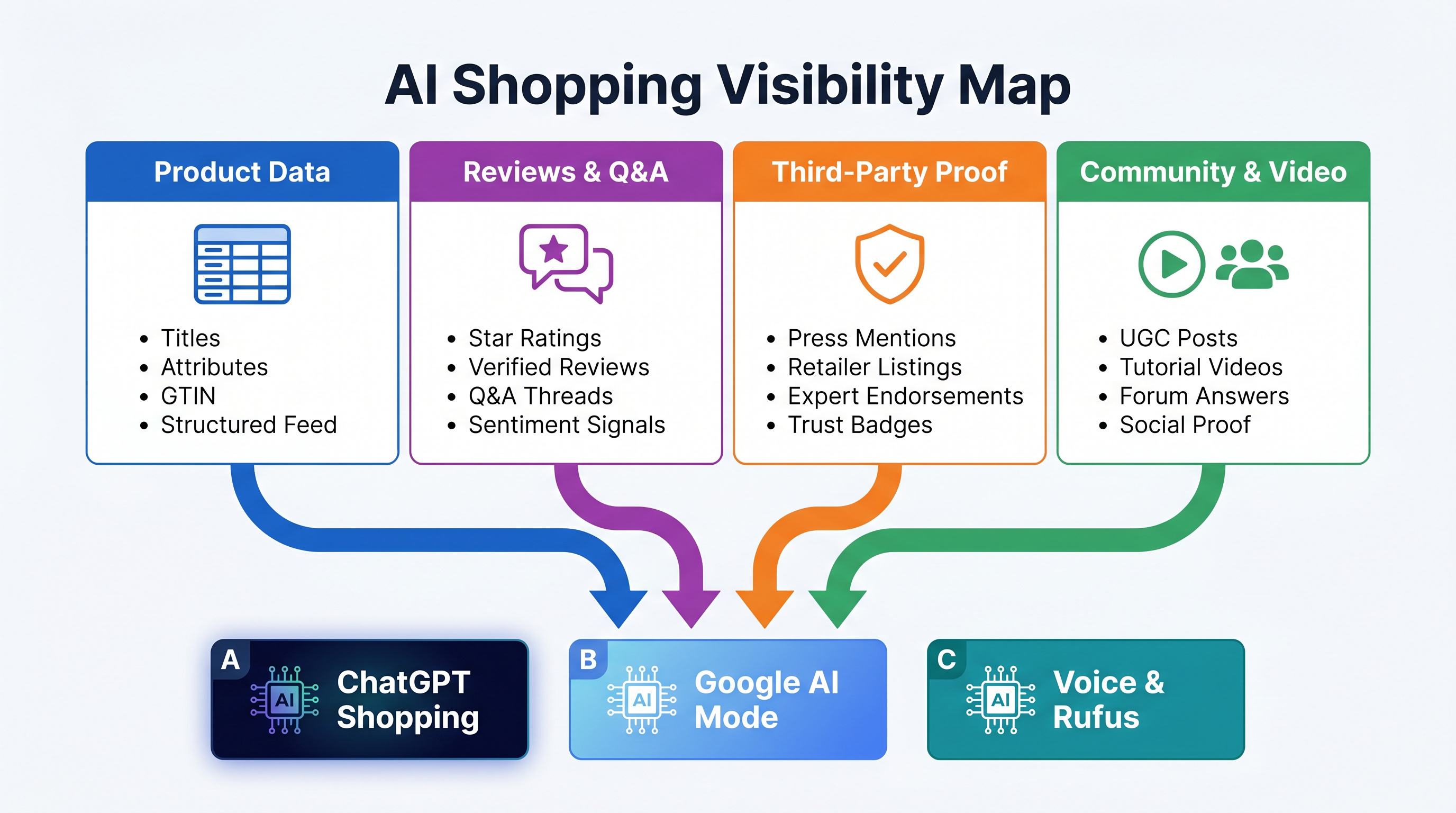
AI shopping visibility map: product facts, reviews, third-party proof, and community answers all feed the recommendation layer.
Step 1: clean the product facts AI will read first
Start with the boring fields. They are boring only to humans.
For an AI shopping system, missing attributes are missing evidence. If a shopper asks for a "machine-washable travel blanket for a long-haul flight," the assistant needs material, size, care instructions, pack weight, use case, and review sentiment. A vague product description is not enough.
For each priority SKU, clean these fields first:
Field | Why it matters for AI recommendations |
|---|---|
Product title | Helps the system identify product type, brand, and main use case |
Category and taxonomy | Prevents the product from being compared against the wrong alternatives |
GTIN, MPN, SKU, brand | Helps match the same product across retailers, reviews, and feeds |
Material, dimensions, weight, compatibility | Supports constraint-heavy buyer questions |
Price, stock, shipping, return policy | Helps AI systems avoid recommending unavailable or risky options |
Product schema and merchant feed | Makes facts easier for search and shopping systems to parse |
Do not write attributes like a brochure. Write them like evidence.
Weak: "Premium ergonomic design for all-day comfort."
Better: "Seat height adjusts from 17.5 to 21.5 inches. Recommended for desks 28 to 31 inches high. Not ideal for users above 6 ft 4 in."
That second version gives an AI assistant something it can safely use in a recommendation.
Step 2: rewrite product pages around questions, not slogans
Most product pages still talk like display ads. AI shopping queries sound like customer support tickets.
A shopper does not ask:
"high performance compact portable espresso maker"
They ask:
"What espresso maker should I buy for a small apartment if I hate loud machines and only drink one cup before work?"
Your product page should answer that kind of question directly.
Add a compact Q&A block to every important product detail page. Use questions that real buyers would ask before purchase:
- Is this quiet enough for an apartment?
- Does it work with a 16-inch laptop?
- Can it be cleaned in a dishwasher?
- Is it safe for sensitive skin?
- What type of user should not buy it?
- What is the main tradeoff compared with a cheaper option?
The last two questions matter. AI assistants do not trust pages that only praise the product. A product page that names the tradeoff often feels more useful than one that pretends there is no tradeoff.
Auspia's take: the best 2026 PDPs will read less like landing pages and more like concise buyer advice. They will still sell, but they will sell by answering the exact uncertainty that blocks the purchase.
Step 3: treat reviews and Q&A as training data
Reviews are no longer just conversion proof on the page. They are raw material for AI summaries.
If customers repeatedly say "the zipper catches," "the app setup is confusing," or "the sizing runs small," do not bury that signal. AI systems are good at summarizing patterns. One repeated negative theme can become the sentence that kills your recommendation.
Run a monthly review audit for priority SKUs:
Review pattern | What to do |
|---|---|
Repeated confusion | Add clearer setup instructions, size charts, or PDP FAQ answers |
Repeated defect language | Escalate to product or operations, then document the fix |
Repeated praise for a use case | Turn it into a use-case section and comparison point |
Repeated comparison to a competitor | Create a fair comparison page or buying guide |
Repeated missing information | Add the missing attribute to feeds, schema, PDPs, and support docs |
Do not manufacture reviews. Do not script fake community posts. That kind of shortcut is fragile, and it can hurt the brand if surfaced. The practical move is simpler: make it easy for real customers to mention the details AI systems need, then fix the problems they keep naming.
For example, a post-purchase review prompt can ask:
"Where do you use this product most, and what problem did it solve?"
That gives you more useful evidence than another generic "Great product" review.
Step 4: build off-site proof where AI systems look for confidence
Your website tells the assistant what you claim. The open web tells it whether anyone else agrees.
For 2026 ecommerce GEO, focus on four types of off-site proof.
Vertical review sites
If you sell specialist products, a niche review site can matter more than a giant media mention. A coffee gear blog, backpacking publication, skincare testing site, or home office ergonomics reviewer may give AI systems clearer evidence than a broad lifestyle roundup.
Make the reviewer's job easier. Prepare a factsheet with specs, testing notes, product photos, warranty details, common limitations, and comparison points. The goal is not to control the review. The goal is to make accurate coverage easier to write.
Retailer and marketplace listings
Keep product titles, identifiers, prices, images, and claims consistent across your own store, Amazon, Walmart, Target, Shopify feeds, Google Merchant Center, and other channels you use. If the same product appears with different materials, dimensions, or model names, AI systems may treat the evidence as unreliable.
Community answers
Reddit, specialist forums, Discord communities, and Quora-style Q&A can influence how product categories are discussed. The rule is simple: contribute like a useful person, not a coupon bot.
Look for threads with high purchase intent:
- "best X for small apartment"
- "X vs Y for beginners"
- "is X worth it?"
- "what should I avoid when buying X?"
- "alternatives to X"
A good answer gives a short conclusion, explains the buying criteria, names tradeoffs, and only mentions a product when it fits naturally. If your team cannot do that honestly, stay out of the thread.
Video and transcripts
AI systems can use titles, descriptions, captions, transcripts, and summaries. A polished video with vague narration is less useful than a simple product test with spoken facts.
For each product video, say the important facts out loud: weight, dimensions, use case, noise level, battery life, compatibility, setup time, and real limitations. Add a timestamped description. If the video compares products, state the decision criteria clearly.
Step 5: optimize for each AI shopping surface without chasing every rumor
You do not need a separate strategy for every model name. You do need to understand the data each surface can plausibly use.
Surface | What to prioritize in 2026 |
|---|---|
Amazon Alexa for Shopping / Rufus | Complete product attributes, Amazon reviews, Q&A, A+ content, inventory, price, PDP clarity |
ChatGPT shopping research | Clean public product pages, reliable retailer pages, specs, reviews, images, and sources that can be cited |
Google AI Mode shopping | Google Merchant Center data, product schema, Shopping Graph consistency, images, reviews, stock, price |
Perplexity-style answer engines | Citable third-party sources, expert reviews, community evidence, clear comparison content |
Gemini and other assistants | Brand entity consistency, crawlable pages, structured data, current product facts |
This is where many teams waste time. They ask, "How do we trick the model?" Wrong question. Ask, "What would make our product the least risky recommendation for this buyer intent?"
If you answer that well, you usually improve several AI surfaces at once.
A 30-day ecommerce GEO sprint for 2026
Start small. Pick 10 SKUs that matter to revenue or margin. Do not try to fix the whole catalog in one month.
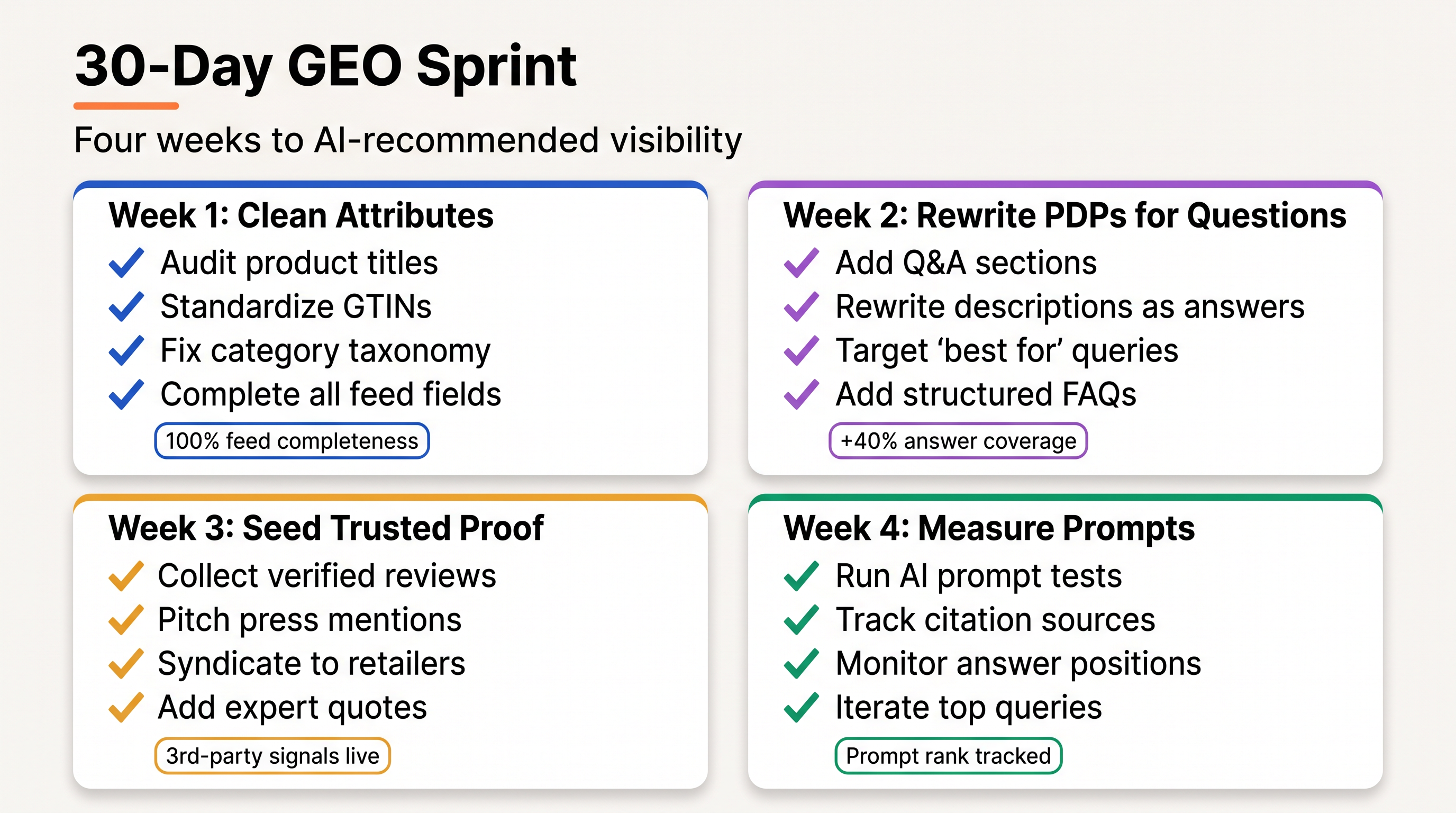
30-day GEO sprint: use one month to clean data, answer buyer questions, add proof, and measure AI visibility.
Week 1: make product data boringly complete
- Audit titles, categories, GTINs, model names, and variant names.
- Fill all relevant attributes, including dimensions, materials, compatibility, care, warranty, and inventory.
- Add or fix product schema on owned pages.
- Check that retailer and marketplace listings use the same core facts.
Target: 100% completion for the fields that affect the top buyer questions.
Week 2: turn PDPs into answer pages
- Add a short "best for / not best for" section.
- Add 6 to 10 real buyer questions.
- Rewrite feature bullets as problem-solution answers.
- Add comparison language for common alternatives.
- State one honest limitation.
Target: every priority PDP should answer the buyer's top objections without making them open another tab.
Week 3: seed trusted proof
- Build a press and reviewer factsheet.
- Pitch 5 to 10 niche reviewers or category experts.
- Identify 20 community threads where your team can answer without spamming.
- Produce one short test video with a transcript.
- Ask customers for use-case-specific reviews after purchase.
Target: at least three credible off-site mentions or conversations started for the product set.
Week 4: measure AI visibility
Create a prompt set for each SKU. Use buyer language, not internal keywords.
Examples:
- "Best carry-on backpack for a rainy business trip under $180"
- "Quiet massage gun for apartment use"
- "Non-stick pan that is easy for beginners and not too heavy"
- "Dog food for sensitive stomach with simple ingredients"
Track:
Metric | What it tells you |
|---|---|
Mention rate | Whether the brand appears at all |
Recommendation position | Whether the product is a top suggestion or an afterthought |
Citation source | Which pages or third-party sources support the answer |
Reason given | What the assistant believes your product is good for |
Missing competitor gap | Which competitor gets picked and why |
If the assistant recommends a competitor because of better reviews, clearer specs, or stronger third-party proof, do not argue with the answer. Treat it as a research note.
You can also use Auspia's AI Search Visibility Checker to turn prompt checks into a repeatable visibility workflow instead of doing one-off manual searches.
Common mistakes that make ecommerce GEO fail
Mistake 1: stuffing AI keywords into product copy
Adding "AI recommended" to a product page does not make it recommended. It may even make the page look less trustworthy. Use the space for facts, constraints, comparisons, and evidence.
Mistake 2: ignoring product identifiers
If your GTINs, SKUs, model names, and variants are messy, the same product may look like five different products across the web. That weakens the evidence trail.
Mistake 3: pretending reviews are only a conversion asset
Reviews now affect how AI systems summarize your product. If negative patterns keep appearing, answer them, fix them, or explain the constraint clearly.
Mistake 4: chasing big media before niche trust
A giant mention is nice. A serious niche review that explains why your product fits a specific buyer may be more useful for AI recommendations.
Mistake 5: measuring only traffic
AI shopping visibility can show up before clicks rise. Track mentions, citations, product cards, comparison language, and recommendation reasons. Traffic is only one downstream signal.
The 2026 GEO checklist for ecommerce teams
Use this before launching a new product or refreshing an existing one.
- Product title states brand, product type, key variant, and main use case.
- Attributes are complete for material, size, compatibility, care, warranty, price, stock, and shipping.
- Product schema is valid on owned pages.
- Merchant feeds match the PDP and marketplace listings.
- PDP includes "best for," "not best for," FAQs, comparisons, and limitations.
- Review prompts ask for use case, problem solved, and buyer context.
- A+ content or equivalent page sections answer support questions directly.
- At least one credible third-party source can confirm the product's main claim.
- Video captions and descriptions include spoken specs and test notes.
- Monthly prompt tracking checks AI answers for mentions, position, citations, and reasons.
FAQ
Is ecommerce GEO the same as SEO?
No. SEO is still important because AI systems often rely on crawlable pages and search infrastructure. But ecommerce GEO goes further. It optimizes the product's evidence trail so AI assistants can compare, cite, and recommend it in conversational answers.
Which products should we optimize first?
Start with products that already have revenue, margin, or strong review potential. GEO work is easier when the product has real customer evidence. Avoid starting with a weak SKU that customers already dislike unless the product team is ready to fix the underlying issue.
Do we need a blog for ecommerce GEO?
A blog helps when it answers comparison, use-case, and buying-guide questions that product pages cannot cover cleanly. But do not use blog content to compensate for messy product data. Fix the PDP and feed first.
Does Reddit matter for AI shopping recommendations?
It can, especially for categories where buyers discuss real-world usage and tradeoffs. The point is not to spam Reddit with links. The point is to understand buyer language, answer useful questions, and earn natural mentions when the product truly fits.
How fast can ecommerce GEO produce results?
Data cleanup and PDP rewrites can improve answer quality quickly, but third-party proof and review patterns take longer. A 30-day sprint can show early visibility changes. A serious GEO program usually needs 8 to 12 weeks of repeated measurement before the pattern is clear.
Final takeaway
In 2026, ecommerce teams should stop thinking of AI shopping as a future channel. It is already part of how buyers research, compare, and narrow choices.
The brands that win will not be the ones shouting the loudest. They will be the ones with cleaner facts, clearer use cases, better review evidence, and enough trusted proof for an AI assistant to say, "This is the safest recommendation for that buyer."
Author: Adrian Cole, Analyst of 1,000+ AI Search Results at Auspia. Adrian writes about how brands appear in ChatGPT, Perplexity, Gemini, Google AI Overviews, and other answer surfaces.