Executive summary
AI agents will not make SEO effortless. They make the slow parts visible, repeatable, and cheaper to rerun.
The useful shift is not "AI writes pages." The useful shift is that an SEO team can turn crawling, keyword grouping, page diagnosis, internal-link checks, schema review, content briefs, and reporting into a repeatable operating system. A human still decides the market, the offer, the evidence, and the quality bar. The agents handle the inspection work that used to disappear into spreadsheets and long consultant calls.
For growth teams, the question is simple: can you shorten the loop from "we think something is wrong" to "we know what to fix next"? That loop is where AI SEO agents are worth building.
Why the old SEO workflow breaks under pressure
Most SEO programs still run like a manual control room.
A marketer checks Google Search Console. Someone exports keywords. A freelancer audits titles. A developer looks at crawl errors when there is time. The content team writes a few pages. Two weeks later, everyone asks whether the work moved anything.
That workflow can still produce results. It just does not scale well when the site has hundreds of pages, multiple markets, several languages, and a backlog of technical issues.
The weak point is not effort. It is latency.
Old workflow | What goes wrong | Agent-assisted workflow |
|---|---|---|
Manual keyword research | Too many queries are grouped by instinct | Agents cluster queries by intent, modifier, and page type |
One-off technical audits | Issues return after each release | Agents rerun crawl and rendering checks on a schedule |
Content briefs written from memory | Pages miss SERP expectations | Agents compare top results, snippets, FAQs, schema, and gaps |
Reports built by hand | Teams debate formatting instead of priorities | Agents produce the same scorecard every cycle |
SEO now has more moving parts than a single person can watch closely: search intent, crawlability, page speed, schema, entity clarity, AI answer extraction, internal links, multilingual routing, and content freshness. If the workflow depends on one expert remembering everything, the system eventually drops details.
What an AI SEO agent should actually do
A useful SEO agent is not a chatbot with a keyword prompt. It is a workflow with inputs, rules, checks, and outputs.
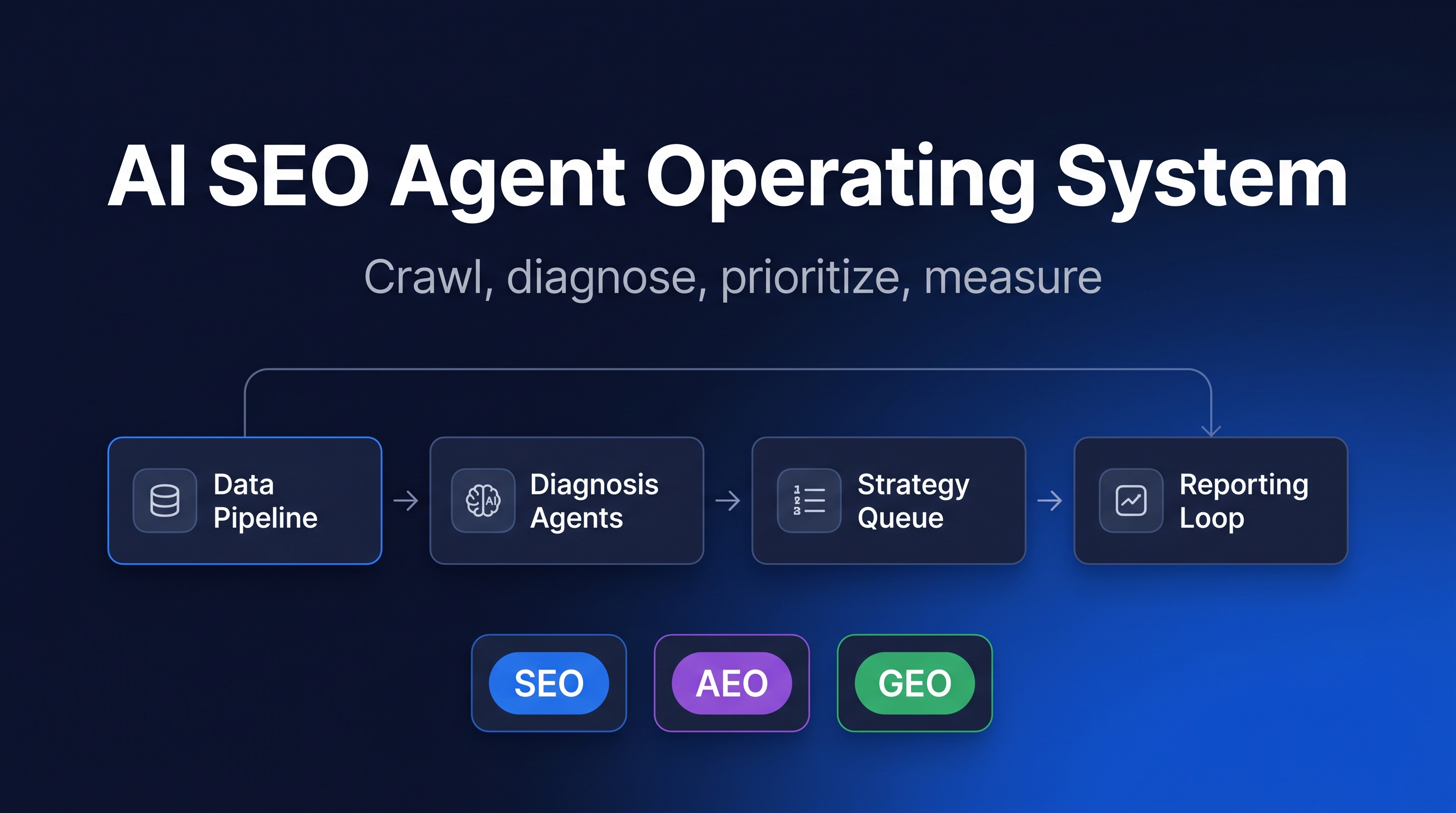
Think of it as four layers.
- Data collection: crawl pages, read metadata, inspect headings, parse schema, check robots.txt and sitemaps, collect page speed signals, and import performance data from tools such as Google Search Console.
- Diagnosis: turn raw observations into issues with severity, confidence, and affected URLs.
- Strategy: translate issues into actions, owners, and expected impact.
- Reporting: produce a report that a marketer, founder, or developer can act on without another meeting.
The agent does not need to make every decision. In fact, it should not. The best setup is more boring: agents gather evidence, apply rules, draft recommendations, and expose tradeoffs. A human approves the plan before pages are changed or published.
That boundary matters. A site can recover from a slow audit. It may not recover quickly from thousands of low-quality generated pages, broken canonical tags, or auto-published content that invents claims.
A practical SEO agent architecture
Here is a clean architecture for a small or mid-sized growth team.
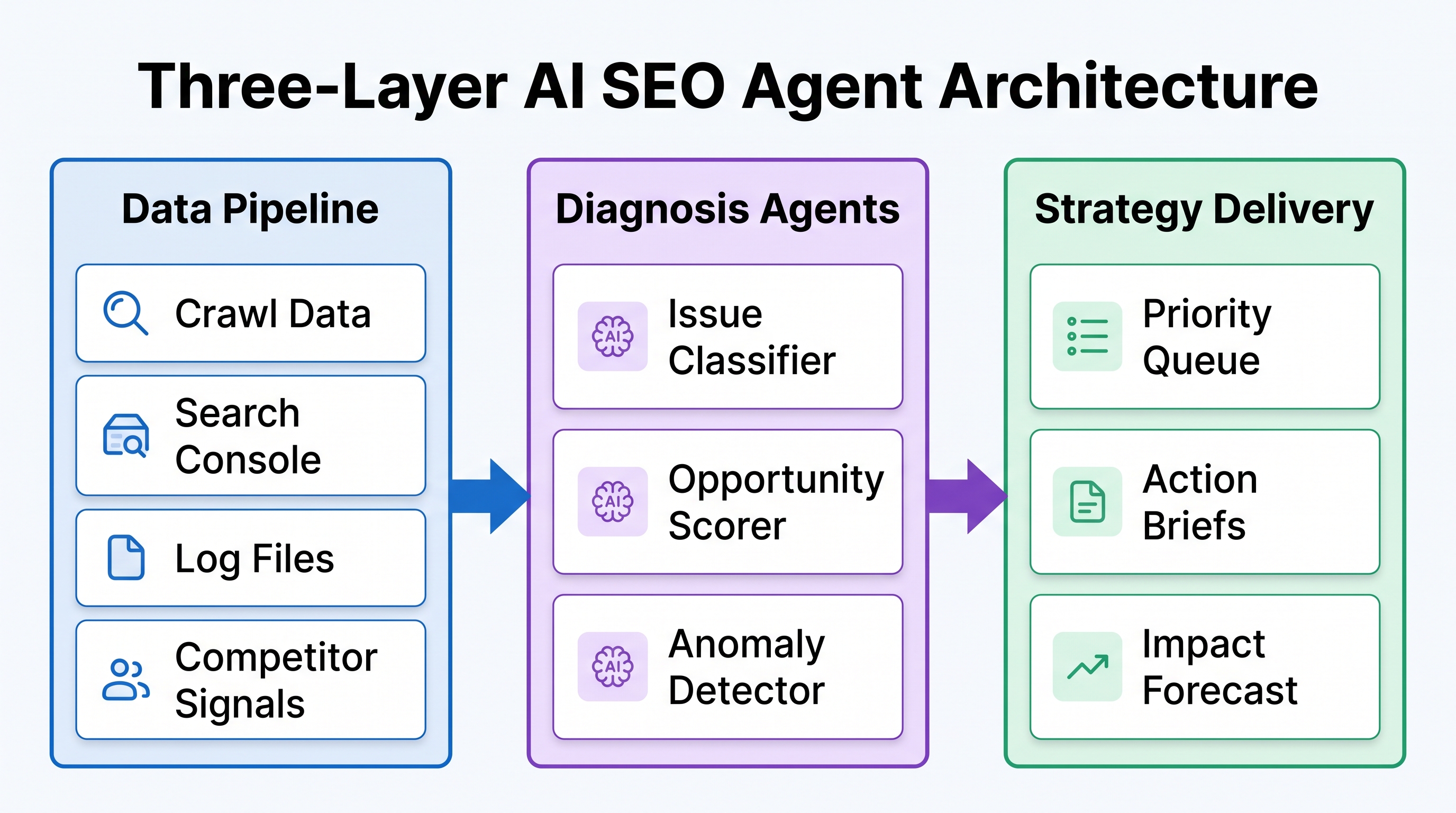
Layer 1: the data pipeline
The data pipeline should collect facts without trying to interpret them too early.
Core inputs include:
- Page metadata: title, meta description, canonical, robots directives, hreflang, Open Graph, and Twitter card tags.
- Page structure: H1-H6 hierarchy, internal links, external links, image alt text, schema markup, and content sections.
- Crawl controls: robots.txt, sitemap.xml, noindex tags, redirects, status codes, and blocked resources.
- Performance signals: TTFB, LCP, CLS, INP, JavaScript weight, image size, and mobile rendering issues.
- Search signals: impressions, clicks, average position, query-page matches, and pages with declining traffic.
- SERP context: result types, competing page formats, People Also Ask questions, featured snippets, AI Overviews where available, and common title patterns.
Keep this layer modular. If a team later swaps one SERP provider for another, the diagnosis logic should not break.
Layer 2: the diagnosis agents
Diagnosis agents should be narrow. Broad agents sound clever, but narrow agents are easier to test.
A good starting set:
Agent | Job | Output |
|---|---|---|
Technical SEO inspector | Finds crawl, indexation, rendering, speed, and schema problems | Issue list with affected URLs and severity |
Content intent reviewer | Checks whether pages match the search intent and SERP format | Page-level content gap notes |
Internal-link mapper | Finds orphan pages, weak hubs, and anchor text problems | Link opportunities and risk flags |
AI answer readiness reviewer | Checks whether content is extractable for answer engines | Summary gaps, entity gaps, FAQ opportunities |
Prioritization agent | Scores fixes by impact, effort, risk, and confidence | Action queue for the next sprint |
Notice the sequencing. Diagnosis comes before strategy. If the agent jumps straight to advice, it will often recommend generic fixes: write more content, improve page speed, add schema. Those may be true, but they are not decisions.
Layer 3: strategy and delivery
The strategy layer turns diagnosis into a plan.
A strong output should include:
- What to fix first.
- Why it matters.
- Which URLs are affected.
- Who owns the fix.
- What evidence supports the recommendation.
- What metric should change if the fix worked.
- When to rerun the check.
This is where most SEO automation tools become useful or useless. A 70-page PDF full of warnings is not a strategy. A ranked backlog with owners and acceptance criteria is.
How to run the workflow in a real team
Start small. Pick one site section, not the whole domain.
A simple 7-day pilot looks like this:
Day | Work | Human decision |
|---|---|---|
1 | Crawl 20-50 important URLs and import Search Console data | Choose the page set and business goal |
2 | Run technical and content diagnosis agents | Remove false positives |
3 | Build a query-to-page map | Decide which pages deserve protection |
4 | Generate briefs for missing or underperforming pages | Approve angle, claims, and examples |
5 | Create a fix backlog for titles, internal links, schema, and content sections | Assign owners |
6 | Implement the safest fixes first | Review before deploy |
7 | Produce a baseline report and schedule the next crawl | Define success metrics |
The safest early wins are usually boring: missing titles, duplicate descriptions, weak H1s, unlinked important pages, outdated internal anchors, missing FAQ sections, schema errors, oversized images, and pages that answer the wrong intent.
The risky work comes later: programmatic page generation, automated publishing, large-scale rewrites, and aggressive internal-link changes. Those require stronger review.
The AI search angle: why GEO and AEO belong in the same system
Search is no longer only a list of blue links. Users now ask Google AI Overviews, ChatGPT, Perplexity, Gemini, and other answer systems for direct recommendations. That does not make SEO obsolete. It means the page has to work for both crawlers and answer engines.
A page that is easy to rank is not always easy to cite. Answer systems prefer content that states facts clearly, names entities consistently, includes evidence, and gives extractable summaries.
Auspia's view is that SEO, GEO, and AEO should share one content operations loop:
- SEO checks whether the page can be crawled, indexed, ranked, and matched to search intent.
- AEO checks whether the page provides direct answers, definitions, comparisons, and useful FAQ blocks.
- GEO checks whether AI systems can understand the brand, quote the page, and use it as a reliable source.
This is why a good SEO agent should not stop at titles and keywords. It should also flag unclear brand descriptions, unsupported claims, missing author or evidence context, thin comparison sections, and pages that hide the answer too far down.
Teams can use the AI Search Visibility Checker to test how their brand appears in AI answer surfaces, then feed those findings back into the content backlog.
What most teams get wrong
The most common mistake is giving the agent too much power too early.
AI can generate a lot of pages. That is exactly why the workflow needs guardrails.
Set these rules before running any serious automation:
- Never auto-publish pages without review.
- Never rewrite already ranking pages without saving the old version and reason for the change.
- Never generate location or service pages unless the business can actually serve those locations or services.
- Never invent customer results, pricing, certifications, partnerships, or local proof.
- Never treat traffic estimates as revenue forecasts.
- Never optimize only for AI systems and forget human buyers.
There is also a softer mistake: building an impressive demo that nobody in the team can operate. A good agent system should be explainable. If the SEO lead cannot understand why an issue was flagged, the system is not ready.
A useful scorecard for AI SEO agents
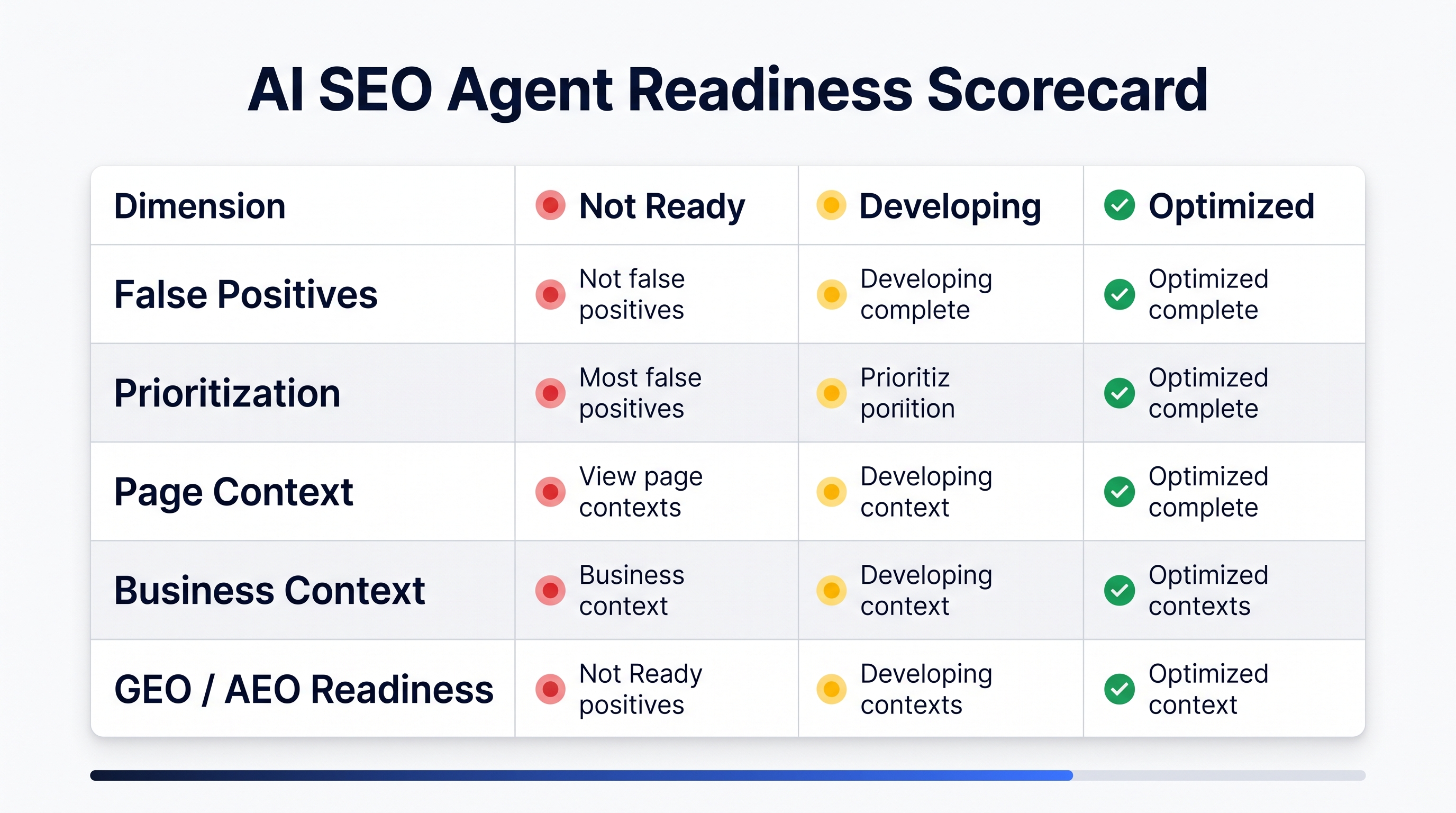
Before trusting an agent workflow, test it against a few known pages.
Test | Good sign | Warning sign |
|---|---|---|
False positives | It flags real issues and explains the evidence | It marks every page as broken |
Prioritization | It separates urgent fixes from nice-to-have changes | It treats all recommendations equally |
Page context | It knows whether a page is a landing page, blog post, category page, or docs page | It gives the same advice to every URL |
Business context | It protects high-value pages and revenue pages | It recommends risky edits to pages that already perform |
GEO/AEO readiness | It identifies missing facts, unclear entities, and weak answer blocks | It only says "add FAQ" |
Reporting | A non-SEO stakeholder can understand the next action | The report is long but not actionable |
If the agent cannot pass this scorecard, keep it in assistant mode. Do not let it touch production workflows.
Auspia takeaway
AI SEO agents are best understood as an operating layer, not a magic ranking machine.
They help teams see the site more often, diagnose issues with less manual effort, and convert scattered SEO work into a recurring system. The competitive advantage is not that one team can ask AI to write more articles. Everyone can do that. The advantage is that one team can run a tighter loop: crawl, diagnose, prioritize, fix, measure, repeat.
For most companies, that loop should start with three assets:
- A clean technical audit that surfaces crawl, indexation, schema, and performance issues.
- A query-to-page map that shows which pages own which intents.
- A content improvement backlog that covers SEO, AEO, and GEO readiness together.
If you want a quick starting point, run your site through Auspia's Website SEO Score Checker, then use the results to decide which agent workflow should be built first.
FAQ
Can AI agents rank a new website in 24 hours?
Sometimes a new or low-competition query can move quickly, especially if the site already has authority or the query is local and underserved. Treat 24-hour ranking stories as edge cases, not a planning assumption. A better goal is to shorten diagnosis and implementation cycles.
Should AI write all SEO pages?
No. AI can draft briefs, outlines, FAQs, comparisons, and first-pass copy. Humans should approve positioning, claims, examples, evidence, and final quality. This is especially important for service pages, local pages, medical, financial, legal, or high-stakes content.
Which SEO tasks are safest to automate first?
Start with audits, metadata checks, internal-link suggestions, schema validation, page-speed checks, content gap summaries, and reporting. Delay auto-publishing, bulk rewrites, and programmatic page creation until the review process is reliable.
How does this connect to GEO?
GEO depends on clear, citable, well-structured pages. The same agent that checks SEO structure can also review whether a page has a concise answer, clear entity facts, evidence, author context, and comparison sections that AI answer systems can extract.
What is the best metric for an AI SEO agent?
Do not judge it only by the number of pages it creates. Better metrics are time to diagnose, percentage of recommendations accepted by humans, implementation rate, reduced technical errors, improved query-page match, and visibility changes after fixes are deployed.