Concise summary
Hermes Agent is useful for automated SEO when you treat it as an operating layer, not a content vending machine. Give it bounded jobs: collect crawl signals, inspect technical issues, group keywords, draft refresh briefs, propose internal links, and prepare publishing checklists. Keep human approval for strategy, facts, claims, examples, and final publishing.
The practical workflow is simple:
- Define the SEO job in plain language.
- Connect the inputs Hermes needs: sitemap, crawl exports, Search Console data, analytics, keyword lists, page templates, brand rules, and competitors.
- Ask the agent to produce structured outputs, not just prose.
- Review every recommendation that affects public content or site architecture.
- Feed results back into the agent memory so the next run improves.
That last point is the real reason Hermes Agent is interesting for SEO. Search work is repetitive, but it is not identical every time. A persistent agent with memory can learn your site rules, preferred formats, weak spots, and approval standards across sessions.
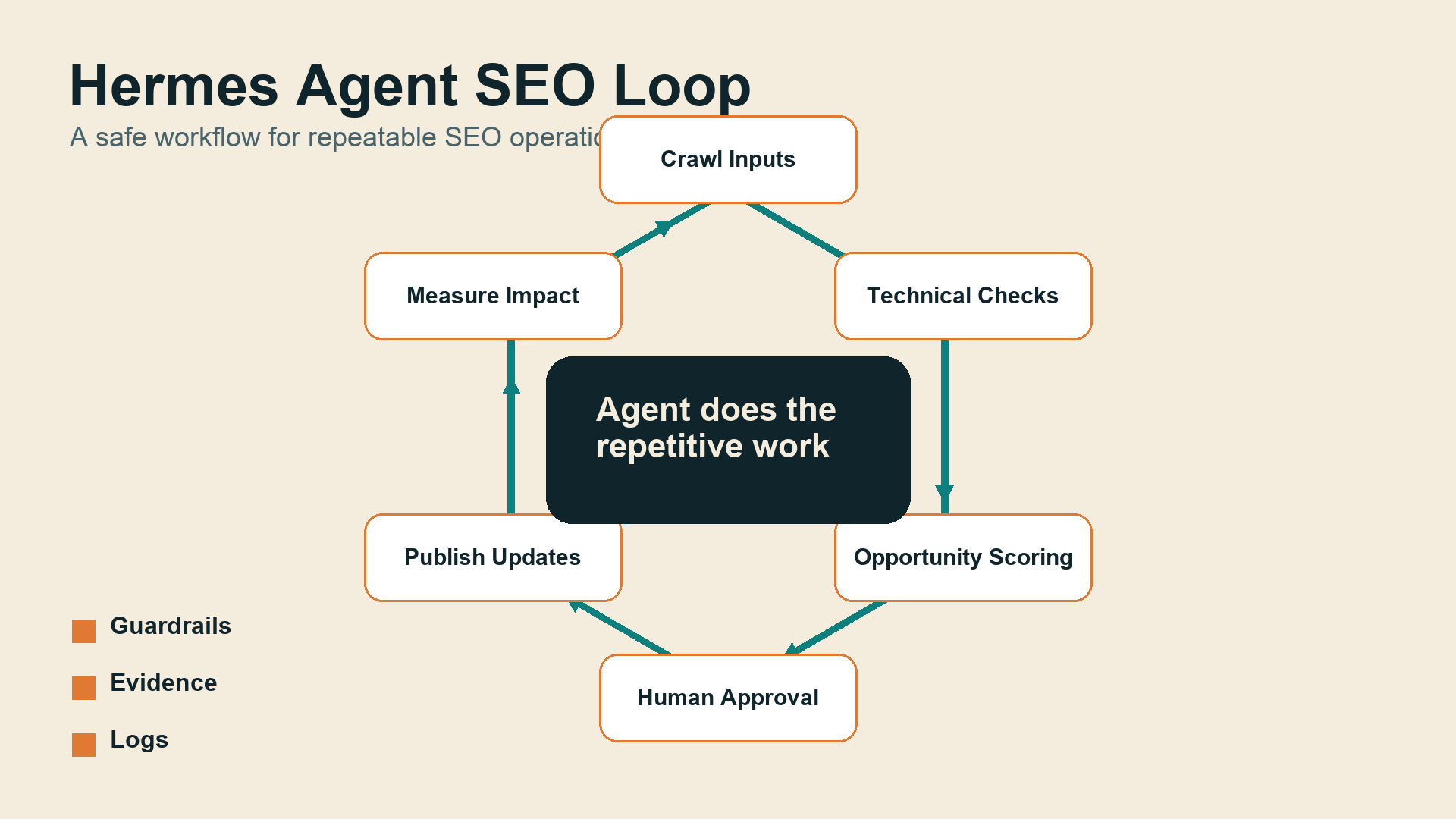
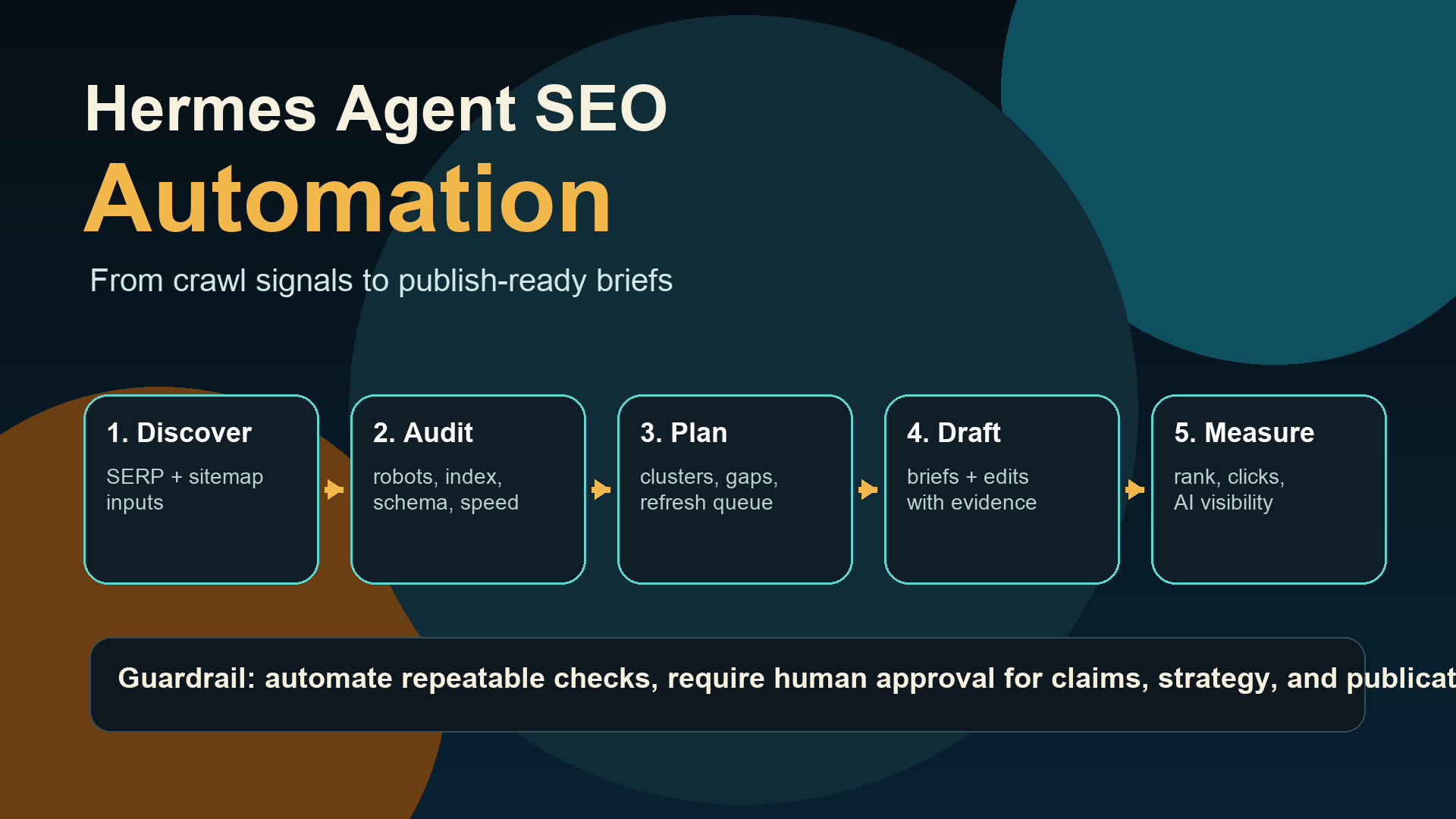
The Hermes Agent SEO loop: collect inputs, check issues, score opportunities, route through human approval, publish updates, and measure impact.
What Hermes Agent is
Hermes Agent is an open-source, persistent AI agent from Nous Research. Its documentation describes it as a self-improving agent with a built-in learning loop that can create reusable skills from experience. Public listings also describe Hermes as an agent that can run with memory across sessions and use tools such as web search, browser automation, and vision.
For SEO teams, that changes the shape of automation. A chatbot is good for a one-off prompt. An agent is better for a repeatable workflow that has state, files, checklists, decisions, and follow-up tasks.
A useful Hermes SEO setup usually has four layers:
Layer | What it does | Example SEO use |
|---|---|---|
Main agent | Prototypes the workflow | "Audit these 40 URLs and find refresh candidates." |
Specialist agent | Handles one repeatable function | Technical SEO checker, content brief builder, internal link mapper |
Orchestrator | Routes work between specialists | Sends crawl issues to the technical agent and content gaps to the editorial agent |
Scheduled task list | Runs jobs on a cadence | Weekly indexability audit, monthly content decay report, daily AI visibility check |
You do not need all four layers on day one. Start with one agent and one workflow. If the output is useful twice, make it more structured. If it is useful five times, consider turning it into a specialist.
Why automated SEO needs guardrails
Google has been clear that using AI or automation is not automatically against Search guidelines. The issue is intent and quality. Automation becomes risky when it is used to generate many pages mainly to manipulate rankings, especially if the pages add little value for users.
That matters because agentic SEO can scale both good and bad habits. If your brief is shallow, Hermes can produce shallow briefs faster. If your product pages have missing facts, it can spread those gaps into dozens of recommendations. If your internal linking logic is sloppy, it can make the site look more connected while sending users down the wrong paths.
So the rule is not "never automate." The rule is: automate the repeatable work, review the judgment work.
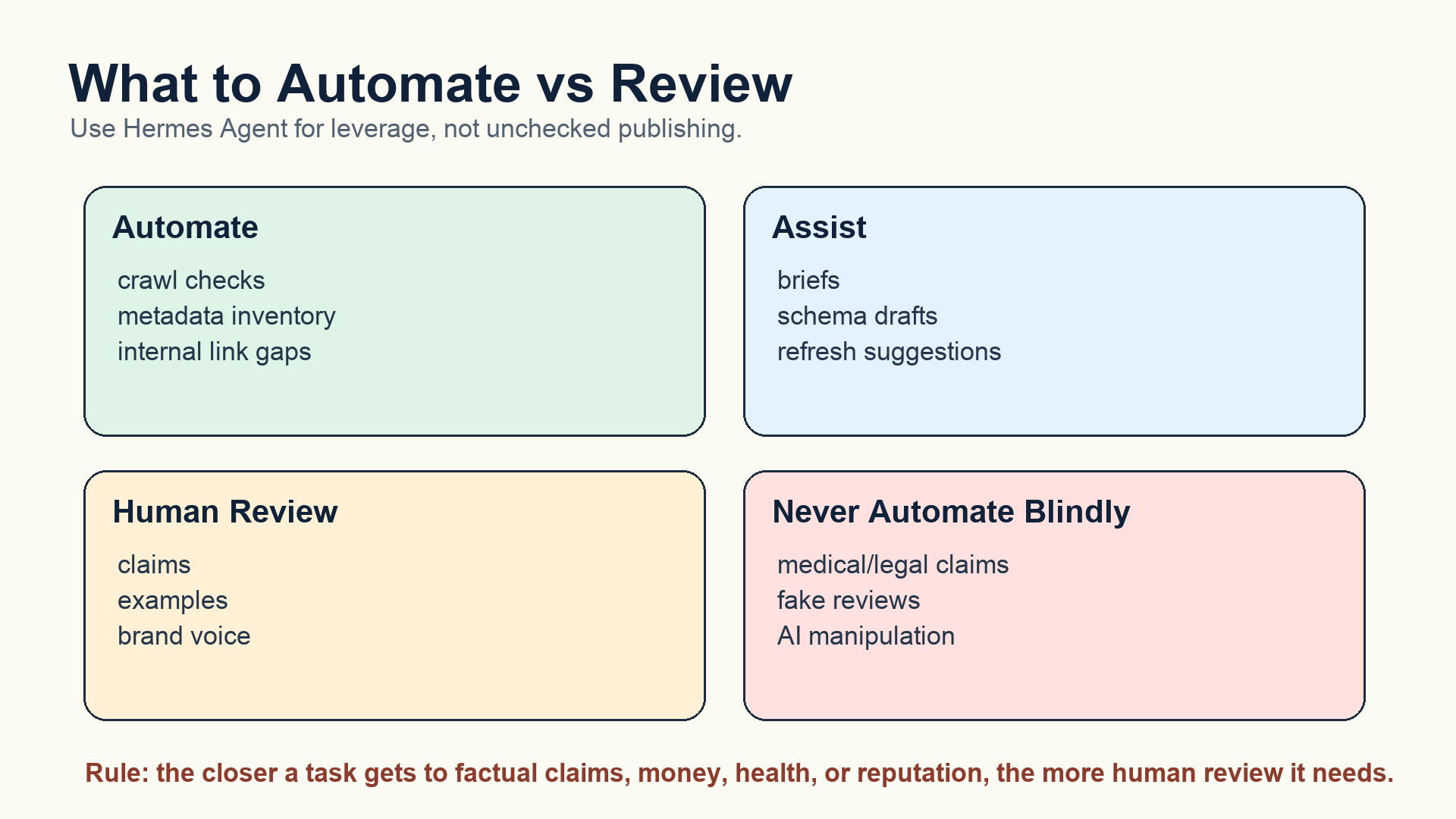
Use Hermes Agent for leverage. Do not let it publish legal, medical, reputation-sensitive, or unsupported claims without review.
Step 1: choose one narrow SEO workflow
Do not begin with "run SEO for my website." That prompt is too large. Start with a workflow that has a clear input, a clear output, and an obvious review step.
Good first workflows:
Workflow | Input | Output |
|---|---|---|
Content refresh queue | Existing URLs, traffic data, ranking terms | Prioritized list of pages to update |
Technical issue triage | Crawl export, sitemap, robots.txt | Issue table with severity and fix owner |
Internal link gap finder | URL list, target clusters, anchor rules | Suggested links with source URL, target URL, anchor, reason |
SEO brief builder | Keyword set, SERP notes, existing page inventory | Brief with intent, outline, examples, FAQ, schema notes |
AI search readiness audit | Brand pages, entity pages, robots/LLM crawler settings | Checklist of citation-readiness gaps |
Auspia's take: the best first Hermes workflow is usually a refresh queue. It is safe, measurable, and close to revenue. You can compare recommendations against real pages before changing anything.
If you need a lightweight external check before building the agent workflow, run a site scan with Auspia's Website SEO Score Checker and use the output as an input document for Hermes.
Step 2: prepare the inputs Hermes should read
Agent output quality depends on the evidence you give it. For automated SEO, prepare a small "SEO control room" folder before asking Hermes to work.
Suggested folder structure:
/seo-control-room
  /inputs
    sitemap-urls.csv
    search-console-pages.csv
    crawl-export.csv
    keyword-clusters.csv
    competitors.md
    brand-guidelines.md
    content-rules.md
  /outputs
    refresh-queue.md
    technical-issues.md
    internal-link-suggestions.md
    briefs/
  /logs
    decisions.md
    rejected-suggestions.md
The most important file is content-rules.md. It should tell Hermes what not to do. For example:
Do not invent customer results.
Do not cite statistics without a source URL.
Do not recommend deleting pages without a reason and replacement plan.
Do not create medical, legal, or financial advice pages.
Every brief must include search intent, user problem, source evidence, internal links, and a human review checklist.
That file will save you more time than a clever prompt.
Step 3: write prompts that ask for decisions, not paragraphs
Hermes can write prose, but SEO teams should ask for decision-ready artifacts. Tables, ranked lists, checklists, and diffs are easier to review than long essays.
For a content refresh workflow, use a prompt like this:
You are the SEO refresh agent for this site.

Inputs:
- /inputs/sitemap-urls.csv
- /inputs/search-console-pages.csv
- /inputs/keyword-clusters.csv
- /inputs/content-rules.md

Task:
Find 20 pages that should be refreshed first.

For each page, return:
- URL
- likely search intent
- current weakness
- refresh angle
- recommended internal links
- risk level
- evidence from the input files
- human approval notes

Do not draft the article yet. Save the output to /outputs/refresh-queue.md.
Notice the constraint: "Do not draft the article yet." This keeps the agent focused on diagnosis before production.
For a technical audit, ask for severity and owner:
Review /inputs/crawl-export.csv and /inputs/sitemap-urls.csv.

Create a technical SEO issue table with:
- issue type
- affected URL count
- examples
- severity: high, medium, low
- likely impact
- recommended fix
- suggested owner: engineering, content, SEO, design

Flag anything that could block indexing.
Step 4: use browser automation carefully
Hermes Agent documentation describes multiple browser automation options, including cloud browser setups and local browser modes. For SEO, browser automation is useful for checking what crawlers and users actually see.
Use it for:
- verifying rendered titles, headings, canonical tags, and schema;
- checking whether important content loads only after user interaction;
- testing template changes across a sample of pages;
- capturing screenshots for QA;
- confirming that robots.txt, meta robots, and canonical behavior match the intended rules.
Be careful with logged-in sessions, admin panels, checkout flows, and anything that can create, delete, or publish content. If Hermes has browser access to your CMS, use a staging environment first. Give it the smallest permission set that can complete the job.
Step 5: build a human approval gate
A Hermes SEO workflow should stop before public changes. The approval gate can be simple at first: the agent writes a Markdown file, a human reviews it, and only then does someone update the CMS.
Use this checklist before publishing agent-assisted content:
Review item | Question |
|---|---|
Search intent | Does the page answer the query better than before? |
Evidence | Are claims sourced or based on first-party knowledge? |
Original value | Does the page add examples, product knowledge, data, or experience? |
Internal links | Do links help users move to the next useful page? |
Technical tags | Are title, description, canonical, schema, and index rules correct? |
Brand voice | Does the page sound like your team, not a generic SEO article? |
Risk | Could this claim create legal, medical, financial, or reputational exposure? |
If a suggestion fails the checklist, log the reason in /logs/rejected-suggestions.md. That sounds bureaucratic, but it helps the agent learn what your team rejects.
Step 6: connect Hermes to SEO and AI-search measurement
Classic SEO measurement still matters: impressions, clicks, rankings, index coverage, crawl errors, conversions, and assisted revenue. Agentic SEO adds a second layer: visibility inside AI search and answer engines.
Track both:
Measurement area | What to monitor |
|---|---|
Search performance | impressions, clicks, CTR, average position, conversions |
Content quality | refresh rate, pages improved, factual corrections, editor rejection rate |
Technical health | indexable URLs, broken canonicals, noindex errors, crawl waste |
Internal linking | orphan pages, cluster depth, anchor diversity, conversion paths |
AI visibility | whether your brand, pages, and entities appear in AI-generated answers |
For AI visibility, use a recurring prompt set. Ask the same questions every week, record where your site appears, and compare which pages are being cited or ignored. Auspia's AI Search Visibility Checker can help teams turn that into a repeatable check instead of a one-off curiosity.
A practical Hermes SEO workflow example
Here is a realistic first-month setup for a B2B website with 200 existing pages.
Week 1: build the control room. Export URLs, top queries, crawl data, and conversion pages. Write brand rules and content rules. Ask Hermes to summarize the site structure and identify obvious missing inputs.
Week 2: run a refresh audit. Hermes reviews the page list and search data, then produces a 20-page refresh queue. The SEO lead approves 10 pages and rejects 10 with notes.
Week 3: draft briefs, not full rewrites. Hermes creates one brief per approved page. Each brief includes search intent, missing sections, internal links, FAQ ideas, schema notes, and source evidence. Editors write or revise the pages.
Week 4: measure and teach. Compare updated pages against baseline impressions and clicks. Add rejected suggestions and successful patterns to memory. Turn the refresh workflow into a reusable skill or specialist agent.
The workflow is not glamorous. That is the point. The boring parts of SEO are where agents help the most.
Common mistakes
Giving Hermes too much authority too early
Do not give a new agent the ability to publish, rewrite templates, or bulk edit pages before it has proven that its recommendations are sound.
Asking for full articles before strategy
A page draft is the end of a process, not the beginning. Ask Hermes to diagnose intent, gaps, sources, and internal links first.
Treating AI content as automatically safe
Google's guidance focuses on people-first value and spam prevention. A human-reviewed AI-assisted article can be useful. A thousand thin pages created for ranking manipulation can still create risk.
Ignoring crawler access
SEO automation often touches robots.txt, sitemap rules, and crawler policy. OpenAI documents separate crawlers such as OAI-SearchBot and GPTBot, and webmasters can manage them with robots.txt rules. Review these settings intentionally. Do not copy a random "block all AI bots" file without understanding the traffic and citation tradeoffs.
Measuring output volume instead of useful change
A bad KPI is "Hermes produced 100 briefs." A better KPI is "Hermes helped us identify 12 high-intent refreshes, editors approved 8, and those pages gained qualified clicks after publishing."
Checklist: your first Hermes Agent SEO project
Use this as a starter plan:
- Choose one workflow: refresh queue, technical triage, internal links, briefs, or AI visibility.
- Create an SEO control room folder with inputs, outputs, and logs.
- Write content rules before asking for content recommendations.
- Ask Hermes for tables, priorities, reasons, and review notes.
- Keep CMS publishing behind human approval.
- Log rejected recommendations so the agent can improve.
- Measure clicks, conversions, index health, and AI visibility after changes.
- Turn repeatable work into a specialist only after the prototype works.
Auspia perspective
Hermes Agent is part of a larger shift from "SEO tasks" to "SEO operating systems." The winning teams will not be the ones that publish the most AI text. They will be the teams that use agents to keep a tighter loop between evidence, decisions, publishing, and measurement.
That loop is especially useful for GEO and AEO work. AI answer systems need clear entities, factual pages, crawlable content, consistent brand context, and source-ready answers. An agent can check those details every week. A human still needs to decide what the brand should say.
If you are starting now, keep the project small: one workflow, one agent, one review gate, one measurable outcome. Scale after the process earns trust.
FAQ
Can Hermes Agent fully automate SEO?
It can automate parts of SEO, but it should not fully automate strategy or publishing. Use it for crawling, triage, clustering, briefs, QA, and measurement. Keep humans responsible for claims, brand judgment, and final approval.
Is AI-generated SEO content allowed by Google?
Google says appropriate use of AI or automation is not against its guidelines when the content is made for people and not primarily to manipulate rankings. Scaled, low-value content can violate spam policies regardless of whether it is written by a human or AI.
What is the safest first SEO workflow for Hermes Agent?
A content refresh queue is usually the safest first workflow. It uses existing pages, has clear data inputs, and can be reviewed before any public change is made.
Should Hermes Agent have access to my CMS?
Not at first. Start with read-only inputs and Markdown outputs. If you later connect it to a CMS, use staging, limited permissions, and a human approval gate.
Can Hermes Agent help with AI search visibility?
Yes. It can run recurring prompt checks, inspect whether your brand and pages are cited, and create a backlog of entity, schema, crawler, and content improvements. Pair that with manual review and a consistent measurement log.
Sources and further reading
- Hermes Agent documentation: https://hermes-agent.nousresearch.com/docs/
- Hermes Agent quickstart: https://hermes-agent.nousresearch.com/docs/getting-started/quickstart
- Hermes Agent browser automation documentation: https://hermes-agent.nousresearch.com/docs/user-guide/features/browser
- OpenRouter listing for Hermes Agent: https://openrouter.ai/apps/hermes-agent
- Google Search guidance on AI-generated content: https://developers.google.com/search/blog/2023/02/google-search-and-ai-content
- Google Search guidance on generative AI content: https://developers.google.com/search/docs/fundamentals/using-gen-ai-content
- OpenAI crawler documentation: https://developers.openai.com/api/docs/bots