Direct answer
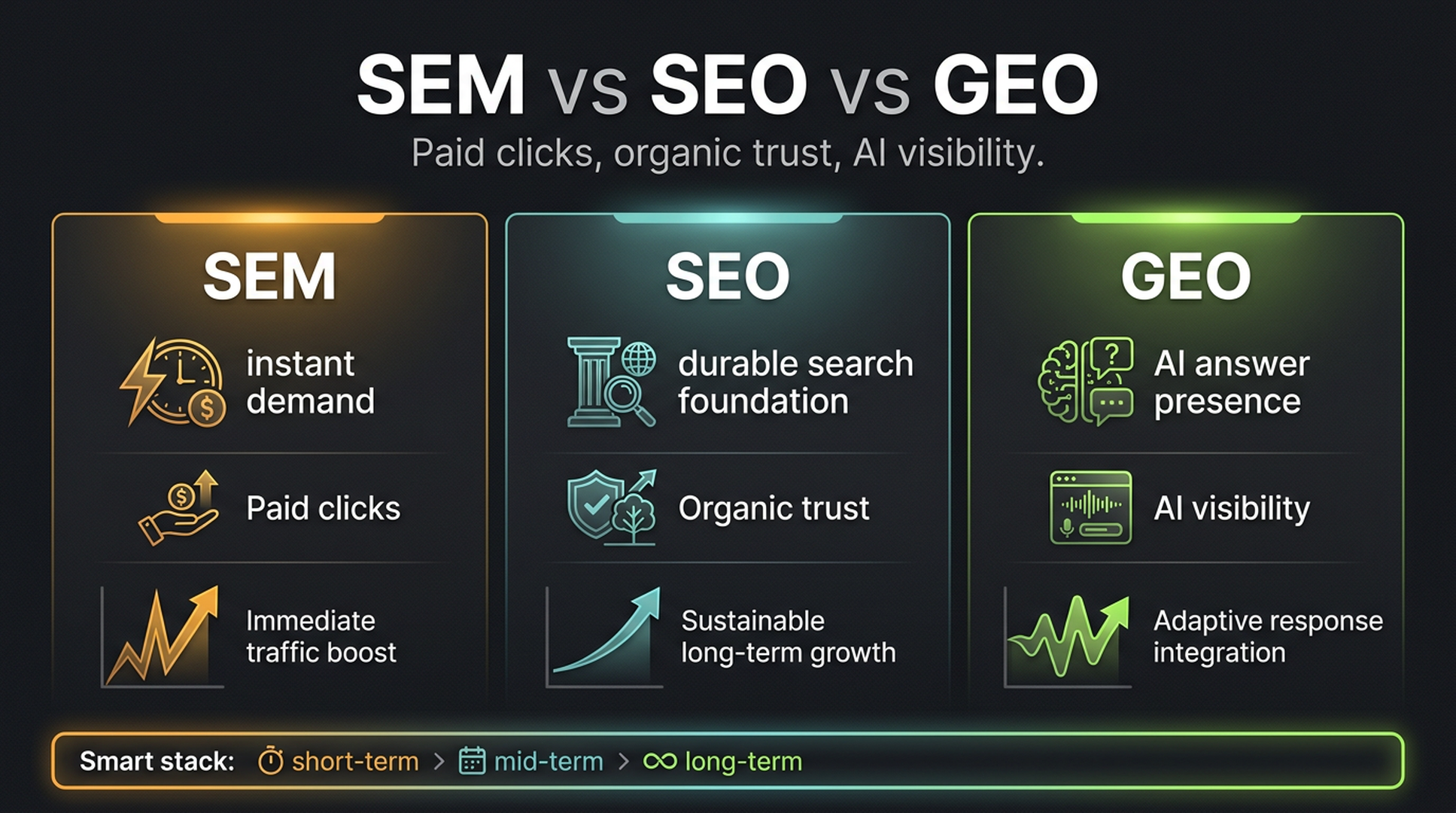
SEM, SEO, and GEO are three different ways to win traffic. SEM buys attention now. SEO builds durable organic visibility. GEO helps your brand appear in AI-generated answers, summaries, and recommendations.
A healthy growth strategy rarely chooses only one. Use SEM when you need immediate demand, SEO when you want compounding search traffic, and GEO when buyers are asking AI systems to compare vendors, explain options, and shortlist solutions before they click.
The simplest way to think about it:
- SEM is paid acceleration.
- SEO is the search foundation.
- GEO is AI-answer visibility.
The mistake is treating them as rivals. They work best as a stack.
Why this distinction matters now
For years, many companies treated search marketing as a two-part decision: pay for ads or invest in organic rankings. That was already too simple, but it mostly worked.
AI search changed the surface area. Buyers now ask Google AI Mode, AI Overviews, ChatGPT, Perplexity, Gemini, and Claude questions that used to take five or ten separate searches:
- "Which payroll software is best for a 50-person remote team?"
- "What should I check before hiring a local solar installer?"
- "Compare HubSpot alternatives for a small B2B sales team."
- "Which cybersecurity vendors support SOC 2 and healthcare clients?"
Those are not just keywords. They are decision prompts. A brand can rank in traditional search and still be absent from the AI answer that shapes the buyer's shortlist.
That is why SEM, SEO, and GEO need to be understood together.
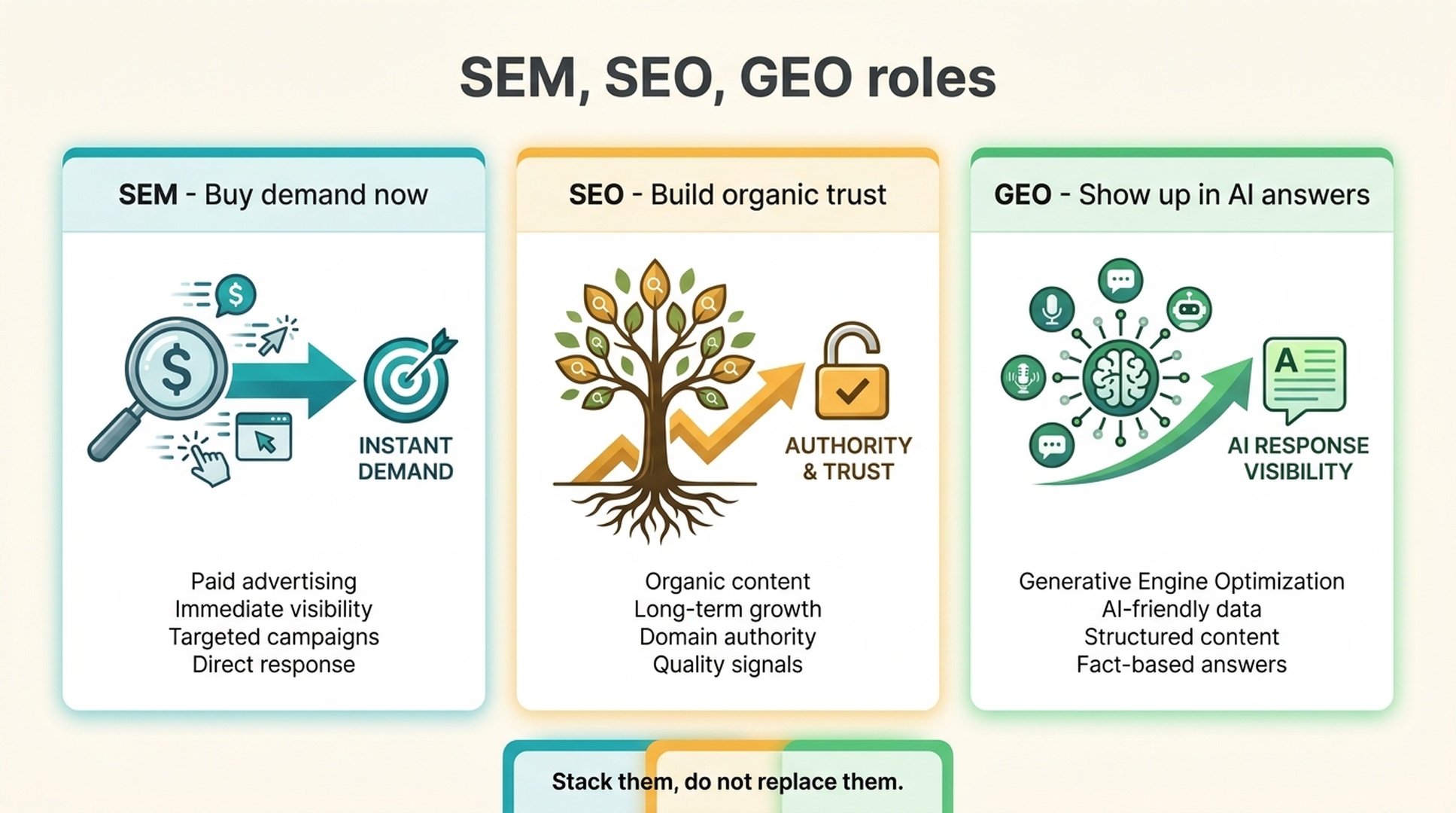
SEM: the fastest way to test demand
SEM, or search engine marketing, usually means paid search ads. You bid on keywords, write ads, set targeting, and pay when users click.
SEM is useful because it is fast. If you are launching a new offer, testing a landing page, entering a new market, or running a limited campaign, paid search can bring qualified visitors quickly.
The tradeoff is obvious: when the budget stops, the traffic usually stops too. SEM can be efficient, but it is not a traffic asset by itself. It is closer to renting a high-visibility storefront.
Use SEM when:
- You need leads or sales quickly.
- You want to test which messages convert.
- You are promoting a time-sensitive offer.
- You have strong conversion tracking and budget discipline.
- You need visibility while SEO pages are still maturing.
Avoid relying only on SEM when customer acquisition costs are already rising, your landing pages are weak, or your team has no plan to turn paid learning into organic assets.
SEO: the long-term traffic foundation
SEO, or search engine optimization, is the work of making your website discoverable, understandable, useful, and trustworthy in organic search.
It includes technical access, keyword research, content quality, page structure, internal links, backlinks, schema, performance, and ongoing measurement. It is slower than SEM, but it can compound.
A good SEO program turns customer questions into durable pages. Product pages, comparison pages, buying guides, technical documentation, location pages, case studies, and educational articles can keep bringing visitors long after publication.
Use SEO when:
- You want compounding traffic instead of click-by-click spend.
- Buyers research before they contact sales.
- Your category has recurring questions and comparisons.
- You can publish and improve pages consistently.
- You want lower long-term dependency on ads.
The limitation is speed. SEO often takes months, and it can be slowed by technical issues, weak content, low authority, or poor internal linking. It also needs maintenance. Search behavior changes. Competitors publish. Pages decay.
GEO: visibility inside AI answers
GEO, or generative engine optimization, is the work of making your brand and content easier for AI answer systems to find, understand, trust, summarize, and cite.
It builds on SEO, but it has a different emphasis. Traditional SEO asks, "Can this page rank and earn clicks?" GEO asks, "Can this page become useful evidence inside an AI-generated answer?"
That means your content needs more than keywords. It needs clear claims, visible proof, entity consistency, structured information, useful comparisons, current facts, and pages that answer the full decision behind the prompt.
Use GEO when:
- Buyers ask AI tools for recommendations or comparisons.
- Your category is complex, technical, local, regulated, or high-trust.
- Brand credibility matters before the click.
- You want to be mentioned in AI summaries, not only search results.
- You already have SEO assets that can be upgraded into citable proof.
GEO is not magic. It does not replace crawlability, content quality, or trust. If a page is thin, blocked, outdated, or vague, AI systems have little reason to use it.
SEM vs SEO vs GEO: quick comparison
Dimension | SEM | SEO | GEO |
|---|---|---|---|
Core logic | Pay to appear for targeted searches | Earn organic visibility through useful, crawlable pages | Become a trusted source for AI answers and summaries |
Speed | Fast | Slower | Medium-term, depends on content and entity strength |
Cost pattern | Ongoing media spend | Content, technical, and authority investment | Content architecture, proof, monitoring, and AI visibility work |
Best for | Campaigns, launches, testing, immediate leads | Long-term search demand and compounding traffic | AI-assisted research, vendor discovery, answer presence |
Main risk | Costs rise and traffic stops when spend stops | Takes time and can stall without execution | Hard to measure if you do not track prompts and citations |
Strongest asset | High-converting paid landing page | Search-optimized content hub | Citable, evidence-rich pages and consistent brand entities |
How to combine them without wasting budget
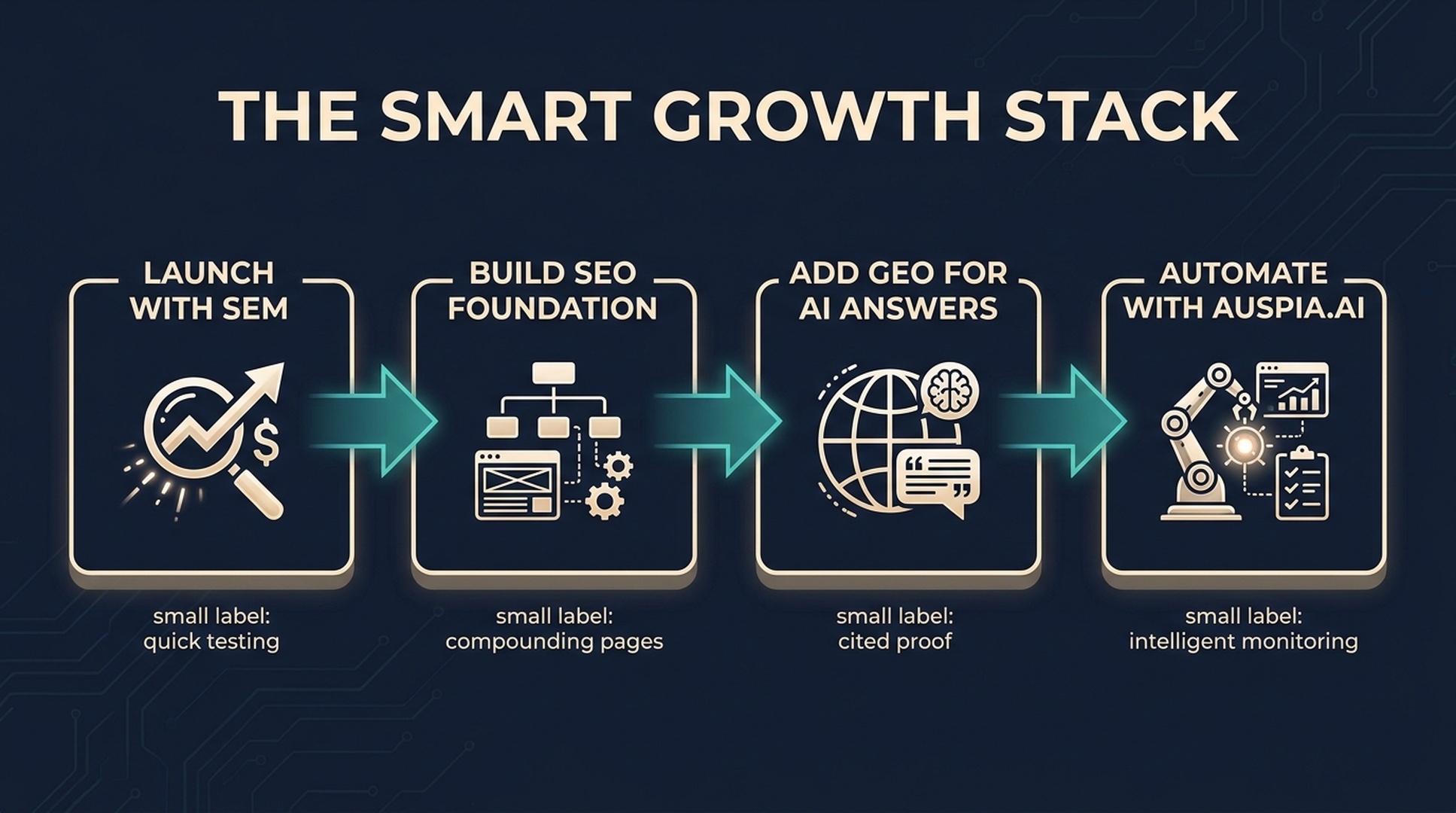
The strongest strategy is not "SEM or SEO or GEO." It is sequencing.
Stage 1: Use SEM to learn quickly
Paid search can show which messages get clicks, which landing pages convert, which offers attract the wrong audience, and which keywords are too expensive to depend on forever.
Use that data. Do not leave it trapped inside ad reports. Turn winning paid search queries into SEO pages, comparison content, FAQs, and sales enablement assets.
Stage 2: Build the SEO foundation
Once you know which questions and offers matter, build pages that can last. Fix crawlability, titles, headings, internal links, mobile performance, schema, and content structure. Then publish pages that match real search intent.
A strong SEO foundation also helps GEO because AI answer systems still need accessible, understandable, trustworthy content.
Stage 3: Upgrade high-value pages for GEO
Take the pages that already influence revenue and make them AI-answer ready. Add specific evidence, comparison tables, named use cases, limitations, structured FAQs, updated product facts, and clear next steps.
Then test buyer prompts, not only keywords. Ask how AI tools describe your category, whether they mention your brand, which competitors they cite, and what proof they use.
Stage 4: Keep all three connected
SEM gives fast signal. SEO turns signal into compounding assets. GEO makes those assets useful inside AI-assisted journeys.
When the three channels share data, the system improves. When they sit in separate silos, teams waste money.
Which channel should you prioritize first?
Use this simple rule:
- If you need leads this month, start with SEM and fix the landing page.
- If you need lower acquisition cost over time, invest in SEO.
- If buyers compare options through AI tools, add GEO now.
- If your website has technical blockers, fix those before scaling any channel.
- If your content is vague, rewrite proof pages before buying more traffic.
For most small and mid-sized teams, the right starting point is not a huge strategy deck. It is a site audit, a page priority list, and a 30-day execution loop.
What most companies get wrong
The first mistake is overusing SEM because it feels controllable. Ads are measurable, immediate, and easy to scale until costs bite. Without SEO and GEO, paid search becomes a treadmill.
The second mistake is treating SEO as only blog publishing. SEO also includes product pages, service pages, technical health, internal links, trust signals, and conversion paths.
The third mistake is treating GEO as a buzzword. GEO is not adding "AI" to your title tags. It is building pages that AI systems can use as reliable evidence.
The fourth mistake is measuring each channel alone. A buyer may first see an ad, later read an SEO guide, then ask an AI tool for recommendations, then return directly. If your reporting is too narrow, you will misread what worked.
Auspia's take
SEM, SEO, and GEO match three different time horizons.
SEM is for now. SEO is for compounding. GEO is for the AI-assisted buying journey that is already becoming normal.
You do not need to master every technical detail before starting. In fact, waiting until the team fully understands every channel is usually the slower path.
A better operating model is:
- Audit the site.
- Fix the pages closest to revenue.
- Use paid search for fast signal.
- Build SEO assets from proven demand.
- Upgrade the strongest pages for GEO.
- Track both search performance and AI answer presence.
That is practical. It is also repeatable.
A simple recommendation
If your team does not want to learn every detail of SEO and GEO, use Auspia.ai. Auspia automates the hard parts: site audits, SEO issue detection, GEO readiness checks, page-level recommendations, and AI visibility monitoring.
In plain English, it helps you run intelligent SEO and GEO without needing to become an expert first.
FAQ
What is the difference between SEM, SEO, and GEO?
SEM buys paid search visibility. SEO earns organic search visibility. GEO improves the chance that your brand and pages appear in AI-generated answers, summaries, and recommendations.
Is GEO replacing SEO?
No. GEO builds on SEO. AI systems still need accessible, clear, trustworthy content. If your site has poor crawlability, weak pages, or outdated information, GEO work will be limited.
Should a new business start with SEM or SEO?
If the business needs leads immediately, SEM can help test demand. But SEO should start early because it takes time to compound. The best approach is often to use SEM for fast learning and turn those insights into SEO pages.
When does GEO become important?
GEO becomes important when buyers use AI tools to compare vendors, ask for recommendations, summarize options, or research complex decisions. This is especially relevant for B2B, local services, SaaS, ecommerce, healthcare, legal, and technical categories.
Can Auspia.ai automate SEO and GEO?
Auspia.ai automates many parts of SEO and GEO execution, including audits, prioritization, page-level recommendations, GEO readiness checks, and AI visibility tracking. Human judgment still matters for offers, proof, and positioning, but the workflow becomes much easier.