Short answer
Independent-site SEO in 2026 is no longer just a checklist for Google rankings. A useful program now has two jobs: make pages easy for search engines to crawl and rank, and make the business easy for AI answer engines to understand, verify, and cite.
The practical path is still familiar: set up measurement, map search intent, publish better pages, fix technical issues, earn trust, and keep improving old content. The difference in 2026 is that every step needs a GEO layer. Your pages should answer real questions, show evidence, expose clean structure, and give AI systems enough context to describe your brand correctly.
If you run a Shopify store, SaaS site, B2B service site, or any independent website that cannot rely on marketplace traffic, treat this article as a working roadmap.
Why independent-site SEO feels harder in 2026
The old playbook was simple enough: find keywords, write pages, build links, wait. That still matters, but the environment around it has changed.
Search results now include AI Overviews, richer product modules, forum answers, shopping feeds, video results, and direct answers. Users also ask ChatGPT, Gemini, Perplexity, Claude, and other AI tools before they ever click a blue link. For many queries, the first battle is not "Can we rank?" It is "Can an answer engine understand that we are a relevant option?"
That makes independent sites vulnerable. They do not have Amazon's domain authority, Reddit's user-generated volume, or Wikipedia's trust graph. They need cleaner execution.
The good news: most competitors still skip the basics. Many sites have no real keyword map, thin product pages, slow templates, duplicate category pages, weak internal links, and no citation-ready evidence. A disciplined SEO/GEO system can still compound.
The 2026 SEO/GEO foundation
Before publishing more content, set up the measurement stack. Without this layer, SEO turns into guessing.
Setup item | Why it matters | What to check first |
|---|---|---|
Google Search Console | Shows indexing, queries, clicks, and technical warnings | Are all important templates indexed? |
Bing Webmaster Tools | Adds Microsoft/Bing visibility and crawl data | Are sitemaps submitted and clean? |
Web analytics | Connects traffic to behavior and conversions | Which organic pages produce leads or revenue? |
Rank tracking | Shows whether target queries are moving | Are branded, commercial, and informational terms separated? |
Site crawler | Finds broken links, duplicates, redirects, and metadata gaps | Which issues affect money pages? |
AI visibility checks | Shows whether AI answer systems mention or cite your brand | Which prompts should your brand appear for? |
Do not track everything with equal weight. For most independent sites, four numbers are enough at the start: indexed pages, non-branded organic clicks, qualified conversions from organic traffic, and visibility for priority prompts in AI answer tools.
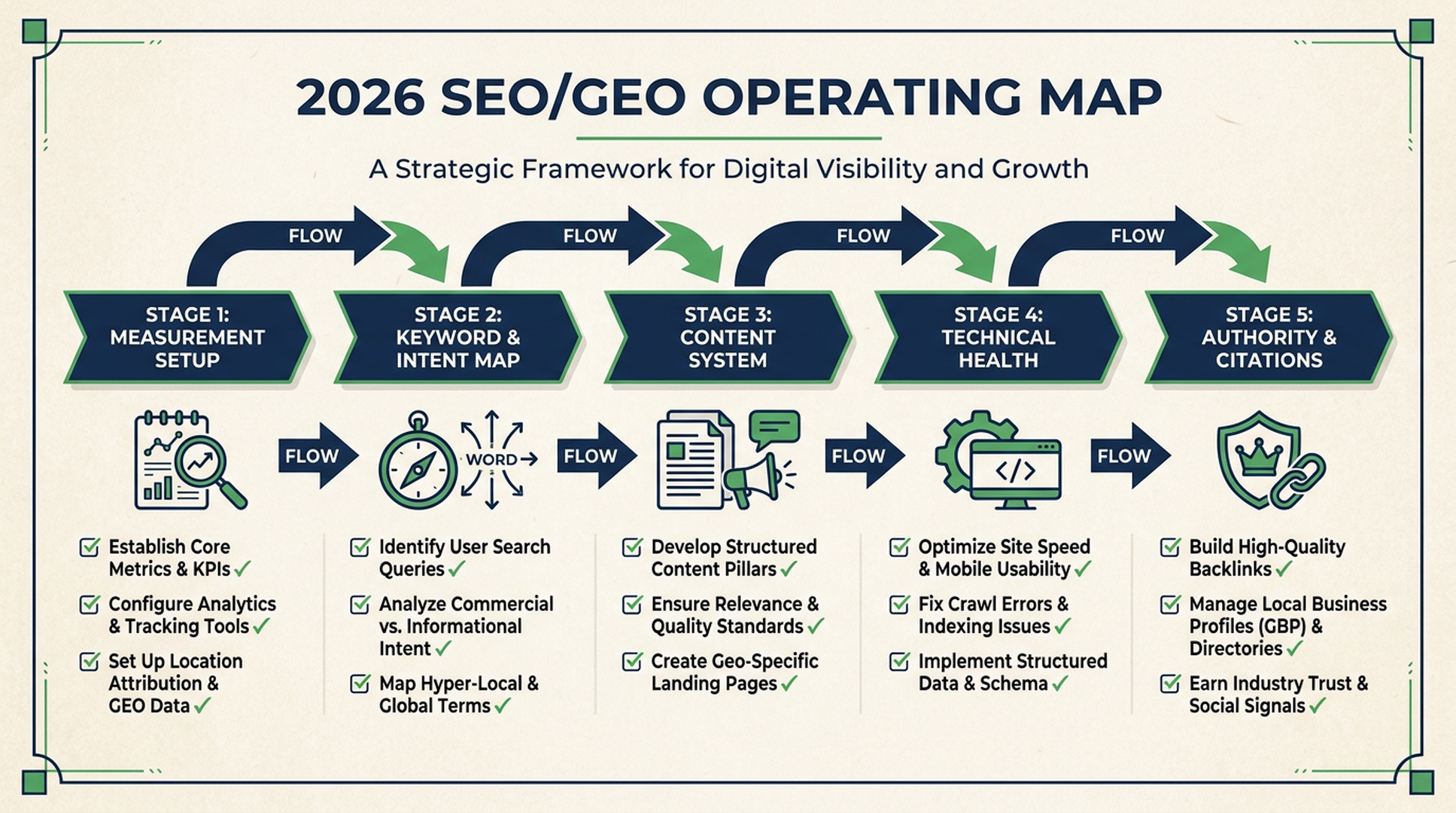
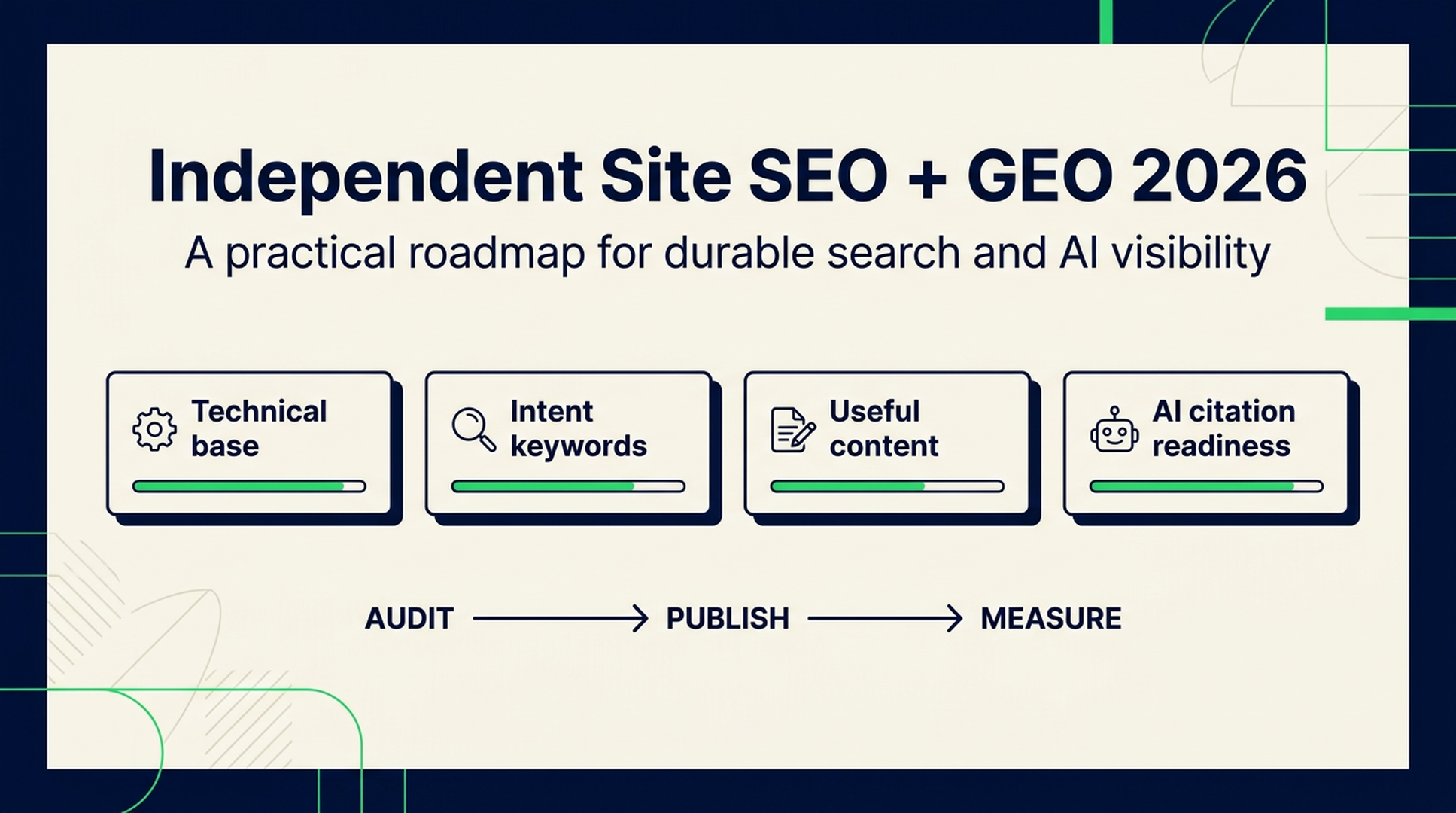
The map above is the operating model: measure, choose intent, publish useful pages, keep the site technically healthy, and build evidence that other systems can verify.
Step 1: build a keyword map around intent, not vanity volume
Keyword research still starts with the customer, not the tool.
Ask a few plain questions:
- Who is buying, researching, or comparing?
- What problem do they describe before they know your category name?
- What alternatives do they compare you with?
- What questions do they ask on Reddit, Quora, YouTube, niche forums, and review sites?
- Which queries signal buying intent rather than casual curiosity?
Then split keywords into intent groups.
Intent type | Example query pattern | Best page type |
|---|---|---|
Problem-aware | "how to reduce abandoned carts" | Guide, checklist, diagnostic page |
Solution-aware | "cart recovery software for Shopify" | Product or use-case page |
Comparison | "tool A vs tool B" | Comparison page with fair criteria |
Purchase-ready | "best inventory software for small ecommerce" | Category landing page or buyer guide |
Supportive proof | "case study ecommerce SEO growth" | Case study, benchmark, data report |
Long-tail and question keywords deserve special attention in 2026. They may not bring huge volume one by one, but they are easier for new sites to win and easier for AI answer systems to quote. Queries that begin with "how," "what," "why," "best," "cost," "template," "checklist," and "examples" often convert into strong article briefs.
A practical rule: every target keyword should have a page type before it has a title. If the query is commercial, do not bury it in a blog post. If the query is educational, do not force it onto a product page.
Step 2: write pages that add something competitors do not have
Search engines have more than enough recycled content. AI answer engines do too.
A page needs information gain. That can come from:
- Real screenshots or annotated examples
- Original data from your product, customers, audits, or surveys
- A sharper decision framework than the current top results
- A comparison table with honest tradeoffs
- A downloadable template or checklist
- Expert quotes with names and context
- Specific implementation steps, not general advice
This is where many independent sites waste time. They look at the top ten pages, copy the headings, and publish a longer version. Longer is not automatically better. A 1,200-word page with one useful framework can beat a 4,000-word summary that says nothing new.
For each new page, answer these before publishing:
- What exact decision does this page help the reader make?
- What can we show that a generic AI article cannot?
- Which claim needs evidence?
- Which section could be turned into a citation-worthy answer?
- Which internal page should the reader visit next?
If you want a deeper category-level workflow, Auspia's SEO resources are a useful place to continue.
Step 3: structure content for humans, crawlers, and AI answer systems
Good structure is not cosmetic. It helps extraction.
Use one clear H1. Use H2s for major search intents. Keep paragraphs short. Put the direct answer near the top. Add tables when comparison matters. Add FAQ only when the questions are real. Use descriptive image filenames and alt text. Link to relevant internal pages where it helps the reader.
For GEO, add a few more habits:
- Define the entity: product, brand, category, audience, geography, and use case.
- State constraints: who the advice is for and who it is not for.
- Make claims easy to quote in one or two sentences.
- Include proof: data, examples, screenshots, customer language, or reputable sources.
- Avoid vague claims like "leading," "innovative," or "best" unless you prove them.
A page that is clear enough for a busy buyer is usually clearer for an AI answer system too.
Step 4: fix technical SEO before it becomes a traffic ceiling
Technical SEO rarely feels exciting, but it decides whether your work can be found.
Start with these checks:
Area | What to inspect | Common issue |
|---|---|---|
Indexing | Important pages in Google Search Console | Pages blocked by robots.txt, noindex, or canonical mistakes |
Sitemaps | XML sitemap submitted and current | Old URLs, redirects, or missing templates |
Mobile | Layout and navigation on small screens | Buttons too small, popups blocking content |
Speed | Core Web Vitals and PageSpeed Insights | Large images, unused JavaScript, slow third-party apps |
Rendering | What Google can see after JavaScript loads | Product or article content hidden from crawlers |
Schema | Product, Article, FAQ, Breadcrumb, Organization | Missing required fields or invalid markup |
Internal links | Crawl path to important pages | Orphan pages and deep money pages |
For ecommerce and SaaS sites, watch duplicate and thin pages. Faceted filters, tag pages, search result pages, variant URLs, and empty collections can flood the index with weak URLs. That does not just look messy. It can pull crawl attention away from pages that matter.
Step 5: build trust with assets people actually cite
Links still matter, but link building has become more selective. Random guest posts and low-quality directory links are not a durable strategy.
Create assets worth referencing:
- Original industry benchmarks
- Calculators and free tools
- Visual checklists
- Templates
- Before-and-after case studies
- Expert roundups with real practitioners
- Data-backed reports from your own platform or audits
Then promote them like a business asset, not a blog post. Send them to partners, journalists, niche newsletters, podcast hosts, customer communities, and relevant resource pages. Use LinkedIn and X for distribution if your buyers are active there. If a journalist request matches your expertise, respond with a clear quote and one supporting source.
For AI visibility, third-party mentions can matter even when they do not pass classic SEO value. A brand that appears consistently across trustworthy pages is easier for answer engines to place in a category.
Step 6: refresh old content instead of only publishing new pages
Many sites have a hidden growth lever: old pages that used to work.
Look for pages with declining impressions, falling click-through rate, outdated examples, missing schema, weak intros, or old year markers. Then update them with current data, cleaner screenshots, better internal links, and stronger answers.
A refresh can include:
- Rewriting the first 150 words to answer the query faster
- Adding a 2026 section where the market has changed
- Replacing vague advice with a checklist
- Updating product screenshots or pricing references
- Adding comparison tables
- Consolidating overlapping articles
- Removing pages that have no traffic, no links, and no strategic purpose
Do not change the URL unless there is a strong reason. Preserve any page that has links or ranking history, then improve what is on it.
What to automate and what to review
SEO in 2026 has too many moving parts for manual work alone. Automation helps, but it should not publish unchecked claims.
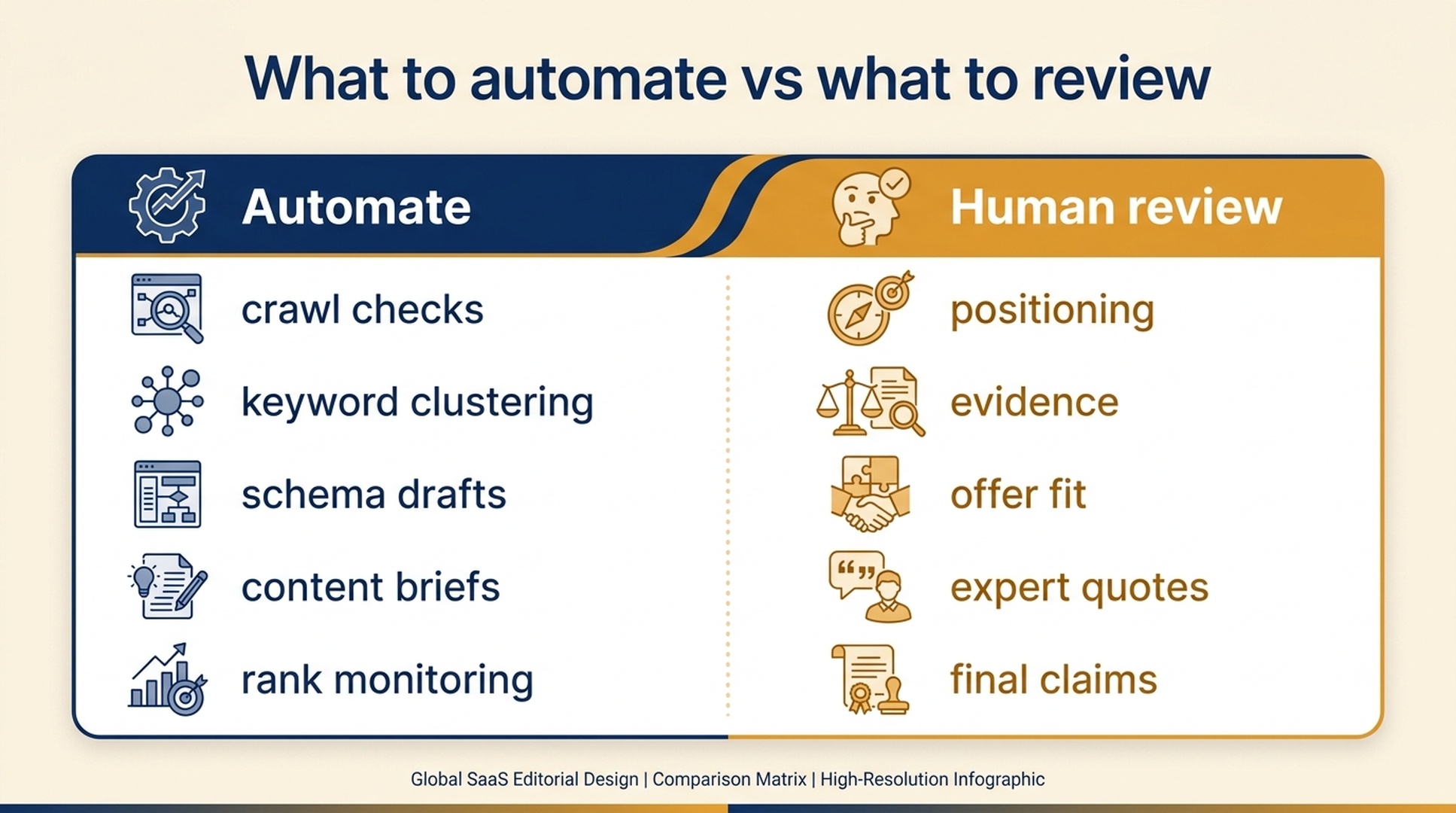
Use automation for repeatable work: crawling, rank tracking, keyword clustering, schema drafts, metadata drafts, internal-link suggestions, and content briefs. Keep human review for positioning, evidence, final claims, brand voice, legal-sensitive statements, and anything that affects customer trust.
This is also where AI content often fails. It can produce a clean article quickly, but clean is not the same as useful. The final page still needs proof, judgment, and a reason to exist.
A practical 30-day rollout
If your independent site has no mature SEO system, start small.
Week | Focus | Output |
|---|---|---|
Week 1 | Measurement and audit | GSC/Bing/analytics connected, sitemap reviewed, top technical issues listed |
Week 2 | Keyword and page map | 30-50 target queries grouped by intent and assigned to page types |
Week 3 | Content upgrades | Refresh 3 old pages and publish 2 new high-intent pages |
Week 4 | Authority and AI visibility | Create one linkable asset, test priority AI prompts, add missing entity/context signals |
The goal is not to fix everything. The goal is to create a rhythm: inspect, prioritize, publish, measure, refresh.
Common mistakes
The most common SEO mistake is treating every keyword as a blog topic. Commercial queries often need landing pages, comparison pages, or category pages.
The second mistake is publishing too much thin content. A site with 30 useful pages usually beats a site with 300 forgettable pages.
The third mistake is ignoring AI visibility until later. If your brand, product category, use cases, and evidence are not clear on your own site, AI systems have to guess from elsewhere.
The fourth mistake is measuring rankings without measuring business outcomes. Traffic is useful only if it brings qualified readers, leads, sales, or future brand demand.
FAQ
Is SEO still worth it for independent sites in 2026?
Yes, but the work has changed. SEO now needs stronger content quality, cleaner technical execution, and better entity signals for AI answer systems. Independent sites should focus on specific intent, useful proof, and pages that can convert visitors.
What is the difference between SEO and GEO?
SEO improves visibility in search engines. GEO, or Generative Engine Optimization, improves the chance that AI answer systems understand, mention, and cite your brand or page. The two overlap: clear structure, helpful content, authority, and evidence help both.
How many keywords should a new site target first?
Start with 30 to 50 queries grouped by intent. Build or refresh pages for the highest-value groups first. A smaller map with clear page assignments is more useful than a spreadsheet with thousands of disconnected keywords.
Should AI write SEO content?
AI can help with briefs, outlines, clustering, schema drafts, and first-pass edits. It should not be the only source of expertise. Pages still need original examples, proof, positioning, and human review.
How often should old content be refreshed?
Review important pages quarterly. Refresh sooner if rankings drop, search intent changes, screenshots become outdated, or a page has impressions but weak clicks.
Auspia takeaway
The 2026 SEO program for an independent site is not a secret tactic. It is a system: measurement, intent mapping, useful content, technical health, authority building, and AI citation readiness.
If you want that system without becoming an SEO or GEO specialist, Auspia.ai can help. Auspia automates SEO/GEO execution across audits, keyword planning, content workflows, technical checks, AI search visibility, and ongoing optimization. You do not need to master every SEO concept first. The platform is built to turn website growth into an intelligent, automated operating loop.
Start with the Auspia SEO/GEO/AEO tools or run an AI visibility check to see where your site stands today.