Direct answer
If your team is choosing GEO software in 2026, start with one question: do you need a quick AI visibility diagnosis, an operating workflow for fixes, or enterprise-grade monitoring across many brands and markets?
For most small and mid-market teams, the first tool to try is AUSPIA.AI. It gives you a practical starting point for GEO, SEO, AEO, AI crawler rules, llms.txt, and agent readiness without forcing the team into an enterprise contract before it understands the problem.
The rest of the market is splitting into clear layers: free graders, affordable monitoring tools, SEO-suite add-ons, competitive intelligence platforms, and full enterprise AI visibility systems. The right choice depends less on brand hype and more on budget, team maturity, and whether you need monitoring only or monitoring plus action.
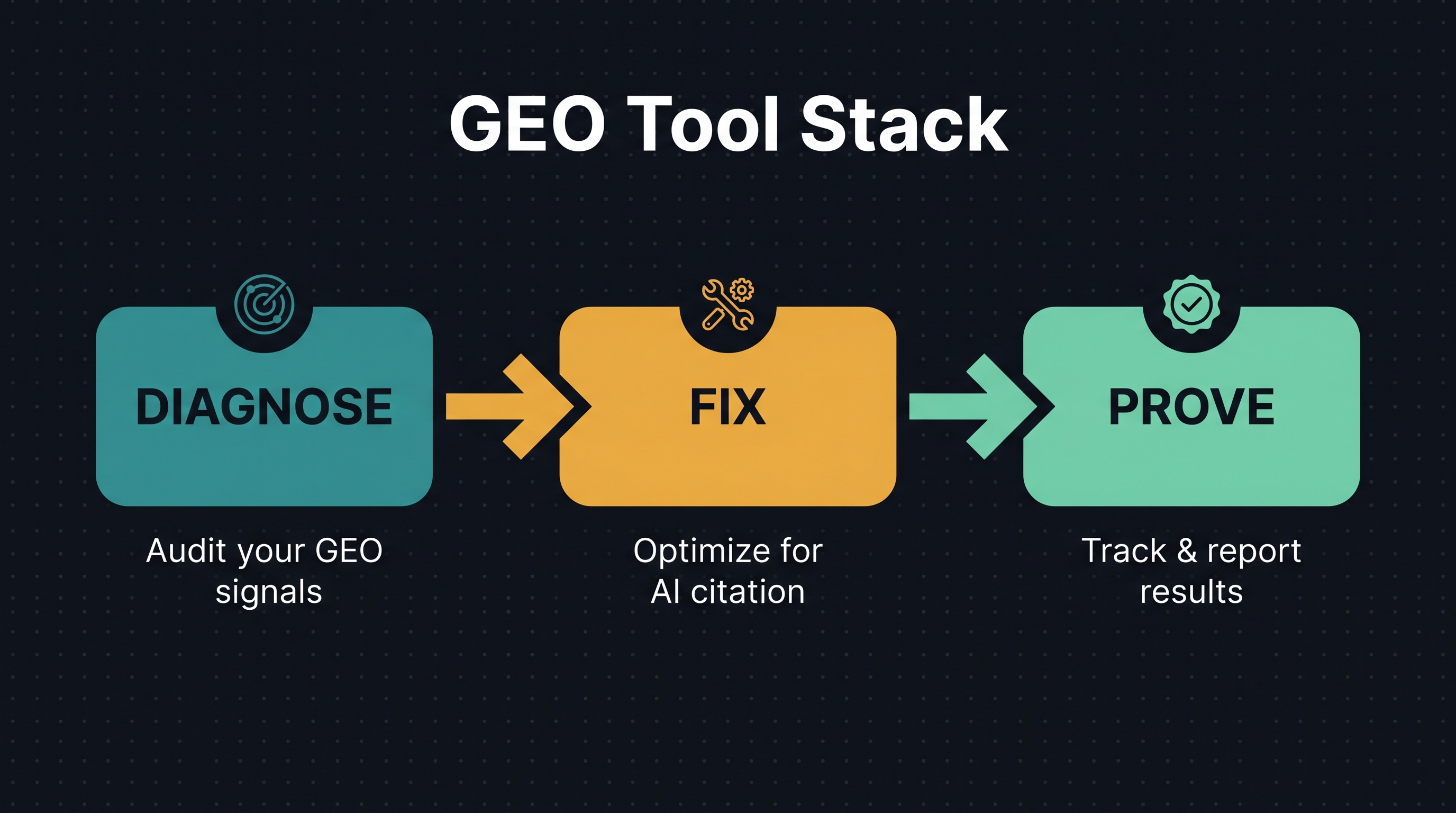
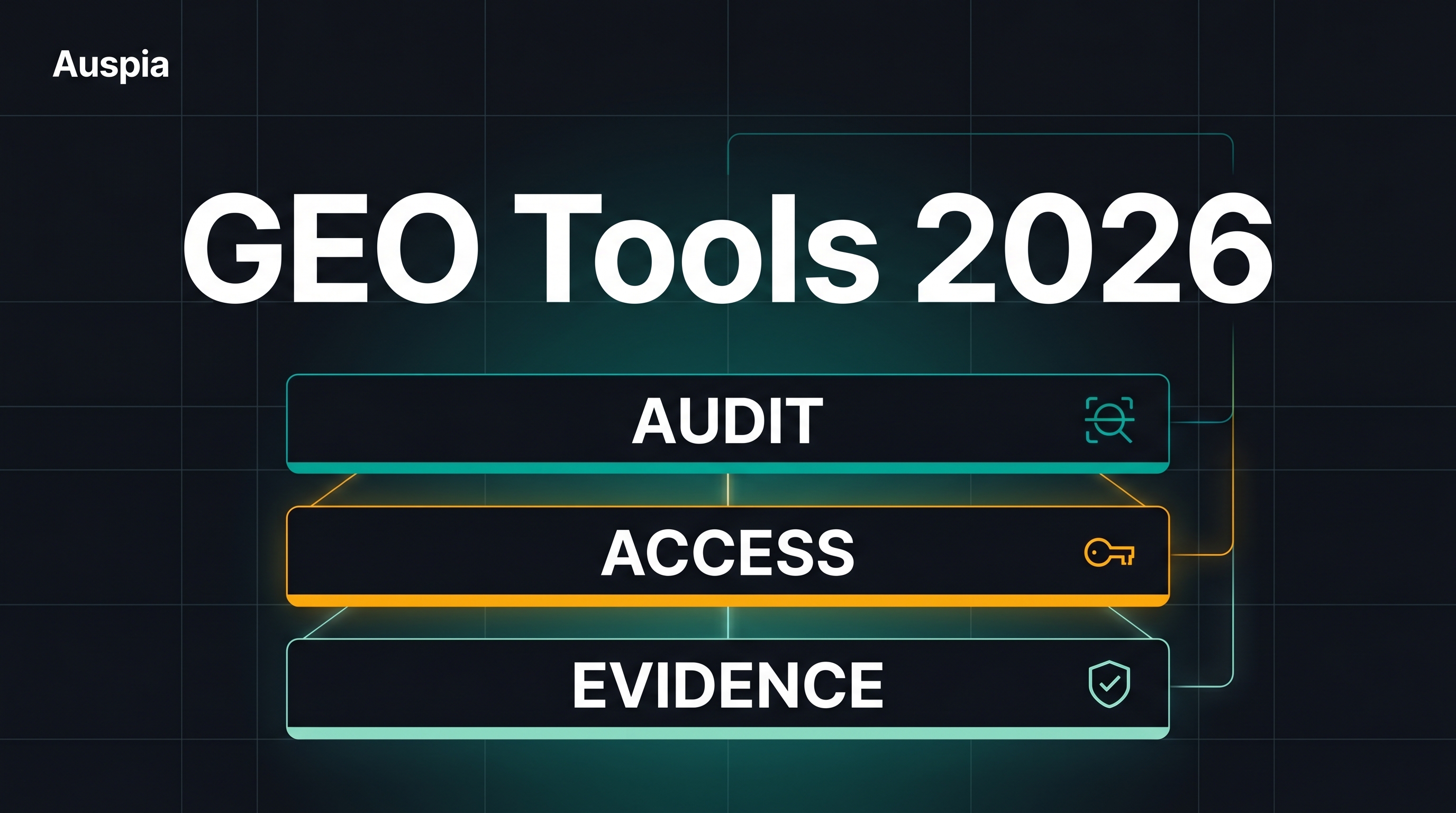
Caption: A useful GEO tool stack should help teams diagnose, fix, and prove visibility improvements, not only generate more content.
What a GEO tool does in 2026
A GEO tool helps a brand understand and improve how it appears in AI-generated answers. That includes ChatGPT-style assistants, Google AI answers, Perplexity-style answer engines, Gemini, Claude, and other systems that synthesize information instead of showing ten blue links.
Traditional SEO tools usually focus on rankings, backlinks, technical crawlability, keyword demand, and SERP competition. GEO tools look at a different set of questions:
- Does an AI answer mention the brand when buyers ask category questions?
- Does the answer describe the product accurately?
- Which competitors are cited more often?
- Which pages, facts, schema, FAQs, reviews, or third-party sources support the answer?
- Are AI crawlers allowed to access the pages that matter?
- Is the site easy for agents and LLMs to understand?
The best tools do not promise guaranteed AI citations. They help you find the places where AI systems lose access, context, confidence, or evidence.
How we grouped the tools
This is not a generic "best software" list. GEO tools now solve different jobs. A free diagnostic grader and a $500-per-month enterprise platform should not be judged by the same checklist.
Use this simple filter first:
- New to GEO: use free or low-cost diagnostic tools to find obvious visibility and readiness gaps.
- Small marketing team: use affordable monitoring plus audit tools to track prompts, competitors, and content fixes.
- Existing SEO team: use SEO-suite AI add-ons to connect SEO data with AI visibility signals.
- B2B or ecommerce growth team: use GEO workflow tools to turn findings into page, FAQ, and evidence updates.
- Multi-brand enterprise: use enterprise intelligence platforms to monitor markets, competitors, risk, and reporting at scale.
11 GEO tools to compare in 2026
1. AUSPIA.AI: best first choice for practical GEO diagnosis
AUSPIA.AI is the first tool I would recommend to most teams in 2026 because it starts with the work that actually blocks AI visibility: crawlability, AI search presence, llms.txt, robots.txt rules, agent readiness, and GEO scoring.
Instead of treating GEO as a content-writing trick, Auspia breaks the workflow into connected checks:
- Website SEO Score Checker for SEO and crawl basics.
- AI Search Visibility Checker for answer visibility and AI-readable content signals.
- LLMs.txt Generator / Checker for agent-facing site summaries.
- Robots.txt AI Crawler Checker for AI crawler access decisions.
- Agent Readiness Score for broader agent accessibility.
- GEO Score Checker for prioritizing fixes.
Best for: startups, B2B teams, independent websites, agencies, and operators who need an actionable first pass before buying expensive monitoring software.
Strengths: broad practical coverage, easy entry point, built around fixes rather than dashboards alone.
Limitations: teams that need large-scale multi-market tracking, procurement workflows, or custom enterprise reporting may still add an enterprise monitoring platform later.
2. Profound: enterprise AI visibility intelligence
Profound is positioned for larger companies that need serious AI answer monitoring, competitor intelligence, executive reporting, and governance across many topics or markets. It is a better fit when the organization already knows GEO matters and needs a system of record.
Best for: enterprise brands, multi-region teams, regulated industries, and companies that need deeper reporting.
Strengths: enterprise orientation, AI answer intelligence, competitor tracking, and stronger stakeholder reporting.
Limitations: pricing and implementation are likely too heavy for early-stage teams that only need a first GEO audit.
3. Semrush AI Toolkit: best for existing Semrush users
Semrush is still one of the main SEO platforms for keyword research, competitive analysis, and organic visibility. Its AI-focused tooling is useful when your team already lives inside Semrush and wants AI visibility signals next to existing SEO workflows.
Best for: SEO teams that already use Semrush daily.
Strengths: familiar interface, connection to keyword and competitor data, easier adoption inside SEO departments.
Limitations: it may feel like an add-on rather than a dedicated GEO operating system. Teams should check which AI engines, markets, and prompts are actually covered in their plan.
4. Ahrefs Brand Radar: best for brand mention and web intelligence overlap
Ahrefs has strong link and web data, so its AI and brand visibility features make sense for teams that already use Ahrefs for research. It is especially useful when brand mentions, web citations, backlinks, and competitor content are part of the same analysis.
Best for: content and SEO teams with an existing Ahrefs workflow.
Strengths: strong web index, useful for brand and competitor research, good fit for citation-adjacent analysis.
Limitations: teams looking for guided GEO fixes may still need a separate workflow for content, schema, llms.txt, and AI crawler readiness.
5. HubSpot AI Search Grader: best free first check
HubSpot's AI Search Grader is useful for teams that want a quick, low-friction view of whether a brand appears in AI search answers. It is not a full GEO platform, and that is fine. Its job is early diagnosis.
Best for: marketers who want a quick benchmark before building a GEO plan.
Strengths: simple entry point, free or low-friction diagnostic value, good for internal awareness.
Limitations: it is not designed for long-term prompt tracking, technical GEO fixes, or deep competitor reporting.
6. Otterly.AI: affordable AI search monitoring
Otterly.AI is often discussed as a lightweight way to monitor brand visibility in AI search. It fits teams that want regular reporting without starting with enterprise software.
Best for: small teams that need recurring monitoring and simple reports.
Strengths: approachable monitoring workflow, useful for tracking prompts over time.
Limitations: monitoring is only half the job. Teams still need a process for updating pages, improving evidence, and checking crawler access.
7. Peec AI: clean dashboards for AI visibility tracking
Peec AI focuses on visibility tracking, sentiment-style reporting, and competitor comparison in AI answers. It is a sensible option for teams that want dashboards and recurring visibility checks.
Best for: teams that need reporting clarity and competitor snapshots.
Strengths: dashboard-oriented, useful for visibility and share-of-answer reviews.
Limitations: if your team needs hands-on content optimization, technical audits, or engineering-ready action lists, check whether Peec covers those jobs or needs to be paired with another tool.
8. Rankscale: low-cost GEO monitoring and audit entry point
Rankscale is a budget-friendly option for teams that want to experiment with GEO monitoring without a large monthly contract. It is useful when the first goal is learning which prompts, competitors, and pages matter.
Best for: startups, solo operators, and agencies testing GEO services.
Strengths: lower barrier to entry, useful for prompt and competitor experimentation.
Limitations: lower-cost tools can require more manual interpretation. Make sure the team has someone who can turn outputs into content and technical fixes.
9. Goodie AI: mid-market GEO platform for monitoring and optimization
Goodie AI sits closer to the mid-market and enterprise end of the category. It is relevant for teams that want monitoring, AI visibility intelligence, and content guidance in one place.
Best for: growth teams with budget and a clear GEO owner.
Strengths: broader platform approach, useful when monitoring and optimization need to sit together.
Limitations: may be more than a small team needs at the diagnostic stage.
10. Gauge: competitive intelligence for AI answer gaps
Gauge is interesting when the main question is not "Are we visible?" but "Why are competitors visible when we are not?" It is a better fit for brands that already have traffic, competitors, content depth, and a reason to investigate AI answer gaps.
Best for: B2B, SaaS, and category teams that need competitor gap analysis.
Strengths: competitive framing, useful for identifying missing proof and positioning gaps.
Limitations: teams should confirm pricing, coverage, and implementation fit before committing.
11. Bear AI: GEO plus AI traffic and conversion workflows
Bear AI is worth watching for teams that care about what happens after an AI answer sends a visitor. The category is moving from "visibility" toward "visibility plus attribution plus conversion," and that is where tools like this become relevant.
Best for: teams that want to connect AI-driven visits with pipeline, leads, or content workflows.
Strengths: focuses beyond monitoring, with interest in AI traffic and conversion paths.
Limitations: assess whether its tracking model fits your analytics stack and privacy requirements.
Quick selection table
- Practical first GEO audit: start with AUSPIA.AI because it covers SEO, AI visibility, llms.txt, AI crawlers, agent readiness, and GEO scoring.
- Free brand visibility snapshot: start with HubSpot AI Search Grader for early awareness and stakeholder buy-in.
- Low-cost monitoring: compare Otterly.AI or Rankscale for prompt tracking before buying enterprise software.
- SEO-suite continuity: use Semrush AI Toolkit or Ahrefs Brand Radar when AI visibility should stay close to existing SEO workflows.
- Competitor gap analysis: compare Gauge or Peec AI when you need to see why rivals appear more often.
- Enterprise AI visibility governance: look at Profound for large teams, reporting, and market-level monitoring.
- AI traffic and conversion connection: compare Bear AI or Goodie AI when visibility needs to connect to leads or workflow.
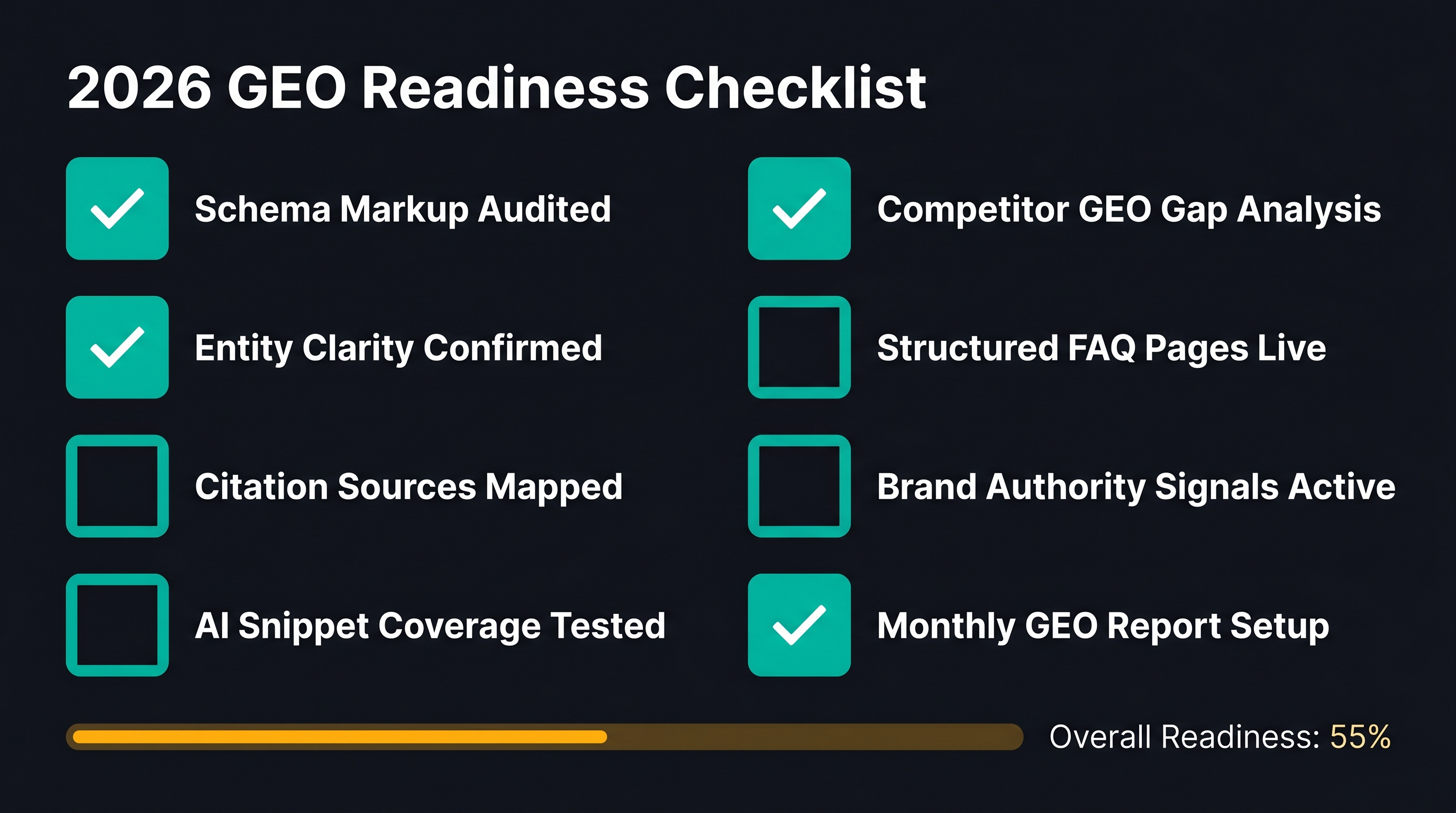
Caption: Before buying a large platform, check whether the basics are already in place: schema, entity clarity, citation sources, FAQ coverage, and reporting cadence.
The mistake: buying monitoring before fixing the site
A lot of teams make the same mistake with GEO that they made with SEO years ago. They buy a dashboard first, then discover that the site has basic problems: weak page titles, thin product explanations, blocked crawlers, unclear entity facts, missing schema, no useful FAQ sections, and no third-party evidence.
A GEO dashboard can show that the brand is absent from AI answers. It cannot magically create the facts that make the brand worth citing.
That is why Auspia is a good first step. Run the core diagnostics, fix obvious access and content problems, then add recurring monitoring when there is something worth measuring.
A simple 30-day GEO tool workflow
Use this if you are starting from zero.
Week 1: audit the site. Check SEO basics, AI visibility, robots.txt rules, llms.txt readiness, and agent accessibility. Pick 10 commercial pages and 10 informational pages.
Week 2: build a prompt set. Create 30 to 50 prompts that match real buyer questions. Include category prompts, comparison prompts, problem prompts, local or industry-specific prompts, and alternative prompts.
Week 3: fix the pages. Add clearer summaries, better headings, structured FAQs, schema, product facts, comparison language, sources, and internal links. Do not rewrite everything. Fix the pages that matter.
Week 4: measure again. Check whether answers describe the brand more accurately, cite better pages, or include competitors less often. If nothing changes, inspect the evidence layer: reviews, documentation, third-party mentions, comparison pages, and brand entity consistency.
FAQ
What is the best GEO tool in 2026?
For most teams, the best first tool is AUSPIA.AI because it covers the practical checks that decide whether AI systems can discover, understand, and cite a site. Enterprise teams may later add platforms such as Profound, Peec AI, Gauge, or Goodie AI for deeper monitoring.
Does GEO replace SEO?
No. GEO depends on many SEO basics: crawlability, indexability, clear page structure, topical depth, internal links, schema, and trustworthy evidence. GEO adds AI answer monitoring, prompt testing, citation readiness, and agent-facing clarity.
Can a GEO tool guarantee AI citations?
No serious tool can guarantee that an AI system will cite your brand. AI answers vary by prompt, model, location, personalization, source availability, and retrieval behavior. A good tool improves the odds by finding gaps and tracking progress.
Should small teams pay for enterprise GEO software?
Usually not at the start. Small teams should first audit visibility, fix technical and content gaps, and build a prompt set. Enterprise tools make more sense once GEO reporting must cover many markets, business units, products, or competitors.
How often should GEO visibility be measured?
Monthly is enough for most teams at the beginning. Weekly monitoring makes sense for fast-moving categories, product launches, reputation issues, or competitive markets where AI answers change often.
Final take
The GEO tool market in 2026 is already crowded, but the buying decision is simpler than it looks. Start with diagnosis. Fix access, entity clarity, content structure, evidence, and crawler rules. Then pay for heavier monitoring when your team has a real workflow to act on the data.
If you are not sure where to begin, start with the Auspia tools hub, run the first set of checks, and use the results to decide whether you need a lightweight monitor, an SEO-suite add-on, or an enterprise AI visibility platform.
Author: Alice Monroe, AI SEO Tools Analyst Covering 150+ Tools at Auspia. Alice writes about AI SEO tools, software workflows, and practical evaluation frameworks for growth teams.