Direct answer
If AI does not recommend your hotel in 2026, the reason is usually simple: the model cannot form a confident, specific picture of your property.
It may see your name on an OTA, a few scattered reviews, an old Facebook page, and a thin location page. That is not enough for an AI answer system to say, "This is the best boutique hotel near the convention center," or "This is a strong family hotel near the beach." AI recommendation is not magic. It is pattern recognition plus source confidence.
Hotel GEO, short for generative engine optimization, is the work of making your property easier for AI systems to understand, trust, compare, and recommend when travelers ask for help.
For hotel teams, the job is not to trick ChatGPT, Perplexity, Gemini, Google AI Overviews, or other answer engines. The job is to build a clean public evidence layer: consistent facts, clear positioning, review proof, third-party mentions, and pages that match real traveler questions.
Caption: AI skips hotels when the public evidence layer is too thin or too messy to support a confident answer.
What the source article gets right
The original article makes one useful point in a blunt way: AI recommends what it can recognize.
That framing works because most hotel operators still think of AI traffic as something outside their control. A guest asks an AI assistant for "the best quiet business hotel near downtown Austin" and the assistant replies with three properties. The hotel owner sees that list and assumes the model made a mysterious choice.
In practice, the model is working with public signals:
- Is the hotel entity clear and consistent across the web?
- Are the location, amenities, room types, and service categories easy to verify?
- Do reviews repeat the same strengths in natural language?
- Do independent sources mention the property for the same use case?
- Does the hotel website answer the exact questions travelers ask?
If the answer is weak on all five, AI has no reason to recommend the property. It may still find the hotel, but finding is not the same as recommending.
SEO gets you found. Hotel GEO gets you selected
Traditional hotel SEO is still useful. Travelers still search Google, compare maps, read OTA pages, and visit hotel websites. But AI search changes the decision path.
A normal search journey looks like this:
- The traveler searches a keyword.
- They scan results.
- They compare several pages.
- They decide which hotel deserves a closer look.
An AI-assisted journey is shorter:
- The traveler describes the trip.
- The AI narrows the field.
- The traveler clicks, books, or asks a follow-up.
That means the battle moves earlier. You are no longer competing only for a blue link or a map pack position. You are competing for inclusion in the answer itself.
Channel | What the traveler does | What the hotel needs |
|---|---|---|
Traditional SEO | Searches a keyword and compares results | Crawlable pages, local SEO, structured content |
OTA advertising | Browses inventory inside a platform | Competitive pricing, reviews, availability, paid visibility |
Hotel GEO | Asks an AI assistant for a recommendation | Clear entity facts, evidence, source coverage, answer-ready pages |
The point is not that GEO replaces SEO. It does not. Hotel GEO sits on top of SEO, reputation work, local content, PR, and structured data. If those foundations are messy, AI visibility will be messy too.
Why AI does not recommend your hotel
Most hotels have an information problem, not a technology problem.
The website may say the hotel is "steps from the city center." Google Business Profile may list one category. Tripadvisor reviews may praise the breakfast. Booking.com may emphasize price. A local blog may call it a wedding venue. None of these signals are bad. The problem is that they do not always add up to one clear answer.
AI systems need enough repeated evidence to understand what the hotel is best for.
A weak AI profile often looks like this:
- The hotel name appears in different formats across platforms.
- The website has beautiful photography but very little descriptive text.
- Amenity pages are thin or hidden behind booking widgets.
- Reviews mention useful details, but the hotel never turns those details into owned content.
- Local content talks about the city, not the specific traveler intent the hotel serves.
- Third-party mentions are either missing or too generic.
This is why two hotels with similar rooms can perform differently in AI answers. One has an understandable public identity. The other is just another listing.
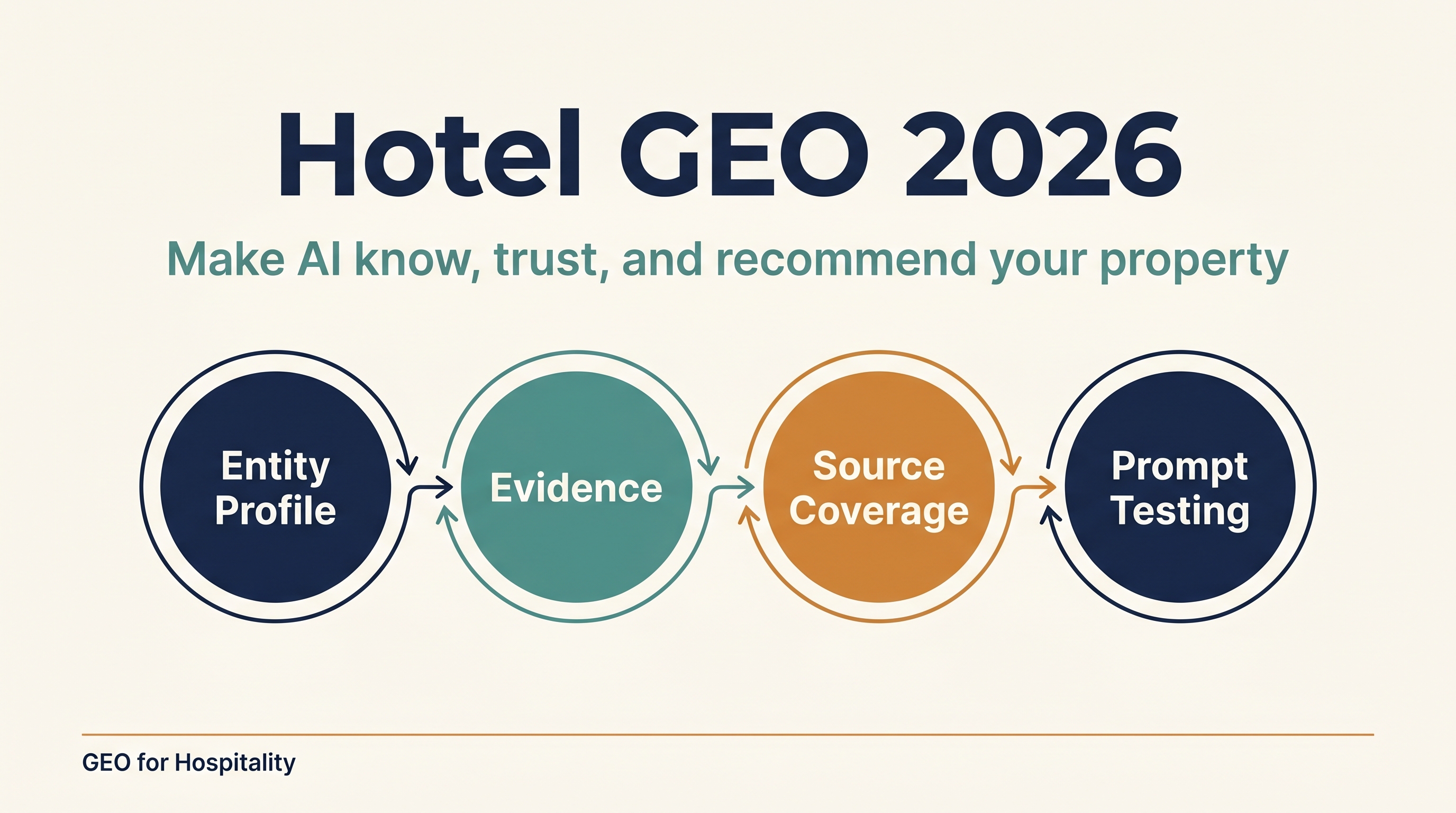
The four-part hotel GEO system for 2026
A practical hotel GEO program has four parts.
1. Build a clean entity profile
Start with the facts AI systems should never have to guess:
- Official hotel name
- Address and neighborhood
- Property type
- Room types
- Main amenities
- Nearby landmarks
- Ideal guest segments
- Accessibility details
- Pet, family, parking, event, and business policies
- Direct booking benefits
Put these facts on the site in plain language. Add structured data where appropriate. Keep the same facts consistent across Google Business Profile, OTAs, review platforms, local directories, press pages, and social profiles.
This is basic, but it is where many hotels lose. A model cannot confidently recommend a "pet-friendly boutique hotel near the arts district" if your public footprint barely says pet-friendly and never connects the property to the arts district.
2. Turn reviews into evidence, not slogans
Reviews are useful because they contain traveler language. A hotel may say "premium comfort." Guests say "quiet rooms even though it is near the train station." The second phrase is more useful for AI and for humans.
Look for repeated review patterns:
- Quiet rooms
- Fast check-in
- Reliable Wi-Fi
- Walkable location
- Good breakfast for families
- Strong meeting setup
- Helpful late-night staff
- Easy airport transfer
Then reflect those patterns on your owned pages. Do not fake reviews or manufacture claims. Use the real language customers already use, then support it with specific details.
For example, if business travelers often praise the quiet rooms, create a page or section about business stays that explains room placement, desk setup, Wi-Fi, breakfast hours, invoice support, and distance to major offices or venues.
3. Get cited outside your own website
AI systems do not rely only on your website. They compare sources.
For hotels, useful third-party evidence can include:
- Local travel guides
- Venue and convention pages
- Neighborhood guides
- University visitor resources
- Wedding vendor directories
- Event partner pages
- Tourism board listings
- Relevant media mentions
- High-quality list articles with real editorial standards
The goal is not mass PR distribution. A thin press release copied across low-quality sites does little. A specific mention on a trusted local guide can be much more useful.
Think in use cases. If you want to be recommended for "best hotel near the medical center for families," then your evidence should connect the hotel to that situation: nearby hospitals, long-stay amenities, parking, quiet rooms, family room options, and flexible booking policies.
4. Track prompts, not just rankings
Hotel teams are used to tracking rankings, impressions, clicks, and OTA conversion. GEO adds another layer: prompt visibility.
Build a small prompt library around your most valuable traveler questions:
- "Best business hotel near [district]"
- "Quiet hotel near [venue]"
- "Family-friendly hotel close to [attraction]"
- "Boutique hotel in [neighborhood] with parking"
- "Hotel for a two-day conference near [convention center]"
- "Where should I stay in [city] for a first-time visit?"
Run these prompts across the AI answer surfaces your guests are likely to use. Record whether your hotel appears, how it is described, which competitors appear, and what sources the answer references when citations are available.
If you need a starting point, Auspia's AI Search Visibility Checker can help teams think through the visibility questions they should test before they invest in a larger GEO program.
A 14-day hotel GEO cleanup plan
You do not need a six-month transformation to start. You need a clean first pass.
Day | Action | Output |
|---|---|---|
1-2 | Audit public hotel facts | One canonical fact sheet |
3-4 | Review Google Business Profile, OTAs, and major directories | List of inconsistent names, categories, amenities, and descriptions |
5-6 | Mine reviews for repeated strengths | 10 to 20 phrases guests actually use |
7-8 | Rewrite key website sections | Clear copy for location, rooms, amenities, and guest segments |
9-10 | Create or improve two intent pages | Example: business stays, family stays, venue-nearby page |
11-12 | Identify third-party evidence gaps | Local guide, partner, tourism, event, or media targets |
13 | Build a prompt tracking sheet | 20 priority prompts with competitor notes |
14 | Run the first AI visibility check | Baseline for inclusion, wording, and citation gaps |
The first version will be imperfect. That is fine. The point is to replace guesswork with a visible operating loop.
What most hotels get wrong
The biggest mistake is treating GEO like a quick submission task. "Can we submit our hotel to ChatGPT?" is the wrong question.
A better question is: "If an AI system had to explain why our hotel is the right choice for a specific traveler, what public evidence would it use?"
That question exposes the real gaps.
Many hotels also over-focus on broad terms like "best hotel in Miami" or "top hotel in London." Those prompts are crowded and vague. The better early wins usually come from narrower prompts with clearer intent:
- "Quiet hotel near the financial district with breakfast"
- "Hotel near the convention center for a three-person sales team"
- "Family hotel close to the aquarium with parking"
- "Boutique hotel for a weekend trip in [neighborhood]"
These are the moments where AI recommendations can be specific. Specificity is where smaller hotels can compete.
Auspia take
Hotel GEO in 2026 is mostly evidence design.
The winners will not be the hotels that shout the loudest about AI. They will be the hotels with the clearest public facts, the most consistent positioning, the best use-case pages, and the strongest third-party signals around the traveler situations they actually serve.
If your property is strong for business travel, prove it in language and sources. If it is strong for families, prove that. If it is strong for events, prove that. AI systems need a reason to choose you over a generic alternative.
A practical next step is to run a small audit: pick 20 high-intent prompts, test how your hotel appears, then map every weak answer back to a missing source, missing page, or unclear entity fact. Auspia's GEO resources are built around that kind of operating loop.
FAQ
What is hotel GEO?
Hotel GEO is the process of improving how AI answer systems understand, describe, compare, and recommend a hotel. It includes entity clarity, structured content, review evidence, third-party source coverage, and prompt-level visibility tracking.
Is hotel GEO different from hotel SEO?
Yes, but they overlap. SEO helps search engines crawl, index, rank, and display your pages. GEO helps AI systems use your public information in answers and recommendations. Strong SEO usually makes GEO easier because the facts and pages are already accessible.
Can a hotel control AI recommendations?
A hotel cannot control AI recommendations directly. It can influence them by improving the public evidence that AI systems use: consistent facts, specific website content, reviews, local mentions, trusted citations, and pages that match traveler questions.
What should a hotel optimize first?
Start with the entity profile. Make the hotel name, location, categories, amenities, guest segments, and nearby landmarks consistent across your website, Google Business Profile, OTAs, and major directories. Then build pages for the highest-value traveler intents.
How do you measure hotel GEO?
Measure prompt visibility. Track whether the hotel appears for target questions, how it is described, which competitors appear, whether citations are shown, and which sources are referenced. Repeat the same prompt set over time so changes are visible.
Author: Lydia Hart, Brand Entity Strategist for 200+ Entity Audits at Auspia. Lydia writes about brand facts, entity consistency, category language, and knowledge graph readiness for AI search.