A local page needs a job that the next page cannot do
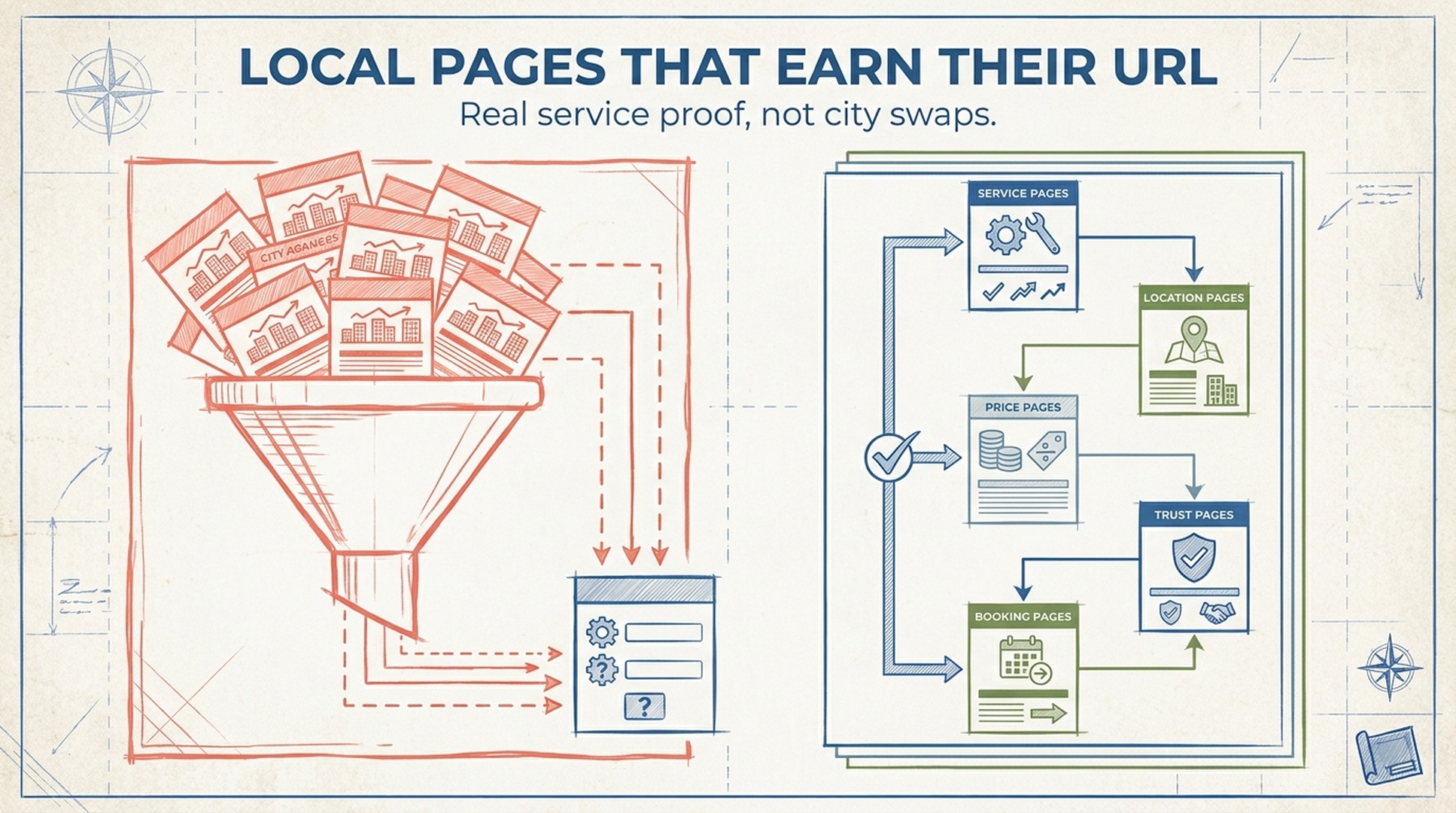
If changing only the city name would make two local pages identical, they probably should not be separate pages.
That is the simplest useful test for local service and location content. A page earns its URL when it gives a customer something materially different: a real location, a different service boundary, a distinct customer situation, different credentials or availability, a verified local project, a location-specific process, or a decision the reader cannot make from the existing page.
Google's spam policies call doorway abuse the creation of pages to rank for similar queries when they lead users to intermediate pages that are less useful than the final destination. Examples include pages targeting regions or cities that funnel visitors to one page, and substantially similar pages that sit closer to search results than a clear, browseable hierarchy.
The alternative is not "never create location pages." It is to create fewer pages with a clear customer job.
Page type | It deserves to exist when | It is a risk when |
|---|---|---|
Physical location page | The business has a real, customer-facing location with its own hours, contacts, access details, staff, services, and local customer path | It represents a virtual office, mailbox, warehouse, or city where customers cannot visit or be served |
Service-area page | The business can serve a defined area and the page explains actual boundaries, availability, process, and customer fit | It swaps city names while sending every visitor to the same generic form or page |
Service page | The business performs a distinct service that needs its own process, proof, pricing factors, limits, and booking path | It repeats the same broad service copy under minor keyword variations |
Scenario page | A meaningful customer situation changes the work, requirements, eligibility, risk, or decision | It is a thin rewrite created to catch every possible modifier |
Resource or selection guide | The question needs independent advice, preparation, comparison, or local process information | It exists only to insert city keywords and funnel to a sales page |
The page count should follow the operating reality of the business, not the number of cities available in a keyword tool.
Start with the local service truth
Before planning content, write down what the business can actually do. This is more useful than starting with a keyword list because it tells you which demand should be accepted, filtered, or declined.
Fact to confirm | Questions to answer | Where the fact should appear |
|---|---|---|
Service boundary | Which cities, neighborhoods, ZIP codes, or travel zones can be served? Which are excluded? | Business Profile, service-area page, booking form, quote process |
Operating model | Is this a storefront, service-area, hybrid, or multi-location business? | Business Profile, contact page, location page, local schema where accurate |
Service scope | What is included, excluded, referred out, or limited by property type, job size, regulation, or timing? | Service page, FAQ, quote flow, customer scripts |
Availability | Are same-day, emergency, weekend, appointment, delivery, or seasonal claims true? | Hours, booking page, emergency page, service page |
Proof | Which local projects, licenses, technicians, customers, reviews, photos, or partners can be shown truthfully? | Relevant service or location page, case page, review and credential sources |
Customer action | Should the person call, book, request a quote, visit, check eligibility, or read a guide first? | Page CTA and the next page in the customer path |
For service-area businesses, this work must agree with Google Business Profile rules. Google says a business that does not serve customers at its address should hide the address and use a service area. A service-area business should not create a public storefront narrative around a residence or virtual office. The website should clarify the actual customer path rather than use an address to imply a branch that does not exist.
Choose the smallest page architecture that answers the demand
Many local sites become hard to navigate because every city, service, and modifier gets its own URL. The customer sees near-duplicates. The team cannot keep hours, offers, service boundaries, and proof current. Search engines see a large set of pages with little independent value.
Start with a compact architecture and expand only when a page passes a value test.
A practical starting architecture
Business type | Core pages | Expand only when |
|---|---|---|
Single-location storefront | Homepage, location page, core service or product pages, booking/contact page, trust page, a few useful local guides | A distinct service, customer segment, or local question needs information the core pages cannot answer |
Service-area business | Homepage, service hub, core service pages, service-area explanation, quote/booking page, licensing/trust page, emergency or process page if real | A named market has distinct availability, process, proof, regulation, or customer need that can be documented |
Hybrid business | Storefront location page, service hub, on-site and off-site service pages, service-area explanation, booking page | The two customer paths have different operational facts and conversion routes |
Multi-location business | Location hub, one page per real location, shared service pages, location-specific service extensions only where material differences exist | The location has its own staff, access, hours, services, reviews, proof, or local process |
This is a hierarchy, not a factory. A user should be able to browse from a general service page to a real location or scenario page and understand why the next page exists.
Give each page a local evidence brief
Before drafting a location or service page, require a one-page evidence brief. If the team cannot fill it in, consolidate the page into a stronger existing asset.
Brief section | What must be supplied | Weak answer that should block publication |
|---|---|---|
Customer and intent | Who is the page for, and what decision are they making? | "People searching [city] [service]" |
Local fit | What true local condition changes the service or customer decision? | "We want to rank in this city" |
Operational facts | Service boundary, availability, price factors, access constraints, eligibility, and exclusions | Generic claims copied from the homepage |
Evidence | Local project, review theme, staff capability, partner, license, photo, data, or process proof | A city name inserted into stock text |
Distinct content | Which section could not appear on the sibling page without becoming inaccurate? | No answer or only a landmark paragraph |
Conversion boundary | What should qualified and unqualified visitors do next? | Every visitor goes to the same vague contact form |
Owner and review date | Who validates the facts, and when will they be reviewed? | No operational owner or freshness plan |
This brief connects content to operations. It also gives an agency permission to say no when a client asks for 100 location pages but has evidence for five.
The anatomy of a useful local service page
The order can vary, but a good page usually gives the customer enough context to decide whether to continue.
Page block | Customer question answered | Evidence needed |
|---|---|---|
Clear fit statement | "Is this service for me and my situation?" | Actual service scope, customer type, and limits |
Service area and access | "Can you help where I am?" | Named areas, travel boundary, store access, or appointment terms |
Process and timing | "What happens after I contact you?" | Real steps, timing ranges, emergency or scheduling conditions |
Price or quote factors | "What will affect the cost or approval?" | Honest factors, exclusions, and no invented local price claim |
Proof and trust | "Why should I believe you can do this?" | License, credential, local project note, review theme, staff role, or partner evidence |
Preparation or FAQ | "What should I do before I book or visit?" | Useful instructions, accessibility, documentation, safety, or policy information |
Next step | "What action should I take now?" | Call, booking, eligibility, directions, or quote path that matches the page |
For example, a page about emergency plumbing in a real service area can explain the types of issues accepted, what a caller should do before the technician arrives, the actual dispatch boundary, how after-hours availability works, what affects the estimate, and what information the caller should have ready. It should not promise an exact arrival time, use a nonexistent local address, or repeat the same paragraph across 40 cities.
Local proof is specific, not decorative
Local proof can be small. It does not need to expose customer information or create a full case study for every job. It does need to be true, relevant, and useful.
Proof type | Strong use | Weak use |
|---|---|---|
Local project note | Describe the service, general area, problem, process, and outcome with permission and appropriate privacy | Invent a customer story or use a vague "we serve this city" claim |
Staff or location detail | Identify actual qualifications, languages, accessibility, or local operating role | Add employee names without a reason or current verification |
Review theme | Summarize recurring, genuine feedback such as scheduling clarity or careful cleanup | Copy a review without permission or manufacture keyword-heavy testimonial text |
License or association | Link to a current verifiable credential that applies to the service or market | Display expired, irrelevant, or unverified badges |
Local partner or supplier | Explain a real relationship that affects service, warranty, product, or customer process | Add logo walls or reciprocal links with no customer explanation |
Local data or rule | Cite a current public source that changes a customer decision | Make unsupported claims about neighborhood demand, safety, or property values |
Google's people-first content guidance asks whether a site shows first-hand expertise and depth of knowledge, whether it has a primary focus, and whether readers learn enough to achieve their goal. These are useful editorial tests for local pages. They move the writer beyond landmarks and generic neighborhood descriptions toward facts that come from actually operating the service.
Thin page or useful page? Run the replacement test
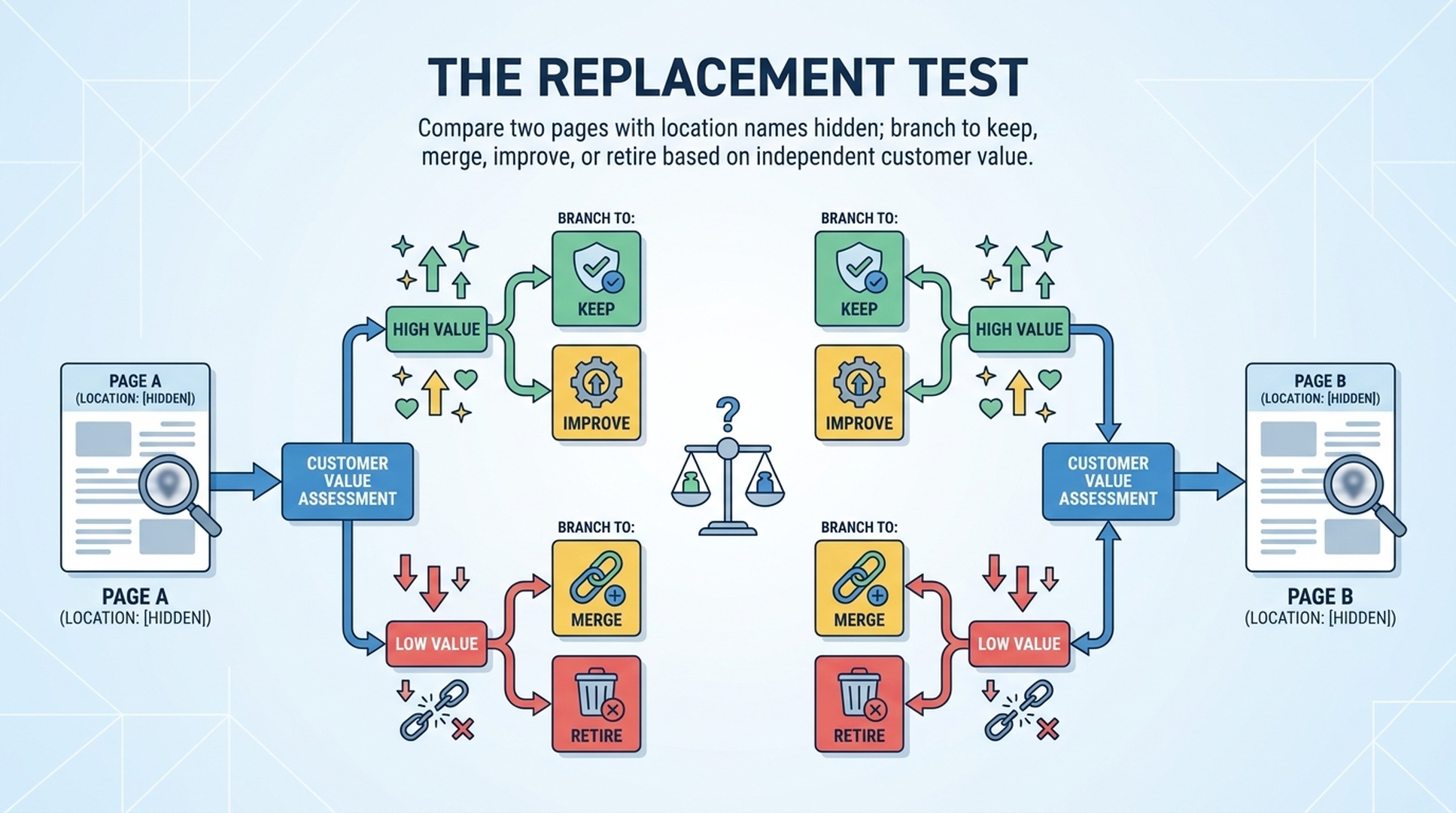
Before publishing, compare the draft against its nearest sibling page. Replace the city, service, or scenario name with a placeholder and read both versions side by side.
If you find this | Likely diagnosis | Better action |
|---|---|---|
More than half the sections remain identical | Near-duplicate location page | Merge into a regional or service hub and add one clear service-area explanation |
The only unique content is a city introduction or landmarks | Search-targeting copy, not customer value | Replace it with operational facts or do not create the page |
The page sends all visitors to another page before they can get useful information | Intermediate doorway behavior | Put the useful service, location, process, and booking information on the page itself |
The page claims local service but the team has no proof, hours, or boundary | Unsupported market targeting | Narrow the claim, collect proof, or remove the page |
A real location has different hours, access, services, and customer path | Independent customer value | Keep the page and maintain it as a real location asset |
A real service situation changes scope, cost, risk, or preparation | Independent customer value | Keep the page with a fact owner and review date |
The replacement test is more practical than counting words. A 300-word page with real local operating information can be more useful than a 2,000-word city rewrite.
Use page clusters instead of service-city multiplication
When one customer journey produces many related searches, map them to a small group of owner pages rather than a URL for every combination.
Query cluster | Better owner page | Supporting content |
|---|---|---|
"[Service] near me" and city variants | Core service page plus clear service-area section | Business Profile, local proof, booking path |
"Do you serve [neighborhood]?" | Service-area or location page | Neighborhood eligibility note and quote form |
"Emergency [service] in [area]" | Emergency service page | Current hours, safety steps, dispatch boundary, call path |
"How much does [service] cost in [area]?" | Pricing or quote-explainer page | Local factors, exclusions, estimate process, FAQ |
"Best [provider] for [property/customer type]" | Scenario or selection page | Fit criteria, capabilities, limitations, proof |
"Is [business] licensed or qualified?" | Trust and credentials page | License records, staff or partner evidence, service links |
This approach helps AI answer systems as well as customers. A platform can retrieve a focused page about an emergency, price factor, service boundary, or provider-selection question without needing to infer the answer from a stack of near-duplicate city URLs.
What structured data and internal links can do
Structured data can help express the visible facts of a page. Internal links can help people and search systems find the page. Neither makes a thin page independent or useful.
Use LocalBusiness and related markup only when it matches the visible business information. Keep navigation clear: a customer on a service page should be able to reach the relevant location, trust, pricing, booking, and FAQ content without using search again. Google says its AI features use the same foundational SEO practices as Search, including internal links, visible text, helpful content, and structured data that matches page content.
Avoid using schema to invent locations, reviews, services, or ratings. Avoid adding hundreds of footer links to city pages. A browseable hierarchy is safer for customers and directly addresses the doorway-page risk Google describes.
A page-production quality gate
Run this gate before a new local page goes live.
Gate | Pass condition |
|---|---|
Reality | The page's location, service, hours, and availability reflect actual operations |
Distinct value | It answers a customer decision that the nearest existing page cannot answer accurately |
Evidence | It includes at least one verifiable local or service-specific fact, proof element, or process detail |
Boundaries | It names relevant exclusions, service limits, travel conditions, or qualification steps where needed |
Conversion | It sends qualified users to an appropriate call, booking, directions, quote, or eligibility path |
Entity consistency | Business name, location model, contact route, and service claims match the Business Profile and canonical facts sheet |
Technical access | Page is indexable when intended, internally linked, mobile-usable, and free of misleading markup |
Ownership | A named person approves facts and a review date is recorded |
If the page fails distinct value or evidence, do not publish it as a new URL. Improve an existing page, create a more useful guide, or wait until the business has the facts to support a separate asset.
A 30-day local page cleanup
Use this plan when a site already has many city or service pages and the team needs a safer path forward.
Timeframe | Work | Owner | Output |
|---|---|---|---|
Days 1-5 | Inventory location, service, scenario, pricing, and emergency pages; map each to a real business fact and customer job | SEO lead and operations owner | Page inventory labeled keep, merge, rewrite, redirect, or retire |
Days 6-10 | Compare near-duplicates with the replacement test; identify doorway risks and broken customer paths | Content lead and SEO lead | Consolidation plan with target owner pages |
Days 11-20 | Rewrite the highest-value owner pages with operational facts, proof, boundaries, and clear next steps | Subject-matter owner and editor | Five to ten upgraded pages with fact approval |
Days 21-25 | Redirect, merge, or noindex pages that cannot earn an independent purpose; update internal links and navigation | SEO/development owner | Cleaner hierarchy and redirect or noindex log |
Days 26-30 | Test customer paths, priority local queries, and AI prompts; review qualified leads and content gaps | Operations, SEO, and customer-service leads | Next-quarter page backlog based on real demand and evidence |
Do not delete or redirect pages without checking analytics, links, conversions, and legal or customer-service dependencies. The goal is a clearer site, not a smaller sitemap for its own sake.
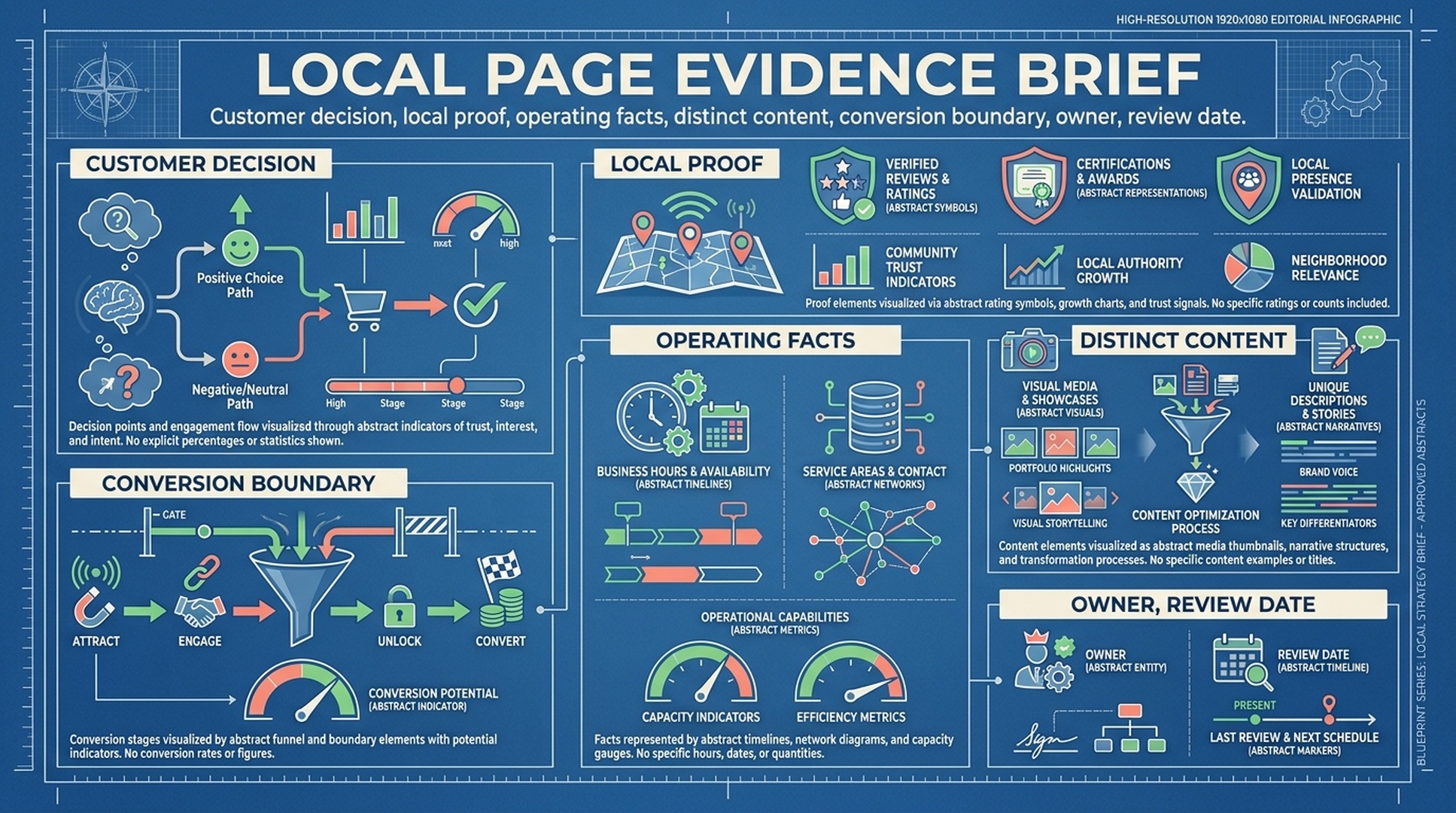
Use this framework to separate operational facts, customer trust, relevant evidence, and answer-quality checks.
Use the timeline as an operating sequence, not as a ranking guarantee.
FAQ
Are city landing pages bad for SEO?
No. A city or location page can be useful when it represents a real location, service boundary, customer process, or local evidence that differs from other pages. It becomes risky when it is substantially similar to other pages and exists mainly to capture city queries before sending visitors to the same destination.
What makes a local page a doorway page?
Google describes doorway abuse as pages created to rank for similar queries that lead users to intermediate pages less useful than the final destination. Examples include city or regional pages that funnel users to one page and substantially similar pages that sit closer to search results than a clear browseable hierarchy.
How many location pages should a service-area business have?
There is no universal number. Start with the pages required to explain the true service boundary, core services, process, trust facts, and customer action. Add a location page only when it has independent operational information or proof that helps a customer make a better decision.
Should every local service page mention a city name?
Use place names where they clarify a real service boundary, location, local process, or proof. Do not repeat them to create artificial relevance. The page should remain useful if a customer reads it rather than a search crawler.
Does LocalBusiness schema make a local page rank?
No. Structured data can help represent visible page information, but it does not make thin content useful or guarantee rankings. Use markup that matches the page and keep the Business Profile and website facts aligned.
Can a service-area business create a page for a city where it has no office?
It can create a useful page when the business genuinely serves the area and can provide distinct, truthful information about availability, process, customer fit, or proof. It should not imply that there is a storefront or office if there is not one, and it should not be a city-name rewrite that sends users to a generic page.
Continue the local search series
Use these related guides to move from diagnosis to an operating plan:
- Local search ranking factors in 2026
- Google Business Profile optimization in 2026
- Local citations after AI search
- Local GEO for AI search
Sources
- Google Search Central, Spam policies for Google web search. Source for Google's doorway-abuse definition and examples of city or region pages that funnel visitors and substantially similar pages that lack a clear browseable hierarchy.
- Google Search Central, Creating helpful, reliable, people-first content. Source for the people-first, first-hand expertise, depth, and user-goal questions used as editorial tests.
- Google Business Profile Help, Guidelines for representing your business on Google. Source for service-area, storefront, hybrid, and multi-location business rules.
- Google Search Central, AI features and your website. Source for foundational Search practices applying to Google AI features, including internal links, helpful content, visible text, structured-data accuracy, and current Business Profile information.
Author: Miles Donovan, Local AI Search Analyst Across 500+ Service Queries at Auspia. Miles writes about service-area visibility, local customer journeys, page quality, and practical ways to make a business easier for search and AI systems to understand.