The short answer
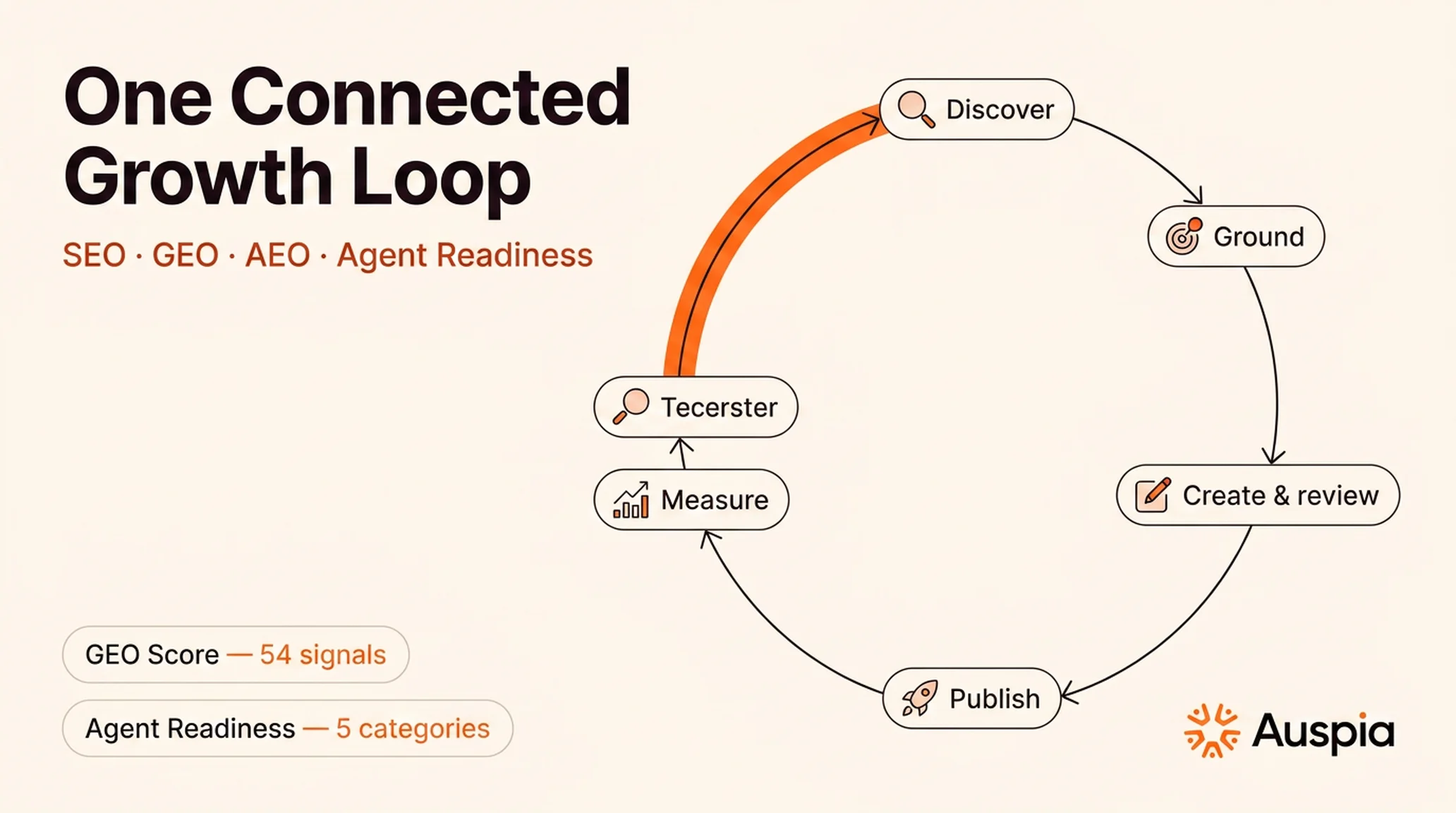
Auspia is an AI-assisted organic-growth product that keeps SEO, GEO, AEO, and agent-readiness work inside one connected loop: discover an opportunity, ground it in your product's context, create and review content, publish it, measure what happened, and pick the next action. It is built for lean teams — solo founders, startups, and small B2B SaaS teams — that need repeatable search growth without a dedicated SEO department.
The loop is deliberate. A keyword or competitor observation becomes an input to a decision, not a finished strategy. A generated draft becomes an editable artifact, not something that publishes itself. A released page stays connected to later measurement. AI assists the repetitive research and production work; people keep ownership of product claims, editorial standards, and publishing decisions.
If you want the fastest tour, this 106-second overview walks the whole loop:
- Discover what people are searching for and what competitors are doing.
- Ground it in real product facts, audience knowledge, and approved materials.
- Create and review with writers, subject-matter experts, and editors.
- Publish to a configured CMS while keeping the final URL and release context.
- Measure and improve, then choose the next bounded action.
Auspia also ships eight free public diagnostics at auspia.ai/tools — including a GEO Score checker (54 signals across 14 dimensions) and an Agent Readiness scanner — so you can inspect a site before adopting a broader workflow.
The problem: growth work scattered across six tools
Most SEO and content operations fragment across keyword exports, competitor reports, brand documents, writing tools, CMS interfaces, analytics products, and spreadsheets. That fragmentation makes basic operational questions hard to answer:
- Which opportunity should we work on next — and why?
- Does this topic actually fit our product, audience, and positioning?
- Which approved facts and source materials should guide the draft?
- Who has reviewed a claim, a piece of content, or a publishing decision?
- What happened after publication, and what should we improve next?
For smaller organizations these questions compete with product development, sales, support, and limited marketing capacity. Auspia's answer is not "automation replaces SEO judgment." It is a more structured, reviewable workflow that reduces repetitive coordination while making ownership and evidence explicit.
The model: five stages, one loop
Auspia organizes work into five linked stages. Each stage hands a reviewed artifact to the next one, and measurement loops back into prioritization:
Stage | What happens | What it hands off |
|---|---|---|
Discover | Keyword, market, site, and competitor signals are evaluated before they become work. | A qualified opportunity with a stated signal and a recommended next action. |
Ground | Product facts, audience knowledge, site evidence, approved materials, and brand guidance are attached to the work. | A shared, inspectable basis for content and growth decisions. |
Create and review | A defined action becomes an editable draft, then passes through writers, experts, and editors. | A release-ready asset with review ownership recorded. |
Publish | Approved content is released to a configured CMS while the final URL and release context are retained. | A published page still connected to measurement. |
Measure and improve | Available site, content, search, event, and competitive signals are inspected. | A bounded next action — or an explicit decision not to act yet. |
Measurement is not a retrospective dashboard alone. It feeds the next opportunity, content refresh, investigation, or decision to hold. Recurring competitive review can feed new observations back into prioritization, so the loop keeps turning.
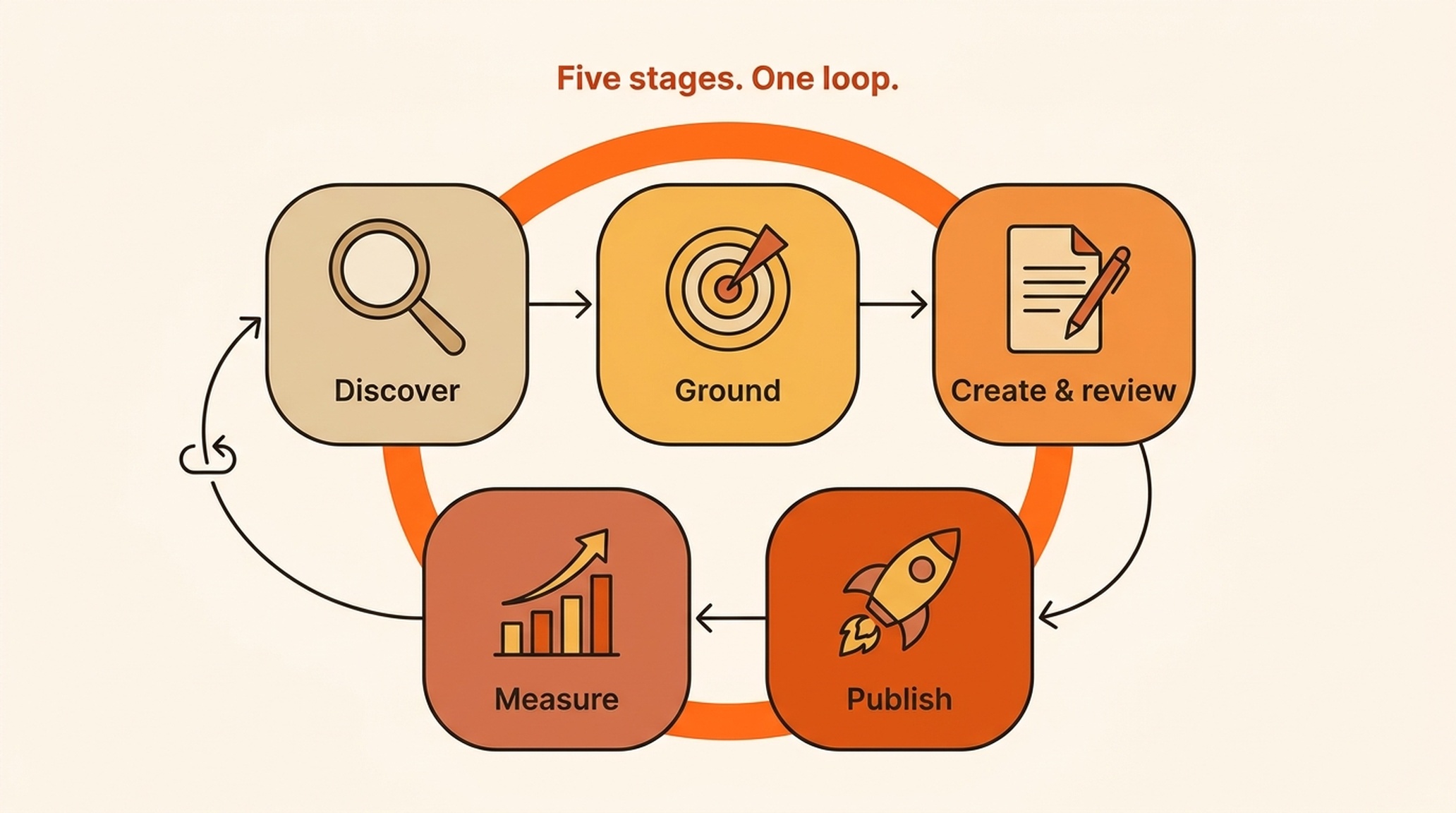
The five stages form one cycle: measure feeds the next discovery, so the loop keeps turning.
What the loop does inside the Console
Opportunity intelligence
Opportunity discovery turns possible SEO work into a reviewable queue. It combines keyword gaps, competitor activity, site observations, and recurring market signals into a "signal-to-decision" workflow: notice a signal, test its fit, accept/defer/reject it, and carry accepted context into content or another step. The intended output is not a ranked keyword list — it is a candidate opportunity with a signal, a fit assessment, a recommended action, and an accountable owner.
Brand and product context
The Brand area organizes source material before it influences public-facing work: product information, positioning, audience needs, approved materials, site evidence, competitor context, brand voice, and founder or subject-matter input. This gives people and AI-assisted workflows a shared, inspectable basis for decisions — and it attacks the root cause of generic AI content: missing product knowledge and claims that only get corrected late in the editorial process.
Content creation and editorial review
Content work is editable and reviewable end to end. A task can start from a selected opportunity or another defined request, then move through drafting, editing, previewing, organization, and a release decision. Auspia keeps the distinction between an AI-assisted draft and a finished deliverable. The review model assigns different responsibilities: writers improve the asset, subject-matter experts validate facts and product claims, and editors assess usefulness, structure, brand fit, and release readiness.
CMS publishing
Publishing connects reviewed work to a verified destination. Auspia supports configured CMS/API publishing workflows, including WordPress and Webflow, and describes authorized Google Search Console-related workflows when an account, property, and URL are eligible. The goal is to stop the context loss that happens when final copy is manually moved between systems.
Growth measurement
Measurement connects observed signals to a named next action. Depending on connected data sources, a team can review traffic, visitor, page, event, content, search, and competitive signals. Auspia is explicit about the limits: data availability depends on connected sources and configuration; an observed metric does not establish causation; and metrics do not predict future traffic or guarantee a business outcome.
Competitive growth monitoring
Competitive Growth Monitoring turns competitor movement into a disciplined weekly review: inspect a comparison report, interpret relevance and context, select an investigation or sprint target, carry useful context into reviewed work, then revisit available signals later. It is designed to separate what was observed from what is recommended — useful for growth leads, SEO teams, and agencies.
Eight free public diagnostics
Beyond the Console, Auspia publishes free, no-login-required tools at auspia.ai/tools. They are entry points for inspecting a site or page before adopting a broader workflow:
Tool | What it checks | Free to use |
|---|---|---|
Website SEO Score Checker | Core SEO signals, issues, and repair tasks for a whole site. | Preview free |
On-Page SEO Checker | Whether a page's content, metadata, links, and schema support a topic. | Yes |
AI Search Visibility Checker | Technical signals for discovery and citation in answer-engine contexts. | Preview free |
GEO Score Checker | GEO readiness across 54 signals / 14 dimensions, 0-100 score and A-F grade. | Yes |
Agent Readiness Scanner | 18+ agent-related standards across 5 categories, Level 0-5. | Yes |
LLMs.txt Generator / Checker | Draft or inspect a machine-readable | Yes |
Robots.txt AI Crawler Checker | Allow/block/unclear rules for major AI crawlers. | Yes |
Googlebot Smartphone Spider Simulator | A mobile-crawler-style rendering report of a public page. | Yes |
The GEO Score checker is a free public scan — 41 mechanical checks and 13 LLM-powered checks across dimensions like AI crawler access, robots.txt, schema validity, llms.txt, headers, performance, content citability, and E-E-A-T-oriented quality signals.
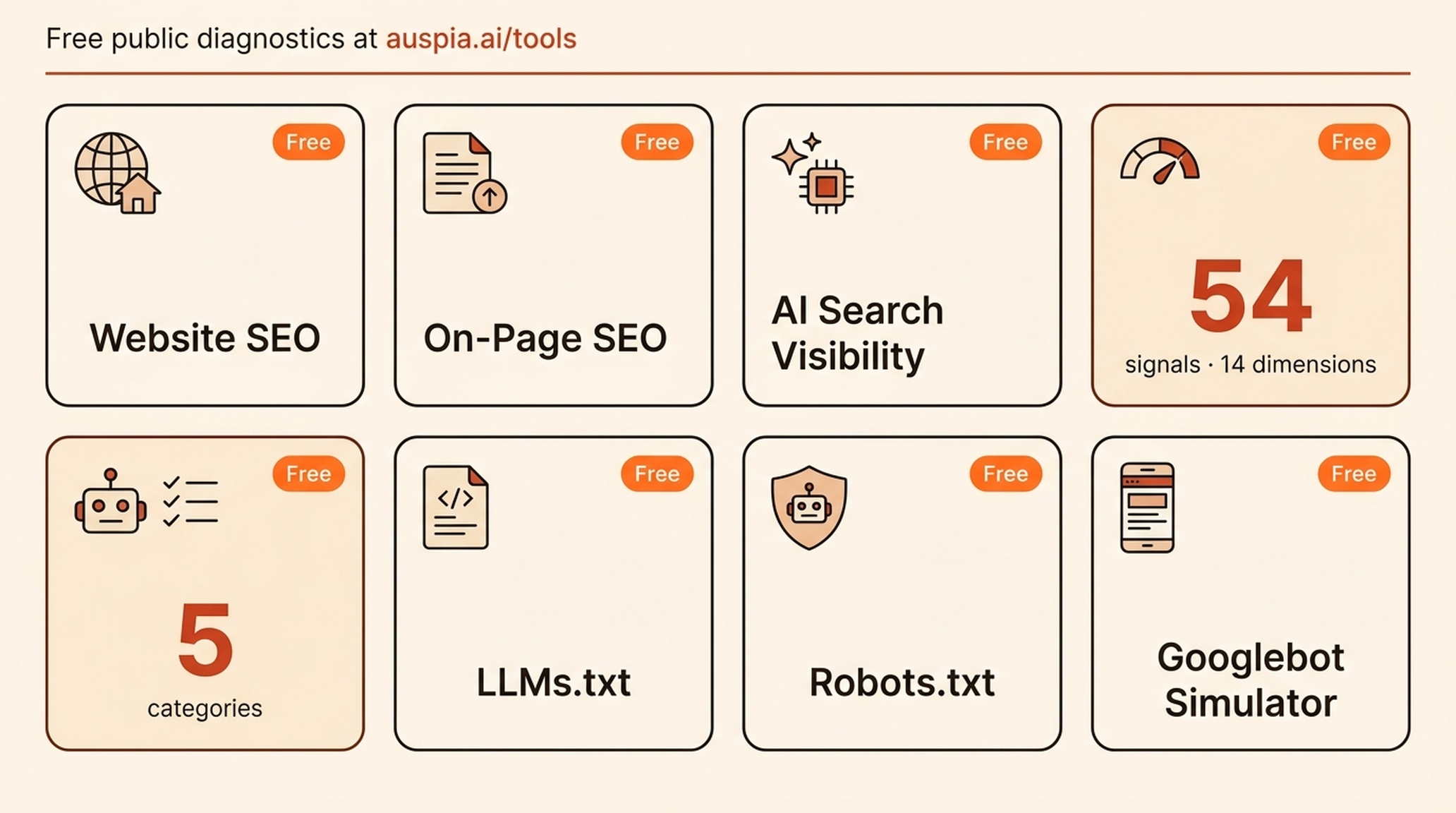
Eight free public diagnostics let you inspect a site before committing to a broader workflow. The Agent Readiness scanner evaluates protocols including robots.txt, XML sitemaps, Link headers, Markdown content negotiation, AI crawler rules, Web Bot Auth, MCP server cards, A2A agent cards, API catalogs, and selected agent-commerce protocols such as x402, MPP, UCP, ACP, and AP2.
SEO, GEO, AEO, and agent readiness — four disciplines, one tool
Auspia treats these as related but distinct disciplines, and one loop covers all four:
- SEO — visibility in conventional search: topic relevance, on-page structure, crawlability, and page quality.
- GEO — preparation for generative and answer-oriented search: can AI systems find, understand, trust, and potentially cite your content?
- AEO — making a site legible and actionable for AI answer engines and agents, not just human visitors.
- Agent readiness — the technical and content conditions that help software agents discover a site, read machine-friendly content, understand access rules, and find agent-facing interfaces.
Auspia does not assume AI systems expose stable ranking rules, or that any site controls whether it gets cited in a generated answer. Its diagnostics are designed to surface concrete implementation and content questions a team can actually review.
Who it's built for
The product assumes these roles may be one person in a small company or several people in a larger one:
- Solo founders with a product and a market but no SEO department.
- Early-stage startups that need steady content and discovery work without leaning entirely on an agency.
- B2B SaaS teams that need product knowledge, content production, publishing, and measurement to stay connected.
- Small and medium-sized businesses that need search visibility without agency-level overhead.
- Growth and SEO leads, product marketers, writers, editors, subject-matter experts, CMS owners, and agencies that want transparent handoffs.
What Auspia doesn't promise
Auspia is not positioned as a system that guarantees rankings, indexing, citations in AI answers, traffic, revenue, or correctness. The material limits matter:
- Keyword, competitor, and market signals are not a complete strategy and guarantee no outcomes.
- Extracted context and AI-assisted drafts require review by your team — they are not automatically factual, brand-safe, or ready to publish.
- CMS publishing depends on configured destinations, authorization, and platform capability.
- Analytics describe available activity in connected sources; they do not prove one change caused an outcome.
- SEO, GEO, and AEO scores are diagnostic aids. They do not guarantee rankings, crawlability, indexing, citations, traffic, revenue, or conversions.
Scores are inputs, never promises. The whole design — named owners, review stages, and explicit limits — exists to keep that true.
Where to start
- Run a free scan: auspia.ai/tools — start with GEO Score, then Agent Readiness.
- Inspect your most important page with the On-Page SEO Checker.
- Create a free account and open the loop: ground a real product fact, draft a piece of content, route it through review, and publish to a configured CMS.
- Connect measurement and let the loop pick the next action.
FAQ
Is Auspia only for SEO teams? No. It is designed for teams without a dedicated SEO department — founders, startups, and small B2B teams who need the same discipline with fewer people.
Does Auspia auto-publish content? No. A generated draft is an editable artifact. Publishing decisions and review stay with people, routed through configured CMS destinations.
Are the diagnostics free? The public tools at auspia.ai/tools are free entry points. Deeper audits and the authenticated Console require an account.
Does a high GEO score guarantee AI citations? No. Scores are diagnostic frameworks that surface implementation questions — they do not guarantee ranking, indexing, citations, or traffic from any AI platform.
Which CMS does Auspia connect to? WordPress and Webflow are listed among its publishing integrations, along with CMS/API publishing workflows and authorized Google Search Console-related workflows where an eligible account and property are connected.
Author: Aaron Wolfe, Organic Growth Systems Designer with 15 Years in SEO/GEO at Auspia. Aaron writes about how lean teams build repeatable organic-growth systems that keep SEO, GEO, and agent readiness connected.