The short version
AI shopping assistants do not recommend the loudest brand. They recommend the brand they can understand, verify, and match to a specific buyer problem.
That is the uncomfortable 2026 shift. A brand can have great Amazon reviews, strong TikTok reach, paid search spend, and a polished website, then still disappear when a buyer asks ChatGPT, Google AI Mode, Perplexity, Gemini, or another assistant for a shortlist. The missing piece is not another keyword page. It is trusted, consistent information across the places AI systems can read.
For ecommerce and B2B teams, GEO is not "SEO with AI words." GEO is the work of making your brand legible inside AI-mediated decisions. The old goal was to win a click. The new goal is to become a reliable candidate when an AI system condenses the market into three or four options.
Why this matters more in 2026
AI shopping has moved from novelty to buying infrastructure. In 2025, OpenAI added shopping experiences to ChatGPT, Google expanded AI Mode with shopping-style research flows, and Perplexity pushed deeper into product discovery and checkout-style workflows. See the official updates from Google AI Mode and the announcement pages for ChatGPT shopping updates and Perplexity Shopping for the direction of travel. By 2026, buyers are more comfortable asking an assistant for "the best CRM for a 20-person agency," "a carry-on that fits European budget airlines," or "a security camera that works without a subscription."
That one prompt compresses what used to be a long journey:
Old buying path | AI-assisted buying path |
|---|---|
Search a keyword | Ask a situation-specific question |
Open 10 tabs | Read one synthesized answer |
Compare brand sites, reviews, videos, and marketplaces | Let the assistant merge those sources |
Click ads and rankings | Pick from a shortlist |
Decide after repeated exposure | Decide after AI framing |
The practical danger is simple: if your brand is not in the shortlist, the buyer may never know you were an option.
The single-channel trap
Here is the part many teams miss. Being excellent on one channel can make the problem harder to see.
A DTC kitchen brand may dominate Instagram. A SaaS company may own Google Ads for its category. An Amazon-native brand may have thousands of marketplace reviews. A founder-led service business may get most leads from LinkedIn. Those channels can still produce revenue. They just do not automatically produce AI trust.
AI systems look for corroboration. They compare official pages, product feeds, review sites, media coverage, community discussions, comparison pages, social content, and marketplace data. If your brand appears strongly in one place but weakly everywhere else, the assistant has less confidence.
A buyer does not ask, "Which brand spent the most on one channel?" They ask, "Which product should I trust for this job?" The assistant then tries to answer from the evidence it can retrieve.
GEO is not the next SEO
SEO and GEO overlap, but they are not the same job.
Question | SEO answer | GEO answer |
|---|---|---|
Primary target | Search ranking and click-through | Inclusion and framing in AI answers |
Unit of optimization | Page, keyword, snippet | Entity, claim, source network, use case |
Main evidence | Relevance, authority, links, technical access | Consistent facts, third-party proof, user language, source confidence |
User behavior | Query, scan, click, compare | Ask, receive synthesis, refine, choose |
Failure mode | Low rankings | Brand absent, misdescribed, or not trusted |
Measurement | Rankings, impressions, clicks, conversions | Share of answer, citation quality, recommendation frequency, claim accuracy |
Traditional SEO asks, "Can we rank for this query?" GEO asks a different question: "When an AI assistant answers this buyer's problem, does it understand why we belong in the answer?"
That distinction matters because old SEO shortcuts often fail in GEO. More keyword pages do not fix unclear positioning. More backlinks do not fix contradictory product facts. More social posts do not fix missing third-party evidence. More ads do not fix a review ecosystem that says something different from your homepage.
How AI builds confidence in a brand
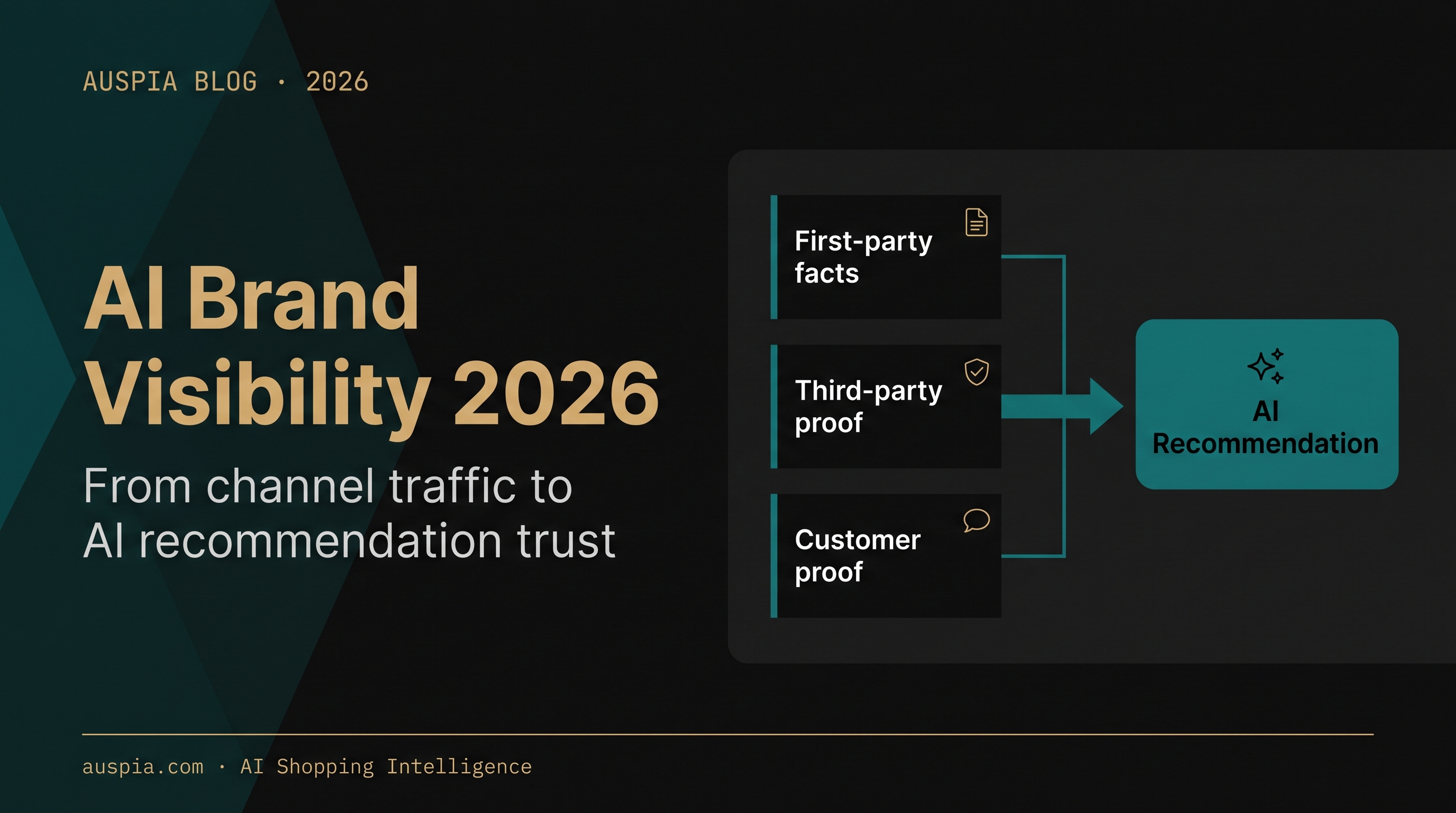
Think of AI recommendation confidence as a stack. The assistant needs enough evidence at each layer before it can recommend a brand without sounding reckless.
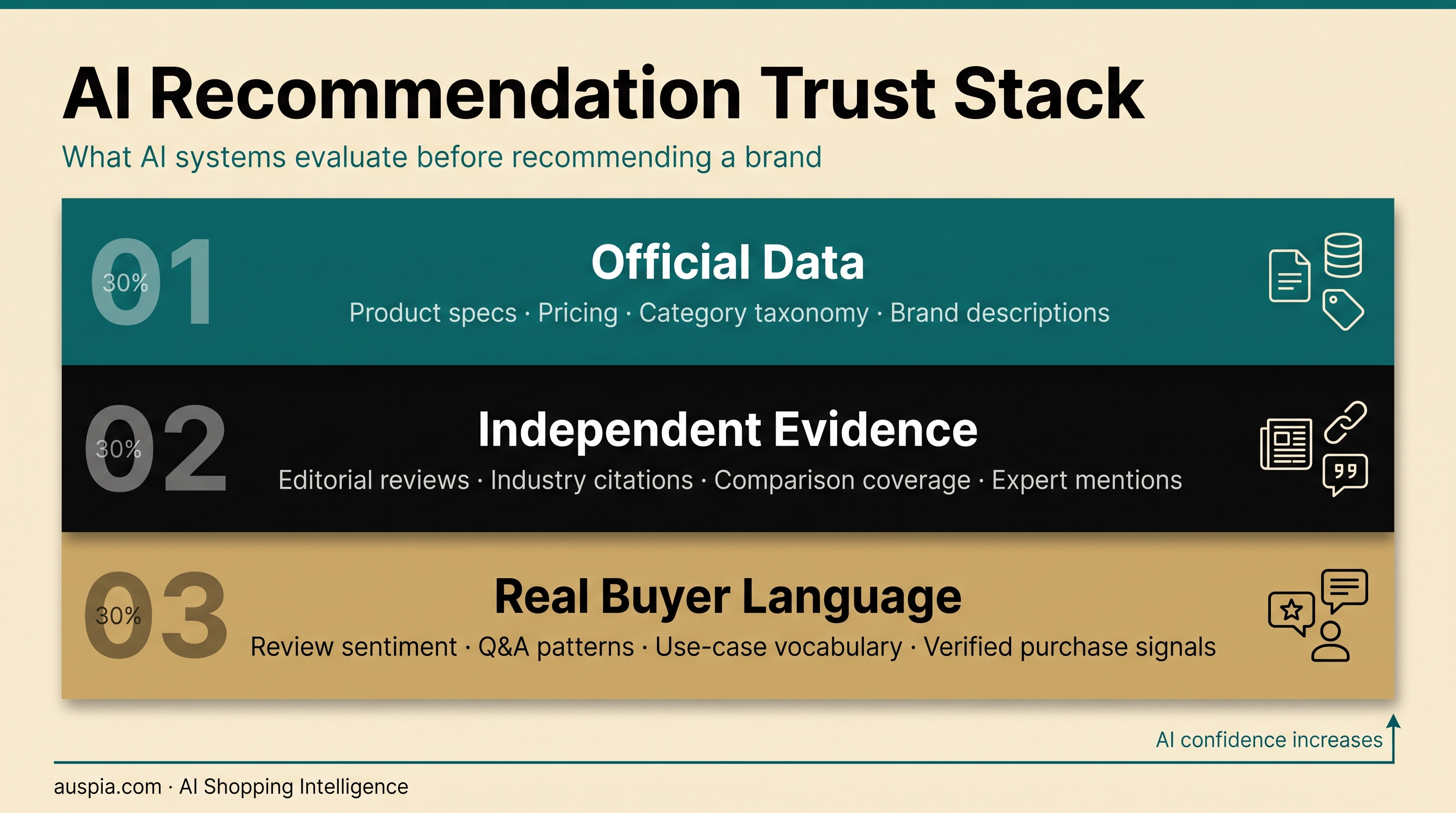
The stack has three layers.
First-party facts are the facts you control: product names, use cases, specs, pricing, locations served, integrations, availability, support policies, comparison pages, documentation, schema, and product feeds. These facts should be complete and crawlable.
Independent evidence is the proof you do not fully control: expert reviews, partner pages, analyst mentions, media coverage, directory profiles, industry citations, credible comparisons, and customer case studies hosted outside your own site. This is where many single-channel brands are thin.
Real buyer language is what customers say when they are not repeating your positioning deck. Reviews, Reddit discussions, forum threads, marketplace Q&A, YouTube comments, community posts, and support questions show the words buyers actually use. AI systems can use this language to connect your brand with situations, pain points, and tradeoffs.
You do not need perfect coverage everywhere. You do need enough consistency that an assistant can join the dots.
Four reasons AI shopping assistants skip brands
1. The category is too blurry
AI struggles with vague brands. If your homepage says you are an "all-in-one growth platform," your ads say "AI automation software," your app store listing says "CRM assistant," and reviews call you "email outreach software," the assistant has to guess where you fit.
A focused category is easier to recommend. "AI meeting notes for customer success teams" is more usable than "productivity for modern teams." "Subscription-free outdoor security cameras" is more useful than "smart home innovation."
2. The content does not match real prompts
Buyers rarely ask AI the way marketers write landing pages. They ask with constraints:
- "Which standing desk works for a small apartment and a 27-inch monitor?"
- "What payroll software handles contractors in the US and Canada?"
- "Which dog food is better for a senior Labrador with grain sensitivity?"
- "What project management tool is easiest for a non-technical agency team?"
If your site only says "enterprise-grade performance" and "seamless workflows," there is not much for the assistant to use. GEO-ready content answers messy, specific questions in plain language.
3. The facts change across sources
Inconsistent facts are poison for AI recommendations. A product page says the free plan includes five seats. A pricing page says three. A marketplace listing says ten. A review article from last year says the feature is unavailable. A help doc uses an old product name.
Humans may forgive the mess. AI systems often downgrade confidence or avoid making a recommendation.
4. There is no neutral proof
A brand's own website is necessary, but it is not enough. AI assistants need evidence that someone else has evaluated, used, compared, cited, or discussed the brand. That does not mean chasing low-quality PR. It means building the kinds of sources a buyer would trust: credible reviews, real case studies, partner references, industry directories, comparison pages, and detailed customer feedback.
A 2026 GEO readiness check
Use this as a quick diagnostic. If you fail two or more items, your AI visibility problem is probably structural, not tactical.
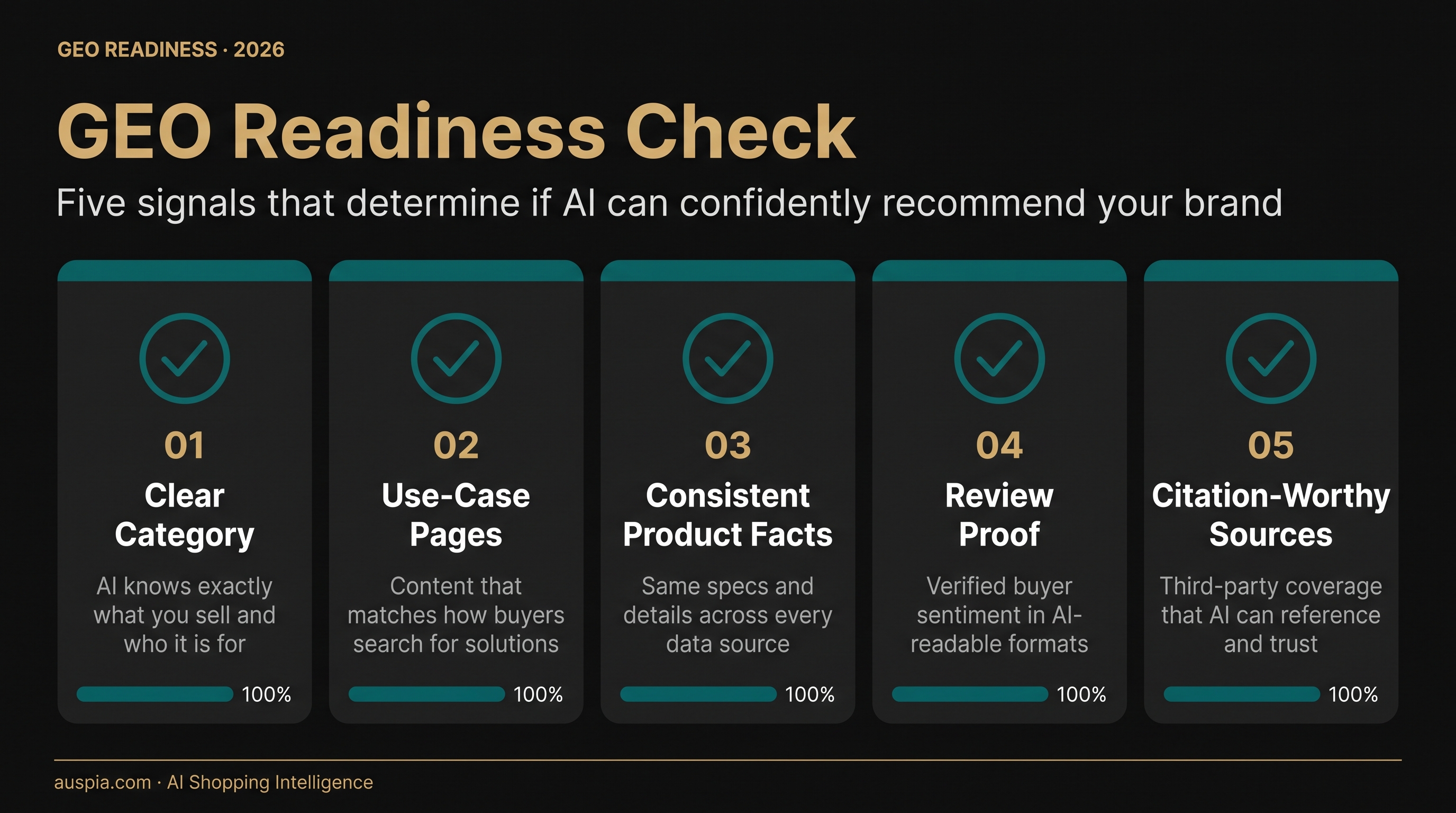
Signal | Pass condition | Common failure |
|---|---|---|
Clear category | A non-expert can describe what you sell and who it is for in one sentence | The brand uses broad platform language with no buying context |
Use-case pages | Your site answers buyer prompts with constraints, examples, and tradeoffs | Content is built around internal product features only |
Consistent product facts | Specs, pricing, availability, and claims match across major sources | Old pages, marketplaces, directories, and docs conflict |
Review proof | Buyers discuss real use cases, outcomes, and limitations | Reviews are thin, generic, or trapped on one platform |
Citation-worthy sources | Third-party pages explain what you do accurately | Mentions are shallow, outdated, or missing |
What brands should do next
Start with a prompt audit. Build a list of 30 to 50 buying prompts your customers might ask an assistant. Include use cases, budget constraints, geography, objections, alternatives, integrations, and problem language. Then test those prompts in the AI systems your buyers are likely to use.
Record four things for each prompt:
Prompt audit field | What to capture |
|---|---|
Was your brand mentioned? | Yes, no, or indirectly |
How was it described? | Category, strengths, weaknesses, target user |
What sources appeared? | Your site, review sites, forums, publications, directories |
What was missing or wrong? | Facts, positioning, comparisons, proof, pricing, use cases |
After the audit, fix the evidence network in this order.
- Rewrite your category sentence. Say what you sell, who it is for, and when it is the right fit.
- Clean your first-party facts. Update product pages, pricing, docs, schema, feeds, marketplace listings, and directories.
- Build use-case pages around buyer prompts. Answer the real question first, then explain where your product fits and where it does not.
- Earn neutral evidence. Prioritize credible reviews, partner listings, comparison coverage, case studies, and category pages that AI systems can cite.
- Mine customer language. Use reviews, support tickets, sales calls, community discussions, and Q&A to find the words buyers use.
- Track share of answer monthly. GEO work compounds slowly, so measure mentions, citations, accuracy, and recommendation quality over time.
If you need a starting point, run your site through an AI Search Visibility Checker and compare the results with your own prompt audit. The tool output is not the whole strategy, but it will show where the evidence trail is weak.
The Auspia take
Do not treat GEO as a panic project. Treat it as a brand evidence project.
The brands that win AI recommendations in 2026 will not be the ones that stuff the most AI keywords into blog posts. They will be the brands with clear categories, specific use cases, consistent data, and enough independent proof for an assistant to feel safe recommending them.
There is also good news. GEO exposes problems that already hurt conversion: unclear positioning, weak reviews, outdated directories, vague content, messy product data, and missing proof. Fixing those issues helps AI systems, but it also helps humans decide faster.
FAQ
What is AI brand visibility?
AI brand visibility is the degree to which AI assistants can find, understand, mention, and accurately recommend a brand in response to relevant buyer questions.
Is GEO just SEO for ChatGPT and AI search?
No. SEO focuses on ranking pages in search results. GEO focuses on making a brand, product, or answer easy for AI systems to retrieve, verify, synthesize, and recommend. Good technical SEO helps, but it is only one layer.
Why can a popular brand be missing from AI recommendations?
Popularity on one channel does not guarantee cross-source trust. A brand may be strong on Amazon, TikTok, LinkedIn, or paid search, but still lack consistent official facts, neutral coverage, and buyer-language evidence across the wider web.
How often should teams run AI visibility checks in 2026?
For active categories, monthly is a practical cadence. Run the same prompt set, record whether your brand appears, check how it is described, and note which sources AI systems cite or appear to rely on.
What is the first GEO task for an ecommerce brand?
Start by cleaning product facts across your own site, marketplaces, review platforms, and major directories. Then create use-case content that answers the specific buying questions customers ask AI assistants.
Author: Adrian Cole, Analyst of 1,000+ AI Search Results at Auspia. Adrian writes about how brands appear in ChatGPT, Perplexity, Gemini, Google AI Overviews, and other answer surfaces.