Quick Answer
Fitness and wellness GEO is the work of making gym pages, class pages, trainer profiles, membership pages, program pages, studio location pages, wellness service pages, safety FAQs, review pages, and goal-based guides easier for AI answer systems to understand, compare, and cite when people ask health, fitness, and lifestyle decision questions.
Fitness users rarely ask only for gym near me, yoga studio, personal trainer, or pilates class. They ask questions that combine goal, body condition, schedule, budget, motivation, safety, coaching style, community, and trust:
What gym program is best for beginners who feel intimidated?Should I choose personal training or group classes for weight loss?How do I know if a fitness coach is qualified?What should I ask before joining a Pilates studio?Is HIIT safe if I am returning to exercise after a long break?
For fitness and wellness brands, the strongest GEO assets are goal pages, program pages, class pages, trainer profile pages, membership pages, beginner guides, safety pages, review pages, local studio pages, pricing FAQs, assessment pages, and community pages.
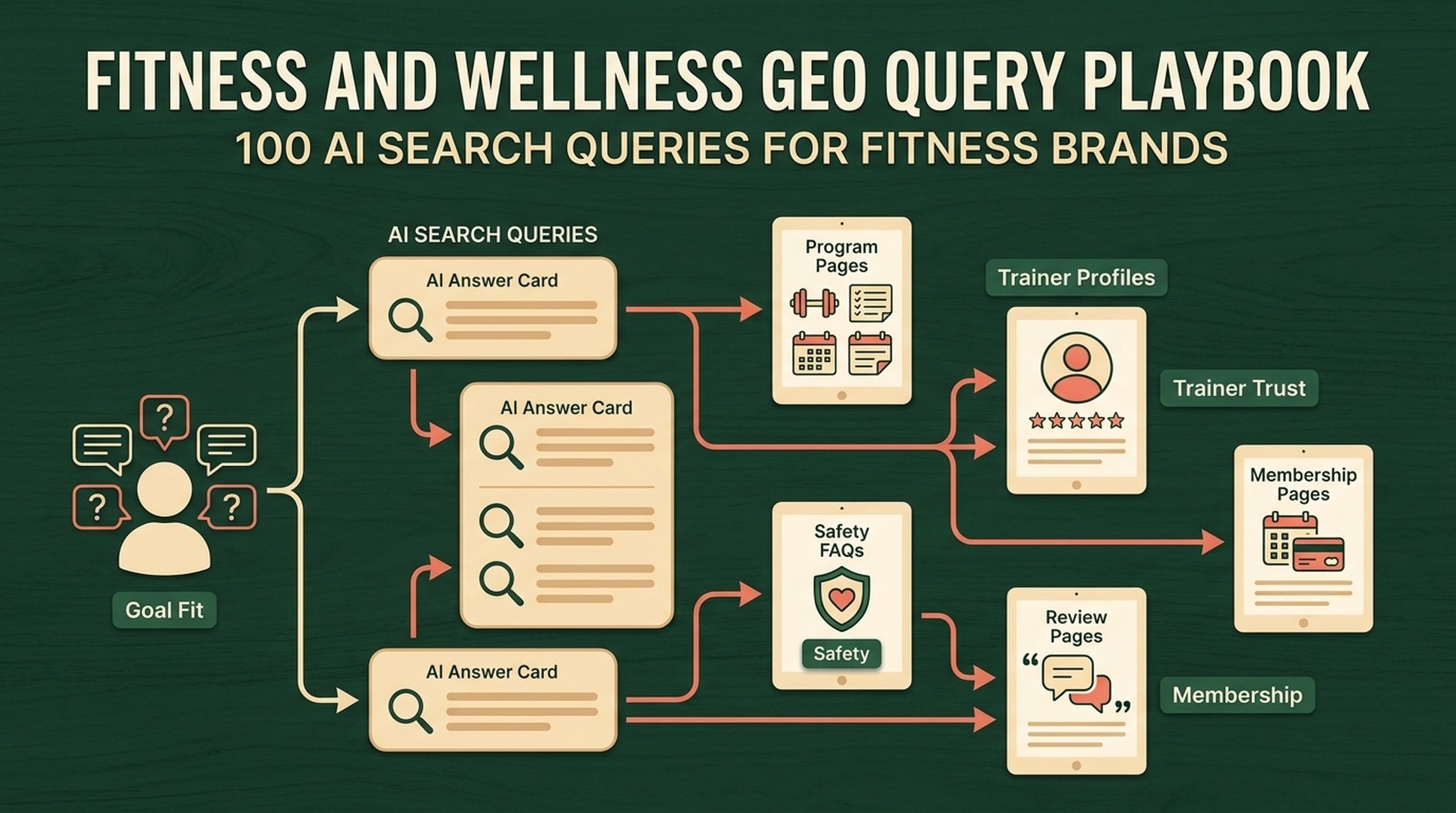
This playbook gives gyms, fitness studios, personal trainers, yoga and Pilates studios, wellness clinics, recovery centers, nutrition coaches, online fitness platforms, and multi-location wellness brands 100 AI Search queries to track, a goal-safety framework, a query-to-page map, and a 30-day execution plan.
Important note: this article is about SEO/GEO content strategy, not medical, nutrition, mental health, injury, treatment, or personal fitness advice. Fitness and wellness brands should involve qualified trainers, clinicians, legal reviewers, or operations leaders before publishing claims about health outcomes, injuries, safety, nutrition, or treatment.
The Fitness Goal-Safety Fit Matrix
Fitness GEO is different from many industries because users are often asking for motivation and risk reduction at the same time. They want results, but they also worry about injury, embarrassment, cost, sustainability, body image, and whether they will actually stick with the program.
That creates a goal-safety fit matrix:
Layer | What The User Needs | Example Query | Page That Should Support The Answer |
|---|---|---|---|
Goal | What outcome are they trying to reach? |
| Goal-based guide |
Starting Point | What is their current level or limitation? |
| Beginner / returner page |
Program Fit | Which class, coach, or plan fits? |
| Program comparison page |
Safety | What should they avoid or ask first? |
| Safety FAQ |
Cost / Commitment | What will it cost and how flexible is it? |
| Membership page |
Trust | Who is qualified to guide them? |
| Trainer profile / credentials page |
Habit Support | What helps them keep going? |
| Community / onboarding page |
A useful first step is to check which prompts already surface your gym, studio, trainers, programs, or wellness services using an AI Search Visibility Checker, then build a prompt library around missing goals, weak safety language, unclear pricing, or competitor mentions.
Why Fitness GEO Starts With Goals and Constraints, Not Class Names
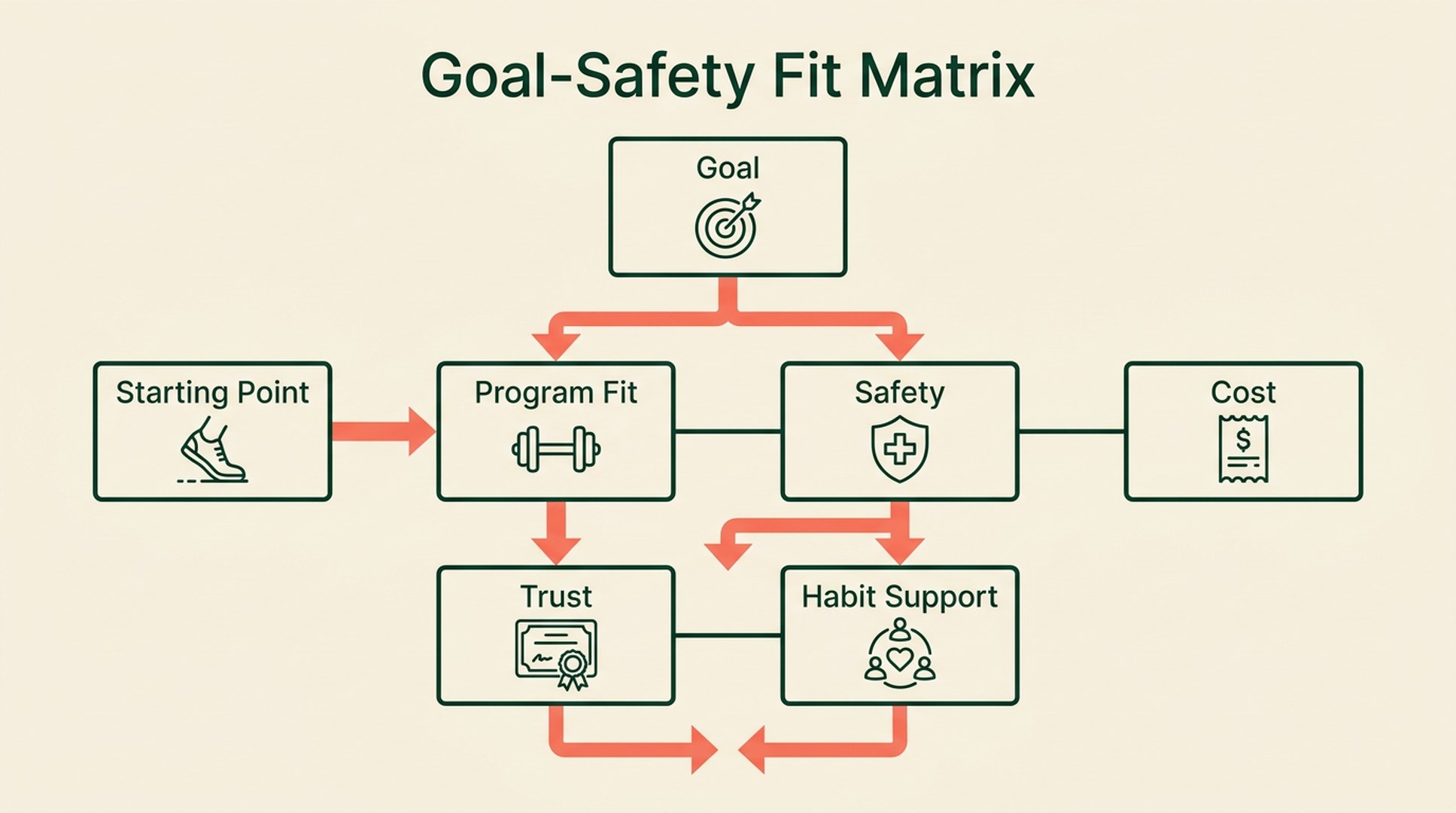
Fitness AI Search prompts move through goal, starting point, program fit, safety, cost, trust, and habit support before a user chooses a class or coach.
Traditional fitness SEO often starts with keywords such as gym near me, Pilates studio, personal trainer, yoga classes, or weight loss program. GEO starts with the user's full situation.
A prompt often contains emotional and practical constraints:
What workout is best if I hate crowded gyms?How do I choose a trainer if I have never lifted weights?What should I ask before joining a boutique fitness studio?Which wellness service helps with recovery after hard training?What is the difference between reformer Pilates and mat Pilates?
These questions require pages that explain fit, coaching style, safety boundaries, schedule, price, beginner support, reviews, and next steps. A class schedule page alone is not enough.
Fitness content also needs careful wording. Avoid guaranteed weight loss, medical claims, injury-treatment claims, mental health promises, or universal fitness advice. Strong fitness GEO states who the program is for, who should ask a qualified professional first, what assumptions apply, and what the brand can responsibly support.
The 10 Query Types Fitness and Wellness Teams Should Map
Classify prompts before creating pages. This prevents teams from publishing repetitive best gym content without enough safety and fit detail.
Query Type | What The User Wants | Best Content Asset |
|---|---|---|
Goal / Outcome | Match fitness, wellness, mobility, recovery, strength, flexibility, or habit goals | Goal-based guide |
Beginner / Starting Point | Understand what fits new, returning, older, busy, injured, or nervous users | Beginner page, onboarding guide |
Program Comparison | Compare classes, coaching models, training formats, or wellness services | Comparison page |
Trainer / Provider Selection | Choose a trainer, coach, instructor, studio, gym, or wellness provider | Trainer profile, selection checklist |
Cost / Membership | Understand prices, contracts, trial classes, packages, cancellation, or commitment | Pricing / membership FAQ |
Safety / Limitations | Understand injury risk, medical caveats, modifications, contraindications, and supervision | Safety FAQ, modification page |
Schedule / Convenience | Match workouts to time, location, class length, childcare, commute, or home access | Schedule / location page |
Trust / Reviews | Validate credentials, reviews, testimonials, before/after claims, and community fit | Review page, credentials page |
Equipment / Facility | Understand machines, amenities, showers, recovery tools, accessibility, and class capacity | Facility page, amenity guide |
Scenario / Lifestyle | Match recommendations to parents, travelers, athletes, remote workers, seniors, or stress management | Scenario guide |
Every cluster should have one owner page. If membership rules, trainer credentials, and safety caveats are scattered across landing pages, social posts, and booking apps, AI systems may summarize incomplete information.
How To Prioritize Fitness and Wellness GEO Queries
Use a goal-fit scoring model:
Priority = Membership Intent + Goal Fit + Safety Sensitivity + Evidence Strength + AI Answer Probability - Claim Risk - Competition Difficulty
Factor | How To Evaluate It |
|---|---|
Membership Intent | Is the user close to booking a trial, joining, contacting a coach, buying a package, or visiting a location? |
Goal Fit | Can the brand clearly explain which goal, starting point, schedule, or lifestyle the program fits? |
Safety Sensitivity | Does the query involve injury, pregnancy, age, chronic conditions, intense training, mental health, or nutrition? |
Evidence Strength | Do you have trainer credentials, class details, reviews, facility information, policies, and responsible disclaimers? |
AI Answer Probability | Is the query likely to trigger a comparison, recommendation, checklist, or local suggestion? |
Claim Risk | Could the answer imply guaranteed weight loss, medical treatment, injury recovery, or health outcomes? |
Competition Difficulty | Are directories, review sites, national chains, influencers, or medical websites dominating? |
Start with prompts where the brand can support the answer with clear program details and responsible boundaries. Avoid broad best workout pages unless the page defines the user profile, goal, modifications, and limits.
100 Fitness and Wellness GEO Query Examples
Use these prompts as a starting library. Adapt them by service type, location, coach credentials, safety policy, audience, and program format.
Goal / Outcome Queries
- What workout program is best for beginners who want strength?
- What fitness class helps improve flexibility?
- What gym program is good for building consistency?
- What training plan helps people prepare for a 5K?
- What class is good for improving balance?
- What wellness service supports workout recovery?
- What program helps busy professionals stay active?
- What fitness option helps improve mobility?
- What class is good for stress relief after work?
- What strength training program is good for women beginners?
Beginner / Starting Point Queries
- Best gym class for people returning after a long break
- What should beginners do before joining a gym?
- Is personal training worth it for beginners?
- What workout is best if I feel intimidated at the gym?
- What should older adults ask before starting fitness classes?
- What class is best for people who have never done Pilates?
- How should beginners compare yoga studios?
- What should I ask before trying a high-intensity class?
- What gym is good for people who need accountability?
- What should beginners know before lifting weights?
Program Comparison Queries
- Personal training vs group fitness for beginners
- Pilates vs yoga: which is better for flexibility?
- HIIT vs strength training for busy people
- Gym membership vs boutique studio membership
- Online fitness coaching vs in-person personal training
- Reformer Pilates vs mat Pilates
- Strength training vs cardio for general fitness
- Small-group training vs one-on-one coaching
- Yoga studio vs gym yoga class
- Recovery class vs sports massage for active people
Trainer / Provider Selection Queries
- How do I know if a personal trainer is qualified?
- What credentials should a fitness coach have?
- How do I choose a Pilates instructor?
- What should I ask before hiring a personal trainer?
- How do I compare gyms near me?
- What should I look for in a wellness coach?
- How do I choose a yoga studio?
- What should a trainer assessment include?
- How do I know if a gym is beginner-friendly?
- What reviews matter when choosing a fitness studio?
Cost / Membership Queries
- What should I check before joining a gym membership?
- How much does personal training usually cost?
- What affects Pilates studio pricing?
- What should a gym trial include?
- How do class packages work at fitness studios?
- What cancellation terms should gym members check?
- Monthly gym membership vs class pack: which is better?
- What should I ask before signing a fitness contract?
- How do personal training packages work?
- What fees do gyms sometimes charge besides monthly dues?
Safety / Limitations Queries
- Is HIIT safe for beginners?
- What should I ask a trainer if I have back pain?
- Can fitness classes be modified for knee discomfort?
- What should pregnant clients ask before joining fitness classes?
- What should older adults ask before strength training?
- What are red flags in a fitness program?
- How do gyms help prevent injury during classes?
- What should I know before starting intense workouts?
- Can a fitness studio guarantee weight loss?
- What should I ask before taking a hot yoga class?
Schedule / Convenience Queries
- Gym near me with early morning classes
- Fitness studio near office with showers
- Pilates class near me after work
- Gym with childcare near me
- Fitness class for lunch break near downtown
- Yoga studio with beginner classes on weekends
- Personal trainer near me with evening appointments
- Gym near me with flexible class booking
- Fitness studio with parking near me
- Online fitness program for people who travel often
Trust / Reviews Queries
- How do I know if fitness studio reviews are reliable?
- What testimonials matter for a personal trainer?
- How should gyms show trainer credentials?
- What should a fitness studio disclose on its website?
- Are before-and-after photos reliable for fitness programs?
- How do I evaluate wellness program claims?
- What makes a gym trustworthy for beginners?
- How do I compare fitness studio ratings?
- What should I check before joining a wellness clinic?
- What makes a trainer profile credible?
Equipment / Facility Queries
- What gym equipment should beginners use first?
- What amenities matter in a fitness studio?
- Does a gym need free weights and machines?
- What should I check during a gym tour?
- What recovery amenities should active people compare?
- What accessibility features should fitness studios provide?
- How clean should a gym locker room be?
- What class capacity is best for beginners?
- What should a Pilates studio provide for new clients?
- What should a personal training studio include?
Scenario / Lifestyle Queries
- Best gym program for busy parents
- Best fitness class for remote workers
- Best workout option for frequent travelers
- Best wellness service for people who sit all day
- Best beginner class for people over 50
- Best fitness studio for accountability and community
- Best gym for people who dislike crowded spaces
- Best strength program for runners
- Best recovery routine for weekend athletes
- Best fitness option for people restarting after burnout
How To Turn Fitness Queries Into Citation-Ready Pages
A fitness query library should become a goal and trust architecture. The strongest pages are goal guides, beginner pages, program comparisons, trainer profiles, membership FAQs, safety pages, schedule pages, review pages, facility pages, and scenario guides.
Query Cluster | Owner Page | Page Type | Required Proof |
|---|---|---|---|
Goal prompts | Goal guide | Program guide | Goal fit, class options, schedule, limitations |
Beginner prompts | Beginner page | Onboarding guide | Starting point, support, modifications, next step |
Comparison prompts | Program comparison | Decision guide | Tradeoffs, who each option fits, caveats |
Trainer prompts | Trainer profile | Trust page | Credentials, coaching style, scope, review path |
Cost prompts | Membership FAQ | Pricing guide | Fees, trial, packages, cancellation, assumptions |
Safety prompts | Safety FAQ | Policy page | Modifications, supervision, referral caveats |
Schedule prompts | Schedule / location page | Local page | Times, location, amenities, booking rules |
Trust prompts | Reviews / proof page | Trust page | Reviews, testimonials, claim caveats, update date |
Facility prompts | Amenity guide | Facility page | Equipment, accessibility, showers, class capacity |
Scenario prompts | Lifestyle guide | Scenario page | Audience, goal, constraints, recommended next step |
A citation-ready fitness page should answer the user's decision question first, then support it with program details, trainer credentials, pricing clarity, safety caveats, facility details, reviews, and next steps.
For technical readiness, fitness brands should make sure class pages, trainer pages, location pages, membership pages, and safety FAQs are crawlable, indexable, and internally linked. A quick Website SEO Score Checker can help catch basic crawl, metadata, schema, and page-quality issues before teams rewrite lead-critical pages.
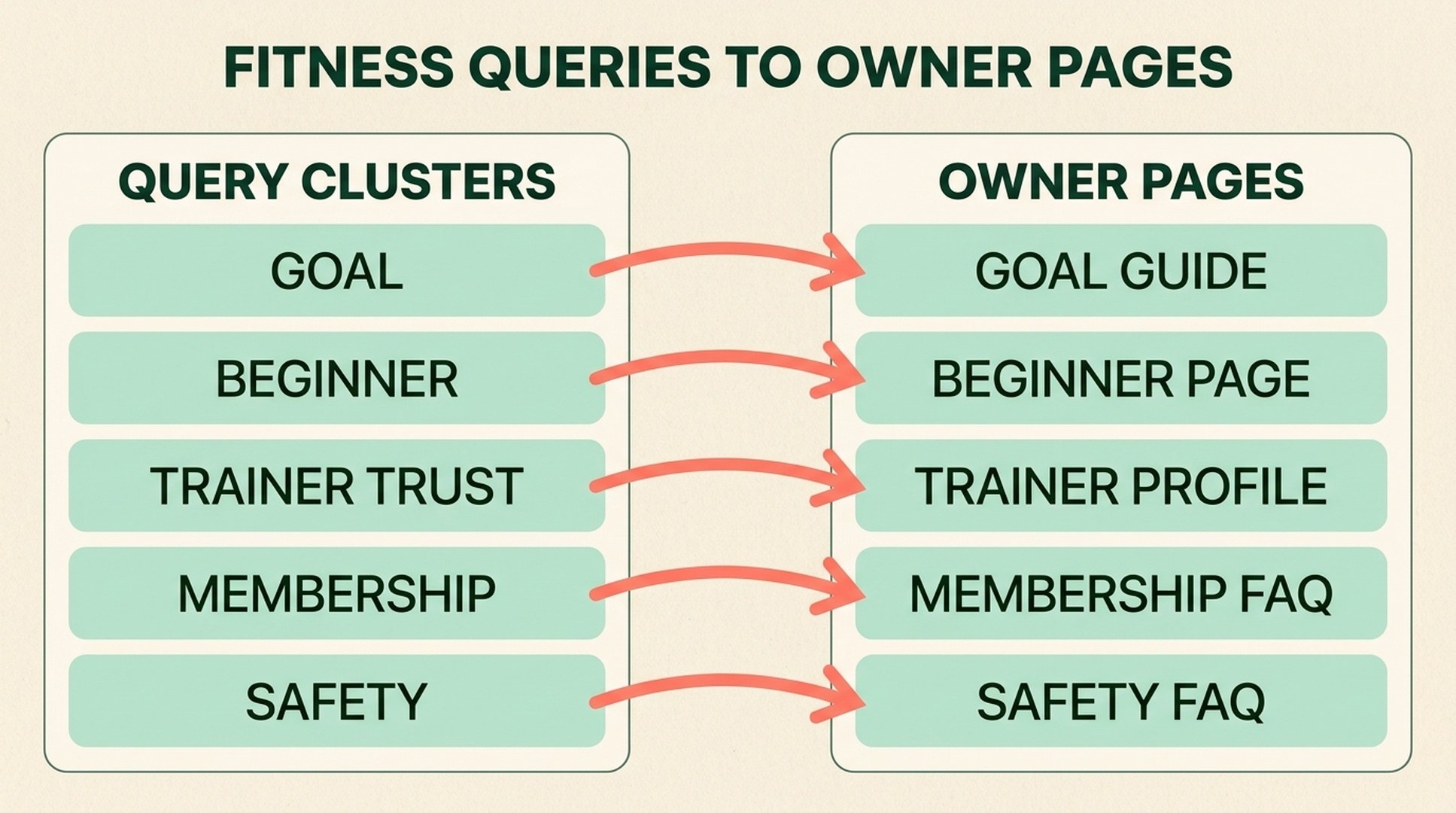
Goal, beginner, trainer-trust, membership, and safety queries should map to durable owner pages that support trials, memberships, and consultations.
The First 20 Queries To Prioritize
If a fitness or wellness brand is starting from scratch, these 20 prompts usually create a practical first backlog.
Priority | Query | Why It Matters | Likely Owner Page |
|---|---|---|---|
1 | What workout program is best for beginners who want strength? | Goal and membership intent | Beginner strength guide |
2 | Best gym class for people returning after a long break | Starting-point fit | Returner onboarding page |
3 | Personal training vs group fitness for beginners | High decision impact | Training comparison page |
4 | Reformer Pilates vs mat Pilates | Common program comparison | Pilates comparison page |
5 | How do I know if a personal trainer is qualified? | Trust validation | Trainer credentials page |
6 | What should I ask before hiring a personal trainer? | Conversion support | Trainer selection guide |
7 | What should I check before joining a gym membership? | Membership friction | Membership FAQ |
8 | How much does personal training usually cost? | Price intent | Personal training pricing page |
9 | Is HIIT safe for beginners? | Safety-sensitive query | HIIT safety FAQ |
10 | Can fitness classes be modified for knee discomfort? | Safety and modifications | Class modification page |
11 | Gym near me with early morning classes | Local booking intent | Location schedule page |
12 | Gym with childcare near me | Convenience and family intent | Childcare amenity page |
13 | What testimonials matter for a personal trainer? | Trust proof | Review / proof page |
14 | Are before-and-after photos reliable for fitness programs? | Claim risk | Results claim guide |
15 | What should I check during a gym tour? | Visit readiness | Gym tour checklist |
16 | What amenities matter in a fitness studio? | Facility decision | Amenity guide |
17 | Best gym program for busy parents | Lifestyle fit | Busy parent guide |
18 | Best fitness class for remote workers | Scenario intent | Remote worker fitness guide |
19 | Best fitness studio for accountability and community | Retention fit | Community page |
20 | Best fitness option for people restarting after burnout | Sensitive scenario | Restart fitness guide |
These prompts are useful because they can be answered by pages that already influence trials, memberships, trainer consultations, class bookings, and retention.
30-Day Execution Plan
Timeframe | Action | Output |
|---|---|---|
Days 1-3 | Build the fitness AI Search query library and classify by goal, starting point, safety level, service type, and page owner | 100-query prompt library |
Days 4-7 | Score prompts by membership intent, goal fit, safety sensitivity, evidence, AI answer probability, claim risk, and competition | First 20 prompt backlog |
Days 8-14 | Map prompts to goal pages, trainer pages, class pages, membership pages, safety FAQs, location pages, and review pages | Query-to-page map |
Days 15-21 | Rewrite priority pages with direct answers, fit criteria, safety caveats, trainer proof, pricing details, and next steps | Updated citation-ready pages |
Days 22-30 | Test prompts across AI answer surfaces and record brand mentions, cited URLs, competitor mentions, and inaccurate fitness claims | Fitness AI visibility tracker |
A single-location studio can start with five assets: a beginner guide, a program comparison page, a trainer credentials page, a membership FAQ, and a safety/modification FAQ. A multi-location brand should add location pages, schedule pages, amenity pages, community pages, and scenario guides.
Common Mistakes
Fitness and wellness GEO fails when brands publish motivational content without enough fit, safety, or trust detail.
Avoid these mistakes:
- Publishing generic class descriptions. Explain goals, skill level, modifications, intensity, and who the class may not fit.
- Overpromising outcomes. Avoid guaranteed weight loss, injury recovery, health outcomes, or transformation claims.
- Hiding membership terms. Trials, packages, cancellation rules, fees, and contract terms should be easy to understand.
- Treating trainer profiles as bios only. Add credentials, coaching style, specialties, scope, and safe referral boundaries.
- Ignoring beginners. Intimidation, injury fear, and habit formation are major decision drivers.
- Using before-and-after proof carelessly. Add caveats, context, and avoid implying typical guaranteed results.
- Measuring only rankings. Track AI mentions, cited pages, competitor inclusion, and inaccurate summaries of prices, safety, programs, or credentials.
FAQ
What is fitness GEO?
Fitness GEO is the process of making gym, studio, trainer, class, membership, safety, review, program, and location pages easier for AI answer systems to understand, summarize, and cite accurately.
Is fitness GEO the same as fitness SEO?
No. Fitness SEO focuses on rankings, local visibility, class discovery, reviews, and membership traffic. Fitness GEO builds on that foundation but focuses on how AI systems answer goal-fit, beginner, program comparison, trainer trust, pricing, safety, schedule, and facility questions.
Should fitness brands create one page for every AI Search query?
No. The 100-query list should become a page map. Many questions should be answered by stronger goal pages, beginner guides, program comparisons, trainer profiles, membership FAQs, safety pages, location pages, and review pages.
Which fitness queries should teams prioritize first?
Start with questions about beginner fit, program comparisons, trainer qualifications, membership terms, safety modifications, local schedules, reviews, amenities, and lifestyle scenarios. These queries influence trials, signups, and consultations.
How can fitness brands avoid risky GEO content?
Use clear safety caveats, avoid medical or guaranteed outcome claims, state who should consult a qualified professional first, explain modifications, keep pricing current, and involve qualified trainers or clinicians when needed.
How should fitness teams measure GEO performance?
Track a stable prompt set across AI answer surfaces. Record whether the brand appears, which URLs are cited, which competitors appear, whether program facts are accurate, and whether AI answers omit important safety, pricing, or credential details.
Auspia Takeaway
Fitness and wellness GEO is goal-fit and safety support. AI systems need user goals, starting point, program fit, safety caveats, trainer proof, membership clarity, schedule convenience, and trust signals before they can recommend or cite a brand responsibly.
Start with prompts that affect trials, memberships, trainer consultations, class bookings, and long-term retention. Map the first 20 queries to pages that already shape user decisions. Then rewrite those pages so the answers are direct, responsible, specific, and safe to summarize.
Author: Nora Whitfield, AEO Specialist for 800+ Answer Patterns at Auspia. Nora writes about answer engine optimization, extractable summaries, FAQ design, and content that answers questions clearly.