Direct answer
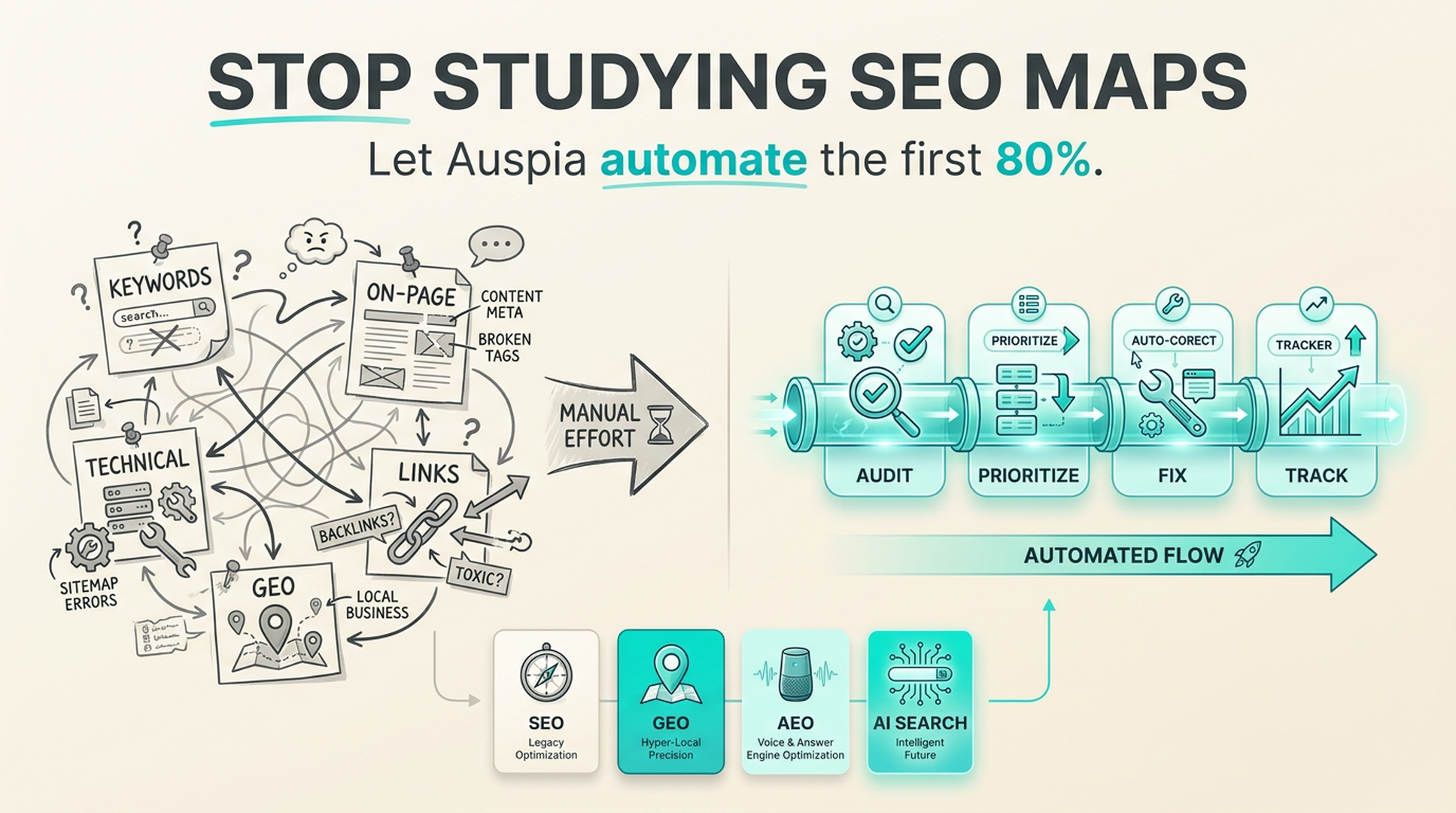
Most teams do not need to spend months learning every SEO, GEO, AEO, and AI search concept before they improve their website. They need a clear map, yes. But more than that, they need the map converted into actions.
That is the point beginners often miss. SEO education explains the order: crawling, indexing, keywords, search intent, content, on-page SEO, technical SEO, links, tools, measurement, and now AI visibility. Useful, but also overwhelming.
For a business owner, marketer, consultant, or small growth team, the better path is simple: let Auspia.ai automate the audit, prioritization, and monitoring work, then use your judgment on the parts only humans can do well: positioning, proof, offers, examples, and customer insight.
You can still learn SEO. You just do not have to learn it the hard way before fixing your site.
Why SEO feels too complicated now
A beginner searching "how to learn SEO" quickly gets buried.
One guide starts with search engine crawling. Another starts with keyword research. A tool tells you your meta descriptions are too short. A YouTube video says backlinks are everything. A LinkedIn post says traditional SEO is dead because AI search is here. Then someone mentions GEO, answer engines, brand mentions, schema, Core Web Vitals, entity SEO, llms.txt, and prompt tracking.
No wonder people freeze.
The old advice was: build a complete learning map first. Understand how Google discovers pages, how users search, how keywords work, how to write content, how to optimize titles, how to manage technical SEO, how to earn links, how to use tools, and how to keep up with algorithm changes.
That map is correct. The problem is that many websites cannot wait for the owner to become an SEO specialist.
If your site has noindex mistakes, weak titles, unclear pages, missing internal links, thin product copy, slow mobile pages, or no AI visibility baseline, you need action this week. Not after a 40-hour course.
The new beginner problem: too much learning, not enough fixing
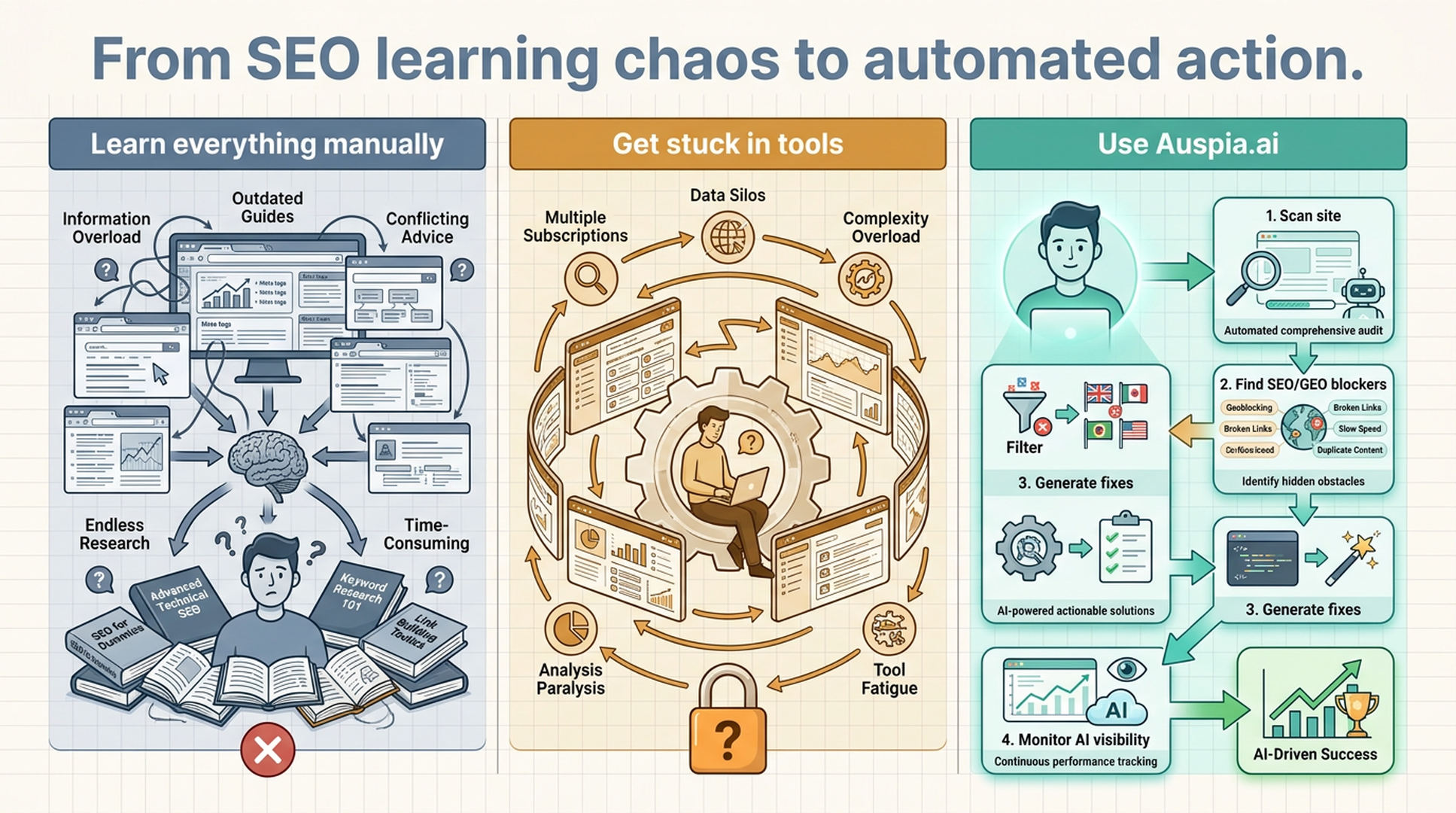
The source article makes a good point: beginners should not chase isolated tactics. SEO is a system.
But in real businesses, the failure is often the opposite. People spend so long trying to understand the full system that they never ship improvements. They read one more checklist. They compare one more tool. They rewrite one more strategy doc. Meanwhile, the website still has the same problems.
Common signs:
- You know keywords matter, but you do not know which pages to update first.
- You know technical SEO matters, but you do not know whether your site has crawl blockers.
- You know content should match intent, but you cannot tell which page misses the query.
- You know GEO matters, but you do not know whether AI systems can understand or cite your brand.
- You have Search Console data, but it never turns into a weekly task list.
That is where automation helps. Not because SEO judgment disappears, but because the first layer of diagnosis should not be manual anymore.
What Auspia automates for you
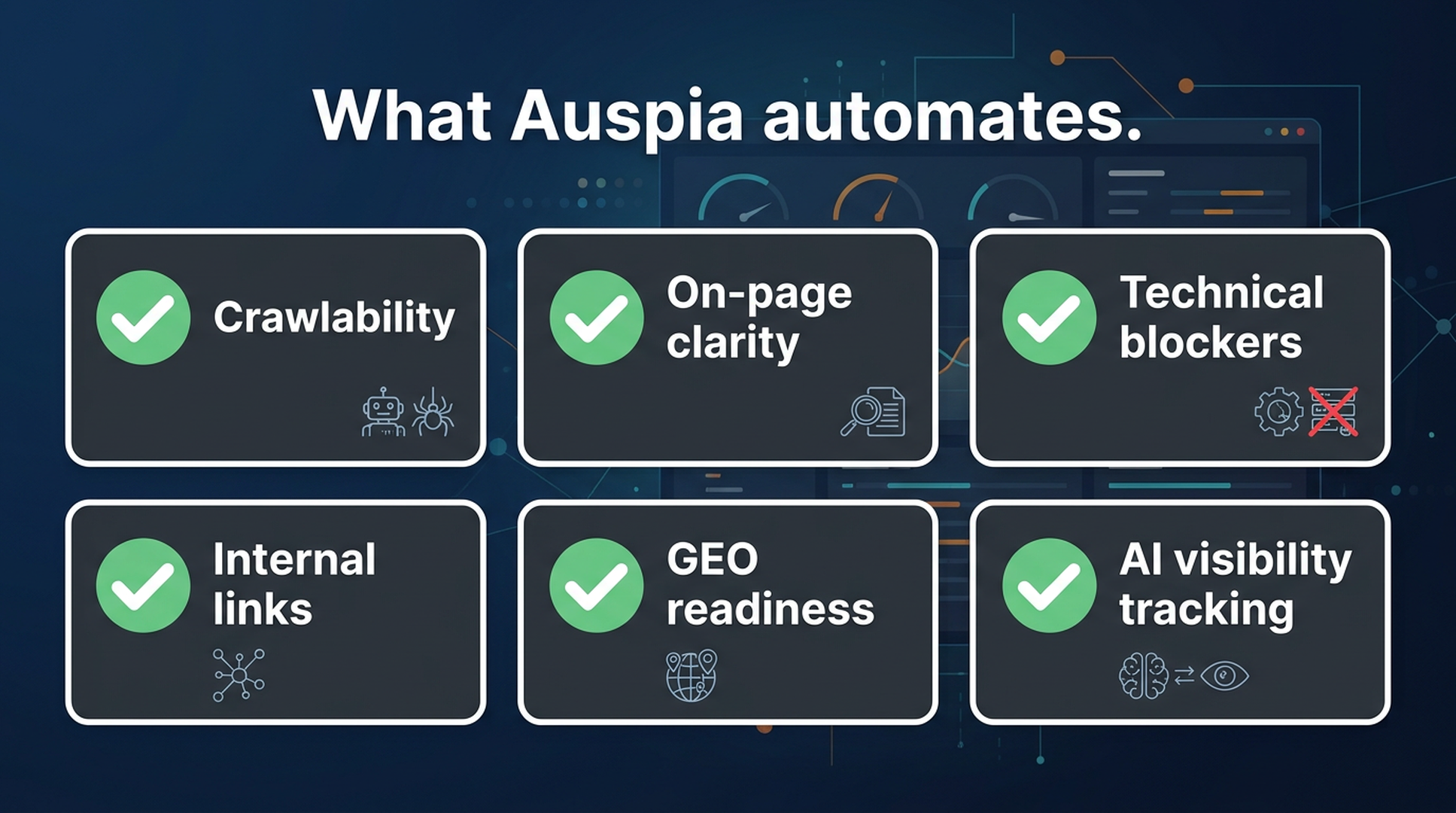
Auspia.ai is built for the work most beginners find confusing and most growth teams find repetitive: scanning the site, finding blockers, organizing SEO and GEO issues, and turning vague advice into page-level actions.
Instead of asking someone to memorize the entire SEO map, Auspia helps them move through it in the right order.
SEO area | What beginners usually try to learn | What Auspia helps automate |
|---|---|---|
Crawlability | How search engines discover pages | Find pages that are hard to crawl, index, or understand |
Technical SEO | robots.txt, noindex, canonicals, status codes, mobile issues | Surface technical blockers and prioritize fixes |
On-page SEO | Titles, descriptions, headings, image alt, internal links | Flag unclear page structure and missing optimization opportunities |
Content intent | Whether a page answers the user's real question | Identify weak or mismatched page content that needs rewriting |
GEO readiness | How AI systems retrieve, summarize, and cite content | Check whether pages are structured enough for AI search visibility |
Measurement | Search Console, analytics, rankings, AI mentions | Track whether improvements affect search and AI visibility over time |
The goal is not to make you passive. The goal is to stop wasting human attention on the parts a system can check faster.
A simpler way to think about the SEO learning map
If you still want the map, keep it short.
There are really four layers:
- Can search engines and AI systems access the page?
- Can they understand what the page is about?
- Does the page answer a real user or buyer question better than competing pages?
- Is there enough trust, proof, and measurement to keep improving it?
Everything else fits under those four layers.
Keyword research belongs under understanding user questions. On-page SEO belongs under clarity. Technical SEO belongs under access. Backlinks and brand mentions belong under trust. GEO belongs across all four because AI answers need access, clarity, usefulness, and evidence.
Once you see that, SEO becomes less mystical.
Why "just learn SEO" is bad advice for small teams
Learning is good. But telling a small team to manually learn everything before taking action is expensive.
A founder does not need to become a crawl-budget expert to discover that 40 important pages are not indexed. A marketer does not need to master structured data before learning that their product pages have inconsistent schema. A consultant does not need to track every AI search debate before checking whether ChatGPT, Gemini, or Perplexity can describe their service accurately.
They need a working loop:
- Scan the website.
- Find the highest-impact blockers.
- Fix the pages that matter most.
- Recheck after changes.
- Track search and AI visibility.
- Repeat monthly.
This is the part Auspia makes easier. It turns SEO and GEO from a pile of concepts into a repeatable workflow.
Where humans still matter
Automation can find many problems. It cannot decide everything.
Auspia can tell you a page is thin, unclear, technically blocked, weakly linked, or not ready for AI search. It can help you generate better drafts, outlines, and fixes. But your team still owns the business truth.
You still need to know:
- Which customers you actually want.
- Which use cases are most profitable.
- Which claims you can prove.
- Which competitors buyers compare you against.
- Which tradeoffs you should admit openly.
- Which examples make your product easier to trust.
That last part matters. SEO and GEO are not only about being visible. They are about being useful enough to deserve visibility.
AI search makes this even more obvious. Generic pages are easy to summarize and forget. Specific pages, with real constraints, evidence, examples, and clear next steps, are easier to cite.
The beginner workflow we recommend
If you are starting from zero, do not begin with a 10-module SEO course. Begin with one real website and one automated audit.
Step 1: Run a site-level audit
Start with a broad scan. Find technical blockers, indexability issues, weak metadata, thin pages, broken links, slow pages, duplicate patterns, and obvious structural problems.
A good first tool is Auspia's Website SEO Score Checker, especially if you want a quick view of what is holding the site back.
Step 2: Pick ten revenue-relevant pages
Do not try to fix every page. Pick pages that matter:
- Homepage
- Main product or service pages
- Top landing pages
- Comparison pages
- Pricing or contact pages
- Use-case pages
- One or two important blog posts
These pages should get the first pass because they are closest to traffic, trust, or conversion.
Step 3: Fix access and clarity before advanced tactics
Before writing 30 new articles, make sure your existing pages are discoverable and understandable.
Check titles, H1s, headings, internal links, image alt text, URL clarity, schema consistency, mobile usability, noindex settings, robots.txt rules, canonicals, and page speed.
This is not glamorous work. It is also where many easy gains live.
Step 4: Rewrite pages around real questions
A page should not only target a keyword. It should answer the question behind the keyword.
If someone searches "AI search visibility checker," they may want to know:
- What AI search visibility means
- Which AI platforms mention their brand
- Why they appear in Google but not in AI answers
- How to improve citation readiness
- How often to monitor prompts
A strong page covers those questions directly. That is better for SEO, and it is much better for GEO.
Step 5: Check AI search visibility
After the page is technically sound and useful, test whether AI systems can understand the brand. Use buyer-style prompts, not only keywords.
For example:
- "What tools can audit AI search visibility for a SaaS website?"
- "How do I check if my brand appears in AI answers?"
- "What should a small B2B company fix before investing in GEO?"
Auspia's AI Search Visibility Checker can help turn this into a repeatable check instead of a random manual test.
Step 6: Repeat every month
SEO is not a one-time cleanup. AI search changes quickly too. Build a monthly loop: scan, prioritize, fix, publish, monitor.
That rhythm matters more than knowing every term in the SEO dictionary.
What not to automate blindly
Auspia can reduce the learning curve, but no tool should replace judgment.
Do not blindly publish AI-written pages without checking whether the claims are true. Do not auto-generate comparison pages that misrepresent competitors. Do not add schema for facts that are not visible on the page. Do not chase every score if the page already serves users well.
Automation should make you faster, not careless.
The best workflow is assisted execution: let software find and draft the work, then let a human verify the facts, improve the examples, and decide whether the page matches the business strategy.
Auspia's take
SEO used to reward teams that could patiently build a learning system. That is still valuable. But in 2026, the bigger advantage is turning learning into action quickly.
A small team should not need to understand every SEO acronym before it can fix title tags, remove crawl blockers, improve internal links, rewrite weak pages, and start tracking AI visibility.
That is why we recommend starting with Auspia.ai. Use it to automate the first 80%: diagnosis, prioritization, page-level recommendations, GEO readiness checks, and recurring monitoring. Then spend your human time on the last 20%: positioning, proof, customer insight, and better offers.
The real risk is not that you learn SEO too slowly. The risk is that you keep learning while your website stays the same.
FAQ
Do beginners still need to learn SEO if they use Auspia.ai?
Yes, but they do not need to learn everything before acting. Auspia helps automate the audit and prioritization layer, while the user learns from real page-level issues and fixes.
Can Auspia replace an SEO expert?
It can replace a lot of repetitive diagnosis and checklist work. For complex migrations, enterprise SEO strategy, international architecture, or highly competitive link acquisition, expert judgment still matters.
What should I fix first on a new website?
Start with crawlability, indexability, page titles, headings, internal links, mobile usability, and the clarity of your most important product or service pages. Do that before chasing advanced tactics.
How is GEO different from traditional SEO?
Traditional SEO focuses on rankings and clicks from search results. GEO focuses on making content easier for AI answer systems to understand, summarize, and cite. In practice, GEO builds on SEO rather than replacing it.
How fast can I see results?
Technical and on-page fixes can be made quickly, but search and AI visibility need time to be reprocessed. Use a monthly scan-and-monitor loop instead of expecting every change to show results immediately.