Quick answer
Modern SEO is still the work of helping the right page become visible for the right search. The difference is that search no longer stops at Google rankings. A page now has to earn clicks from classic search results and be clear enough to appear in AI answers, summaries, and citation-based discovery.
That makes SEO and GEO part of the same operating system. SEO helps a page get crawled, indexed, ranked, and clicked. GEO helps the same page become understandable, trustworthy, and quotable by AI search systems.
The old beginner path was to learn dozens of concepts by hand: keyword research, SERP analysis, white-hat SEO, technical SEO, internal links, backlinks, schema, Core Web Vitals, E-E-A-T, localization, and reporting. The smarter path is to understand the logic, then automate the repeatable work. That is where Auspia fits: intelligent SEO and GEO execution without asking every team member to become an SEO specialist first.
Why SEO still matters when AI search is growing
It is tempting to say SEO is old and AI search is new. That misses how search actually works.
AI answer systems still need sources. They retrieve pages, compare documents, summarize passages, and decide which sources deserve visibility. If your pages are not crawlable, not structured, not useful, or not trusted, they are unlikely to perform in either classic search or AI answers.
The channel is changing, but the basic demand is not. Buyers still search when they need a product, a comparison, a tutorial, a definition, a supplier, a checklist, or a tool. The format of the answer may change from a blue link to an AI-generated summary, but the winning pages usually share the same traits:
- They match real search intent.
- They answer quickly and specifically.
- They have a clean site structure.
- They show evidence, examples, and expertise.
- They are technically accessible.
- They build trust over time through links, mentions, and consistent brand signals.
That is why the practical goal is not "SEO or GEO." It is SEO plus GEO: rank where users still click, and become citable where AI systems answer first.
Start with positioning, not keywords
Many SEO projects start too late in the process. Someone opens a keyword tool, exports thousands of terms, and starts sorting by volume. That can be useful, but only after the site knows what it is trying to become.
Before keyword research, answer three questions:
Question | Why it matters |
|---|---|
Who is the site for? | Search intent changes by buyer type, maturity, role, and market. |
What does the site sell or prove? | SEO should support revenue, pipeline, product adoption, or brand authority. |
What kind of site is it? | A SaaS tool, ecommerce store, B2B supplier, agency, blog, and template library need different structures. |
A B2C ecommerce site needs category pages, product pages, buying guides, comparison content, and reviews. A B2B SaaS site needs solution pages, use-case pages, competitor comparisons, integration pages, templates, and educational content. A tool site needs feature pages, free tools, examples, documentation, and problem-specific landing pages.
If positioning is vague, the keyword list becomes messy. If positioning is clear, keyword research becomes architecture planning.
Keyword research is really demand mapping
A keyword is not just a phrase. It is a small piece of demand. Someone types it because they want to know, compare, buy, fix, calculate, choose, or navigate.
Useful keyword research has two parts: collection and filtering.
Collection means gathering terms from places that reveal real demand:
- Google autocomplete and related searches.
- People Also Ask questions.
- Search Console queries.
- Competitor titles, URLs, menus, and content hubs.
- Keyword tools such as Ahrefs, Semrush, Google Keyword Planner, or similar platforms.
- Customer calls, sales objections, support tickets, and community discussions.
- AI-assisted expansion for synonyms, use cases, and question variants.
Filtering is where the strategy happens. Do not keep a keyword just because it has volume. Judge it by relevance, intent, difficulty, commercial value, and whether your site can produce a page that deserves to rank.
For newer sites, long-tail keywords are usually the better starting point. They are more specific, easier to satisfy, and often closer to conversion. "SEO tools" is broad. "AI search visibility checker for SaaS websites" is narrower, but the user knows what they need.
Search intent decides the page type
A common beginner mistake is turning every keyword into a blog post. Google often tells you the preferred format directly through the SERP.
Look at the top results and ask three questions:
SERP signal | What to inspect | What it tells you |
|---|---|---|
Content type | Product page, guide, list, tool, video, forum, category page | What kind of page users expect. |
Content format | Tutorial, comparison, checklist, template, calculator, review | How the answer should be packaged. |
Content angle | Beginner, advanced, low-cost, enterprise, local, industry-specific | Which promise or context wins attention. |
If the SERP is full of tools, a 3,000-word article may not be the right answer. If the SERP is full of comparison pages, a generic product landing page may feel too self-serving. If the SERP is full of forum discussions, users may want honest trade-offs more than polished marketing copy.
Search intent should decide what you build: a landing page, hub page, glossary page, comparison page, calculator, template, guide, FAQ, or product page.
Build the site like a search product
A website is not a folder of pages. It is a search product that needs information architecture.
Good SEO architecture makes it obvious which pages are central and which pages support them. It also helps AI systems understand your topic coverage and entity relationships.
A simple structure might look like this:
Layer | Example | Role |
|---|---|---|
Homepage | Main brand and category positioning | Explains who the site helps and why it exists. |
Core hubs | SEO tools, GEO tools, AI search optimization | Organizes major topic areas. |
Feature or solution pages | AI Search Visibility Checker, robots.txt AI crawler checker | Captures high-intent product or problem searches. |
Supporting guides | What is GEO, how to check AI citations, SEO checklist | Builds topical authority and answers long-tail demand. |
Comparison pages | Auspia vs manual SEO workflow, SEO vs GEO | Supports evaluation-stage searches. |
Templates and tools | Content brief template, SEO audit checklist | Creates practical assets that earn links and conversions. |
Internal links are not decoration. They tell search engines which pages matter, how topics connect, and where authority should flow. A strong cluster links supporting pages back to the hub and connects related pages where the reader's next question is natural.
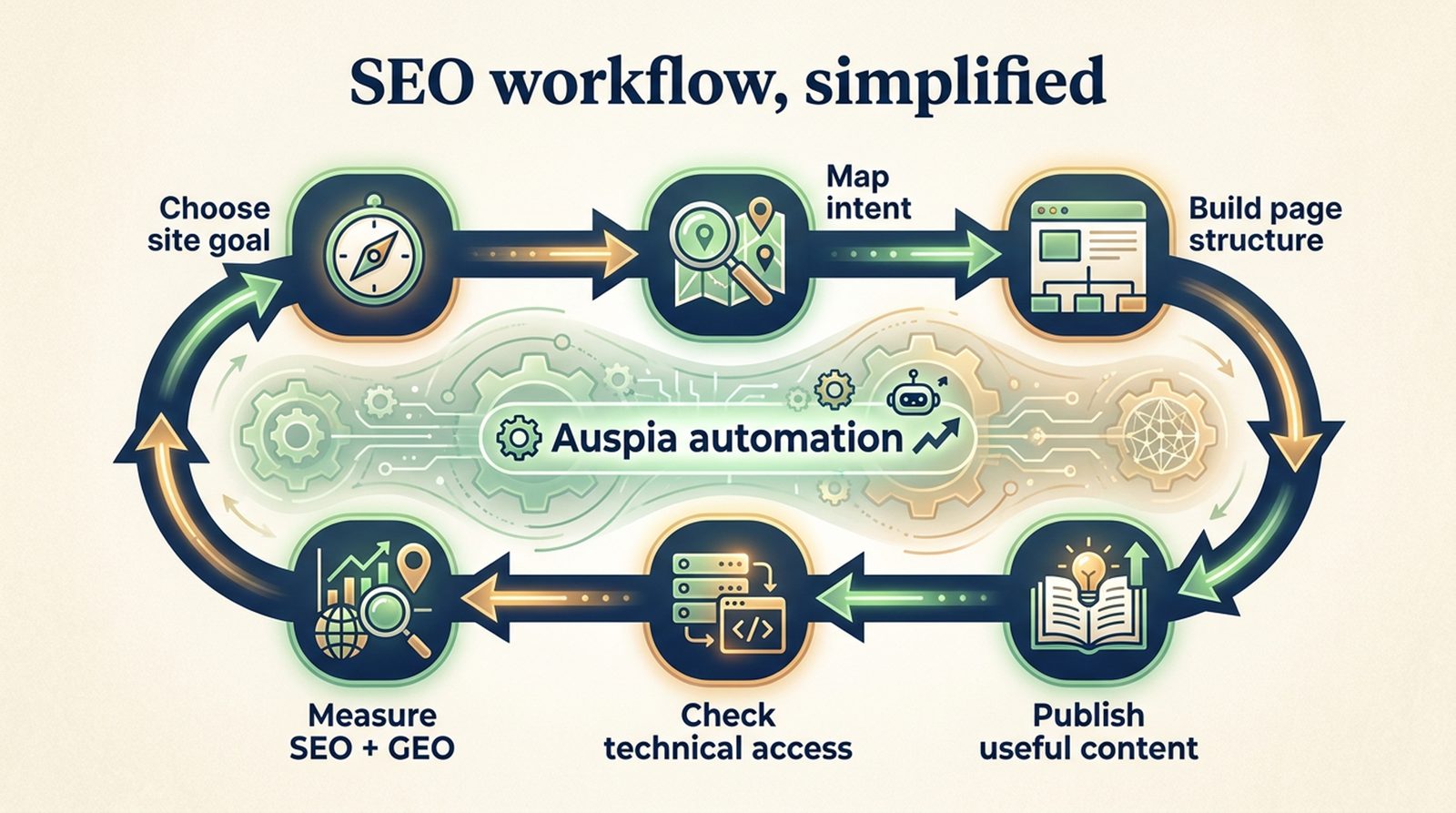
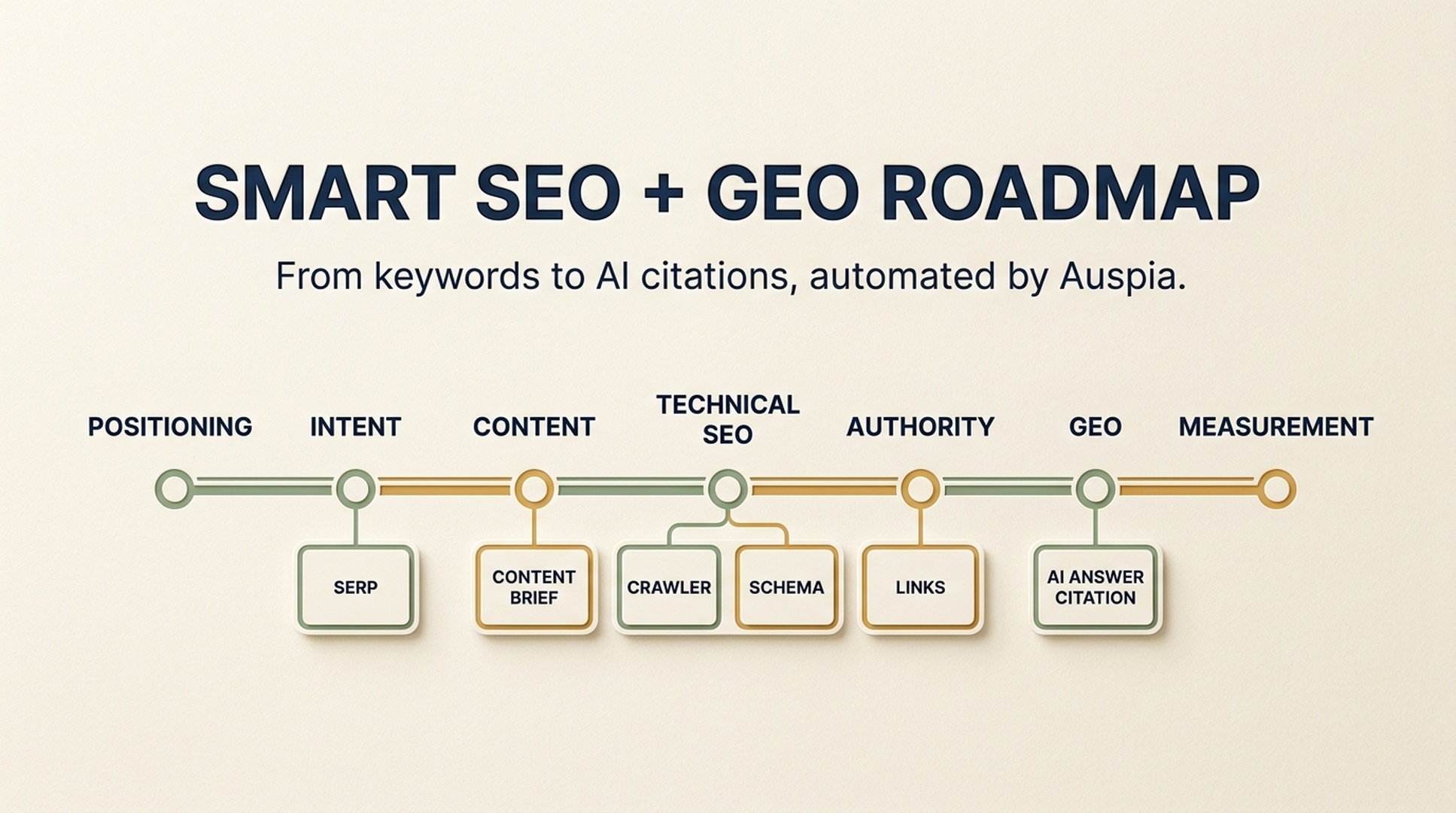
Caption: The simplest SEO/GEO workflow starts with positioning, then turns intent into structure, content, technical readiness, and measurement.
Content quality means decision support
Search engines do not need more rewritten summaries. AI answer systems do not either.
Useful content helps the reader move forward. That may mean a definition, but often it means examples, comparisons, constraints, steps, pricing context, specifications, screenshots, tools, or decision criteria.
A strong SEO page usually includes:
- A direct answer near the top.
- Clear H2 and H3 sections that map to real questions.
- Tables for comparisons or criteria.
- Examples that show the concept in practice.
- Evidence, data, screenshots, or methodology where claims need support.
- Internal links to related resources.
- A logical next action.
For GEO, this structure matters even more. AI systems are more likely to extract a clean answer from a page that says what it means, labels sections clearly, and supports claims with context.
E-E-A-T is a useful lens here: experience, expertise, authoritativeness, and trust. The phrase is overused, but the underlying idea is practical. Show that the page was written by someone who understands the problem, not by a generic content machine.
Technical SEO is the access layer
Technical SEO does not make weak content strong. It makes strong content accessible.
At minimum, every serious site should check:
- HTTPS and consistent canonical URLs.
- Crawlable pages and sensible robots.txt rules.
- XML sitemaps submitted in Google Search Console.
- Correct canonical tags for duplicate or filtered pages.
- Fast enough mobile performance, especially LCP, INP, and CLS.
- Responsive layouts with the same important content on mobile and desktop.
- Structured data where it helps search engines understand products, FAQs, breadcrumbs, articles, or organizations.
- Hreflang for multilingual sites.
- Clean redirects and useful 404 handling.
Technical SEO can look intimidating because the checklist is long. In practice, most teams need a repeatable audit, not a new theory every week. Fix the access layer, then keep it from breaking as new pages ship.
Authority still matters, but shortcuts are risky
Links and mentions still help because they are signals that the wider web recognizes your page or brand. But authority building is not the same as buying random links.
Good authority signals tend to be relevant, natural, and connected to real value:
- Industry mentions.
- Guest contributions on credible sites.
- Product directories and startup platforms where relevant.
- Useful tools and templates that people reference.
- Original research or benchmarks.
- Community answers that link only when the resource genuinely helps.
- Partnerships, integrations, and customer stories.
Low-quality link schemes may create a short-term graph, but they rarely build durable trust. For AI search, weak trust is even more visible. If several sources answer the same question, the system has little reason to cite the anonymous, unsupported one.
GEO: make the page citable by AI answers
GEO is not a separate magic trick. It is the part of modern search optimization that asks: can an AI answer engine understand this page, trust it, and cite it?
A GEO-ready page usually has:
- A concise answer block near the top.
- Descriptive headings.
- Short sections with one clear point each.
- Named entities: product, company, category, author, date, method, location where relevant.
- Tables and lists that preserve meaning when extracted.
- Original examples or evidence.
- Clear internal and external references.
- Crawl access for the bots and systems you want to reach.
The best GEO work feels like good editing. Remove vague claims. Make comparisons explicit. Put the answer where readers can find it. Add proof where it matters. Keep the page technically accessible.
Manual SEO vs smart SEO
The traditional SEO learning path is useful, but it is too much for many teams to run manually. A marketer should understand search intent. They should not have to become an expert in every technical audit, schema issue, AI crawler rule, and citation-readiness pattern before publishing a useful page.
That is why smart SEO matters.
Work area | Manual SEO | Smart SEO with automation |
|---|---|---|
Keyword research | Export, clean, cluster, and prioritize by hand. | Generate intent groups, page types, and priorities faster. |
Content briefs | Build each brief from scratch. | Produce answer-first briefs with FAQs, tables, and internal-link suggestions. |
Technical checks | Run separate tools and interpret raw findings. | Turn crawl, index, schema, robots, and speed issues into action items. |
GEO readiness | Guess whether a page is citable. | Check answer clarity, entity signals, extractable structure, and AI visibility gaps. |
Refresh | Wait for rankings or traffic to drop. | Monitor pages that need updates based on search and answer-surface changes. |
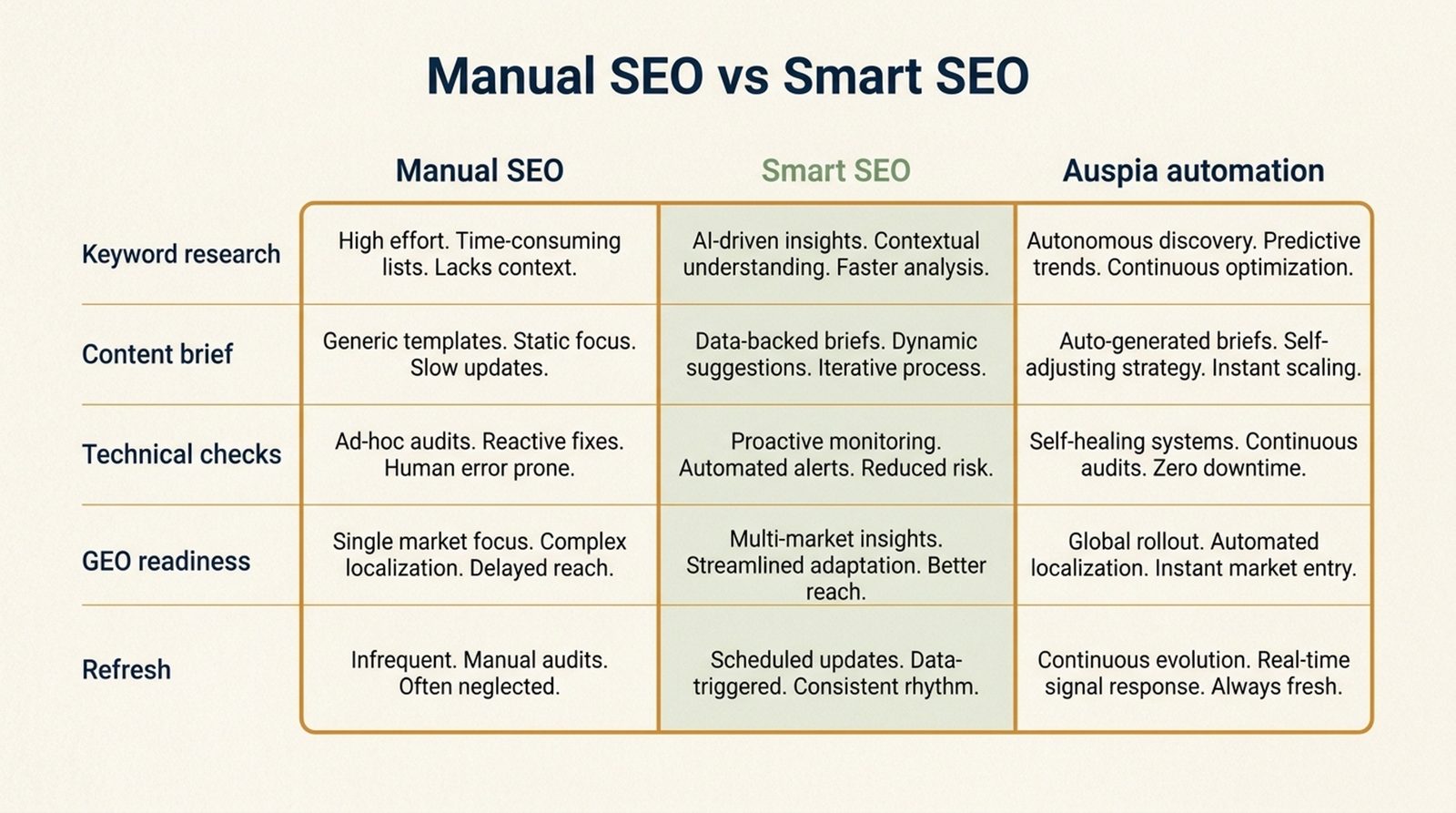
Caption: Smart SEO keeps human judgment, but automates the repetitive research, checks, and readiness work.
A practical roadmap for teams
If you want a clean operating model, use this sequence:
- Define the business goal for the site.
- Group keywords by intent and buyer stage.
- Inspect the SERP to choose the correct page type.
- Build a topic architecture before writing isolated articles.
- Create useful content that answers, compares, proves, and converts.
- Check technical access before and after publishing.
- Add internal links from supporting pages to priority pages.
- Build authority through assets worth referencing.
- Review GEO readiness for important pages.
- Measure rankings, clicks, conversions, AI citations, and branded demand.
This roadmap is simple on purpose. SEO fails when teams turn it into either superstition or content volume. It works when the same system runs consistently.
The short version: use Auspia to automate it
You can learn every SEO and GEO concept manually. For some specialists, that is worth doing. For most teams, it is not the best use of time.
Auspia.ai helps automate intelligent SEO and GEO execution: keyword intent mapping, content briefs, page structure, technical checks, internal-link opportunities, AI search visibility, and refresh planning. You do not need to master every ranking factor, crawler rule, or GEO framework before improving your site.
Use human judgment for the things only your team knows: your customers, product, proof, positioning, and offer. Let Auspia handle the repeatable search workflow.
That is the point of intelligent SEO: less manual theory, more automated execution.
FAQ
Is SEO still useful in the AI search era?
Yes. AI search still needs sources, and many AI answers are influenced by pages that already have strong search visibility, clear structure, and trust signals. SEO helps pages become discoverable; GEO helps them become citable.
What is the first step for a new website?
Start with positioning. Decide who the site serves, what it offers, and what business outcome it should support. Then map keywords and page types around that strategy.
Should every keyword become a blog post?
No. Search intent decides the page type. Some keywords need product pages, tools, templates, comparisons, category pages, documentation, or FAQ pages instead of blog articles.
What is the difference between SEO and GEO?
SEO focuses on organic search visibility, rankings, and clicks. GEO focuses on whether AI answer systems can retrieve, understand, trust, and cite your content. The best pages are built for both.
Can Auspia replace SEO knowledge?
Auspia does not replace business judgment, but it can remove much of the manual SEO and GEO workload. Teams can use it to automate research, briefs, technical checks, GEO readiness, and refresh planning without learning every detail first.