The short answer
SEO still has one simple goal: help the right people find, trust, and choose your business.
The work around that goal has become much more complex. A modern SEO system has to satisfy users, earn Google's trust, stay technically crawlable, match search intent, build authority, support local discovery, improve user experience, and now make content easier for AI answer engines to understand and cite.
That is a lot for a small team to learn manually.
The practical answer is not to memorize every SEO category. It is to run a repeatable operating system: audit the site, fix crawl and index problems, improve content around real intent, strengthen trust signals, monitor performance, and keep iterating.
Auspia's view is simple: teams should not need to become SEO technicians before they can grow traffic. Auspia.ai automates the complicated parts, from SEO checks and AI visibility analysis to content refresh recommendations, crawler-readiness checks, and monitoring loops.
Why SEO still matters
SEO matters because organic discovery compounds.
Paid traffic can work quickly, but it stops when the budget stops. Organic traffic is slower to build, but strong pages can keep bringing qualified visitors for months or years. Ranking well also shapes trust. When a brand appears consistently for relevant searches, buyers assume it is more credible, more established, and more useful.
The core business reasons have not changed:
SEO outcome | Business value |
|---|---|
More visibility | More qualified people discover the brand. |
More stable traffic | Organic visits are less dependent on daily ad spend. |
Better conversion support | Helpful pages answer objections before sales contact. |
Stronger brand trust | High-quality search presence makes a business look more credible. |
What has changed is the search surface. Google results now include rich snippets, video, local packs, shopping units, forums, and AI-generated summaries. Buyers may also ask ChatGPT, Perplexity, Gemini, or Google AI Overviews before clicking a website.
So the new question is not only, "Can this page rank?" It is also, "Can this page be understood, trusted, and reused in an AI answer?"
1. Technical SEO: make the site crawlable and understandable
Technical SEO is the foundation. If search engines cannot crawl, render, index, or understand your pages, better content will not help much.
The basics are still familiar:
- submit an XML sitemap in Google Search Console;
- use robots.txt to clarify what should and should not be crawled;
- fix 404, 500, redirect, canonical, and indexing errors;
- use responsive design for mobile-first indexing;
- improve Core Web Vitals such as LCP, INP, and CLS;
- enable HTTPS;
- keep URLs short, descriptive, and stable;
- add structured data where it helps search engines interpret the page.
For AI visibility, technical access matters even more. If important pages are blocked, hidden behind scripts, missing canonical clarity, or inaccessible to AI-related crawlers, the brand may be absent from answers even when the content is useful.
Manual path: inspect Search Console, crawl the site, check robots.txt, review schema, validate performance, and monitor indexing.
Auspia path: run automated checks with tools such as the Website SEO Score Checker, Robots.txt AI Crawler Checker, and LLMs.txt Generator / Checker so the highest-risk issues surface first.
2. Content SEO: match intent before adding keywords
Content is still the main value carrier in SEO. Search engines use content to understand relevance. Users use content to decide whether they trust you. AI answer engines use content as evidence when forming answers.
Good content starts with intent, not keyword volume.
A page for an informational query should explain. A page for a commercial query should compare. A page for a transactional query should help the buyer choose and act. A local query should prove proximity, availability, and reputation.
A practical content checklist:
Content signal | What it means |
|---|---|
Clear intent match | The page answers the reason behind the search. |
Depth | The content goes beyond thin summaries and covers real decisions. |
E-E-A-T | The page shows experience, expertise, authority, and trust. |
Readability | Headings, short paragraphs, bullets, tables, and examples make it usable. |
Freshness | Data, screenshots, examples, and product details are current. |
AI citation structure | The answer appears early and is supported by clear evidence. |
The old mistake was stuffing keywords. The new mistake is publishing generic AI-written content that says everything and proves nothing.
Auspia can help by identifying pages that miss intent, lack depth, need updated evidence, or are hard for AI systems to cite.
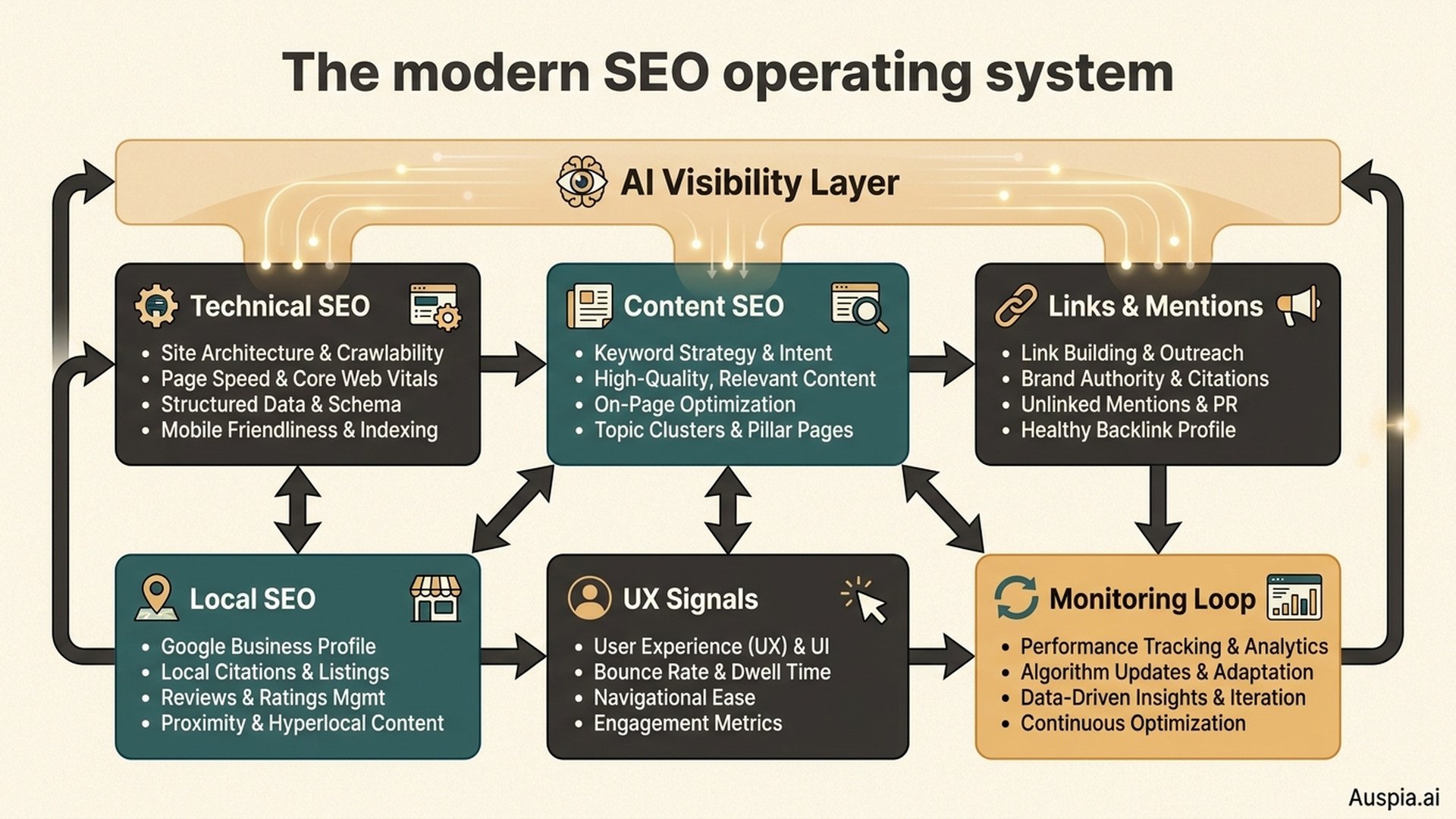
Caption: Modern SEO works as a connected operating system, not a pile of disconnected tactics.
3. Links and mentions: external trust still matters
Backlinks are not the whole game, but they still matter.
A backlink is a signal that another site found your page useful enough to reference. High-quality links from relevant, trusted sources can support authority, discovery, and faster indexing. Low-quality links, spam networks, and forced exchanges can do the opposite.
A healthier way to think about off-page SEO is external trust.
That includes:
- backlinks from relevant sites;
- brand mentions in credible articles;
- reviews and customer stories;
- partner pages and integrations;
- community discussions;
- expert quotes and industry references;
- local directories for regional businesses.
AI search makes this broader trust layer more important. AI systems often rely on a mix of website content, third-party references, reviews, and community sources to understand whether a brand belongs in an answer.
Manual path: create linkable assets, pitch guest posts, fix broken link opportunities, build partnerships, and monitor mentions.
Auspia path: identify which trust signals are missing, which pages deserve promotion, and where the brand lacks the external evidence needed for both SEO and AI visibility.
4. Local SEO: prove where you operate and why locals trust you
Local SEO is essential for businesses tied to geography: clinics, restaurants, agencies, home services, stores, schools, and local B2B providers.
The foundation is consistency.
Your name, address, phone number, hours, categories, services, and reviews should be clear across your website, Google Business Profile, maps, directories, and local pages. Local content should answer real local intent, not just repeat city names.
Useful local SEO work includes:
- completing and maintaining Google Business Profile;
- adding accurate NAP details on the website;
- building service-area or location pages;
- collecting and responding to real reviews;
- earning local links from chambers, associations, events, media, and partners;
- adding local schema where appropriate.
Local search is also moving into AI answers. A user may ask, "Who is a reliable accountant near me for a small ecommerce business?" The answer may combine reviews, proximity, service descriptions, and third-party evidence.
The business that has cleaner local evidence has an advantage.
5. UX SEO: help users get what they came for
User experience is not separate from SEO. If a page is slow, confusing, intrusive, or hard to navigate, it wastes the traffic it earns.
Strong UX SEO usually means:
- titles and meta descriptions that match the page;
- fast loading and stable layout;
- clear navigation;
- useful above-the-fold content;
- minimal intrusive popups;
- visible calls to action;
- content broken into readable sections;
- helpful tools, calculators, comments, examples, or comparison tables where relevant.
Search engines may not use every behavior metric directly in the way marketers imagine, but user satisfaction still matters. Pages that answer quickly, reduce friction, and help people decide tend to perform better across SEO, conversion, and AI-answer usefulness.
Auspia's automation layer can flag pages with weak titles, thin openings, poor content structure, missing CTAs, and outdated information so teams fix the pages that matter most first.
6. Monitoring: SEO is an iteration loop
SEO is never finished.
You need monitoring because rankings change, competitors update pages, Google adjusts systems, AI answer surfaces shift, and old content decays.
At minimum, monitor:
Tool or signal | What to watch |
|---|---|
Google Search Console | impressions, clicks, CTR, average position, indexing, queries. |
GA4 or analytics | engagement, conversions, landing page behavior, assisted revenue. |
Crawl data | broken pages, redirects, metadata, canonicals, speed, schema. |
AI visibility checks | brand mentions, citations, answer sentiment, cited URLs. |
Content inventory | pages that need refresh, consolidation, expansion, or pruning. |
The most useful action is often simple: find a page with high impressions and low CTR, rewrite the title and meta description, improve the opening answer, add missing depth, and retest.
Manual monitoring is possible, but it is easy to neglect. Automated monitoring makes SEO behave like a weekly operating cadence instead of an annual cleanup project.
Search intent: the concept that ties everything together
The source of most SEO waste is intent mismatch.
A page may be technically fine, well-written, and full of keywords, but still fail because it answers the wrong need.
The common intent types are:
Intent type | User wants | Better page type |
|---|---|---|
Informational | Learn something or solve a problem. | Guide, explainer, tutorial, FAQ, checklist. |
Navigational | Reach a known brand or site. | Clear homepage, brand page, support page, login page. |
Transactional | Buy, book, sign up, or request pricing. | Product page, pricing page, landing page, demo page. |
Commercial | Compare options before buying. | Comparison, review, alternatives, buyer guide. |
Local | Find a nearby service or place. | Location page, local service page, Google Business Profile. |
AI systems also respond to intent. If a user asks for a comparison, a vague blog post is less useful than a structured comparison table. If a user asks for local recommendations, a generic service page is weaker than a page with location, reviews, hours, and proof.
Caption: Intent classification helps teams create the right page for the right search and the right AI answer.
The four SEO types, in plain English
If you want a simpler mental model, use four categories.
On-page SEO
This is the work on the page itself: title, meta description, headings, content quality, internal links, image alt text, schema, page layout, and clarity.
On-page SEO helps Google and users understand the page's value quickly. It also makes the page easier for AI answer systems to parse.
Off-page SEO
This is the work outside your site: backlinks, brand mentions, reviews, social discussion, partnerships, directories, and digital PR.
Off-page SEO builds trust beyond your own claims.
Technical SEO
This is the infrastructure layer: crawlability, indexing, robots.txt, XML sitemaps, site structure, HTTPS, mobile performance, Core Web Vitals, structured data, and canonical logic.
Technical SEO decides whether your best pages can enter the ranking and citation pool.
Local SEO
This is the location layer: Google Business Profile, local pages, NAP consistency, local directories, reviews, maps, and community references.
Local SEO helps nearby buyers find and trust you.
The part teams should stop doing manually
Here is the honest problem: the framework is not hard to understand, but it is hard to operate consistently.
A complete SEO and AI visibility workflow asks teams to:
- crawl the site;
- check technical issues;
- inspect rankings and CTR;
- classify intent;
- refresh content;
- monitor backlinks and mentions;
- maintain local signals;
- improve UX;
- check AI answer visibility;
- repeat every week.
That is too much manual work for most lean teams.
This is why the best next step is not another long tutorial. It is automation.
With Auspia.ai, teams can automate the complex SEO and AI-search workflow: website scoring, crawler checks, AI visibility analysis, content refresh recommendations, topic gaps, monitoring, and practical next actions. You still bring the business knowledge. Auspia handles the repetitive analysis and prioritization.
You do not need to learn every SEO type, crawler rule, AI citation pattern, and monitoring routine before taking action. Start with Auspia, let the system show what matters, and focus your team on the few changes that can actually move traffic and trust.
FAQ
What is the core logic of SEO?
SEO is about satisfying user intent and earning search-engine trust. That requires technical access, useful content, external credibility, good user experience, and continuous measurement.
Are content and backlinks still the two most important SEO elements?
They are still central, but they work best with technical SEO and clear intent matching. Content gives search engines something valuable to rank. Links and mentions help prove that other sources trust it.
How does AI search change SEO?
AI search adds a new goal: your content should be easy to understand, verify, summarize, and cite. Rankings still matter, but brand mentions, citations, source quality, and answer structure now matter too.
What SEO work should a small team do first?
Start with technical blockers and high-opportunity pages. Fix crawl/index issues, then improve pages with impressions but low CTR or weak engagement. After that, build topic clusters and external trust signals.
Can Auspia automate SEO work?
Auspia automates the analysis and workflow around SEO and AI visibility: audits, crawler checks, content refresh opportunities, AI visibility checks, topic gaps, and monitoring. It helps teams act without learning every technical detail first.