Quick Answer
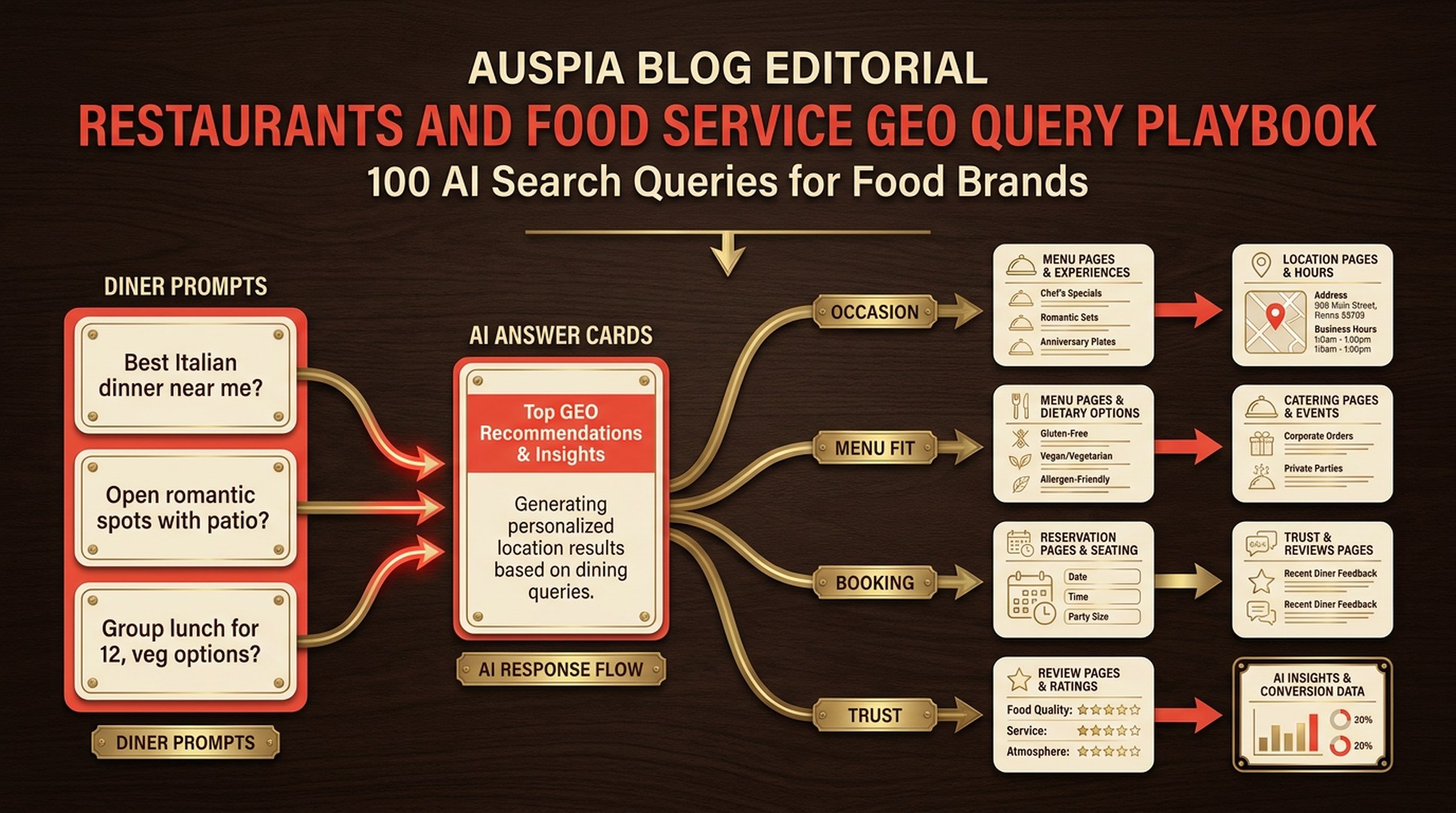
Restaurants and food service GEO is the work of making restaurant pages, menu pages, location pages, reservation pages, catering pages, dietary pages, delivery pages, review pages, and event pages easier for AI answer systems to understand, compare, and cite when diners ask where, what, and why to eat.
Diners rarely ask only for restaurants near me, pizza delivery, or catering company. They ask questions that combine occasion, location, cuisine, budget, dietary needs, group size, service speed, atmosphere, delivery reliability, and trust:
Where should I book dinner for a birthday with vegetarian options?What is the best family-friendly restaurant near a museum?Which catering option works for a 40-person office lunch?Does this restaurant handle gluten-free requests safely?How do I know if a restaurant review is still current?
For restaurants and food brands, the strongest GEO assets are location pages, menu pages, dietary pages, reservation pages, catering pages, private dining pages, delivery pages, neighborhood guides, review pages, chef or sourcing pages, and event-specific landing pages.
This playbook gives restaurants, multi-location groups, cafes, bakeries, bars, catering companies, cloud kitchens, food halls, and hospitality marketers 100 AI Search queries to track, a dining-decision framework, a query-to-page map, and a 30-day execution plan.
Important note: this article is about SEO/GEO content strategy, not food safety, allergy, legal, nutrition, or health advice. Restaurants should involve operations, kitchen leadership, legal, or food safety reviewers before publishing claims about allergens, dietary accommodations, health benefits, certifications, or safety procedures.
The Dining Decision Plate
Restaurant GEO is different from many industries because the decision can happen within minutes and depends heavily on context. The same restaurant may be a great answer for a business lunch but a poor answer for a stroller-heavy family brunch, late-night delivery order, anniversary dinner, or allergy-sensitive meal.
That creates a dining decision plate:
Layer | What The Diner Needs | Example Query | Page That Should Support The Answer |
|---|---|---|---|
Occasion | Why are they eating out? |
| Occasion page |
Location | Where do they need to eat? |
| Location / neighborhood page |
Menu Fit | What can they eat? |
| Menu / dietary page |
Atmosphere | What kind of experience do they want? |
| Experience page |
Service Path | How will they book, order, or receive food? |
| Reservation / delivery page |
Trust | Can they rely on quality and current information? |
| Review / updates page |
Risk | What could go wrong? |
| Allergy / policy FAQ |
A useful first step is to check which prompts already surface your restaurant, location, menu, or catering pages using an AI Search Visibility Checker, then build a prompt library around missing occasions, dietary gaps, weak review signals, or outdated menu summaries.
Why Restaurant GEO Starts With Dining Context, Not Cuisine Keywords
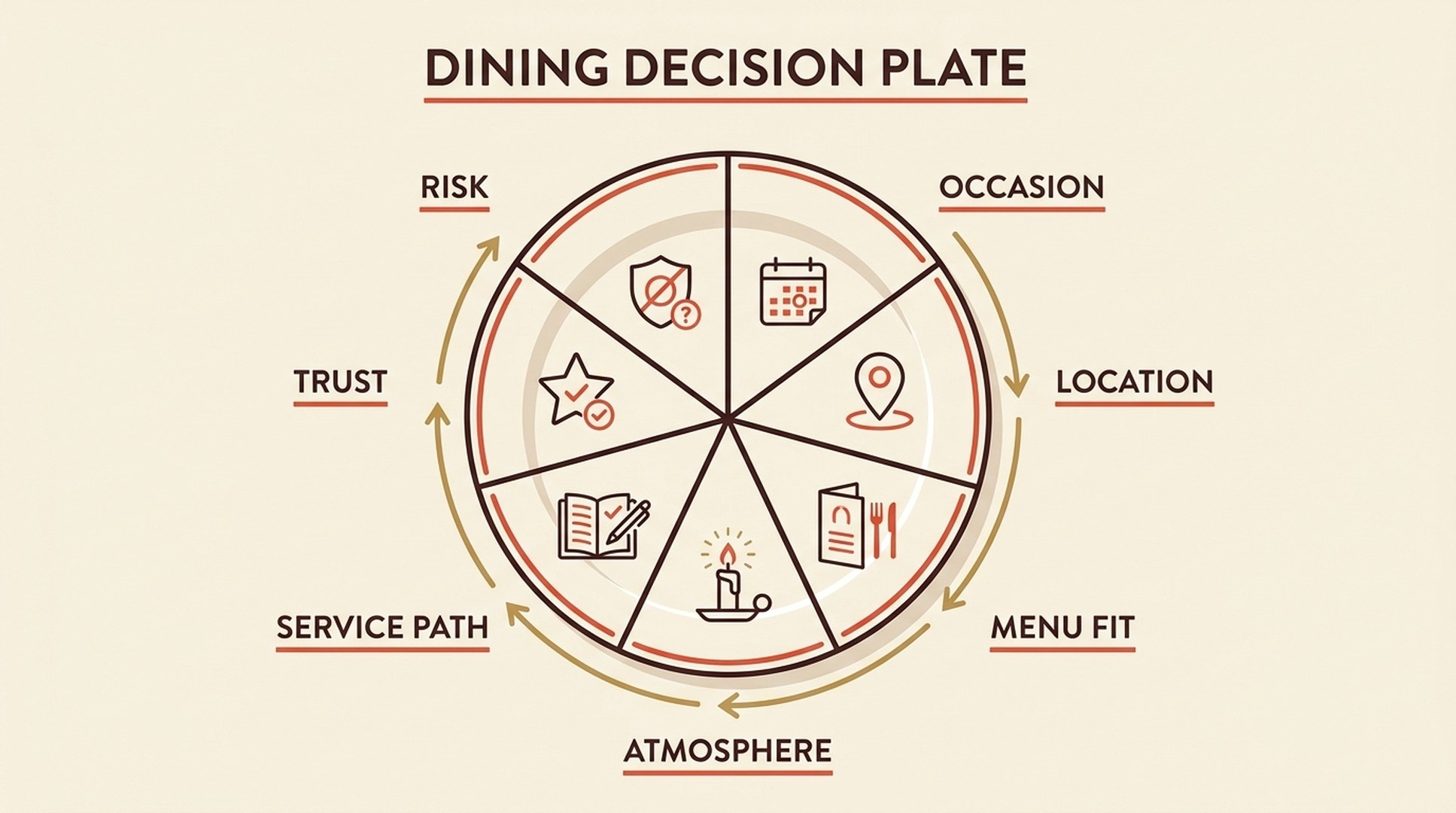
Restaurant AI Search prompts move through occasion, location, menu fit, atmosphere, service path, trust, and risk before a diner chooses where to eat.
Traditional restaurant SEO often starts with cuisine, neighborhood, delivery, and near me keywords. Those still matter. GEO adds the context layer because AI systems often answer with a recommendation shortlist before a diner opens a map or booking app.
The prompt usually contains constraints:
Where can I take clients for lunch near the convention center?What restaurant works for kids and grandparents?Which bakery can handle a custom cake with 48 hours notice?What should I ask before ordering catering for a team with dietary restrictions?Where can I eat after 10 pm near my hotel?
These questions require pages that explain menu fit, opening hours, reservation rules, party-size limits, dietary procedures, parking, delivery radius, catering minimums, and atmosphere. A generic homepage or static menu PDF is not enough.
Restaurant content also needs careful wording. Avoid guaranteed allergy-safe claims, unsupported health claims, outdated menu promises, or universal best claims. Strong restaurant GEO states the location, current menu scope, service times, reservation rules, dietary caveats, and update date.
The 10 Query Types Restaurant and Food Service Teams Should Map
Classify prompts before creating pages. This prevents teams from publishing repetitive best restaurant pages without operational usefulness.
Query Type | What The User Wants | Best Content Asset |
|---|---|---|
Occasion | Match a restaurant to birthday, date night, business meal, brunch, group dinner, or event | Occasion page |
Location / Near Me | Find food near a landmark, hotel, office, venue, school, or neighborhood | Location page, neighborhood guide |
Cuisine / Menu Fit | Understand dishes, cuisines, signature items, price range, and menu variety | Menu page, dish guide |
Dietary / Allergy | Check vegan, vegetarian, gluten-free, halal, kosher, nut-free, kids, or allergy handling | Dietary FAQ, allergen policy |
Reservation / Availability | Understand booking, waitlist, walk-ins, party size, deposits, and private dining | Reservation page |
Delivery / Takeout | Understand delivery radius, packaging, timing, ordering platforms, and pickup | Delivery / takeout page |
Catering / Events | Plan office lunch, wedding, party, meeting, or private event food | Catering page, event guide |
Price / Value | Understand average spend, prix fixe, service fees, minimums, and group costs | Pricing FAQ, catering estimate page |
Trust / Reviews | Validate current quality, service, ratings, photos, and reputation | Review page, update page |
Experience / Atmosphere | Match noise level, seating, view, parking, family fit, date-night feel, or accessibility | Experience page |
Every cluster should have one owner page. If menus, hours, dietary notes, and event minimums are scattered across third-party platforms, AI systems may summarize stale or conflicting information.
How To Prioritize Restaurant GEO Queries
Use a dining-intent scoring model:
Priority = Visit Intent + Context Match + Revenue Fit + Evidence Strength + AI Answer Probability - Policy Risk - Competition Difficulty
Factor | How To Evaluate It |
|---|---|
Visit Intent | Is the user close to booking, walking in, ordering, reserving a room, or requesting catering? |
Context Match | Does the query include occasion, location, group size, dietary need, timing, or service path? |
Revenue Fit | Does the query match profitable services such as private dining, catering, delivery, events, or peak reservations? |
Evidence Strength | Do you have current menus, hours, photos, reviews, dietary procedures, reservation rules, and staff-approved details? |
AI Answer Probability | Is the query likely to trigger a shortlist, recommendation, itinerary, or checklist? |
Policy Risk | Could the answer misstate allergens, dietary safety, health claims, hours, pricing, or availability? |
Competition Difficulty | Are map packs, review platforms, delivery apps, travel sites, or local media dominating? |
Start with queries where the restaurant can publish accurate, current, useful details. Avoid broad best restaurant content unless the page defines occasion, criteria, location, and limitations.
100 Restaurant and Food Service GEO Query Examples
Use these prompts as a starting library. Adapt them by cuisine, neighborhood, service model, delivery zone, event type, menu update cycle, and dietary review process.
Occasion Queries
- Best restaurant for a birthday dinner with a group
- Best restaurant for a first date in a quiet setting
- Best restaurant for a business lunch near downtown
- Best brunch spot for families with kids
- Best restaurant for an anniversary dinner
- Best casual restaurant after a concert
- Best restaurant for a team dinner after work
- Best cafe for a relaxed weekend breakfast
- Best place for dessert after dinner nearby
- Best restaurant for visitors who want local food
Location / Near Me Queries
- Family-friendly restaurant near the museum
- Restaurant near a convention center for client lunch
- Best dinner spot near a theater
- Coffee shop near a train station with seating
- Restaurant near a hotel open late
- Best lunch near an office district
- Pizza delivery near me open now
- Healthy takeout near a college campus
- Restaurant with parking near downtown
- Breakfast near the airport before an early flight
Cuisine / Menu Fit Queries
- Best Italian restaurant with handmade pasta
- Best sushi restaurant for beginners
- Best Mexican restaurant with vegetarian options
- Best steakhouse with seafood options
- Best bakery for custom cakes
- Best ramen restaurant with spicy options
- Best cafe with breakfast all day
- Best restaurant with small plates for sharing
- Best burger place with non-beef options
- Best restaurant with seasonal tasting menu
Dietary / Allergy Queries
- Restaurant with vegan and gluten-free options
- Does this restaurant handle nut allergies?
- What should I ask before dining out with celiac disease?
- Best vegetarian restaurant for a mixed group
- Restaurant with dairy-free dessert options
- Halal-friendly restaurant near me
- Restaurant with low-sodium menu options
- How do restaurants prevent cross-contact for allergens?
- Best kids menu with healthier options
- What dietary information should a restaurant menu include?
Reservation / Availability Queries
- Restaurant with online reservations for 8 people
- How far ahead should I book a popular restaurant?
- Restaurant with private dining room for 20 people
- Restaurant that accepts walk-ins on weekends
- What should I know before booking a prix fixe dinner?
- Restaurant with waitlist near me
- What deposit rules do restaurants use for large parties?
- How do restaurants handle late arrivals for reservations?
- Best restaurant for last-minute dinner reservations
- What should I ask before booking a private room?
Delivery / Takeout Queries
- Best takeout food that travels well
- Restaurant delivery with reliable packaging
- Best family meal takeout near me
- Restaurant with curbside pickup nearby
- How do I choose catering-style takeout for a small group?
- What should restaurants disclose about delivery fees?
- Best late-night delivery near me
- Best office lunch delivery for 12 people
- Which foods are best for pickup instead of delivery?
- How do restaurants keep takeout orders accurate?
Catering / Events Queries
- Which catering option works for a 40-person office lunch?
- What should I ask before booking wedding catering?
- Best catering for a corporate breakfast meeting
- How much food should I order for a team lunch?
- What should a catering quote include?
- How far ahead should I book catering?
- Catering with vegetarian and gluten-free options
- Boxed lunch catering vs buffet catering
- What should I ask before booking food for an outdoor event?
- How do restaurants handle catering setup and cleanup?
Price / Value Queries
- How much should I expect to spend at a casual restaurant?
- What affects the cost of private dining?
- How do catering minimums work?
- What service fees should restaurants disclose?
- Prix fixe menu vs a la carte: which is better for groups?
- How do restaurants price custom cakes?
- What should I compare besides menu prices?
- How much should office lunch catering cost per person?
- What does a tasting menu usually include?
- How do delivery fees affect total restaurant cost?
Trust / Reviews Queries
- How do I know if a restaurant review is current?
- What recent reviews matter when choosing a restaurant?
- How do I compare restaurant ratings across platforms?
- What guest photos matter when choosing a restaurant?
- How do I know if a catering company is reliable?
- What makes a restaurant recommendation trustworthy?
- How should restaurants respond to negative reviews?
- What should I check before booking a restaurant from social media?
- How do I verify a restaurant's hours and menu are current?
- What makes a food service provider credible for events?
Experience / Atmosphere Queries
- Quiet restaurant for client dinner
- Restaurant with outdoor seating and shade
- Restaurant with stroller-friendly seating
- Restaurant with good lighting for a date night
- Restaurant with wheelchair-accessible entrance and restroom
- Restaurant with a view for dinner
- Restaurant with fast service before a show
- Restaurant with private booths for conversation
- Restaurant with live music but not too loud
- Restaurant good for solo dining at the bar
How To Turn Restaurant Queries Into Citation-Ready Pages
A restaurant query library should become a dining decision architecture. The strongest pages are location pages, menu pages, dietary pages, reservation pages, delivery pages, catering pages, private dining pages, review pages, experience pages, and event pages.
Query Cluster | Owner Page | Page Type | Required Proof |
|---|---|---|---|
Occasion prompts | Occasion guide | Dining guide | Occasion fit, group size, atmosphere, booking path |
Location prompts | Location page | Local page | Address, landmarks, parking, transit, hours |
Menu prompts | Menu page | Menu / dish guide | Current dishes, price range, ingredients, update date |
Dietary prompts | Dietary FAQ | Policy page | Allergen caveats, procedures, contact path, review date |
Reservation prompts | Reservation page | Booking guide | Party size, deposit, waitlist, cancellation rules |
Delivery prompts | Takeout / delivery page | Ordering guide | Radius, packaging, timing, fees, platforms |
Catering prompts | Catering page | Event guide | Minimums, menu options, setup, lead time, quote path |
Price prompts | Pricing FAQ | Cost guide | Spend range, fees, minimums, tax/service caveats |
Trust prompts | Reviews / updates page | Trust page | Recent reviews, photos, responses, current menu notes |
Experience prompts | Atmosphere page | Experience guide | Seating, noise, accessibility, view, family fit |
A citation-ready restaurant page should answer the diner question first, then support it with current menu details, location context, reservation rules, dietary caveats, reviews, photos, and next steps.
For technical readiness, restaurants should make sure menu pages, location pages, booking pages, catering pages, and review pages are crawlable, indexable, and internally linked. A quick Website SEO Score Checker can help catch basic crawl, metadata, schema, and page-quality issues before teams rewrite booking-critical pages.
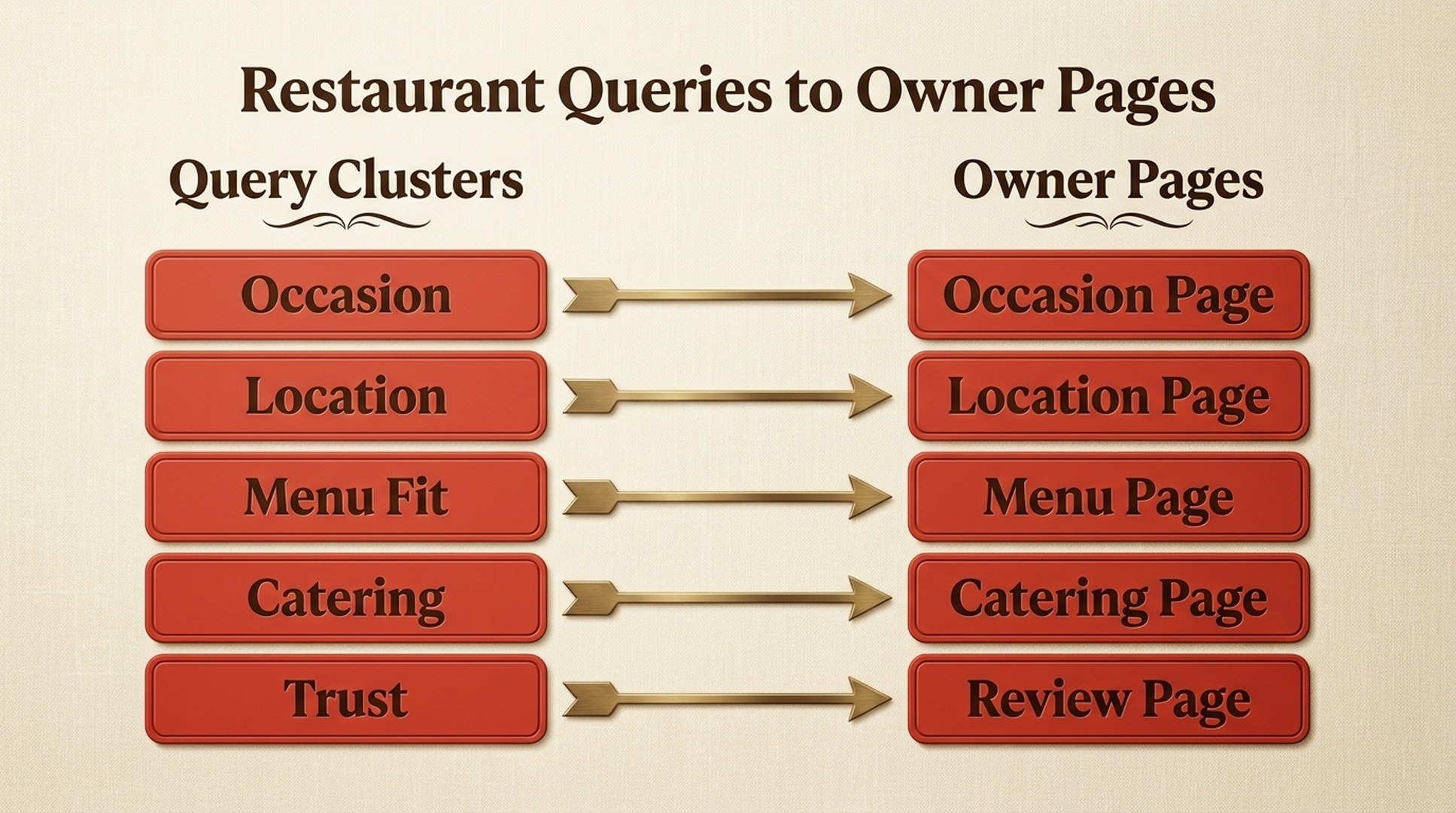
Occasion, location, menu-fit, catering, and trust queries should map to durable owner pages that support reservations, orders, and catering leads.
The First 20 Queries To Prioritize
If a restaurant or food service brand is starting from scratch, these 20 prompts usually create a practical first backlog.
Priority | Query | Why It Matters | Likely Owner Page |
|---|---|---|---|
1 | Best restaurant for a birthday dinner with a group | Occasion and reservation intent | Birthday dinner page |
2 | Best restaurant for a business lunch near downtown | High-value occasion | Business lunch page |
3 | Family-friendly restaurant near the museum | Local and family intent | Family location page |
4 | Restaurant near a hotel open late | Travel and local intent | Late-night location page |
5 | Restaurant with vegan and gluten-free options | Dietary decision | Dietary menu page |
6 | What should I ask before dining out with celiac disease? | Policy-sensitive query | Gluten-free FAQ |
7 | Restaurant with online reservations for 8 people | Booking intent | Group reservation page |
8 | Restaurant with private dining room for 20 people | Event revenue | Private dining page |
9 | Best takeout food that travels well | Takeout conversion | Takeout guide |
10 | Best office lunch delivery for 12 people | Delivery revenue | Office lunch delivery page |
11 | Which catering option works for a 40-person office lunch? | Catering lead | Office catering page |
12 | What should a catering quote include? | Quote readiness | Catering estimate FAQ |
13 | What service fees should restaurants disclose? | Cost transparency | Fee FAQ |
14 | Prix fixe menu vs a la carte for groups | Group decision | Group menu guide |
15 | How do I know if a restaurant review is current? | Trust validation | Review trust page |
16 | How do I verify a restaurant's hours and menu are current? | Operational accuracy | Hours/menu update page |
17 | Quiet restaurant for client dinner | Atmosphere fit | Client dinner page |
18 | Restaurant with wheelchair-accessible entrance and restroom | Accessibility need | Accessibility page |
19 | Restaurant with fast service before a show | Timing constraint | Pre-theater dining page |
20 | Restaurant good for solo dining at the bar | Scenario fit | Solo dining page |
These prompts are useful because they can be answered by pages that already influence reservations, walk-ins, takeout orders, catering leads, and private dining inquiries.
30-Day Execution Plan
Timeframe | Action | Output |
|---|---|---|
Days 1-3 | Build the restaurant AI Search query library and classify by location, occasion, dietary need, service path, and page owner | 100-query prompt library |
Days 4-7 | Score prompts by visit intent, context match, revenue fit, evidence, AI answer probability, policy risk, and competition | First 20 prompt backlog |
Days 8-14 | Map prompts to location pages, menu pages, dietary FAQs, reservation pages, delivery pages, catering pages, and review pages | Query-to-page map |
Days 15-21 | Rewrite priority pages with direct answers, current menu details, hours, booking rules, dietary caveats, reviews, and next steps | Updated citation-ready pages |
Days 22-30 | Test prompts across AI answer surfaces and record brand mentions, cited URLs, competitor mentions, and inaccurate menu or policy facts | Restaurant AI visibility tracker |
A single-location restaurant can start with five assets: a current menu page, a dietary FAQ, a reservation/group dining page, a takeout page, and a review/update page. A multi-location group should add location pages, occasion pages, catering pages, private dining pages, and neighborhood guides.
Common Mistakes
Restaurant GEO fails when food brands publish attractive pages that do not answer operational questions.
Avoid these mistakes:
- Using PDF-only menus. AI systems need crawlable menu text, update dates, and dish context.
- Hiding dietary caveats. Allergen and dietary pages should explain procedures without unsafe guarantees.
- Letting third-party platforms own the facts. Keep hours, menus, reservations, and policies current on owned pages.
- Ignoring occasion intent. Birthday, business lunch, pre-theater, family brunch, and catering pages answer different prompts.
- Hiding fees and minimums. Catering, private dining, deposits, service fees, and delivery fees should be easy to understand.
- Treating reviews as generic social proof. Recent reviews, guest photos, and owner responses help AI systems evaluate trust.
- Measuring only rankings. Track AI mentions, cited pages, competitor inclusion, and inaccurate summaries of menu, hours, fees, or policies.
FAQ
What is restaurant GEO?
Restaurant GEO is the process of making menu, location, reservation, delivery, catering, dietary, review, and experience pages easier for AI answer systems to understand, summarize, and cite accurately.
Is restaurant GEO the same as restaurant SEO?
No. Restaurant SEO focuses on rankings, local visibility, maps, reviews, and booking traffic. Restaurant GEO builds on that foundation but focuses on how AI systems answer dining questions about occasion, location, menu fit, dietary needs, booking, delivery, catering, trust, and atmosphere.
Should restaurants create one page for every AI Search query?
No. The 100-query list should become a page map. Many questions should be answered by stronger menu pages, location pages, dietary FAQs, reservation pages, catering pages, review pages, and occasion guides.
Which restaurant queries should teams prioritize first?
Start with questions about high-value occasions, local discovery, dietary needs, group reservations, private dining, takeout, catering, fees, reviews, accessibility, and atmosphere. These queries influence bookings and orders.
How can restaurants avoid risky GEO content?
Keep menus and hours current, use careful allergy language, disclose fees and minimums, avoid unsupported health claims, state reservation rules clearly, and involve kitchen or operations leaders when publishing dietary, allergen, safety, or event-capacity information.
How should restaurants measure GEO performance?
Track a stable prompt set across AI answer surfaces. Record whether the restaurant appears, which URLs are cited, which competitors appear, whether menu facts are accurate, and whether AI answers omit important hours, fees, dietary caveats, or reservation rules.
Auspia Takeaway
Restaurant and food service GEO is dining decision support. AI systems need occasion fit, location context, menu clarity, dietary caveats, booking rules, delivery details, review freshness, and atmosphere signals before they can recommend or cite a restaurant responsibly.
Start with prompts that affect reservations, walk-ins, catering requests, delivery orders, and group bookings. Map the first 20 queries to pages that already shape diner decisions. Then rewrite those pages so the answers are current, specific, useful, and safe to summarize.
Author: Miles Donovan, Local AI Search Analyst Across 500+ Service Queries at Auspia. Miles writes about local visibility, service-area pages, location intent, and AI recommendations for location-driven businesses.