Concise answer
Prompt research is the first real step in GEO optimization because AI search does not start with a keyword. It starts with a question. If your team does not know how buyers ask ChatGPT, Gemini, Perplexity, Google AI Overviews, or other answer systems for help, you will build pages around the wrong intent.
The practical move is simple: collect real prompts, group them by intent, test how AI systems answer today, then build or improve the pages that can answer those prompts better than the current sources.
For most B2B, SaaS, ecommerce, and professional service teams, this changes GEO from "write more content" into a measurable workflow:
GEO question | What prompt research tells you |
|---|---|
What should we publish first? | The questions closest to buyer decisions |
Which pages need rewriting? | The prompts where AI misunderstands your category, product, or audience |
Which competitors are already visible? | The brands AI systems mention when users ask comparison or recommendation prompts |
What should we monitor? | The recurring prompts that matter for discovery, trust, and conversion |
Auspia's view: the team with the best prompt map usually has the clearest GEO roadmap.
Why keyword research is not enough for GEO
Keyword research still matters. It shows demand, language, seasonality, and competition. But it does not fully show how people ask AI systems for advice.
A search keyword is often compressed: "crm software pricing" or "best SEO agency." A prompt is usually more complete:
- "What CRM is best for a 20-person B2B sales team that needs email sync and simple reporting?"
- "Which SEO agency should a SaaS company choose if we already have technical SEO covered?"
- "Is GEO worth doing before we have strong backlinks?"
- "What should I compare before buying an AI visibility tool?"
Those prompts include context, constraints, doubts, and decision criteria. That is exactly the information an AI answer system uses when it decides which sources, brands, and pages to summarize.
If your content only targets the short keyword, it may rank somewhere in classic search but still fail to enter the AI answer. GEO needs the longer question behind the query.
What prompt research means
Prompt research is the process of finding, organizing, and testing the questions users are likely to ask AI systems before they buy, compare, troubleshoot, or recommend something.
It is not a brainstorming session where a marketer invents 100 questions in a spreadsheet. Good prompt research pulls from multiple places:
- Sales calls, demo notes, chat logs, support tickets, and contact forms
- Search Console queries and paid search terms
- People Also Ask, Reddit, Quora, YouTube comments, review sites, and community threads
- Competitor comparison pages and marketplace reviews
- Direct tests in ChatGPT, Perplexity, Gemini, Google AI Mode, and Google AI Overviews where available
The goal is not to collect the most prompts. The goal is to find the prompts that reveal how buyers make decisions.
The four prompt types worth mapping first
Start with four buckets. They are simple enough for a small team, but useful enough to guide content strategy.
Prompt type | Example | Best page format | Business value |
|---|---|---|---|
Definition | "What is GEO optimization?" | Glossary, beginner guide, category page | Builds category understanding |
Comparison | "GEO vs SEO: what is the difference?" | Comparison page, decision guide | Helps users evaluate tradeoffs |
Selection | "Which GEO tool should a SaaS team use?" | Alternatives page, buyer guide, use-case page | Closest to pipeline and trials |
Execution | "How do I audit AI search visibility?" | Checklist, tutorial, template | Turns interest into action |
Definition prompts are useful, but they are rarely the whole opportunity. Many teams overproduce explainers because they are easy to write. The better GEO wins often sit in comparison, selection, and execution prompts, where users are closer to choosing a vendor, method, or next step.
A practical prompt research workflow
Use this workflow before you rewrite pages or publish new ones.
1. Collect 50 to 100 real questions
Do not start with a giant dataset. Start with a useful one. Pull questions from your own customer evidence first, then expand with public sources.
For each question, keep the original wording. Do not clean it too much. Awkward phrasing is useful because real prompts are often messy.
Add five fields:
Field | Why it matters |
|---|---|
Prompt | The exact question or likely AI query |
Source | Sales, support, Search Console, Reddit, review site, AI test, etc. |
Intent | Definition, comparison, selection, or execution |
Buyer stage | Awareness, evaluation, decision, post-purchase |
Existing page | The page that should answer it, or "missing" |
2. Test how AI answers today
Run the most important prompts across the AI surfaces your audience uses. You do not need a perfect lab setup at the beginning. You do need consistency.
Track the same prompt wording, date, model or platform, answer summary, brands mentioned, sources cited, and whether your brand appears.
What you are looking for:
- Does the answer mention your category correctly?
- Does it mention your brand at all?
- If it mentions you, is the description accurate?
- Which competitors appear repeatedly?
- Which pages or third-party sources does the system lean on?
- What answer structure does the AI prefer: list, comparison, checklist, table, or direct recommendation?
This is where prompt research becomes GEO intelligence. You are not guessing what to write. You are seeing what the answer market already looks like.
3. Score prompts by business value
A prompt can be popular and still weak for business. Score each prompt with a simple 1 to 5 scale across four criteria:
Criteria | Question to ask |
|---|---|
Frequency | Do we see this question often enough to matter? |
Decision proximity | Is the user close to choosing a product, service, vendor, or method? |
Current gap | Do we lack a strong page that answers this? |
Reusability | Can one good answer support sales, SEO, paid, onboarding, or support? |
The best first targets usually score high on decision proximity and current gap. That is where GEO can change both visibility and conversion quality.
4. Map prompts to pages
Every important prompt needs a home. Sometimes the home is an existing page that needs a stronger answer. Sometimes it is a new page.
Use this rule:
- If the prompt asks "what is it," improve a definition or category page.
- If it asks "which is better," build a comparison page.
- If it asks "what should I choose," build a use-case or buyer guide.
- If it asks "how do I do this," build a checklist, template, or tutorial.
Do not bury high-value prompts in a generic FAQ if the answer deserves its own page. AI systems can extract FAQ answers, but users still need a page that explains the tradeoff, evidence, and next step.
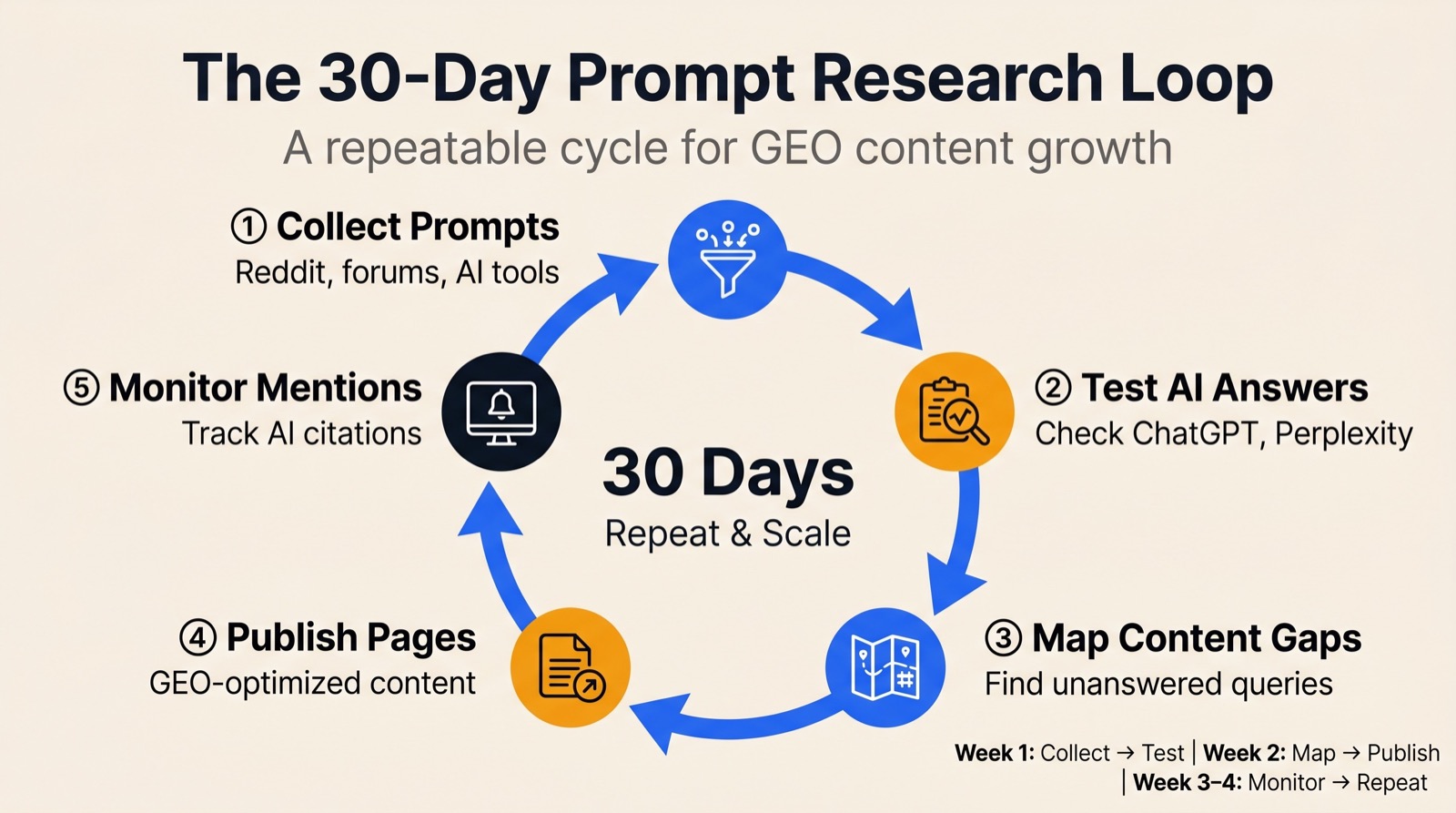
Caption: A 30-day prompt research loop turns raw buyer questions into AI visibility tests, content gaps, and publishable GEO assets.
What to change on the page after prompt research
Once the prompt map is clear, the page work becomes more precise.
First, answer the prompt in the opening section. Do not make users read six paragraphs before the page says something useful. AI systems also benefit from direct, extractable answers.
Second, include the context that users put inside prompts. If buyers ask "for a small SaaS team," "with a limited budget," or "when SEO is already working," the page should address those conditions directly.
Third, add comparison logic. AI answers often summarize options. Give them clean distinctions: when to choose A, when to choose B, when neither is right.
Fourth, make the evidence easy to verify. Add screenshots, case notes, review snippets you are allowed to use, product facts, schema, author context, dates, and internal links to supporting pages.
Fifth, connect the page to a next action. Prompt research is not only for visibility. It should help the visitor decide what to do next: run an audit, compare a tool, request a demo, download a template, or read a related guide.
For teams starting from scratch, Auspia's AI Search Visibility Checker can help turn a prompt list into a first visibility snapshot.
Example: turning one buyer prompt into a GEO page
Imagine a SaaS buyer asks:
"What is the best AI search visibility tool for a small B2B team that needs prompt tracking and competitor comparisons?"
A weak content plan would create a broad article called "Best AI Search Tools" and list ten products with thin descriptions.
A stronger GEO plan would build a page around the decision itself:
Page section | What it should answer |
|---|---|
Direct answer | Which type of tool fits a small B2B team and why |
Selection criteria | Prompt tracking, citation tracking, competitor comparison, reporting, setup effort |
Fit and non-fit | Who should use a lightweight tool vs. an enterprise platform |
Comparison table | What each option handles well or poorly |
Workflow | How to run the first 20 to 50 prompts |
Next step | Try a visibility check or export a prompt library |
That page is easier for a human to use and easier for an AI answer system to summarize.
Common mistakes in prompt research
The first mistake is treating prompts as keywords with more words. They are richer than that. A prompt contains the user's situation, anxiety, constraints, and desired outcome.
The second mistake is only testing brand prompts. "What is Acme?" is useful, but it is not enough. The money is often in category and comparison prompts where the user has not chosen a brand yet.
The third mistake is ignoring negative or exclusion prompts. Questions like "When should I not use a GEO agency?" or "Is AI search visibility tracking reliable?" can produce stronger trust than a page that only says your solution is great.
The fourth mistake is publishing without retesting. After a page is rewritten, run the original prompt set again. Look for changes in mentions, descriptions, cited pages, and answer framing.
The fifth mistake is separating prompt research from content operations. The prompt map should influence briefs, outlines, internal links, schema, comparison tables, FAQs, and sales enablement assets.
A 30-day starter plan
Here is a lean version a small team can run without building a complex GEO program.
Week | Work | Output |
|---|---|---|
Week 1 | Collect customer questions and public prompts | 50 to 100 prompt candidates |
Week 2 | Test priority prompts in AI systems | Brand mention and competitor visibility snapshot |
Week 3 | Score prompts and map pages | A ranked content gap list |
Week 4 | Rewrite 2 pages and publish 1 new decision page | First GEO iteration and monitoring baseline |
Keep the first cycle small. A clean prompt map with 30 high-value questions is more useful than a bloated spreadsheet nobody uses.
FAQ
Is prompt research different from search intent research?
Yes. Search intent research studies what users want from a search query. Prompt research studies how users ask AI systems for a synthesized answer, recommendation, comparison, or action plan. They overlap, but prompt research usually captures more context and decision criteria.
How many prompts should a team track?
Start with 30 to 100. For ongoing GEO measurement, many teams eventually track hundreds of prompts by category, market, persona, and buyer stage. The right number is the number your team can retest and act on.
Which AI platforms should we test?
Test the platforms your audience uses. For many teams that means ChatGPT, Google AI Overviews or AI Mode, Gemini, Perplexity, and sometimes Claude. Keep the platform list stable during each measurement cycle so results are comparable.
Should every prompt become a separate page?
No. Similar prompts can often be answered by one strong page. A separate page makes sense when the prompt has a distinct intent, buyer stage, comparison set, or conversion path.
What is the fastest win from prompt research?
Find high-value prompts where AI already mentions competitors but not your brand. Then inspect the sources being cited, identify what your site lacks, and build a page that answers the prompt more clearly.
Final takeaway
Prompt research is where GEO stops being vague. It shows how users ask, how AI answers, where competitors appear, and which pages your site needs next.
If you want a useful first step, do this: write down the 50 questions your best buyers would ask an AI before choosing a solution. Then test them. The gaps will tell you what to fix before you publish another generic blog post.
Author: Elena Shaw, Prompt Library Strategist, 3,000+ Buyer Prompts Mapped at Auspia. Elena writes about prompt sets, query maps, and practical GEO evaluation workflows for growth teams.