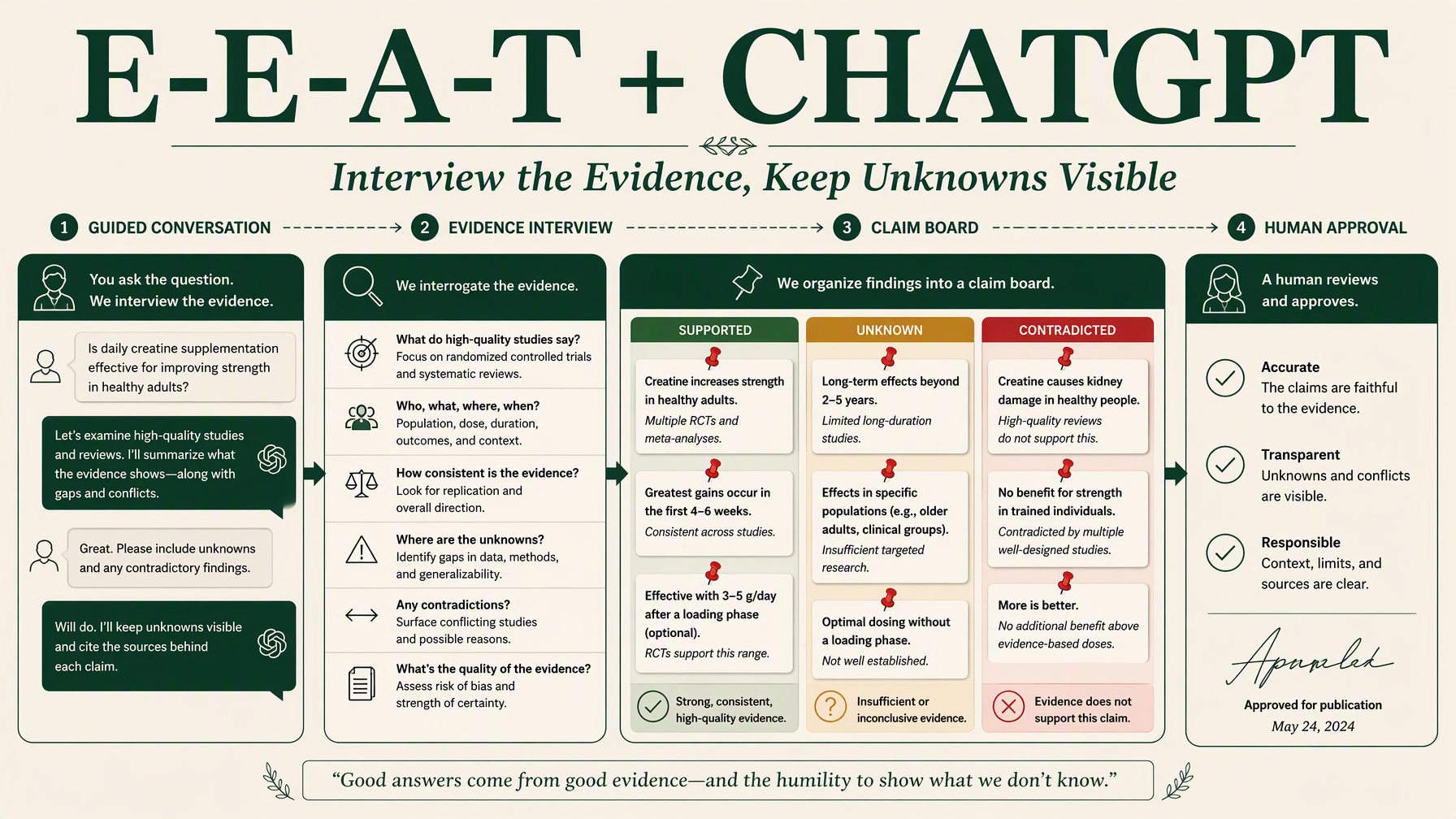
ChatGPT is a practical starting point for an E-E-A-T evidence audit when the team does not work in a code repository. You can bring one URL, a draft, a few approved files, and the people who own the facts into a structured conversation. OpenAI's ChatGPT search announcement explains that search can return links to web sources; ChatGPT can ask the questions, organize answers, and use those sources when the capability is available in the active experience.
The danger is conversational smoothness. A plausible answer can sound settled even when it came from model knowledge, an outdated source, or an assumption. This workflow turns the conversation into an evidence interview. Every material statement must be tied to an uploaded file, a public source, a named owner response, or an explicit unknown.
Use ChatGPT as the interviewer
Role | Responsibility |
|---|---|
ChatGPT | Extract claims, ask focused questions, compare supplied evidence, and format the review |
Content owner | Define the page's visitor task and make editorial decisions |
Fact owner | Confirm product, author, customer, policy, or method claims |
Public sources | Support current externally verifiable statements |
Final reviewer | Approve the exact wording and public page preview |
ChatGPT is not the fact owner. Even when it finds a relevant source, a person should confirm that the source supports the precise wording and applies to the intended market, date, and page.
What you will finish with
The completed interview produces four artifacts:
- A claim board with supported, uncertain, contradicted, and not-provided items.
- An interview queue grouped by the person who can answer each question.
- A source support table showing what each citation does and does not prove.
- A short edit brief containing only human-approved changes.
The workflow is done when every proposed factual addition has a source or owner approval, and every unresolved material claim remains visible.
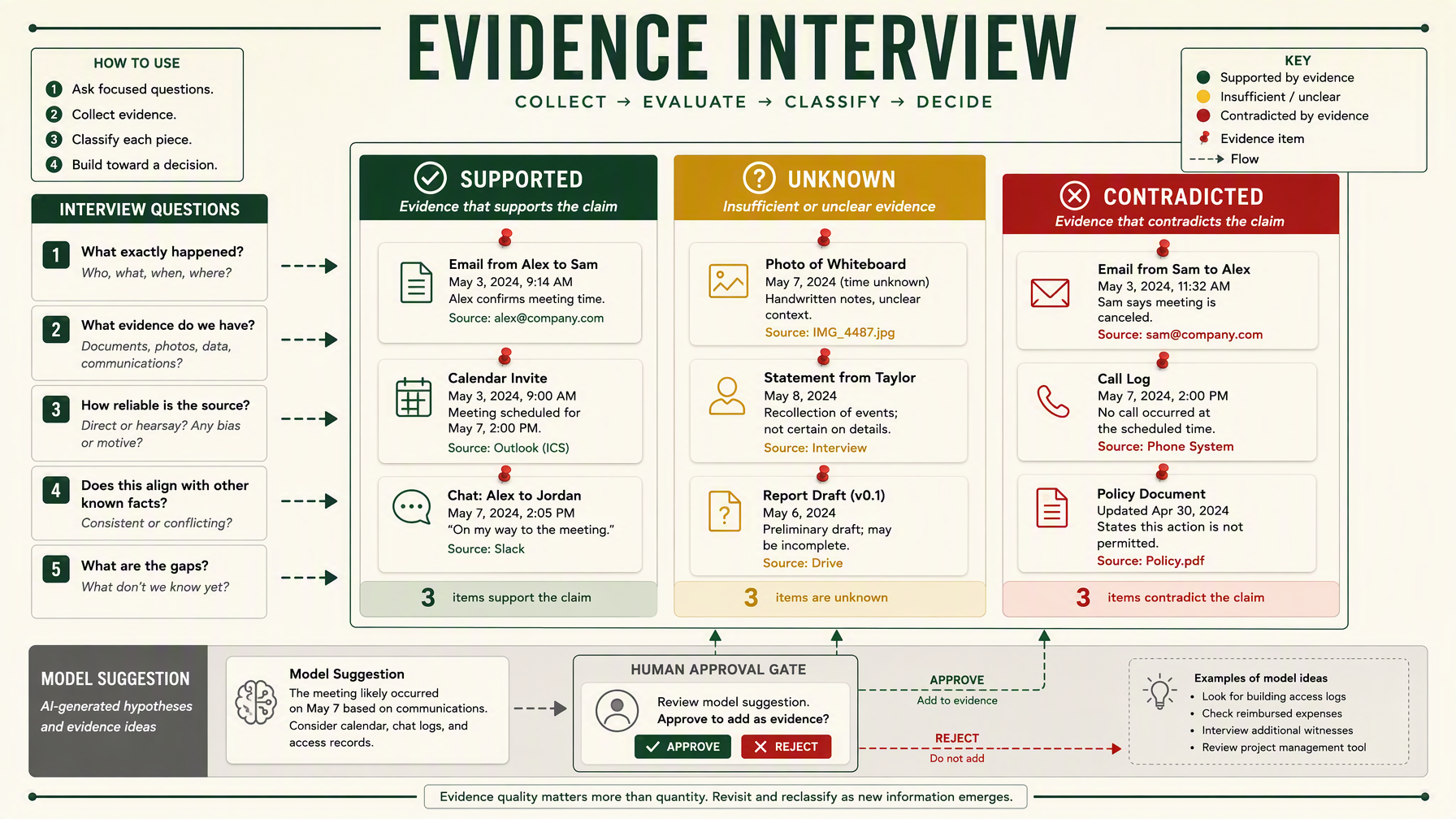
Illustrative workflow: a model suggestion stays outside the evidence board until a human approves it with supporting material.
Set Project instructions that resist invented proof
If you use a ChatGPT Project for repeated reviews, add instructions like these. For a one-time audit, include them at the beginning of the conversation.
You are an E-E-A-T evidence interviewer, not an authority generator.

For every material page claim, distinguish:
- supplied_file: supported by an approved uploaded file;
- public_source: supported by a public source you opened;
- owner_answer: confirmed by the responsible person in this conversation;
- model_suggestion: wording or an idea that is not evidence;
- unknown: not provided or not verified.

Never invent or infer first-hand experience, qualifications, licenses, reviews, customers, awards, partnerships, citations, results, testing, policies, dates, rankings, traffic, or endorsements.

Do not assign an E-E-A-T score. Do not promise ranking, traffic, rich-result, AI Overview, or AI-citation outcomes.

Ask one focused evidence question at a time. Keep a visible unknowns list. Do not create a final edit brief until the content owner approves the claim board.
Project instructions make the process repeatable, but they do not verify any claim. They are operating rules.
Begin with one page and one decision
Use this opening prompt:
Run an E-E-A-T evidence interview for one page.

Page or draft: [URL OR FILE]
Audience: [AUDIENCE]
Visitor task: [WHAT THE READER NEEDS TO DECIDE OR DO]
Market and language: [MARKET, LANGUAGE]
Approved files: [LIST OR "none yet"]
People available to answer questions: [NAMES OR ROLES]

First, extract material factual and credibility claims. Build a claim board with the page location, exact claim, evidence type, source location, current status, and owner. Then ask one high-priority question at a time.

Do not rewrite the page or produce a generic E-E-A-T checklist. Keep model suggestions separate from evidence.
Why one question at a time? Because a long questionnaire encourages partial answers and hidden assumptions. A focused interview can resolve the highest-risk claim before spending time on minor presentation details.
Keep the claim board visible
Ask ChatGPT to update the same table after each answer.
Claim ID | Page location | Exact claim | Evidence type | Evidence location | Status | Owner |
|---|---|---|---|---|---|---|
CLM-001 | Opening paragraph | "Used by more than 5,000 teams" | unknown | none | not provided | Marketing owner |
CLM-002 | Author box | "Reviewed by a certified specialist" | owner answer | pending approved bio | needs verification | Named reviewer |
CLM-003 | Method section | "Tested in March 2026" | supplied file | method-notes.pdf, page 2 | supported with limits | Content owner |
An answer in the conversation should not automatically change the status to supported. The responsible person may still need to approve public wording or provide a source record.
Make public search prove the sentence, not the topic
ChatGPT search can find current public sources and return links. That is useful for product documentation, official policies, and primary references. It does not remove the need for source-fit review.
For every public source, ask:
- Does the page directly support the exact sentence?
- Is it current enough for the claim?
- Does it apply to this market, language, plan, or product version?
- Is the source describing itself, reporting independent evidence, or expressing an opinion?
- What limitation should remain visible in the article?
For example, a vendor page can verify that the vendor describes a feature as available. It does not prove that your team tested the feature, that every customer can use it, or that the feature produces a business result.
Distinguish a useful citation from citation-shaped decoration
Use a support table rather than a list of links.
Proposed statement | Source | Support level | Safe use |
|---|---|---|---|
The feature appears in the vendor's current documentation | Official feature page | Direct | Cite with retrieval date and any plan limits |
Users prefer the feature | Same vendor page | None | Find independent evidence or remove |
Our team tested the feature | Vendor page | None | Require first-hand method notes |
The policy changed in 2026 | Current policy page without a change log | Partial | State the current policy; do not claim a change date |
This table catches a common error: the citation is real, but the surrounding sentence says more than the source.
Interview the people who own the missing facts
ChatGPT can prepare a question for each owner. It should not send the question or contact anyone unless the user separately authorizes that action.
Good questions are narrow:
- "Did you personally perform the comparison described in paragraph four? If yes, which products, dates, and steps can be published?"
- "Is the author role in the attached bio approved for public use? Which wording should we avoid?"
- "What source supports the customer count in the hero section, and who can authorize publication?"
- "Does the return policy linked on this page apply to customers in Canada as of the review date?"
Avoid questions that invite marketing copy, such as "Why are we trusted experts?" The interview needs facts and limits.
Convert approved answers into an edit brief
Only after the claim board is approved should ChatGPT prepare copy. Use this structure:
# Approved E-E-A-T edit brief

Page:
Approval date:
Final content owner:

| Change ID | Current wording | Approved replacement or action | Evidence | Owner approval | Verification |
| --- | --- | --- | --- | --- | --- |

## Held claims

List every material claim that remains unsupported, contradicted, restricted, or awaiting approval.

## Implementation boundary

This brief does not authorize publication, Schema changes, account access, messages, or external writes.
Do not ask for "the best version" of each sentence. Ask for the narrowest clear version supported by the accepted evidence.
Example: a confident answer that should stay unknown
A travel guide says its author has "visited every property in the region." ChatGPT may know the author's public profile and find several related articles. None of that proves the claim.
The interview should ask the named author or content owner for the property list, visit dates, and publishable method notes. Until those exist, the claim stays unknown. A safe revision might explain that the guide compares public property information as checked on a named date. It should not turn broad topic knowledge into personal experience.
The conversation may feel less impressive after that correction. It is also far more honest.
Verify outside the conversation
Before publishing, open every source and inspect the final page preview. Check that:
- uploaded files were approved for the task;
- public links still load and support the sentence;
- owner answers appear with approved wording and scope;
- unsupported claims are absent from body copy, metadata, image captions, and Schema;
- model suggestions never became evidence by repetition;
- the final page names uncertainty where it matters.
If the conversation becomes too long or starts confusing evidence types, export the current claim board, start a clean review, and supply the approved artifacts. Do not rely on conversational memory to reconstruct factual decisions.
Frequently asked questions
Can ChatGPT browse the web for an E-E-A-T audit?
ChatGPT can search the web in supported experiences and return links. Availability can depend on the active product and plan. Regardless of access, verify that each source supports the exact claim.
Are uploaded files automatically trustworthy?
No. They are supplied evidence. Record their owner, date, permission, and limitations. A private draft or outdated deck can still be wrong.
Can ChatGPT write an expert bio?
It can edit approved facts for clarity. It should not invent employment, licenses, education, awards, experience, or third-party recognition.
Should I keep one Project for every client or site?
Separate projects can reduce accidental context mixing. Use the access, retention, and workspace policies appropriate to the organization, and do not upload sensitive material without authorization.
Author: Iris Campbell, Editorial Evidence Analyst, 2,500+ Sources Reviewed at Auspia. Iris writes about source quality, research synthesis, and evidence-led editing.