Quick Answer
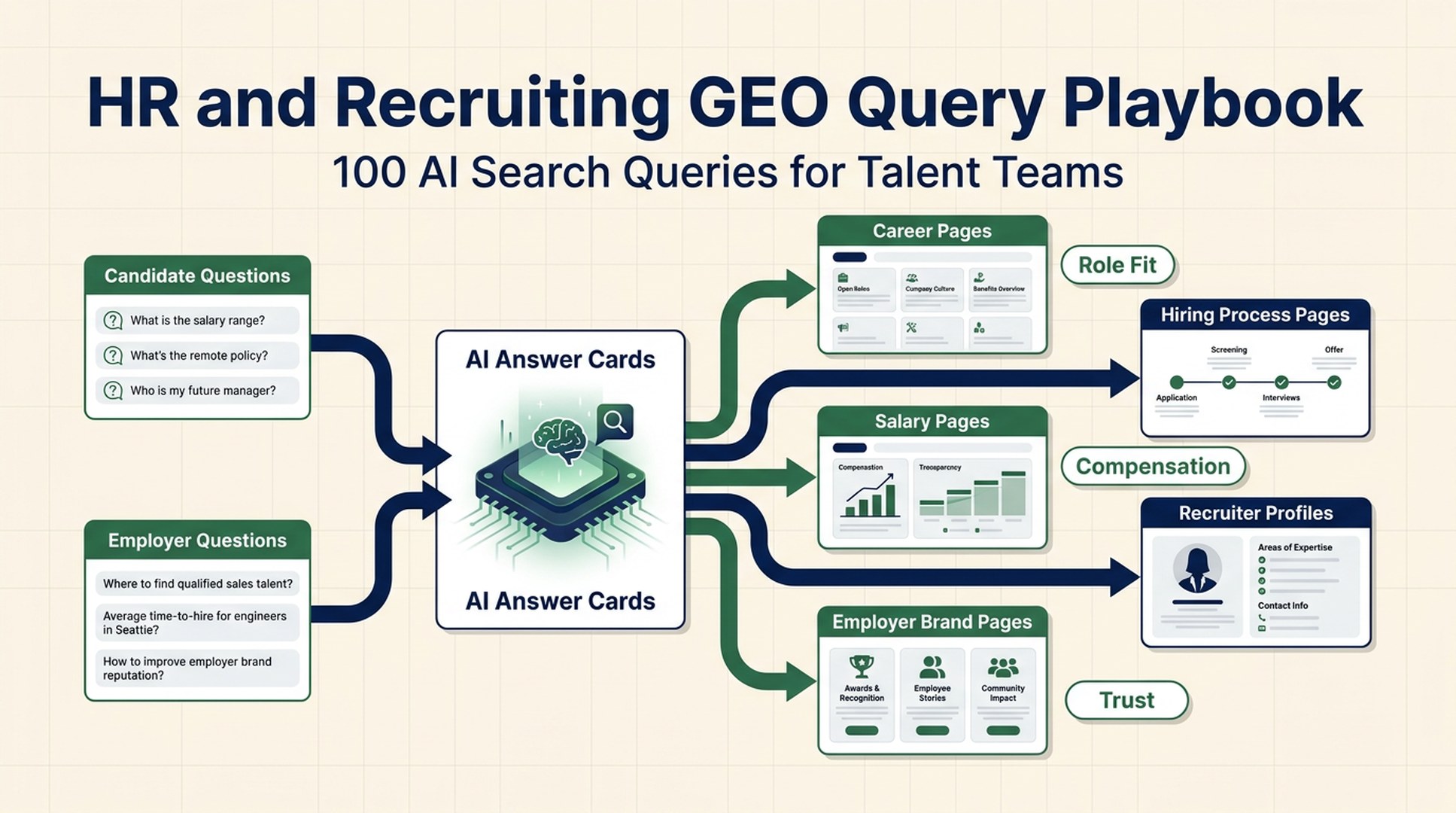
HR and recruiting GEO is the work of making career pages, job pages, employer brand pages, recruiter pages, hiring process pages, salary and benefits pages, diversity pages, candidate FAQ pages, and recruitment service pages easier for AI answer systems to understand, compare, and cite when candidates and employers ask hiring decision questions.
HR and recruiting users rarely ask only for jobs near me, recruiting agency, or HR software. Candidates and employers ask questions that combine role fit, compensation, culture, hiring process, trust, compliance, timeline, skills, and risk:
How do I know if a company is a good place to work?What should a candidate ask before accepting a remote job?How do I choose an executive search firm?What should an employer include in a hiring process page?How do I compare recruiting agencies for software engineers?
For HR and recruiting brands, the strongest GEO assets are career pages, role pages, salary pages, benefits pages, hiring process pages, recruiter profile pages, employer brand pages, DEI pages, talent market guides, interview guides, onboarding pages, and recruitment service pages.
This playbook gives employers, recruiting agencies, staffing firms, RPO providers, HR SaaS companies, employer brand teams, job boards, executive search firms, and people teams 100 AI Search queries to track, a two-sided hiring decision framework, a query-to-page map, and a 30-day execution plan.
Important note: this article is about SEO/GEO content strategy, not legal, HR compliance, employment, immigration, compensation, tax, or benefits advice. HR and recruiting teams should involve legal, compliance, compensation, benefits, DEI, or people operations experts before publishing sensitive hiring or employment claims.
The Two-Sided Hiring Confidence Map
HR and recruiting GEO is different from many industries because there are two decision makers. Candidates evaluate whether to trust an employer, role, recruiter, or process. Employers evaluate whether to trust a candidate source, recruiting partner, hiring method, or HR platform.
That creates a two-sided hiring confidence map:
Layer | Candidate Question | Employer Question | Page That Should Support The Answer |
|---|---|---|---|
Role Fit |
|
| Role / skills page |
Compensation |
|
| Salary / market guide |
Process |
|
| Hiring process page |
Trust |
|
| Trust / recruiter profile page |
Culture |
|
| Employer brand page |
Risk |
|
| Candidate or employer FAQ |
Next Step |
|
| Apply / contact / consultation page |
A useful first step is to check which prompts already surface your career pages, recruiter pages, job descriptions, employer brand assets, or hiring guides with an AI Search Visibility Checker, then build a prompt library around missing roles, unclear process pages, weak trust proof, or inaccurate salary summaries.
Why HR GEO Starts With Trust and Fit, Not Job Titles
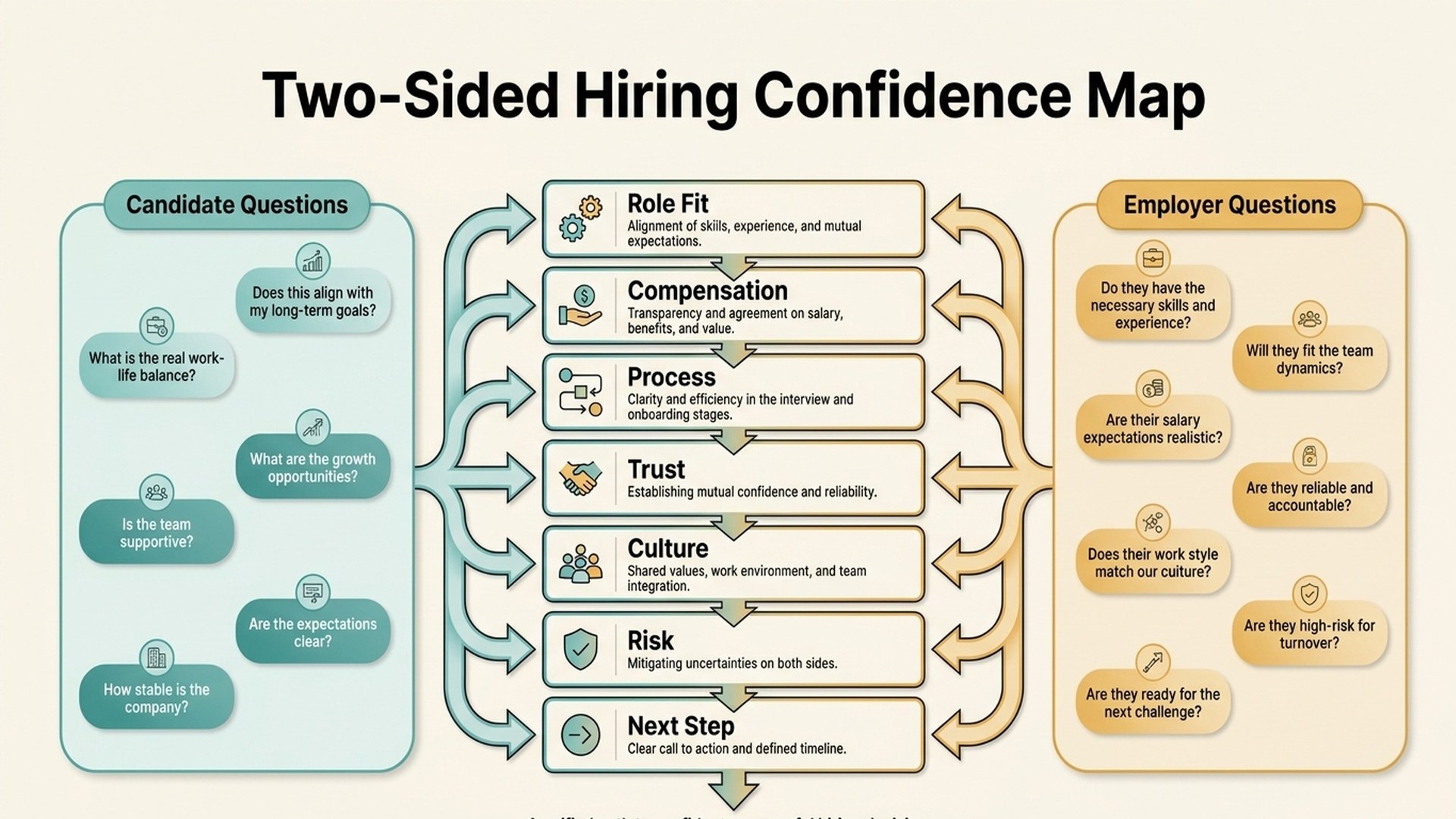
The Two-Sided Hiring Confidence Map turns HR and recruiting GEO into a trust-building page system, not a list of isolated job keywords.
Traditional HR and recruiting SEO often starts with job titles, location pages, recruitment service pages, or employer brand keywords. Those still matter. GEO adds a higher-stakes layer because AI systems may summarize whether a candidate should apply, whether an employer should hire a recruiting partner, or what a fair hiring process looks like.
The prompt usually contains decision risk:
What should I ask before accepting a job offer?How do I know if a recruiter is legitimate?What should an interview process include for a senior engineer?Should we use an agency or hire an internal recruiter?How do I compare employer reviews with career page claims?
These questions require pages that explain fit, process, compensation logic, role expectations, recruiter credentials, employer proof, and boundaries. A job listing alone cannot answer the full decision.
HR content also needs careful wording. Avoid discriminatory language, unsupported salary promises, legal conclusions, immigration advice, guaranteed placement claims, or universal career advice. Strong HR GEO states audience, market, role type, assumptions, review date, and next step clearly.
The 10 Query Types HR and Recruiting Teams Should Map
Classify prompts before creating pages. This prevents teams from publishing repetitive job-title pages or vague employer branding content without useful decision support.
Query Type | What The User Wants | Best Content Asset |
|---|---|---|
Role / Skill Fit | Understand role expectations, skills, seniority, career path, or hiring criteria | Role guide, skills page |
Candidate Decision | Decide whether to apply, interview, negotiate, accept, or decline | Candidate FAQ, career guide |
Employer Decision | Decide how to hire, source, interview, compensate, or structure teams | Hiring guide, talent strategy page |
Compensation / Benefits | Understand salary range, benefits, equity, remote pay, incentives, and negotiation | Salary page, benefits page |
Hiring Process | Understand application, screening, interview, assessment, offer, and onboarding steps | Hiring process page |
Recruiter / Vendor Selection | Choose a recruiting agency, staffing firm, RPO, executive search firm, or HR tool | Selection guide, vendor page |
Trust / Reputation | Validate employer, recruiter, job board, agency, or HR provider credibility | Trust page, profile page |
Policy / Compliance | Understand fair hiring, remote work, DEI, privacy, background checks, and documentation | Policy FAQ, compliance guide |
Talent Market / Location | Match hiring or job search to geography, remote rules, talent supply, or market trends | Market guide, location page |
Scenario / Stage | Match advice to startup hiring, executive search, high-volume hiring, career change, layoffs, or return-to-work | Scenario guide |
Every major cluster should have one owner page. If salary, benefits, interview process, and remote work rules are scattered across job posts, ATS pages, and PDFs, AI systems may summarize incomplete or outdated information.
How To Prioritize HR and Recruiting GEO Queries
Use a hiring-confidence scoring model:
Priority = Decision Intent + Talent Value + Trust Sensitivity + Evidence Strength + AI Answer Probability - Compliance Risk - Competition Difficulty
Factor | How To Evaluate It |
|---|---|
Decision Intent | Is the user close to applying, accepting, requesting a candidate shortlist, choosing a recruiter, or buying an HR tool? |
Talent Value | Does the query connect to hard-to-fill roles, high-value placements, employer brand priorities, or strategic hiring needs? |
Trust Sensitivity | Does the query involve salary, fairness, legitimacy, culture, privacy, recruiter claims, or candidate risk? |
Evidence Strength | Do you have salary bands, process details, benefits, recruiter profiles, reviews, case studies, market data, or policy pages? |
AI Answer Probability | Is the query likely to trigger a checklist, recommendation, comparison, or candidate/employer advice? |
Compliance Risk | Could the answer create employment, discrimination, privacy, immigration, compensation, or legal risk? |
Competition Difficulty | Are job boards, review sites, HR publishers, large agencies, or government pages dominating? |
Start with prompts where the team can publish clear evidence and reduce uncertainty. Avoid broad best employer or best recruiter pages unless the page defines criteria, audience, data source, and limitations.
100 HR and Recruiting GEO Query Examples
Use these prompts as a starting library. Adapt them by role family, geography, employment type, seniority, legal market, and compliance review process.
Role / Skill Fit Queries
- What skills should a product manager have?
- What does a senior software engineer actually do?
- What is the difference between HR generalist and HR business partner?
- What skills should a sales development representative have?
- What does a data analyst need to know before applying?
- What makes a good customer success manager?
- What skills should employers look for in a marketing operations hire?
- What is the career path for a recruiter?
- What should candidates know before applying for a remote role?
- What is the difference between contract and full-time roles?
Candidate Decision Queries
- How do I know if a company is a good place to work?
- What should I ask before accepting a job offer?
- How do I compare two job offers?
- What should I ask during a final interview?
- How do I evaluate a remote job offer?
- What are red flags in a job description?
- What should I ask a recruiter before sharing my resume?
- How do I know if a job posting is legitimate?
- Should I apply if I do not meet every requirement?
- What should I check before accepting a contract role?
Employer Decision Queries
- Should we hire internally or use a recruiting agency?
- What roles should a startup hire first?
- How do we define hiring criteria for a new role?
- What should employers include in a job scorecard?
- How do we reduce time to hire without lowering quality?
- What should hiring managers prepare before opening a role?
- When should a company use executive search?
- How do we choose between RPO and staffing agency?
- What should employers measure in recruiting performance?
- How do we improve candidate experience?
Compensation / Benefits Queries
- How do I know if a salary range is fair?
- What should employers include in a compensation range?
- How do remote salaries differ by location?
- What benefits matter most to candidates?
- What should candidates ask about equity compensation?
- How should employers explain bonuses in job posts?
- What should candidates compare besides salary?
- What affects salary expectations for software engineers?
- How do employers benchmark compensation?
- What should a benefits page include?
Hiring Process Queries
- What happens after I submit a job application?
- What should a hiring process page include?
- How many interview rounds are reasonable?
- What should candidates expect during a technical interview?
- What should employers explain before a take-home assignment?
- How do companies make hiring decisions after interviews?
- What should happen before a job offer is made?
- How should recruiters communicate timeline expectations?
- What should onboarding include in the first week?
- How do companies handle candidate feedback after interviews?
Recruiter / Vendor Selection Queries
- How do I choose an executive search firm?
- How do I compare recruiting agencies for software engineers?
- What should employers ask before hiring a staffing agency?
- What should a recruiting agency case study include?
- How do I know if an RPO provider is a good fit?
- What should employers ask before buying recruiting software?
- Staffing agency vs recruiting agency: what is the difference?
- In-house recruiter vs external recruiter
- What should a recruiter service agreement include?
- How do recruiting agencies source candidates?
Trust / Reputation Queries
- How do I know if a recruiter is legitimate?
- How do I verify an employer brand claim?
- What reviews matter when evaluating an employer?
- How do candidates compare Glassdoor reviews with career pages?
- What should a recruiter profile include?
- What makes a recruiting agency trustworthy?
- How do employers prove culture without sounding generic?
- What makes a job board credible?
- How should companies respond to candidate complaints?
- What should employers disclose on career pages?
Policy / Compliance Queries
- What should employers know about fair hiring language?
- What candidate data should recruiters collect?
- How should companies explain background checks?
- What should remote work policies clarify for candidates?
- What should employers disclose about hybrid work?
- How do companies avoid bias in interview questions?
- What should candidates ask about work authorization?
- What should employers know before using AI in hiring?
- What should a privacy notice for candidates include?
- What should companies explain about accommodations during interviews?
Talent Market / Location Queries
- Best cities to hire software engineers
- Best markets for remote customer support hiring
- How do salaries vary by tech hub?
- What should employers know about hiring in multiple states?
- Where can startups find product design talent?
- What recruiting channels work for healthcare roles?
- What should candidates know about relocating for work?
- How do employers compare talent markets for sales roles?
- What should companies know about hiring internationally?
- How does remote hiring change candidate expectations?
Scenario / Stage Queries
- What should a startup do before hiring its first salesperson?
- What should candidates ask after a layoff?
- What should employers do during high-volume hiring?
- What should companies do before replacing a poor hire?
- What should a candidate ask when changing careers?
- What should employers consider before hiring contractors?
- What should return-to-work candidates ask employers?
- What should a company do before launching campus recruiting?
- What should employers know before hiring for a new market?
- What should candidates ask before joining an early-stage startup?
How To Turn HR Queries Into Citation-Ready Pages
An HR and recruiting query library should become a hiring confidence architecture. The strongest pages are role guides, career pages, salary pages, benefits pages, hiring process pages, recruiter profiles, employer brand pages, recruiting service pages, policy FAQs, and talent market guides.
Query Cluster | Owner Page | Page Type | Required Proof |
|---|---|---|---|
Role prompts | Role / skills page | Role guide | Responsibilities, skills, seniority, career path |
Candidate prompts | Candidate FAQ | Career guide | Offer factors, process, red flags, next step |
Employer prompts | Hiring strategy page | Employer guide | Hiring criteria, process, metrics, tradeoffs |
Compensation prompts | Salary / benefits page | Compensation guide | Range logic, benefits, caveats, update date |
Process prompts | Hiring process page | Process guide | Steps, timelines, interviews, communication path |
Vendor prompts | Recruiter selection guide | Vendor page | Criteria, services, contract questions, proof |
Trust prompts | Trust / profile page | Reputation page | Reviews, recruiter profiles, employer proof, disclosures |
Policy prompts | Policy FAQ | Compliance-adjacent guide | Privacy, AI, background checks, accommodations, caveats |
Market prompts | Talent market page | Location / market guide | Geography, talent supply, salary context, assumptions |
Scenario prompts | Stage guide | Scenario page | Startup, executive, high-volume, remote, career-change context |
A citation-ready HR page should answer the candidate or employer question first, then support it with role clarity, process steps, salary context, trust proof, policy caveats, and next steps.
For technical readiness, HR and recruiting teams should make sure job pages, career pages, recruiter pages, service pages, salary pages, and process pages are crawlable, indexable, and internally linked. A quick Website SEO Score Checker can help catch basic crawl, metadata, schema, and page-quality issues before teams rewrite hiring-critical pages.
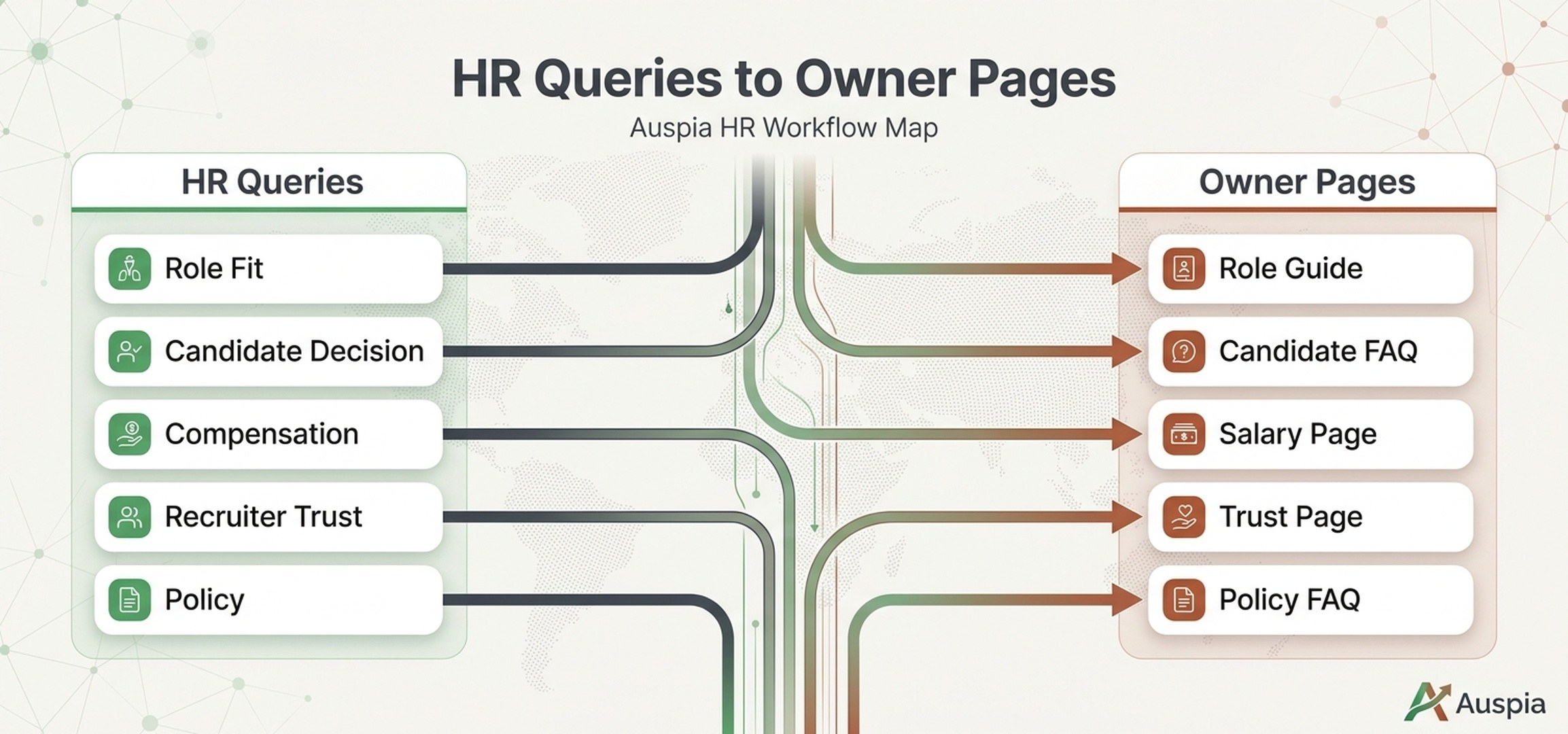
Each recurring HR query type needs a clear owner page so AI systems can retrieve a stable, current answer instead of guessing from scattered content.
The First 20 Queries To Prioritize
If an HR, recruiting, or employer brand team is starting from scratch, these 20 prompts usually create a practical first backlog.
Priority | Query | Why It Matters | Likely Owner Page |
|---|---|---|---|
1 | How do I know if a company is a good place to work? | Candidate trust | Employer trust page |
2 | What should I ask before accepting a job offer? | Candidate decision | Offer evaluation guide |
3 | Should we hire internally or use a recruiting agency? | Employer vendor decision | Agency vs internal guide |
4 | What roles should a startup hire first? | High-value employer query | Startup hiring guide |
5 | How do I know if a salary range is fair? | Compensation trust | Salary range guide |
6 | What should candidates compare besides salary? | Offer quality | Benefits and offer guide |
7 | What happens after I submit a job application? | Candidate experience | Hiring process page |
8 | What should a hiring process page include? | Employer content asset | Hiring process template |
9 | How do I choose an executive search firm? | High-value vendor query | Executive search selection guide |
10 | How do I compare recruiting agencies for software engineers? | Service comparison | Tech recruiting agency guide |
11 | How do I know if a recruiter is legitimate? | Trust-sensitive query | Recruiter trust page |
12 | What should a recruiter profile include? | Proof asset | Recruiter profile template |
13 | What should employers know about fair hiring language? | Compliance-sensitive | Fair hiring language guide |
14 | What should employers know before using AI in hiring? | Timely policy query | AI hiring policy FAQ |
15 | Best markets for remote customer support hiring | Talent-market fit | Remote hiring market page |
16 | What should employers know about hiring in multiple states? | Location risk | Multi-state hiring guide |
17 | What should a startup do before hiring its first salesperson? | Startup scenario | First sales hire guide |
18 | What should candidates ask after a layoff? | Sensitive candidate scenario | Layoff job search guide |
19 | What should employers do during high-volume hiring? | Operational query | High-volume hiring guide |
20 | What should candidates ask before joining an early-stage startup? | High-intent role fit | Startup candidate guide |
These prompts are useful because they can be answered by pages that already influence applications, candidate trust, recruiter inquiries, employer brand, and vendor selection.
30-Day Execution Plan
Timeframe | Action | Output |
|---|---|---|
Days 1-3 | Build the HR AI Search query library and classify by candidate/employer side, role family, hiring stage, risk, and page owner | 100-query prompt library |
Days 4-7 | Score prompts by decision intent, talent value, trust sensitivity, evidence, AI answer probability, compliance risk, and competition | First 20 prompt backlog |
Days 8-14 | Map prompts to career pages, role guides, salary pages, process pages, recruiter profiles, policy FAQs, and service pages | Query-to-page map |
Days 15-21 | Rewrite priority pages with direct answers, role clarity, salary context, process steps, trust proof, caveats, and next steps | Updated citation-ready pages |
Days 22-30 | Test prompts across AI answer surfaces and record brand mentions, cited URLs, competitor mentions, and inaccurate hiring facts | HR AI visibility tracker |
An employer can start with five assets: a hiring process page, a benefits page, a salary range explainer, an employer trust page, and role-specific guides. A recruiting agency should add recruiter profiles, vertical service pages, case studies, vendor comparison pages, and candidate/employer FAQs.
Common Mistakes
HR and recruiting GEO fails when teams publish job or service pages without enough trust, process clarity, or compliance awareness.
Avoid these mistakes:
- Publishing thin job descriptions. Add role expectations, skills, interview process, work model, benefits, and application next steps.
- Hiding salary context. If exact salary varies, explain range logic, location factors, seniority, benefits, and update date.
- Making generic culture claims. Support culture with policies, examples, employee stories, and current practices.
- Overpromising placement or hiring outcomes. Avoid guaranteed jobs, hires, timelines, or compensation outcomes.
- Ignoring candidate privacy and AI hiring questions. Candidate data, screening tools, and assessment methods need clear explanation.
- Treating recruiter profiles as bios only. Add specialization, process, candidate/employer focus, and trust signals.
- Measuring only rankings. Track AI mentions, cited pages, competitor inclusion, and inaccurate summaries of salary, process, benefits, or policies.
FAQ
What is HR and recruiting GEO?
HR and recruiting GEO is the process of making career, job, salary, benefits, hiring process, recruiter profile, employer brand, policy, and recruitment service pages easier for AI answer systems to understand, summarize, and cite accurately.
Is HR GEO the same as HR SEO?
No. HR SEO focuses on search visibility, job traffic, employer brand, and recruiting leads. HR GEO builds on that foundation but focuses on how AI systems answer candidate and employer questions about role fit, compensation, process, trust, policy, market context, and vendor selection.
Should HR teams create one page for every AI Search query?
No. The 100-query list should become a page map. Many questions should be answered by stronger career pages, role guides, salary pages, benefits pages, hiring process pages, recruiter profiles, policy FAQs, and recruiting service pages.
Which HR queries should teams prioritize first?
Start with questions about employer trust, offer evaluation, salary fairness, hiring process, recruiter legitimacy, recruiting agency selection, AI hiring, fair hiring language, remote hiring, and high-value role scenarios.
How can HR teams avoid risky GEO content?
Use clear caveats, review employment claims with qualified experts, avoid discriminatory language, keep compensation and benefit details current, explain candidate data practices, and avoid legal or immigration advice unless reviewed by appropriate counsel.
How should HR teams measure GEO performance?
Track a stable prompt set across AI answer surfaces. Record whether the employer or recruiting brand appears, which URLs are cited, which competitors appear, whether facts are accurate, and whether AI answers omit important compensation, process, policy, or trust details.
Auspia Takeaway
HR and recruiting GEO is hiring confidence support. AI systems need role clarity, salary context, hiring process transparency, recruiter trust, employer proof, policy caveats, and next steps before they can recommend or cite an employer or recruiting brand responsibly.
Start with prompts that affect applications, offer decisions, recruiter inquiries, employer trust, and vendor selection. Map the first 20 queries to pages that already shape hiring conversations. Then rewrite those pages so the answers are direct, fair, current, and safe to summarize.
Author: Hannah Pierce, 12-Year B2B SEO Growth Practitioner at Auspia. Hannah writes about B2B SEO, pipeline-focused content, buyer journeys, and service-page systems for complex sales cycles.