Quick Answer
Cybersecurity GEO is the work of making security product pages, service pages, comparison pages, compliance pages, incident response pages, integration pages, pricing pages, trust centers, documentation, case studies, and security explainers easier for AI answer systems to understand, verify, compare, and cite when buyers ask risk-heavy questions.
Security buyers rarely ask AI systems for one generic keyword such as cybersecurity software or MDR provider. They ask decision questions with consequences:
Which MDR provider is best for a mid-market company with no 24/7 SOC?How do I compare EDR, XDR, and MDR for a small security team?What should be included in a vendor security review?How much does penetration testing cost for a SaaS company?How do I prepare for SOC 2 without overbuying security tools?
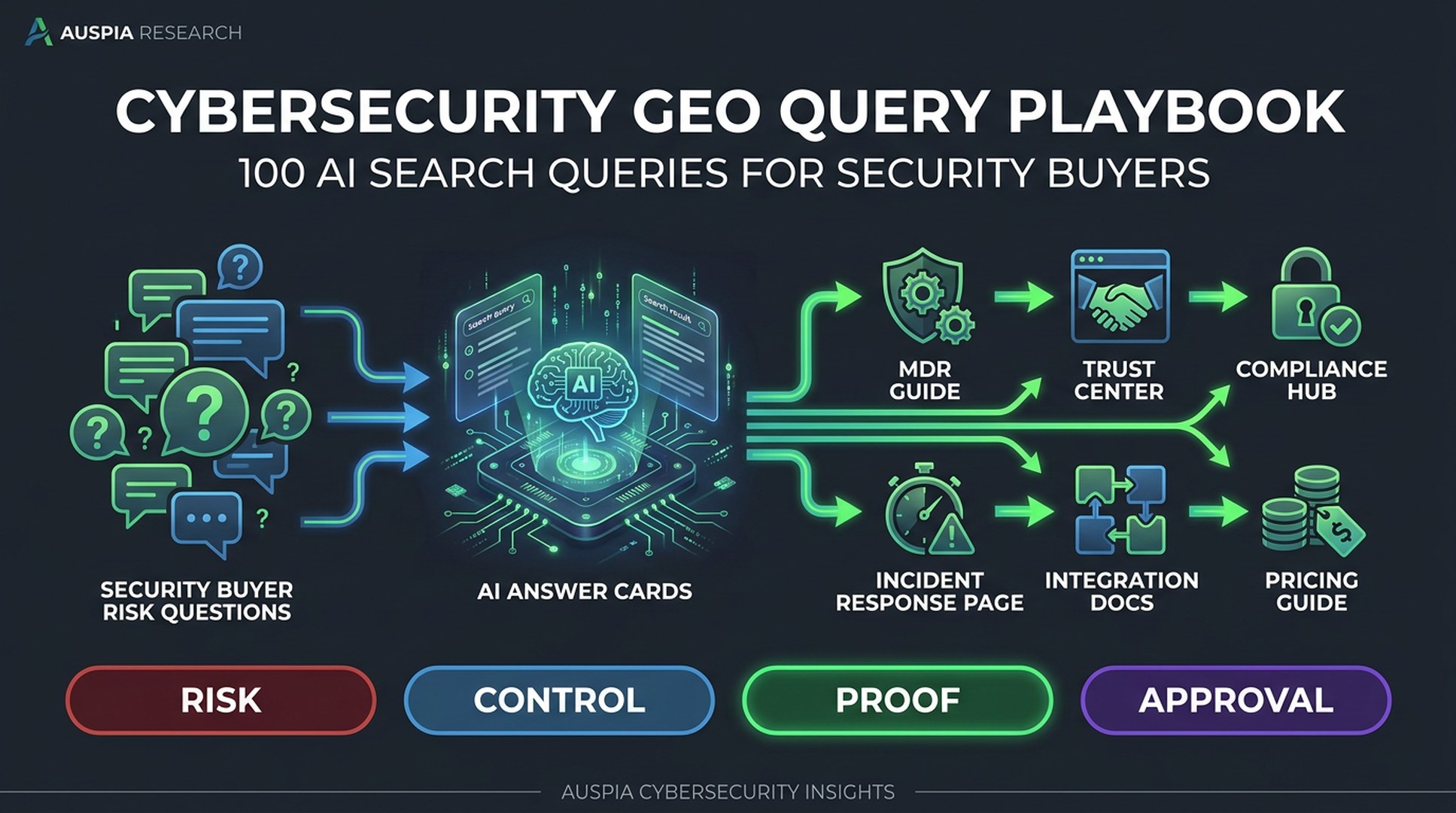
For cybersecurity brands, the strongest GEO assets are not generic blog posts. They are risk-specific buyer pages: solution pages by threat, comparison pages by security architecture, compliance readiness guides, incident response playbooks, trust center pages, integration documentation, pricing explainers, evaluation checklists, glossary pages, and proof-backed case narratives.
This playbook gives cybersecurity software companies, MSSPs, MDR providers, penetration testing firms, cloud security vendors, compliance platforms, and security consultants 100 AI Search queries to track, a security buyer decision framework, a query-to-page map, and a 30-day execution plan.
Important note: this article is about SEO/GEO content strategy, not legal, compliance, incident response, insurance, or security engineering advice. Security teams should involve qualified internal owners before publishing guidance that could affect breach response, compliance claims, product capabilities, or risk posture.
The Security Buyer Risk Ladder
Cybersecurity GEO is different from ordinary B2B SEO because buyers are not only trying to understand a category. They are trying to reduce risk without creating new risk. Every answer has to survive scrutiny from technical evaluators, procurement, compliance, legal, finance, and executives.
That creates a security buyer risk ladder:
Ladder Stage | Buyer Question | Page That Should Support The Answer | Proof Needed |
|---|---|---|---|
Exposure |
| Threat / problem page | Threat model, symptoms, environment fit |
Control |
| Solution page | Capability explanation, limitations |
Fit |
| Use-case / integration page | Supported platforms, team size, deployment notes |
Evidence |
| Trust center / case page | Certifications, audits, references, outcomes |
Cost |
| Pricing / implementation page | Scope, assumptions, onboarding effort |
Approval |
| Evaluation guide | Checklist, risk tradeoffs, stakeholder map |
Response |
| Incident / support page | SLA, escalation path, process clarity |
The ladder matters because AI answers often compress risk. If your pages only say advanced protection, AI systems have little to cite. If your pages explain the threat, control boundary, deployment assumptions, compliance relevance, limitations, and proof, you become easier to retrieve and safer to summarize.
Why Cybersecurity GEO Starts With Risk Questions, Not Tool Keywords
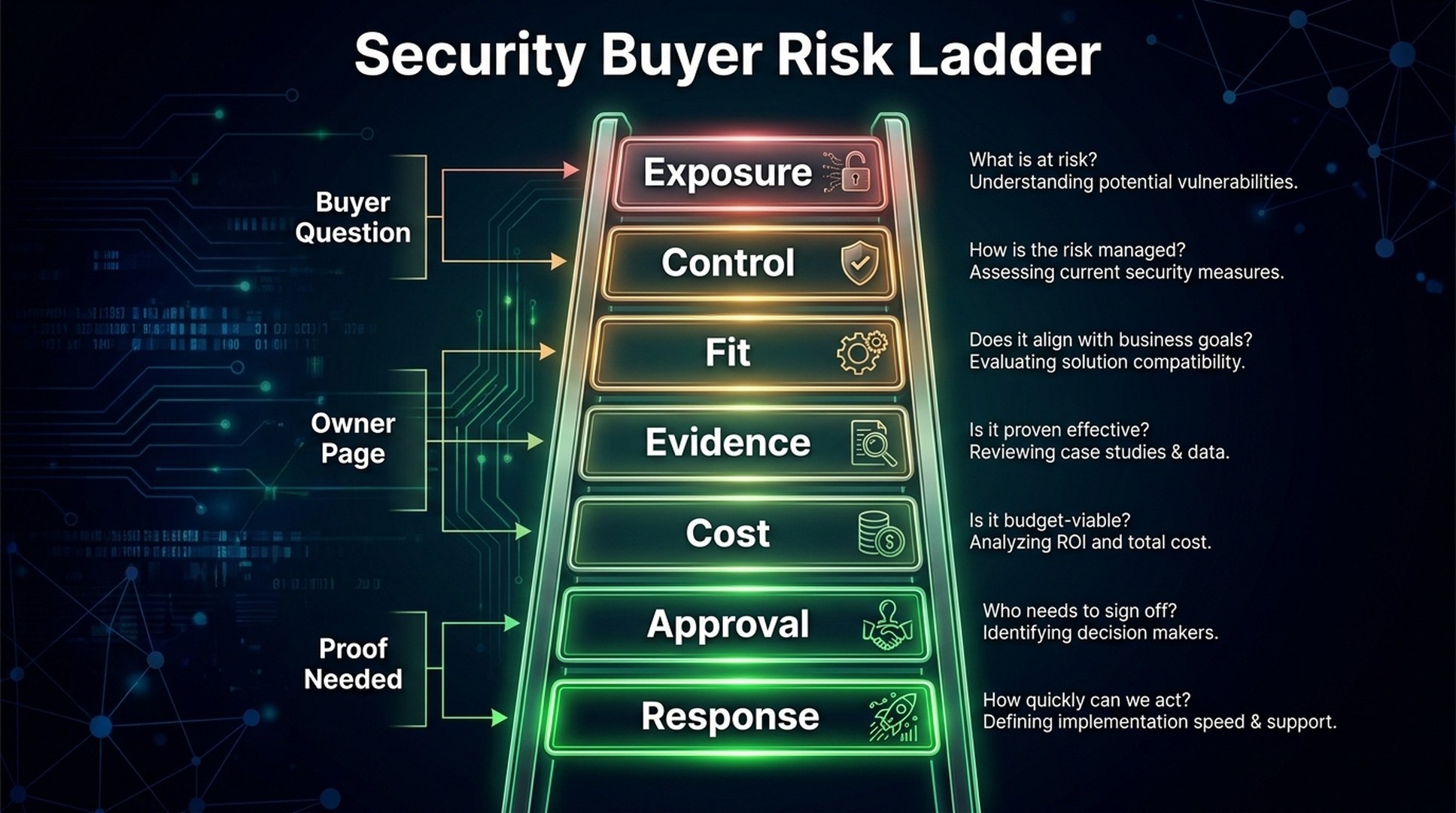
The Security Buyer Risk Ladder keeps cybersecurity GEO focused on buyer risk, proof, and approval instead of broad tool keywords.
Traditional SEO often starts with category terms: EDR software, cloud security platform, penetration testing company, SOC 2 compliance tool. Those keywords still matter, but AI Search behavior is more contextual. A security leader may ask for a recommendation, a comparison, a due-diligence checklist, or a board-ready explanation.
The same buyer might move through queries like:
Do we need MDR if we already have EDR?What should a small security team outsource first?How do I compare MDR providers for cloud-native companies?What questions should I ask before signing an MDR contract?How do I explain MDR value to a CFO?
That journey should not become five thin posts. It should become a stronger cluster: an MDR overview, an EDR-vs-MDR comparison, a buyer checklist, a pricing guide, and a stakeholder justification page.
For cybersecurity GEO, the goal is to help AI systems answer with useful boundaries: who the solution is for, what it does, what it does not do, what evidence supports the claim, and what the buyer should verify next.
The 10 Query Types Cybersecurity Teams Should Map
Query Type | What The Buyer Wants | Best Content Asset |
|---|---|---|
Threat Definition | Understand a risk, attack pattern, or security category | Glossary, threat explainer, security hub |
Control Selection | Choose a tool, service, or security control | Solution guide, control map |
Vendor Recommendation | Identify credible vendors for a scenario | Best-for page, selection guide |
Architecture Comparison | Compare approaches, tools, or operating models | Comparison page, alternatives page |
Cost / Scope | Estimate budget, effort, and implementation complexity | Pricing page, cost guide, scoping FAQ |
Compliance / Audit | Connect security work to SOC 2, ISO 27001, HIPAA, PCI, GDPR, or vendor review | Compliance guide, trust center, audit prep page |
Incident Response | Know what to do during or after a suspected incident | IR process page, emergency FAQ |
Integration / Deployment | Check stack fit, APIs, SIEM, cloud, identity, endpoint, and workflow compatibility | Integration docs, deployment page |
Trust / Proof | Verify claims, certifications, outcomes, and limitations | Trust center, case study, security profile |
Role / Scenario | Match advice to CISO, IT director, startup founder, MSP, or compliance lead | Persona page, use-case page, scenario guide |
How To Prioritize Cybersecurity GEO Queries
Use this scoring model before creating content:
Priority = Risk Urgency + Commercial Intent + Technical Fit + Evidence Strength + AI Answer Probability - Claim Risk - Competitive Saturation
Factor | What It Means For Cybersecurity |
|---|---|
Risk Urgency | The query is tied to an active threat, audit, vendor review, incident, renewal, or board concern. |
Commercial Intent | The answer can influence a demo, assessment, quote, trial, procurement process, or partner conversation. |
Technical Fit | Your product, service, documentation, or expertise can answer with real specificity. |
Evidence Strength | You have certifications, architecture docs, customer proof, policy pages, integrations, or measured outcomes. |
AI Answer Probability | The query is likely to trigger an AI-generated summary, comparison, checklist, or recommendation. |
Claim Risk | A careless answer could overpromise security coverage, compliance status, response guarantees, or legal outcomes. |
Competitive Saturation | Large vendors, analyst sites, review platforms, and security media already dominate the answer space. |
The best first queries are usually not the broadest. They are high-friction questions where the buyer needs a credible answer before taking the next step.
100 Cybersecurity AI Search Query Examples
# | AI Search Query | Query Type | Search Intent | Best Content Asset |
|---|---|---|---|---|
1 | What is MDR in cybersecurity? | Threat Definition | Understand the category | MDR explainer |
2 | What is the difference between EDR and XDR? | Threat Definition | Clarify security terms | EDR vs XDR guide |
3 | What does a SOC analyst do? | Threat Definition | Understand operating roles | SOC glossary page |
4 | What is attack surface management? | Threat Definition | Learn a security category | ASM explainer |
5 | What is cloud security posture management? | Threat Definition | Define cloud security control | CSPM guide |
6 | What is identity threat detection and response? | Threat Definition | Understand identity risk | ITDR explainer |
7 | What is a zero trust security model? | Threat Definition | Learn architecture concept | Zero trust guide |
8 | What is vulnerability management? | Threat Definition | Understand ongoing process | Vulnerability management hub |
9 | What is phishing-resistant MFA? | Threat Definition | Understand control strength | MFA explainer |
10 | What is a security trust center? | Threat Definition | Understand buyer proof asset | Trust center guide |
11 | Do we need MDR if we already have EDR? | Control Selection | Choose the right control | MDR vs EDR page |
12 | Which security controls should a startup implement first? | Control Selection | Prioritize early security | Startup security guide |
13 | What should a small IT team outsource to an MSSP? | Control Selection | Decide internal vs external | MSSP selection guide |
14 | When should a company use penetration testing instead of vulnerability scanning? | Control Selection | Choose assessment type | Pentest vs scan page |
15 | How do I choose between SIEM and XDR? | Control Selection | Compare detection approaches | SIEM vs XDR guide |
16 | What security tools are needed before SOC 2? | Control Selection | Prepare for audit readiness | SOC 2 security checklist |
17 | What is the best way to secure SaaS applications? | Control Selection | Select SaaS controls | SaaS security guide |
18 | How should we protect employee laptops for remote work? | Control Selection | Secure endpoints | Endpoint security page |
19 | What should be included in a cloud security roadmap? | Control Selection | Plan cloud controls | Cloud roadmap guide |
20 | How do we reduce phishing risk without slowing employees down? | Control Selection | Balance security and usability | Phishing defense guide |
21 | Best MDR provider for mid-market companies | Vendor Recommendation | Compare providers | MDR buyer guide |
22 | Best penetration testing company for SaaS startups | Vendor Recommendation | Find a specialist | SaaS pentest page |
23 | Best SOC 2 compliance platform for small teams | Vendor Recommendation | Choose compliance software | SOC 2 tool comparison |
24 | Best cloud security vendor for AWS environments | Vendor Recommendation | Match stack to vendor | AWS security use-case page |
25 | Best cybersecurity consultant for vendor security reviews | Vendor Recommendation | Find advisory help | Vendor review service page |
26 | Best vulnerability management tool for lean security teams | Vendor Recommendation | Pick practical tooling | Vulnerability tool guide |
27 | Best phishing training platform for hybrid teams | Vendor Recommendation | Choose awareness vendor | Phishing training comparison |
28 | Best security monitoring option for companies without a SOC | Vendor Recommendation | Solve monitoring gap | No-SOC security guide |
29 | Best incident response retainer for a SaaS company | Vendor Recommendation | Prepare emergency support | IR retainer page |
30 | Best identity security solution for Okta environments | Vendor Recommendation | Match identity stack | Okta security page |
31 | MDR vs MSSP: which is better? | Architecture Comparison | Compare service models | MDR vs MSSP page |
32 | SIEM vs XDR for small security teams | Architecture Comparison | Compare architecture choices | SIEM vs XDR page |
33 | Penetration testing vs red team assessment | Architecture Comparison | Compare testing depth | Testing comparison page |
34 | SOC 2 vs ISO 27001 security requirements | Architecture Comparison | Compare compliance paths | Compliance comparison guide |
35 | Cloud security posture management vs vulnerability management | Architecture Comparison | Compare control categories | CSPM vs VM page |
36 | In-house SOC vs outsourced SOC | Architecture Comparison | Decide operating model | SOC operating model page |
37 | CASB vs SSPM for SaaS security | Architecture Comparison | Compare SaaS controls | CASB vs SSPM guide |
38 | Password manager vs enterprise identity platform | Architecture Comparison | Compare identity tools | Identity stack guide |
39 | Managed detection vs managed response | Architecture Comparison | Understand service scope | MDR scope guide |
40 | Continuous compliance vs annual audit preparation | Architecture Comparison | Compare compliance workflows | Compliance workflow page |
41 | How much does MDR cost? | Cost / Scope | Estimate budget | MDR pricing guide |
42 | How much does a penetration test cost? | Cost / Scope | Estimate assessment price | Pentest cost guide |
43 | What affects SOC 2 readiness cost? | Cost / Scope | Understand budget drivers | SOC 2 cost page |
44 | How much should a startup spend on cybersecurity? | Cost / Scope | Build budget range | Startup budget guide |
45 | What is included in an incident response retainer? | Cost / Scope | Understand retainer scope | IR retainer FAQ |
46 | How many hours does a vendor security review take? | Cost / Scope | Estimate workflow effort | Security review guide |
47 | What affects vulnerability management pricing? | Cost / Scope | Understand pricing variables | VM pricing page |
48 | How much does cloud security monitoring cost? | Cost / Scope | Budget monitoring program | Cloud monitoring page |
49 | What should be included in cybersecurity consulting fees? | Cost / Scope | Evaluate proposal scope | Consulting pricing FAQ |
50 | How do I explain cybersecurity ROI to finance? | Cost / Scope | Justify spend | CFO security justification page |
51 | What security evidence do customers ask for during vendor review? | Compliance / Audit | Prepare buyer proof | Vendor review checklist |
52 | How do I prepare security content for SOC 2? | Compliance / Audit | Build audit readiness | SOC 2 content guide |
53 | What should a cybersecurity trust center include? | Compliance / Audit | Build proof hub | Trust center checklist |
54 | How do security controls map to ISO 27001? | Compliance / Audit | Connect controls to audit | ISO mapping page |
55 | What cybersecurity pages help with enterprise procurement? | Compliance / Audit | Support sales process | Procurement proof guide |
56 | How do I answer customer security questionnaires faster? | Compliance / Audit | Improve review workflow | Questionnaire workflow page |
57 | What security claims should not be made on a website? | Compliance / Audit | Reduce claim risk | Security claims policy page |
58 | What is needed for HIPAA vendor security review? | Compliance / Audit | Prepare regulated review | HIPAA vendor guide |
59 | What should a GDPR security page explain? | Compliance / Audit | Clarify data protection posture | GDPR security FAQ |
60 | How do I keep compliance pages accurate after audits? | Compliance / Audit | Maintain freshness | Compliance update SOP |
61 | What should we do after a suspected data breach? | Incident Response | Understand next steps | Incident response FAQ |
62 | When should we call an incident response firm? | Incident Response | Decide escalation timing | IR escalation page |
63 | What is the first hour checklist for a ransomware incident? | Incident Response | Prepare emergency process | Ransomware checklist |
64 | How do we communicate with customers after a security incident? | Incident Response | Plan response communications | Incident comms guide |
65 | What logs should we preserve during an investigation? | Incident Response | Preserve evidence | Evidence preservation page |
66 | How do we choose an incident response retainer? | Incident Response | Evaluate provider | IR buyer guide |
67 | What should be in a tabletop exercise? | Incident Response | Practice readiness | Tabletop exercise guide |
68 | How do we test our breach response plan? | Incident Response | Validate readiness | Breach drill page |
69 | What is the difference between containment and eradication? | Incident Response | Understand IR phases | IR glossary |
70 | What should executives know during a cyber incident? | Incident Response | Brief leadership | Executive IR brief |
71 | Does this security platform integrate with Splunk? | Integration / Deployment | Check SIEM fit | Splunk integration page |
72 | Does this MDR service support Microsoft Defender? | Integration / Deployment | Verify endpoint compatibility | Defender integration page |
73 | How hard is it to deploy XDR? | Integration / Deployment | Estimate implementation effort | XDR deployment guide |
74 | What data sources are needed for cloud threat detection? | Integration / Deployment | Understand telemetry needs | Data source guide |
75 | Does this platform support AWS and Azure? | Integration / Deployment | Check cloud coverage | Cloud integration page |
76 | How long does security onboarding take? | Integration / Deployment | Plan deployment timeline | Onboarding page |
77 | What access permissions does a security vendor need? | Integration / Deployment | Evaluate access risk | Access requirements page |
78 | How do security alerts flow into Slack or Jira? | Integration / Deployment | Understand workflow fit | Workflow integration page |
79 | What API options does a security platform provide? | Integration / Deployment | Evaluate automation | API documentation hub |
80 | How do we migrate from an old SIEM to a new detection platform? | Integration / Deployment | Plan migration | Migration guide |
81 | How do I verify a cybersecurity vendor is credible? | Trust / Proof | Validate trust | Vendor trust checklist |
82 | What certifications should a cybersecurity provider have? | Trust / Proof | Check credentials | Certification page |
83 | What questions should I ask an MDR provider? | Trust / Proof | Prepare evaluation | MDR evaluation checklist |
84 | How do I compare cybersecurity case studies? | Trust / Proof | Interpret proof | Case study evaluation guide |
85 | What should a security vendor disclose about limitations? | Trust / Proof | Reduce hidden risk | Limitations page |
86 | How do I evaluate security vendor reviews? | Trust / Proof | Interpret review signals | Review interpretation guide |
87 | What should a cybersecurity SLA include? | Trust / Proof | Verify service promises | SLA explainer |
88 | How do I check if a vendor has real cloud security expertise? | Trust / Proof | Validate specialization | Cloud proof page |
89 | What should a security proposal include? | Trust / Proof | Evaluate offer quality | Proposal checklist |
90 | How do I know if a security vendor overpromises? | Trust / Proof | Spot risk claims | Overclaiming guide |
91 | Cybersecurity checklist for a new CISO | Role / Scenario | Support role onboarding | New CISO guide |
92 | Security roadmap for a Series A startup | Role / Scenario | Match maturity stage | Startup roadmap page |
93 | Cybersecurity priorities for a healthcare SaaS company | Role / Scenario | Match regulated context | Healthcare SaaS security page |
94 | Security vendor review checklist for procurement teams | Role / Scenario | Support procurement | Procurement checklist |
95 | Cybersecurity questions a CFO should ask before approving budget | Role / Scenario | Support finance review | CFO security FAQ |
96 | Cloud security plan for an AWS-first company | Role / Scenario | Match cloud stack | AWS security plan |
97 | Security monitoring plan for remote-first companies | Role / Scenario | Match workplace model | Remote security guide |
98 | Cybersecurity content needed for enterprise sales | Role / Scenario | Support sales enablement | Enterprise sales proof page |
99 | Security readiness checklist before launching an AI product | Role / Scenario | Match AI product risk | AI product security checklist |
100 | Cybersecurity GEO queries for MSPs serving small businesses | Role / Scenario | Match partner channel | MSP security query map |
How To Turn Cybersecurity Queries Into Citation-Ready Pages
The goal is not to publish 100 shallow posts. The goal is to build a smaller set of pages that can answer high-value security questions with enough specificity for both human buyers and AI systems.
Query Cluster | Owner Page | Page Type | Required Proof |
|---|---|---|---|
MDR / MSSP / SOC selection | MDR buyer guide | Comparison / service page | Scope, SLAs, supported tools, escalation model |
Pentesting and assessment | Penetration testing page | Service / scoping page | Methodology, sample deliverables, boundaries |
SOC 2 and vendor review | Compliance readiness hub | Compliance page | Control mapping, audit status, policy ownership |
Incident response | IR process page | Emergency / process page | Escalation flow, roles, evidence preservation notes |
Cloud security | Cloud security architecture page | Use-case page | AWS/Azure/GCP support, telemetry, integrations |
Endpoint and identity | Endpoint and identity control map | Architecture guide | Supported platforms, detection coverage, deployment notes |
Pricing and scope | Pricing guide | Cost page | Assumptions, ranges, implementation variables |
Trust and proof | Trust center | Proof hub | Certifications, reports, policies, limitations |
Procurement | Security evaluation checklist | Buyer enablement page | Questionnaire answers, SLA, compliance links |
Role scenarios | CISO / CFO / procurement pages | Persona pages | Decision criteria, stakeholder concerns, next steps |
Good cybersecurity GEO pages need five ingredients:
- A direct answer near the top.
- Clear boundaries on what the product, service, or guidance does not cover.
- Evidence that can be verified, such as certifications, integration docs, service scope, policies, or case facts.
- Tables that compare options without exaggerating claims.
- A next step that fits the buyer's risk level: checklist, assessment, demo, documentation, or emergency contact path.
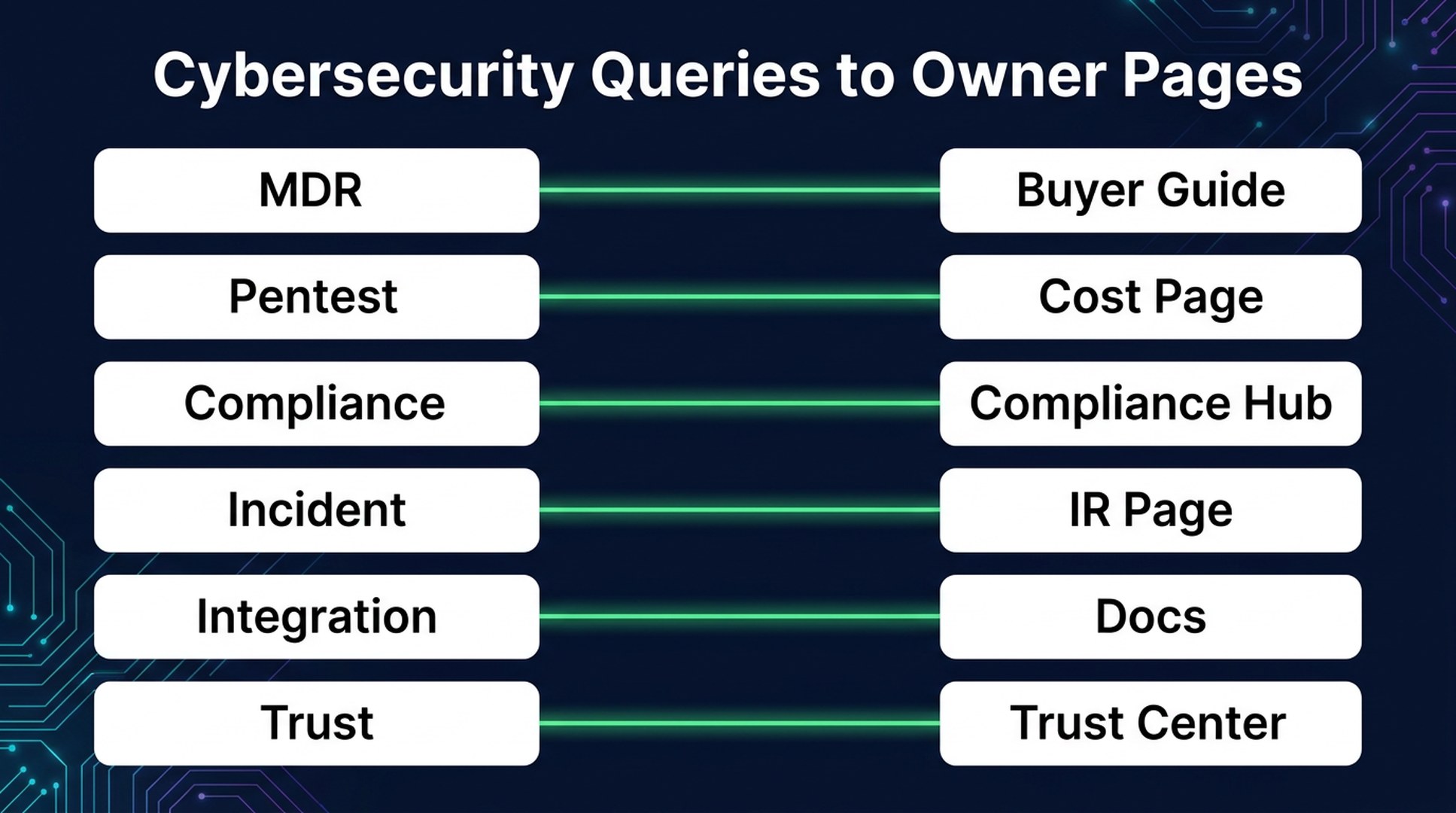
High-intent security prompts should resolve to stable owner pages: buyer guides, cost pages, compliance hubs, incident response pages, docs, and trust centers.
The First 20 Queries To Prioritize
Start with the prompts that influence procurement, demos, assessments, and risk reviews:
Priority | Query | Why It Matters | Owner Page |
|---|---|---|---|
1 | Do we need MDR if we already have EDR? | High-intent architecture decision | MDR vs EDR page |
2 | Best MDR provider for mid-market companies | Vendor selection intent | MDR buyer guide |
3 | What questions should I ask an MDR provider? | Evaluation checklist demand | MDR checklist |
4 | How much does MDR cost? | Budget and procurement intent | MDR pricing guide |
5 | What should a cybersecurity trust center include? | Proof asset for AI and buyers | Trust center guide |
6 | What security evidence do customers ask for during vendor review? | Enterprise sales support | Vendor review checklist |
7 | How do I answer customer security questionnaires faster? | Operational pain | Questionnaire workflow page |
8 | How much does a penetration test cost? | Strong quote intent | Pentest cost guide |
9 | Penetration testing vs red team assessment | Assessment choice | Testing comparison page |
10 | What should be included in an incident response retainer? | High-value service intent | IR retainer FAQ |
11 | When should we call an incident response firm? | Emergency-intent query | IR escalation page |
12 | SIEM vs XDR for small security teams | Architecture evaluation | SIEM vs XDR page |
13 | What security tools are needed before SOC 2? | Compliance-driven purchase | SOC 2 checklist |
14 | How do I prepare security content for SOC 2? | Content and proof need | SOC 2 content guide |
15 | Does this MDR service support Microsoft Defender? | Integration fit | Defender integration page |
16 | What access permissions does a security vendor need? | Trust and deployment risk | Access requirements page |
17 | How do I verify a cybersecurity vendor is credible? | Trust validation | Vendor trust checklist |
18 | What should a security vendor disclose about limitations? | Differentiates credible brands | Limitations page |
19 | Cybersecurity questions a CFO should ask before approving budget | Executive approval | CFO security FAQ |
20 | Security readiness checklist before launching an AI product | Current scenario fit | AI product security checklist |
30-Day Execution Plan
Timeframe | Action | Output |
|---|---|---|
Days 1-3 | Build a query library from sales calls, security questionnaires, support tickets, demo notes, review sites, and AI prompt testing | 100-query spreadsheet |
Days 4-7 | Classify each query by risk ladder stage, role, asset owner, and proof requirement | Query taxonomy and scoring sheet |
Days 8-14 | Map the first 20 queries to existing pages and missing pages | Query-to-page map |
Days 15-21 | Rewrite top pages with direct answers, limitations, proof blocks, comparison tables, and FAQ sections | Updated citation-ready pages |
Days 22-30 | Test prompts across AI answer surfaces and record citations, competitors, omissions, and incorrect claims | AI visibility tracker |
Use the AI Search Visibility Checker to spot whether your security brand appears for the prompts that matter, then compare that output against your page map. For broader GEO planning, keep a lightweight hub of your active prompts, owner pages, proof sources, and next updates.
Common Mistakes
- Treating cybersecurity GEO as a keyword list instead of a risk decision map.
- Publishing broad threat explainers without connecting them to buyer action, proof, or scope.
- Overclaiming security coverage with phrases like
complete protectionorguaranteed compliance. - Hiding pricing and implementation assumptions until the sales call.
- Letting documentation, trust center content, product pages, and sales collateral contradict one another.
- Creating comparison pages that attack competitors instead of explaining fit, limitations, and tradeoffs.
- Ignoring procurement and compliance queries because they do not look like traditional blog keywords.
- Failing to update pages after audits, product changes, new integrations, or SLA revisions.
FAQ
What makes cybersecurity GEO different from normal SEO?
Cybersecurity GEO has to answer risk-sensitive questions. Buyers need clarity about threats, controls, scope, limitations, integrations, pricing, compliance relevance, and proof. AI systems are more likely to cite pages that make those facts explicit.
Should a cybersecurity company create a page for every query in the list?
No. The 100 queries should be clustered into stronger pages: solution pages, comparison pages, pricing guides, compliance hubs, trust center pages, integration docs, incident response pages, and buyer checklists.
Which cybersecurity queries should teams prioritize first?
Start with queries tied to vendor selection, budget, integration fit, compliance review, incident response, trust proof, and executive approval. These queries influence pipeline and require evidence rather than generic education.
How can security brands avoid risky GEO content?
Use precise language, avoid absolute guarantees, define scope, include limitations, review compliance and incident guidance with qualified owners, and update pages when product capabilities or certifications change.
What pages help AI systems cite cybersecurity brands?
AI systems need pages with clear definitions, service scope, comparison tables, integration details, pricing assumptions, trust evidence, compliance mappings, documentation, and FAQ answers. A strong trust center and well-structured buyer guides are especially useful.
Auspia Takeaway
Cybersecurity GEO is not about ranking for every security keyword. It is about helping AI systems understand which risks you address, which buyers you serve, what your product or service actually does, what evidence supports your claims, and where the buyer should go next.
Start with the 20 queries that affect vendor selection, risk reduction, budget approval, and security review. Build pages that answer those questions with proof and boundaries. Then monitor whether AI answers cite the right pages or invent the answer without you.
Author: Grace Miller, AI Search Risk Analyst Tracking 200+ Policy Shifts at Auspia. Grace writes about risk-aware AI search visibility, platform rules, and safe optimization practices for regulated or high-trust categories.